Little Dieter and Rescue Dawn ______16
Total Page:16
File Type:pdf, Size:1020Kb
Load more
Recommended publications
-

Werner Herzog Retrospective
Home Category / Arts and Culture / Werner Herzog Retrospective Werner Herzog Retrospective Slave trade abolition in Cobra Verde Share it! 28 SHARES Published May 15, 2017, 12:05 AM By Rica Arevalo Film director Werner Herzog is a leading gure of the New German Cinema. Born on Sept. 5, 1942, his lms are unconventional and important with the art house audience. The Goethe-Institut Philippinen in partnership with the Film Development Council of the Philippines is showing Herzog’s acclaimed lms until June 4. On May 20, 6 p.m., Cobra Verde (1987) starring Klaus Kinski based on the novel, The Viceroy of Ouidah by Bruce Chatwin, is going to be screened at the FDCP Cinematheque Manila. Kinski plays Francisco Manoel da Silva, nicknamed Cobra Verde, a bandit who walks barefoot and does not own a horse for travelling. People are afraid and run away from him. He tells a bar owner that he never had a friend in all his life. At that time, slave trade was ourishing in Brazil. Black men were sold in exchange for ammunition, liquor, and silk. Cobra Verde meets Don Octavio, a sugar plantation owner who asks him to manage his elds. He accepted the job oer but impregnated Don Octavio’s daughters. To banish him, he was sent to Africa to buy slaves knowing that he will not survive. Cobra Verde took hold of a garrison, Fort Elmina, improved the place and lived there managing the slaves with Taparica (King Ampaw). The slave trade across the Atlantic and Brazil was their route. Werner Herzog and Klaus Kinski But “btlack people believe the devil is white” so the King’s men captured the two. -

An Anguished Self-Subjection: Man and Animal in Werner Herzog's Grizzly
An Anguished Self-Subjection: Man and Animal in Werner Herzog’s Grizzly Man Stefan Mattessich Santa Monica College Do we not see around and among us men and peoples who no longer have any essence or identity—who are delivered over, so to speak, to their inessentiality and their inactivity—and who grope everywhere, and at the cost of gross falsifications, for an inheritance and a task, an inheritance as task? Giorgio Agamben The Open erner herzog’s interest in animals goes hand in hand with his Winterest in a Western civilizational project that entails crossing and dis- placing borders on every level, from the most geographic to the most corporeal and psychological. Some animals are merely present in a scene; early in Fitzcarraldo, for instance, its eponymous hero—a European in early-twentieth-century Peru—plays on a gramophone a recording of his beloved Enrico Caruso for an audience that includes a pig. Others insist in his films as metaphors: the monkeys on the raft as the frenetic materializa- tion of the conquistador Aguirre’s final insanity. Still others merge with characters: subtly in the German immigrant Stroszek, who kills himself on a Wisconsin ski lift because he cannot bear to be treated like an animal anymore or, literally in the case of the vampire Nosferatu, a kindred spirit ESC 39.1 (March 2013): 51–70 to bats and wolves. But, in every film, Herzog is centrally concerned with what Agamben calls the “anthropological machine” running at the heart of that civilizational project, which functions to decide on the difference between man and animal. -

PETER ZEITLINGER Director of Photography
PETER ZEITLINGER Director of Photography Narrative Features: SALT AND FIRE - Benaroya Pictures - Werner Herzog, director QUEEN OF THE DESERT - IFC Films/Benaroya - Werner Herzog, director ANGELIQUE - EuropaCorp - Ariel Zeitoun, director HATED - Independent - Lee Madsen, director MY SON, MY SON WHAT HAVE YE DONE - First Look Pictures - Werner Herzog, director Starring Willem Dafoe and Michael Shannon THE BAD LIEUTENANT: PORT OF CALL - NEW ORLEANS - Millennium Films - Werner Herzog, director Nomination, Best Cinematography, Independent Spirit Awards Starring Nicolas Cage and Eva Mendes HOUSE OF CARDS - The Independents - Silvia Zeitlinger, director RESCUE DAWN - MGM - Werner Herzog, director Starring Christian Bale and Steve Zahn INVINCIBLE - Werner Herzog Filmproduktion - Werner Herzog, director Documentary Features: LO & BEHOLD, REVERIES OF THE CONNECTED WORLD - Magnolia Pictures - Werner Herzog, director INTO THE INFERNO - Netflix - Werner Herzog, director FROM ONE SECOND TO THE NEXT - AT&T - Werner Herzog, director CAVES OF FORGOTTEN DREAMS - Werner Herzog Filmproduktion - Werner Herzog, director TONTINE MASSACRE - Scrimshaw Productions - Ezna Sands, director ENCOUNTERS AT THE END OF THE WORLD - Discovery Films - Werner Herzog, director Nomination, Academy Award, Best Documentary GRIZZLY MAN - Lionsgate - Werner Herzog, director Winner, Alfred P. Sloan Prize, Sundance Film Festival Nine Best Documentary Awards WHEEL OF TIME - Werner Herzog Filmproduktion - Werner Herzog, director LITTLE DIETER NEEDS TO FLY - Werner Herzog Filmproduktion -
Rescue Dawn La Cavale Secours À L’Aube — États-Unis 2007, 126 Minutes Charles-Stéphane Roy
Document généré le 28 sept. 2021 03:04 Séquences La revue de cinéma Rescue Dawn La cavale Secours à l’aube — États-Unis 2007, 126 minutes Charles-Stéphane Roy Léo Bonneville 1919-2007 Numéro 250, septembre–octobre 2007 URI : https://id.erudit.org/iderudit/58972ac Aller au sommaire du numéro Éditeur(s) La revue Séquences Inc. ISSN 0037-2412 (imprimé) 1923-5100 (numérique) Découvrir la revue Citer ce compte rendu Roy, C.-S. (2007). Compte rendu de [Rescue Dawn : la cavale / Secours à l’aube — États-Unis 2007, 126 minutes]. Séquences, (250), 43–43. Tous droits réservés © La revue Séquences Inc., 2007 Ce document est protégé par la loi sur le droit d’auteur. L’utilisation des services d’Érudit (y compris la reproduction) est assujettie à sa politique d’utilisation que vous pouvez consulter en ligne. https://apropos.erudit.org/fr/usagers/politique-dutilisation/ Cet article est diffusé et préservé par Érudit. Érudit est un consortium interuniversitaire sans but lucratif composé de l’Université de Montréal, l’Université Laval et l’Université du Québec à Montréal. Il a pour mission la promotion et la valorisation de la recherche. https://www.erudit.org/fr/ CRITIQUES I LES FILMS RESCUE DAWN I La cavale // fut un temps où les bravades de Werner Herzog dans des contrées impossibles attiraient les badauds par milliers dans les salles. Après avoir été jusqu'au bout de l'enfer et en être revenu d'innombrables fois, l'Allemand a délaissé la fiction le temps de plusieurs documentaires réussis, plus inspiré par les vrais fous que par ses créations. -

Mediated Meetings in Grizzly Man
An Argument across Time and Space: Mediated Meetings in Grizzly Man TRENT GRIFFITHS, Deakin University, Melbourne ABSTRACT In Werner Herzog’s 2005 documentary Grizzly Man, charting the life and tragic death of grizzly bear protectionist Timothy Treadwell, the medium of documentary film becomes a place for the metaphysical meeting of two filmmakers otherwise separated by time and space. The film is structured as a kind of ‘argument’ between Herzog and Treadwell, reimagining the temporal divide of past and present through the technologies of documentary filmmaking. Herzog’s use of Treadwell’s archive of video footage highlights the complex status of the filmic trace in documentary film, and the possibilities of documentary traces to create distinct affective experiences of time. This paper focuses on how Treadwell is simultaneously present and absent in Grizzly Man, and how Herzog’s decision to structure the film as a ‘virtual argument’ with Treadwell also turns the film into a self-reflexive project in which Herzog reconsiders and re-presents his own image as a filmmaker. With reference to Herzog’s notion of the ‘ecstatic truth’ lying beneath the surface of what the documentary camera records, this article also considers the ethical implications of Herzog’s use of Treadwell’s archive material to both tell Treadwell’s story and work through his own authorial identity. KEYWORDS Documentary time, self-representation, digital film, trace, authorship, Werner Herzog. Introduction The opening scene of Grizzly Man (2005), Werner Herzog’s documentary about the life and tragic death of grizzly bear protectionist and amateur filmmaker Timothy Treadwell, shows Treadwell filming himself in front of bears grazing in a pasture, addressing the camera as though a wildlife documentary presenter. -

Approvement the Analysis of Dieter Dengler's Defense Mechanism in Rescue Dawn Movie English Letters Department Letters And
APPROVEMENT THE ANALYSIS OF DIETER DENGLER’S DEFENSE MECHANISM IN RESCUE DAWN MOVIE A Thesis Submitted to Letters and Humanities Faculty in partial Fulfillment of the requirements for By: Woro Endah Sitoresmi 105026000921 Approved By: Advisor, Mohammad Supardi, S.S. ENGLISH LETTERS DEPARTMENT LETTERS AND HUMANITIES FACULTY STATE ISLAMIC UNIVERSITY “SYARIF HIDAYATULLAH” JAKARTA 2008 i ABSTRACT Woro Endah Sito Resmi, “The Analysis of Dieter Dengler’s Defense Mechanism in Rescue Dawn Movie”. Skripsi. Jakarta: Letters and Humanities Faculty, State Islamic University Syarif Hidayatullah, July 2008. The paper examines Dieter Dengler’s defense mechanism in surviving process from the Vietcong jail as the main character in Rescue Dawn movie. The paper looks at one problem: How are Dieter Dengler’s surviving process viewed from the concept of defense mechanism. The objective of the research is intended to describe Dieter Dengler’s defense mechanism in surviving process from the jail that implied in this movie. This movie is analyzed carefully and accurately using the theory of Sigmund Freud’s Psychoanalysis; it is Ego defense mechanism concept. The data on this research are got from the unit of analysis, the sources, and the analysis from the writer. As it is fulfilled, the writer finds out that Dieter applied his defense mechanism through Eros instinct, fantasy, repression, format reaction, rationalization and sublimation. His defense mechanism becomes the power which leads and dominates all of his actions in order to get the freedom. ii LEGALIZATION A thesis entitled “The analysis of Dieter Dengler’s Defense Mechanism in Rescue Dawn movie” has been defended before the Letters and Humanities Faculty’s Examination Committee on October, 16 2008. -

'Antiphusis: Werner Herzog's Grizzly Man'
Film-Philosophy, 11.3 November 2007 Antiphusis: Werner Herzog’s Grizzly Man Benjamin Noys University of Chichester The moon is dull. Mother Nature doesn’t call, doesn’t speak to you, although a glacier eventually farts. And don’t you listen to the Song of Life. Werner Herzog1 At the heart of the cinema of Werner Herzog lies the vision of discordant and chaotic nature – the vision of anti-nature. Throughout his work we can trace a constant fascination with the violence of nature and its indifference, or even hostility, to human desires and ambitions. For example, in his early film Even Dwarfs Started Small (1970) we have the recurrent image of a crippled chicken continually pecked by its companions.2 Here the violence of nature provides a sly prelude to the anarchic carnival violence of the dwarfs’ revolt against their oppressive institution. This fascination is particularly evident in his documentary filmmaking, although Herzog himself deconstructs this generic category. In the ‘Minnesota Declaration’ (1999)3 on ‘truth and fact in documentary cinema’ he radically distinguishes between ‘fact’, linked to norms and the limits of Cinéma Vérité, and ‘truth’ as ecstatic illumination, which ‘can be reached only through fabrication and imagination and stylization’ (in Cronin (ed.) 2002, 301). In particular he identifies nature as the site of this ecstatic illumination – in which we find ‘Lessons of Darkness’ – but only through the lack of any ‘voice’ of nature. While Herzog constantly films nature he films it as hell or as utterly alien. This is not a nature simply corrupted by humanity but a nature inherently ‘corrupt’ in 1 In Cronin (ed.) 2002, 301. -

Conceiving Grizzly Man Through the "Powers of the False" Eric Dewberry, Georgia State University, US
Conceiving Grizzly Man through the "Powers of the False" Eric Dewberry, Georgia State University, US Directed by New German Cinema pioneer Werner Herzog, Grizzly Man (2005) traces the tragic adventures of Timothy Treadwell, self-proclaimed ecologist and educator who spent thirteen summers living among wild brown bears in the Katmai National Park, unarmed except for a photographic and video camera. In 2003, Treadwell and his girlfriend, Amy Huguenard, were mauled to death and devoured by a wild brown bear. The event is captured on audiotape, and their remains were found in the area around their tent and inside Bear #141, who was later killed by park officials. Herzog's documentary is assembled through interviews of friends close to Treadwell, various professionals, family, and more than 100 hours of footage that Treadwell himself captured in his last five years in Alaska. Grizzly Man is more than a conventional wildlife documentary, as the title of the film emphasizes the centrality of the main protagonist to the story. Herzog subjectively structures the film to take the viewer on a dialectical quest between his and Treadwell's visions about man versus nature and life versus death. As Thomas Elsaesser recognized early in Herzog's career, the filmmaker is famous for reveling in the lives of eccentric characters, who can be broken down into two different subjects: "overreachers," like the prospecting rubber baron Fitzcarraldo and the maniacal conquistador Aguirre, or "underdogs" like Woyzeck, all of them played by the equally unconventional German actor Klaus Kinski (Elsaesser, 1989). Including Herzog's documentary subjects, they are all outsiders, living on the edge, and in excessive pursuit of their goals in violation of what is considered normal and ordinary in society. -
Presentación De Powerpoint
2016 BUSINESS AND BIODIVERSITY FORUM SECTION H: TOURISM – DECEMBER 3, 2016 PERU • One of the 17 megadiverse countries in the world (UNESCO 1998). • 84 of 104 life zones according to the Holdridge System. • 55 Centuries of Culture. • Gastronomy as National Identity. BIODIVERSITY NEW ECONOMIC VARIABLE • Natural resources are capital goods. • Value of natural capital is essential to measure sustainability. • Conservation is not an expense, but a long-term investment. • Measuring natural capital is required for management and investment on natural goods. LOSS OF BIODIVERSITY Search of short-term profit leads to loss of biodiversity and local cultures. AMAZON RAINFOREST Forest degradation caused by logging, livestock, illegal mining, etc. Some consequences: • Loss of ecosystems. • Less carbon sequestration. • Loss of medicinal plants. • Migration of native cultures. • Water pollution. 2017 INTERNATIONAL YEAR OF SUSTAINABLE TOURISM FOR DEVELOPMENT DECLARED BY UNITED NATIONS INKATERRA RESERVA AMAZONICA INKATERRA Established in 1975, pioneering ecotourism and sustainable development in Peru. Member of Relais & Châteaux, Virtuoso and National Geographic Unique Lodges of the World. Replicable Ecotourism Model: Scientific Research → Conservation + Education = Sustainable Development INKATERRA MACHU PICCHU PUEBLO HOTEL INKATERRA AREAS OF INFLUENCE • Amazon rainforest of Madre de Dios • Machu Picchu cloud forest • Sacred Valley of the Incas • Cusco City • Cabo Blanco Tropical Ocean, Desert and Dry Forest INKATERRA LA CASONA Aguirre, The Wrath of God -
Bruce Chatwin, a Kindred Spirit Who Dedicated His Life to Illuminating the Mysteries of the World
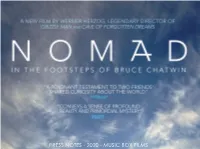
PRESS NOTES - 2020 - MUSIC BOX FILMS LOGLINE Werner Herzog travels the globe to reveal a deeply personal portrait of his friendship with the late travel writer Bruce Chatwin, a kindred spirit who dedicated his life to illuminating the mysteries of the world. SYNOPSIS Werner Herzog turns the camera on himself and his decades-long friendship with the late travel writer Bruce Chatwin, a kindred spirit whose quest for ecstatic truth carried him to all corners of the globe. Herzog’s deeply personal portrait of Chatwin, illustrated with archival discoveries, film clips, and a mound of “brontosaurus skin,” encompasses their shared interest in aboriginal cultures, ancient rituals, and the mysteries stitching together life on earth. WERNER HERZOG Werner Herzog was born in Munich on September 5, 1942. He grew up in a remote mountain village in Bavaria and studied History and German Literature in Munich and Pittsburgh. He made his first film in 1961 at the age of 19. Since then he has produced, written, and directed more than sixty feature- and documentary films, such as Aguirre der Zorn Gottes (AGUIRRE, THE WRATH OF GOD, 1972), Nosferatu Phantom der Nacht (NOSFERATU, 1978), FITZCARRALDO (1982), Lektionen in Finsternis (LESSONS OF DARKNESS, 1992), LITTLE DIETER NEEDS TO FLY (1997), Mein liebster Feind (MY BEST FIEND, 1999), INVINCIBLE (2000), GRIZZLY MAN (2005), ENCOUNTERS AT THE END OF THE WORLD (2007), Die Höhle der vergessenen Träume (CAVE OF FORGOTTEN DREAMS, 2010). Werner Herzog has published more than a dozen books of prose, and directed as many operas. Werner Herzog lives in Munich and Los Angeles. -

101 Films for Filmmakers
101 (OR SO) FILMS FOR FILMMAKERS The purpose of this list is not to create an exhaustive list of every important film ever made or filmmaker who ever lived. That task would be impossible. The purpose is to create a succinct list of films and filmmakers that have had a major impact on filmmaking. A second purpose is to help contextualize films and filmmakers within the various film movements with which they are associated. The list is organized chronologically, with important film movements (e.g. Italian Neorealism, The French New Wave) inserted at the appropriate time. AFI (American Film Institute) Top 100 films are in blue (green if they were on the original 1998 list but were removed for the 10th anniversary list). Guidelines: 1. The majority of filmmakers will be represented by a single film (or two), often their first or first significant one. This does not mean that they made no other worthy films; rather the films listed tend to be monumental films that helped define a genre or period. For example, Arthur Penn made numerous notable films, but his 1967 Bonnie and Clyde ushered in the New Hollywood and changed filmmaking for the next two decades (or more). 2. Some filmmakers do have multiple films listed, but this tends to be reserved for filmmakers who are truly masters of the craft (e.g. Alfred Hitchcock, Stanley Kubrick) or filmmakers whose careers have had a long span (e.g. Luis Buñuel, 1928-1977). A few filmmakers who re-invented themselves later in their careers (e.g. David Cronenberg–his early body horror and later psychological dramas) will have multiple films listed, representing each period of their careers. -

A Collection of Essays on Werner Herzog
Encounters at the End of the World: A Collection of Essays on Werner Herzog Author: Michael Mulhall Persistent link: http://hdl.handle.net/2345/542 This work is posted on eScholarship@BC, Boston College University Libraries. Boston College Electronic Thesis or Dissertation, 2008 Copyright is held by the author, with all rights reserved, unless otherwise noted. Encounters at the End of the World: A Collection of Essays on Werner Herzog “I am my films” Michael Mulhall May 1, 2008 TABLE OF CONTENTS 1. Introduction 5. Chapter 1: Herzog’s Cultural Framework: Real and Perceived 21. Chapter 2: Herzog the Auteur 35. Chapter 3: Herzog/Kinski 48. Chapter 4: Blurring the Line 59. Works Cited Werner Herzog is one of the most well-known European art-house directors alive today (Cronin viii). Born in 1944 in war-torn Munich, Herzog has been an outsider from the start. He shot his first film, an experimental short, with a stolen camera. He has infuriated and confounded countless actors, producers, crew-members and studios in his lengthy career with his insistence on doing things his own way. Due to this maverick persona and the specific “adventurous madman” mystique he has cultivated over the past forty years, Herzog has attracted a large following worldwide. Herzog is perhaps best known for the lush but unforgiving jungles of Aguirre: Der Zorn Gottes (1972) and Fitzcarraldo (1982) and his contemplative musings on the structures of society in The Enigma of Kaspar Hauser (1974) and Stroszek (1977). Though he has never been a huge commercial success in terms of theater receipts, he has had a relatively impressive recent run at the box office, including the much-heralded Grizzly Man (2005) and his long awaited return to feature filmmaking, Rescue Dawn (2006).