The International Journal of Humanities & Social Studies
Total Page:16
File Type:pdf, Size:1020Kb
Load more
Recommended publications
-

Johnson Gbende Faleyimu-Master Thesis
UNESCO CHAIR OF PHILOSOPHY FOR PEACE UNIVERSITAT JAUME I MILITARY INTERVENTION IN NIGERIAN POLITICAL SYSTEM: ITS IMPACT ON DEMOCRATIC DEVELOPMENT (1993-1999) MASTER THESIS Student: Johnson Gbende Faleyimu Supervisor: Dr Jose Angel Ruiz Jimenez Tutor: Dr Irene Comins Mingol Castellón, July 2014 Abstract Key words: Military, intervention, democracy and Nigerian politics A study of literature on civil-military relations in Nigeria reveals a question: why does the military intervene in the politics of some countries but remain under firm civilian control in others? This thesis delves into military intervention in Nigerian Politics and its general impact on democracy (1993-1999). The military exploits its unique and pivotal position by demanding greater institutional autonomy and involvement when the civilian leadership fails. The main purpose of this study is to discourage military intervention in Nigeria politics, and to encourage them to focus their primary assignment of lethal force, which includes use of weapons, in defending its country by combating actual or perceived threats against the state. i Dedication This thesis is dedicated to my late parents High Chief J.F Olijogun and Olori Meminat Marian Olijogun ii Acknowledgements My sincere gratitude goes to God and all who contributed to the successful completion of this thesis work. Very special thanks to my supervisor, Dr Jose Angel Ruiz Jimenez of University of Granada, for his brilliant guidance and encouragement-what a wonderful display of wealth of experience-without which this thesis would not have been possible. My profound appreciation goes to the lecturers and staffs of the International Master’s Degree Program in Peace, Conflict and Development studies at the Universitat Jaume I, who gave me all the skills and knowledge that are required to carry out an academic research and other academic endeavours. -

Download (3763Kb)
A Thesis Submitted for the Degree of PhD at the University of Warwick Permanent WRAP URL: http://wrap.warwick.ac.uk/145151 Copyright and reuse: This thesis is made available online and is protected by original copyright. Please scroll down to view the document itself. Please refer to the repository record for this item for information to help you to cite it. Our policy information is available from the repository home page. For more information, please contact the WRAP Team at: wrap@warwick.ac.uk warwick.ac.uk/lib-publications APPENDIX A Containing Violence to What End? The Political Economy of Amnesty in Nigeria’s Oil-Rich Niger Delta (2009-2016) by Elvis Nana Kwasi Amoateng A thesis submitted in partial fulfilment of the requirements for the degree of Doctor of Philosophy in Politics and International Studies University of Warwick, Department of Politics and International Studies February 2020 Contents Acronyms ...................................................................................................................... 4 List of Figures ............................................................................................................... 5 Acknowledgement ........................................................................................................ 7 Abstract ......................................................................................................................... 8 Introduction: ............................................................................................................... -
A Comparative Analysis of the Gowon, Babangida and Abacha Regimes
University of Pretoria etd - Hoogenraad-Vermaak, S THE ENVIRONMENT DETERMINED POLITICAL LEADERSHIP MODEL: A COMPARATIVE ANALYSIS OF THE GOWON, BABANGIDA AND ABACHA REGIMES by SALOMON CORNELIUS JOHANNES HOOGENRAAD-VERMAAK Submitted in fulfilment of the requirements for the degree MAGISTER ARTIUM (POLITICAL SCIENCE) in the FACULTY OF HUMAN SCIENCES UNIVERSITY OF PRETORIA January 2001 University of Pretoria etd - Hoogenraad-Vermaak, S ACKNOWLEDGEMENT The financial assistance of the Centre for Science Development (HSRC, South Africa) towards this research is hereby acknowledged. Opinions expressed and conclusions arrived at, are those of the author and are not necessarily to be attributed to the Centre for Science Development. My deepest gratitude to: Mr. J.T. Bekker for his guidance; Dr. Funmi Olonisakin for her advice, Estrellita Weyers for her numerous searches for sources; and last but not least, my wife Estia-Marié, for her constant motivation, support and patience. This dissertation is dedicated to the children of Africa, including my firstborn, Marco Hoogenraad-Vermaak. ii University of Pretoria etd - Hoogenraad-Vermaak, S “General Abacha wasn’t the first of his kind, nor will he be last, until someone can answer the question of why Africa allows such men to emerge again and again and again”. BBC News 1998. Passing of a dictator leads to new hope. 1 Jul 98. iii University of Pretoria etd - Hoogenraad-Vermaak, S SUMMARY THE ENVIRONMENT DETERMINED POLITICAL LEADERSHIP MODEL: A COMPARATIVE ANALYSIS OF THE GOWON, BABANGIDA AND ABACHA REGIMES By SALOMON CORNELIUS JOHANNES HOOGENRAAD-VERMAAK LEADER: Mr. J.T. BEKKER DEPARTMENT: POLITICAL SCIENCE DEGREE FOR WHICH DISSERTATION IS MAGISTER ARTIUM PRESENTED: POLITICAL SCIENCE) The recent election victory of gen. -

Foreign Policy and Afrocentricism: an Appraisal of Nigeria’S Role
Journal of Business and Social Review in Emerging Economies Vol. 5, No 1, June 2019 Volume and Issues Obtainable at Center for Sustainability Research and Consultancy Journal of Business and Social Review in Emerging Economies ISSN: 2519-089X (E): 2519-0326 Volume 5: No. 1, June 2019 Journal homepage: www.publishing.globalcsrc.org/jbsee Foreign Policy and Afrocentricism: An Appraisal of Nigeria’s Role 1 Muritala Dauda , 2 Mohammad Zaki Bin Ahmad , 3 Mohammad Faisol Keling 1 Ph.D Candidate, School of International Studies, College of Law, Government and International Studies (COLGIS), Universiti Utara Malaysia (UUM). The Corresponding email address: kalmurtala@gmail.com. 2 Senior Lecturer, School of International Studies, College of Law, Government and International Studies (COLGIS), Universiti Utara Malaysia (UUM). ARTICLE DETAILS ABSTRACT History Nigerian foreign policy is a tool use by the country to achieve its national Revised format: May 2019 interest. The country‘s external policy has been tailored to be Afrocentric Available Online: June 2019 since its independence in 1960 which shows the commitment of Nigeria towards Africa‘s stability and development. The principles of Nigeria‘s Keywords foreign policy and its Afrocentricism has consistently operated by the Foreign Policy, Afrocentrism, government of the country irrespective of whether it is civilian or military National Interest, Diplomacy, administration. The notion of four concentric circle of Nigerian foreign Stability policy where the country considers its national interest and the interest of its neighbouring States first, the West African sub-region, Africa‘s interest JEL Classification: and the interest of the world, have accrued numerous benefits to the L50, L52,L59, C62 country. -
The Nigerian 2007 Election: a Guide for Journalists and Commentators
Africa Programme Briefing Note AFP BN 07/01 The Nigerian 2007 Election: A Guide for Journalists and Commentators Sola Tayo February 2007 Key Points: • Nigerians will vote in April for a president to replace Olusegun Obasanjo. The election is shaping up to be highly controversial. • Corruption remains a major concern, with allegations reaching as high as the Vice-Presidency. • Whoever wins will face the mounting challenges of the oil-rich but poor and increasingly violent Niger Delta region. Introduction Nigeria’s President, Olusegun Obasanjo, is bucking the trend set by some of his peers across the continent – he is stepping aside after two terms. As the leader of one of Africa’s largest economies, a leading producer and exporter of oil, he must have been greatly tempted to serve another term or two. In fact, he sought to alter the constitution to allow the reigning president to stay beyond two terms but the bid was thrown out by Senate. So who is likely to win favour with Nigeria’s 140 million-strong population? Before their bitter and public falling out last year, Obasanjo’s Vice-President Atiku Abubakar was viewed as his natural successor. Now, with the pair barely on speaking terms and accusing each other of corruption, Abubakar has been forced to campaign under the ticket of another party. Other candidates include the former military heavyweights Ibrahim Badamasi Babangida – the mention of whose name strikes fear into the hearts of many Nigerians – and Muhamadu Buhari. By complete contrast, Obasanjo’s chosen successor is the reclusive and softly spoken Umaru Musa Yar'Adua, the Governor of Katsina state. -
Restoring Social Equilibrium in Nigeria Through Reconfiguration
PARTITION OR PERISH: RESTORING SOCIAL EQUILIBRIUM IN NIGERIA THROUGH RECONFIGURATION Okechukwu Oko" I. INTRODUCTION Ethnic identity is central to the life of Africans.' An individual's ethnic identity helps to shape perceptions, political behavior,2 and even personal relationships.3 Prospects of a better life, such as access to modem facilities, adequate health care, and state appointments, far too often depend on an African's ethnicity.4 Fear of exclusion from power, and by extension from the nation's wealth, is genuine and remains a major impetus for aggressive ethnic identification in most African countries.5 The fear of losing control of the machinery of government to another ethnic group reinforces the * LL.B. (Hons), LL.M. (University of Nigeria); LL.M., J.S.D. (Yale Law School); Assistant Professor, Southern University Law Center, Baton Rouge, Louisiana. I gratefully acknowledge the useful comments and suggestions by Professor Q. Johnstone, Professor Emeritus, Yale Law School. I also wish to thank Triscilla Taylor, J.D. '98, and Lakoshia Roberts, J.D. '99, for their invaluable research assistance. 1. A. Selassie, Ethnic Identity and ConstituionalDesign for Africa, 29 STAN. J. INT'L L. 1, 12 (1992) ("Ethnicity tends to be more important to Africans than it is to individuals elsewhere. In much of Africa, ethnicity is the hub around which life revolves."); GERHARD MARE, ETlNICITY AND PoLmcs INSouTH AFRICA 2 (1993) ("Ethnic identity is similar to a story; it is a way of dealing with the present through a sense of identity rooted in the past."). 2. Rotimi Suberu, Comment, Federalism and Nigeria's Political Future, 87 AFR. -
Nigeria: Reversing the Tide of Decline
MATTHEW HASSAN KUKAH Nigeria: Reversing the Tide of Decline he prolonged crisis of legitimacy which brought The Protracted Crisis of the Nigerian State Tabout the collapse of Soviet Communism in 1989 provided the spark for the quest for what has With hindsight, it is clear that when the British now come to be known as a »new world order«. conceded independence to Nigeria (October 1, Popular thought has been that for this project 1960), they merely decided to cut their losses and to succeed, the new order must be anchored on move on to consolidate their economic interests liberal democracy. For us in Africa, the period has in the new Nigeria. There had been no serious introduced new dynamics and challenges leading program to industrialize and modernize the coun- many students of the continent to believe that try (as the logic of colonialism tended to dictate) the struggle has begun, not for democracy per and forty years after this so-called independence, se but for Africa’s »second liberation«. Many most of the questions which surfaced before inde- believe that it is only the success of this second pendence remain unanswered. Nigeria’s quest has liberation that can truly guarantee a platform seen the nation move from the West Minster Par- for lasting democracy, for rule of law, prosperity, liamentary system, which was terminated with development, freedom, justice and equality. the first military coup of January 15, 1966, to the Unfortunately in Africa democracy is still con- American presidential system and then to a pro- sidered to be just a means to an end to hunger, longed military interregnum. -

Peacekeeping from a Realist Viewpoint: Nigeria and the OAU Operation in CHAD
Journal of Political Science Volume 25 Number 1 Article 4 November 1997 Peacekeeping From a Realist Viewpoint: Nigeria and the OAU Operation in CHAD Terry M. Mays Follow this and additional works at: https://digitalcommons.coastal.edu/jops Part of the Political Science Commons Recommended Citation Mays, Terry M. (1997) "Peacekeeping From a Realist Viewpoint: Nigeria and the OAU Operation in CHAD," Journal of Political Science: Vol. 25 : No. 1 , Article 4. Available at: https://digitalcommons.coastal.edu/jops/vol25/iss1/4 This Article is brought to you for free and open access by the Politics at CCU Digital Commons. It has been accepted for inclusion in Journal of Political Science by an authorized editor of CCU Digital Commons. For more information, please contact commons@coastal.edu. PEACEKEEPING FROM A REALIST VIEWPOINT: NIGERIA AND THE OAU OPERATION IN CHAD Terry M Mays, Citadel A successful multinational peacekeeping operation needs the cooperation of states willing to contribute men and women to field the mission. The Nigerian government, located in the new capital of Abuja, is the most frequent African provider of observers, police, and military contingents for multinational peacekeeping operations around the globe. Between 1964 and 1997, Nigeria contributed personnel to a total of23 multinational peacekeeping missions -12 on the African continent and 11 outside of the continent. The Nigerian peacekeepers have served in missions fielded by the United Nations, the Organization of African Unity (OAU), and the Economic Community of West African States (ECOW AS). All nine Nigerian prime ministers or presidents, military and civilian, have either personally participated in a peacekeeping operation or have held the title of commander in chief of the Nigerian armed forces during an Abuja supported peacekeeping mission. -

Utafiti Sera Research Brief Series,March 2021
Utafiti Sera Research Brief Series Issue 1, March 2021 Fuel subsidy in Nigeria: Lessons in leading the people’s side of the tussle In a nutshell widespread and led to significant policy initiatives (especially SURE-P). Since 2015 fuel prices have continuously gone up Each time the Federal Government of Nigeria considers the (once, down) but labour and the activists have not succeeded burden of fuel subsidy too heavy, it attempts to shed a bit of it. in getting people out onto the streets. In effect, they seem to Two things often follow: first, the prices of petroleum products have lost the ability and legitimacy to lead the people’s side and the cost of living instantly go up; second, the organised of the tussle. This has negative implications for the subsidy- labour and civil society organisations mobilise the citizens related contentions that sometimes bring reprieve for citizens, for protest. They assume the leading position among citizens even temporarily. In the study reported here, we examined articulating citizens’ side of the tussle in the narratives. In most how labour and others lost that role, and we draw out lessons cases, these protests take place and lead to a downward on how to lead the people’s side of a volatile tussle such as review of the prices of petroleum products; in a few cases the fuel subsidy issue. the protests barely take place. In 2012, the protests were Attempts to remove or reduce subsidy by different administrations in Nigeria Year President/Head of State Change in price Remarks 1973 Yakubu Gowon 6k to 8.45k -
First Term E-Learning Note Subject: Government Class
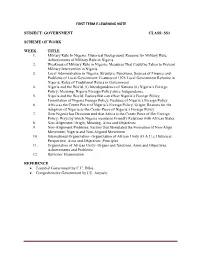
FIRST TERM E-LEARNING NOTE SUBJECT: GOVERNMENT CLASS: SS3 SCHEME OF WORK WEEK TITLE 1. Military Rule In Nigeria: Historical Background, Reasons for Military Rule, Achievements of Military Rule in Nigeria 2. Weakness of Military Rule in Nigeria; Measures That Could be Taken to Prevent Military Intervention in Nigeria 3. Local Administration in Nigeria; Structure, Functions, Sources of Finance and Problems of Local Government: Features of 1976 Local Government Reforms in Nigeria; Roles of Traditional Rulers in Government 4. Nigeria and the World; (i) Interdependence of Nations (ii) Nigeria’s Foreign Policy; Meaning, Nigeria Foreign Policy since Independence 5. Nigeria and the World; Factors that can affect Nigeria’s Foreign Policy, Formulation of Nigeria Foreign Policy; Features of Nigeria’s Foreign Policy 6. Africa as the Center Piece of Nigeria’s Foreign Policy; Origin; Reasons for the Adoption of Nigeria as the Center Piece of Nigeria’s Foreign Policy 7. How Nigeria has Demonstrated that Africa is the Center Piece of Her Foreign Policy; Ways by which Nigeria maintains Friendly Relations with African States 8. Non-Alignment; Origin, Meaning, Aims and Objectives 9. Non-Alignment Problems; Factors that Stimulated the Formation of Non-Align Movement; Nigeria and Non-Aligned Movement 10. International Organization- Organization of African Unity (O.A.U.); Historical Perspective, Aims and Objectives, Principles 11. Organization of African Unity- Organs and functions, Aims and Objectives, Achievements and Problems 12. Revision/ Examination REFERENCE Essential Government by C.C. Dibie Comprehensive Government by J.U. Anyaele WEEK ONE MILITARY RULE IN NIGERIA HISTORICAL BACKGROUND The first military regime in Nigeria started in January 15th 1966, which was staged by five (5) Majors led by Major Chukwuma Kaduna Nzeogwu. -

Asiwaju Bolanle Ahmed Adekunle Tinubu
This is the biography of Asiwaju Bolanle Ahmed Adekunle Tinubu. ASIWAJU: THE BIOGRAPHY OF BOLANLE AHMED ADEKUNLE TINUBU by Moshood Ademola Fayemiwo, PhD and Margie Neal-Fayemiwo, Ed.D Order the complete book from the publisher Booklocker.com http://www.booklocker.com/p/books/9183.html?s=pdf or from your favorite neighborhood or online bookstore. ASIWAJU THE BIOGRAPHY OF BOLANLE AHMED ADEKUNLE TINUBU Moshood Ademola Fayemiwo and Margie Neal-Fayemiwo Copyright © 2017 by Moshood Ademola Fayemiwo & Margie Neal- Fayemiwo Paperback ISBN: 978-1-63492-251-7 All rights reserved. No part of this publication may be reproduced, stored in a retrieval system or transmitted in any form by any means, photocopying, recording or otherwise without written permission from the authors, except for brief excerpts in newspaper reviews. The editing format of this book used The New York Times Manual of Style and Usage revised and expanded edition by Alan Siegal and William Connolly 1999 with thanks. A Publication of The Jesus Christ Solution Center, DBA, USA in collaboration with Booklocker Publishing Company Inc. St Petersburg, Florida USA Printed on acid-free paper. Cover Design Concept: Muhammad Bashir, Abuja Nigeria Cover Design by: Todd Engel Photos: - Olanre Francis, Washington DC Photos and Inner Page Layout: Brenda van Niekerk, South Africa First Edition: 2017 The Jesus Christ Newspaper Publishing Company Nigeria Limited (RC: 1310616) Tel: 0812-198- 5505; Email: moshood.fayemiwo@aol.com The Jesus Christ Solution Center, DBA USA (FEIN: 81-5078881) and its subsidiaries are registered trademarks licensed to conduct legitimate business activities in the United States of America. -
Ideological Implications of Broadcasting Practice in Nigeria: from Pre and Post Independence Regulation to Deregulation
IOSR Journal Of Humanities And Social Science (IOSR-JHSS) Volume 15 , Issue 2 (Sep. - Oct. 2013), PP 41-55 e-ISSN: 2279-0837, p-ISSN: 2279-0845. www.Iosrjournals.Org Ideological Implications of Broadcasting Practice in Nigeria: From Pre and Post Independence Regulation to Deregulation Olalekan Ganiyu Akashoro 1, Onjefu Okidu 2, Mikaila Ishola Ajaga 3 1. Department of Public Relations and Advertising, School of Communication, Lagos State University, Nigeria 2. Department of Mass Communication, Caleb University, Nigeria 3. Department of Broadcasting, School of Communication, Lagos State University, Nigeria Abstract: The paper, within historical and ideological contexts, traces the development of the Nigerian broadcasting industry from a colonial initiative to a wholly public (government) enterprise and an admixture of public and private operations following deregulation.. Using, as framework, McQuail’s suggested mass media normative responses to environmental social forces, an appraisal of how Nigerian broadcast media organizations have been responding normatively to the demands of component social forces within their operational environment leads the paper to conclude and recommend that the challenges of the dynamic social forces in the media environment impinging on the operations, creativity and potentials of media operatives should be given adequate attention by the industry's stakeholders. Keywords: broadcasting, deregulation, mass media, McQuail, normative responses I. Introduction I.I Conceptual Framework To broadcast is to disseminate information through mechanical means, simultaneously to a wide, diverse and heterogeneous audience made up individual within and outside a society. Broadcasting is indispensable in any society, permeating and fulfilling all individual, social, political and hedonic needs of people pivoted by the transfer of meaning – communication.