Correlation Between Resistance to UV Irradiation and the Taxonomic
Total Page:16
File Type:pdf, Size:1020Kb
Load more
Recommended publications
-
The 2014 Golden Gate National Parks Bioblitz - Data Management and the Event Species List Achieving a Quality Dataset from a Large Scale Event
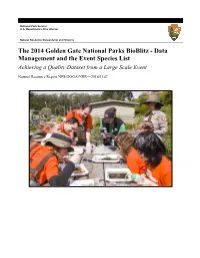
National Park Service U.S. Department of the Interior Natural Resource Stewardship and Science The 2014 Golden Gate National Parks BioBlitz - Data Management and the Event Species List Achieving a Quality Dataset from a Large Scale Event Natural Resource Report NPS/GOGA/NRR—2016/1147 ON THIS PAGE Photograph of BioBlitz participants conducting data entry into iNaturalist. Photograph courtesy of the National Park Service. ON THE COVER Photograph of BioBlitz participants collecting aquatic species data in the Presidio of San Francisco. Photograph courtesy of National Park Service. The 2014 Golden Gate National Parks BioBlitz - Data Management and the Event Species List Achieving a Quality Dataset from a Large Scale Event Natural Resource Report NPS/GOGA/NRR—2016/1147 Elizabeth Edson1, Michelle O’Herron1, Alison Forrestel2, Daniel George3 1Golden Gate Parks Conservancy Building 201 Fort Mason San Francisco, CA 94129 2National Park Service. Golden Gate National Recreation Area Fort Cronkhite, Bldg. 1061 Sausalito, CA 94965 3National Park Service. San Francisco Bay Area Network Inventory & Monitoring Program Manager Fort Cronkhite, Bldg. 1063 Sausalito, CA 94965 March 2016 U.S. Department of the Interior National Park Service Natural Resource Stewardship and Science Fort Collins, Colorado The National Park Service, Natural Resource Stewardship and Science office in Fort Collins, Colorado, publishes a range of reports that address natural resource topics. These reports are of interest and applicability to a broad audience in the National Park Service and others in natural resource management, including scientists, conservation and environmental constituencies, and the public. The Natural Resource Report Series is used to disseminate comprehensive information and analysis about natural resources and related topics concerning lands managed by the National Park Service. -
I GENOMIC and TRANSCRIPTOMIC ANALYSES of Jeotgalibacillus
i GENOMIC AND TRANSCRIPTOMIC ANALYSES OF Jeotgalibacillus malaysiensis TO PROVIDE INSIGHTS INTO ITS OSMOTIC ADAPTATION AMIRA SURIATY BINTI YAAKOP A thesis submitted in fulfilment of the requirements for the award of the degree of Doctor of Philosophy (Bioscience) Faculty of Biosciences and Medical Engineering Universiti Teknologi Malaysia AUGUST 2017 iii iv ACKNOWLEDGEMENT I would like to take this opportunity to dedicate my endless gratitude, sincere appreciation and profound regards to my dearest supervisor, Dr. Goh Kian Mau for his scholastic guidance. He has been instrumental in guiding my research, giving me encouragement, guidance, critics and friendship. Without you this thesis will not be presented as it is today. Furthermore, I would like to convey my appreciation toward my labmates Ms. Chia Sing and Mr. Ummirul, Ms. Suganthi and Ms. Chitra for their guidance and support Not forgetting the helpful lab assistant Mdm. Sue, Mr. Khairul and Mr. Hafizi for all their assistances throughout my research. My sincere appreciation also extends to all my others lab mates in extremophiles laboratory who have provided assistance at various occasions. Last but not least, my special gratitude to my husband, Mohd Hanafi bin Suki who see me up and down throughout this PHD journeys, my lovely parents Noora’ini Mohamad and Yaakop Jaafar, my family members for their support and concern. Not to forget, my friends who had given their helps, motivational and guidance all the time with love. Their mentorship was truly appreciated. v ABSTRACT The genus Jeotgalibacillus under the family of Planococcaceae is one of the understudy genera. In this project, a bacterium strain D5 was isolated from Desaru beach, Johor. -
CALIFORNIA STATE UNIVERSITY, NORTHRIDGE Comparative
CALIFORNIA STATE UNIVERSITY, NORTHRIDGE Comparative Genomics and Epigenomics of Sporosarcina ureae A thesis submitted in partial fulfillment of the requirement for the degree of Master of Science in Biology By Andrew Oliver August 2016 The thesis of Andrew Oliver is approved by: _________________________________________ ____________ Sean Murray, Ph.D. Date _________________________________________ ____________ Gilberto Flores, Ph.D. Date _________________________________________ ____________ Kerry Cooper, Ph.D., Chair Date California State University, Northridge ii Acknowledgments First and foremost, a special thanks to my advisor, Dr. Kerry Cooper, for his advice and, above all, his patience. If I can be half the scientist you are someday, I would be thrilled. I would like to also thank everyone in the Cooper lab, especially my colleagues Courtney Sams and Tabitha Bayangnos. It was a privilege to work along side you. More thanks to my committee members, Dr. Gilberto Flores and Dr. Sean Murray. Dr. Flores, you were instrumental in guiding me to ask the right questions regarding bacterial taxonomy. Dr. Murray, your contributions to my graduate studies would make this section run on for pages. I thank you for taking me under your wing from the beginning. Acknowledgement and thanks to the Baresi lab, especially Dr. Larry Baresi and Tania Kurbessoian for their partnership in this research. Also to Bernardine Pregerson for all the work that lays at the foundation of this study. This research would not be what it is without the help of my childhood friend, Matthew Kay. You wrote programs, taught me coding languages, and challenged me to go digging for answers to very difficult questions. -

Product Sheet Info
Product Information Sheet for HM-331 Sporosarcina sp., Strain 2681 Incubation: Temperature: 37°C Atmosphere: Aerobic Catalog No. HM-331 Propagation: 1. Keep vial frozen until ready for use, then thaw. For research use only. Not for human use. 2. Transfer the entire thawed aliquot into a single tube of broth. Contributor: 3. Use several drops of the suspension to inoculate an Kimberlee A. Musser, Ph.D., Chief, Bacterial Diseases, agar slant and/or plate. Division of Infectious Diseases, Wadsworth Center, New York 4. Incubate the tubes and plate at 37°C for 48 hours. State Department of Health, Albany, New York Citation: Manufacturer: NIH Biodefense and Emerging Infections Acknowledgment for publications should read “The following reagent was obtained through the NIH Biodefense and Research Resource Repository Emerging Infections Research Resources Repository, NIAID, NIH as part of the Human Microbiome Project: Sporosarcina Product Description: sp., Strain 2681, HM-331.” Bacteria Classification: Planococcaceae, Sporosarcina Species: Sporosarcina sp. Biosafety Level: 2 Strain: 2681 Original Source: Sporosarcina sp., strain 2681 was isolated Appropriate safety procedures should always be used with 1 this material. Laboratory safety is discussed in the following from human blood. Comments: Sporosarcina sp., strain 2681 is a reference publication: U.S. Department of Health and Human Services, Public Health Service, Centers for Disease Control and genome for The Human Microbiome Project (HMP). HMP Prevention, and National Institutes of Health. Biosafety in is an initiative to identify and characterize human microbial flora. The complete genome of Sporosarcina sp., strain Microbiological and Biomedical Laboratories. 5th ed. Washington, DC: U.S. Government Printing Office, 2007; see 2681 is currently being sequenced at the Human Genome www.cdc.gov/od/ohs/biosfty/bmbl5/bmbl5toc.htm. -

Sporosarcina Aquimarina Sjam16103 Isolated from the Pneumatophores of Avicennia Marina L
Hindawi Publishing Corporation International Journal of Microbiology Volume 2012, Article ID 532060, 10 pages doi:10.1155/2012/532060 Research Article Plant Growth Promoting of Endophytic Sporosarcina aquimarina SjAM16103 Isolated from the Pneumatophores of Avicennia marina L. S. Rylo Sona Janarthine1 and P. Eganathan2 1 Faculty of Marine Science, Annamalai University, Chidambaram 608 502, India 2 Biotechnology Division, M S Swaminathan Research Foundation, Chennai 600 113, India Correspondence should be addressed to S. Rylo Sona Janarthine, jana eco@yahoo.co.in Received 17 October 2011; Revised 12 January 2012; Accepted 20 April 2012 AcademicEditor:A.J.M.Stams Copyright © 2012 S. R. S. Janarthine and P. Eganathan. This is an open access article distributed under the Creative Commons Attribution License, which permits unrestricted use, distribution, and reproduction in any medium, provided the original work is properly cited. Endophytic Sporosarcina aquimarina SjAM16103 was isolated from the inner tissues of pneumatophores of mangrove plant Avicennia marina along with Bacillus sp. and Enterobacter sp. Endophytic S. aquimarina SjAM16103 was Gram variable, and motile bacterium measured 0.6–0.9 μm wide by 1.7–2.0 μm long and light orange-brown coloured in 3-day cultures on tryptone broth at 26◦C. Nucleotide sequence of this strain has been deposited in the GenBank under accession number GU930359. This endophytic bacterium produced 2.37 μMol/mL of indole acetic acid and siderophore as it metabolites. This strain could solubilize phosphate molecules and fixes atmospheric nitrogen. Endophytic S. aquimarina SjAM16103 was inoculated into four different plants under in vitro method to analyse its growth-promoting activity and role inside the host plants. -

AB Supplemental Figure 1. MNV Treatment Alters The
A Phylum Class Order Taxonomy Other Taxonomy Unclassified Bacteria Actinobacteria Actinobacteria Coriobacteriales Coriobacteriaceae Proteobacteria γ-proteobacteria Enterobacteriales Enterobacteriaceae Unclassified Bacteroidetes Bacteroidetes Bacteroidia Bacteroidales Unclassified Bacteroidales Unclassified Firmicutes Unclassified Clostridiales Clostridiales Incertea Sedis XIV Clostridia Clostridiales Clostridiaceae Lachnospiraceae Peptostreptococcaceae Firmicutes Ruminococcaceae Planococcaceae Bacillales Staphylococcaceae Bacillaceae Bacilli Enterococcaceae Lactobacillales Streptococcaceae Lactobacillaceae Erysipelotrichi Erysipelotrichales Erysipelotrichaceae B Untreated MNV MNV Recovery 100% 80% Ileum 60% Contents 40% 20% 0% 100% 80% Ileum Wall 60% 40% 20% 0% 100% 80% 60% Cecum 40% 20% 0% 100% 80% 60% Feces 40% 20% 0% Supplemental Figure 1. MNV treatment alters the composition of the microbiota. (A) Color code for the most predominant bacterial populations found in the murine intestine. (B) Phylogenetic classification of 16S rDNA frequencies in the ileum, cecum or feces collected from untreated mice, mice treated with metronidazole+neomycin+vancomycin (MNV), or mice allowed to recover for two weeks from the MNV treatment. Each bar represents the microbiota composition of an individual mouse. A Phylum Class Order Taxonomy Other Taxonomy Unclassified Bacteria Actinobacteria Actinobacteria Coriobacteriales Coriobacteriaceae Proteobacteria γ-proteobacteria Enterobacteriales Enterobacteriaceae Unclassified Bacteroidetes Bacteroidetes Bacteroidia -

Biomineralization Mediated by Ureolytic Bacteria Applied to Water Treatment: a Review
crystals Review Biomineralization Mediated by Ureolytic Bacteria Applied to Water Treatment: A Review Dayana Arias 1,2 ID , Luis A. Cisternas 2,3 ID and Mariella Rivas 1,3,* 1 Laboratory of Algal Biotechnology & Sustainability, Faculty of Marine Sciences and Biological Resources, University of Antofagasta, Antofagasta 1240000, Chile; dayana.arias.t@gmail.com 2 Department of Chemical Engineering and Mineral Process, University of Antofagasta, Antofagasta 1240000, Chile; luis.cisternas@uantof.cl 3 Science and Technology Research Center for Mining CICITEM, Antofagasta 1240000, Chile * Correspondence: mariella.rivas@uantof.cl Academic Editor: Jolanta Prywer Received: 6 October 2017; Accepted: 4 November 2017; Published: 17 November 2017 Abstract: The formation of minerals such as calcite and struvite through the hydrolysis of urea catalyzed by ureolytic bacteria is a simple and easy way to control mechanisms, which has been extensively explored with promising applications in various areas such as the improvement of cement and sandy materials. This review presents the detailed mechanism of the biominerals production by ureolytic bacteria and its applications to the wastewater, groundwater and seawater treatment. In addition, an interesting application is the use of these ureolytic bacteria in the removal of heavy metals and rare earths from groundwater, the removal of calcium and recovery of phosphate from wastewater, and its potential use as a tool for partial biodesalination of seawater and saline aquifers. Finally, we discuss the benefits of using biomineralization processes in water treatment as well as the challenges to be solved in order to reach a successful commercialization of this technology. Keywords: biomineralization; calcite; seawater; wastewater; heavy metals removal; biodesalination 1. -
Compile.Xlsx
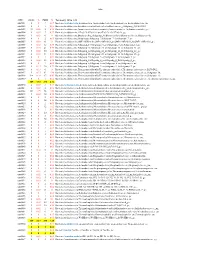
Silva OTU GS1A % PS1B % Taxonomy_Silva_132 otu0001 0 0 2 0.05 Bacteria;Acidobacteria;Acidobacteria_un;Acidobacteria_un;Acidobacteria_un;Acidobacteria_un; otu0002 0 0 1 0.02 Bacteria;Acidobacteria;Acidobacteriia;Solibacterales;Solibacteraceae_(Subgroup_3);PAUC26f; otu0003 49 0.82 5 0.12 Bacteria;Acidobacteria;Aminicenantia;Aminicenantales;Aminicenantales_fa;Aminicenantales_ge; otu0004 1 0.02 7 0.17 Bacteria;Acidobacteria;AT-s3-28;AT-s3-28_or;AT-s3-28_fa;AT-s3-28_ge; otu0005 1 0.02 0 0 Bacteria;Acidobacteria;Blastocatellia_(Subgroup_4);Blastocatellales;Blastocatellaceae;Blastocatella; otu0006 0 0 2 0.05 Bacteria;Acidobacteria;Holophagae;Subgroup_7;Subgroup_7_fa;Subgroup_7_ge; otu0007 1 0.02 0 0 Bacteria;Acidobacteria;ODP1230B23.02;ODP1230B23.02_or;ODP1230B23.02_fa;ODP1230B23.02_ge; otu0008 1 0.02 15 0.36 Bacteria;Acidobacteria;Subgroup_17;Subgroup_17_or;Subgroup_17_fa;Subgroup_17_ge; otu0009 9 0.15 41 0.99 Bacteria;Acidobacteria;Subgroup_21;Subgroup_21_or;Subgroup_21_fa;Subgroup_21_ge; otu0010 5 0.08 50 1.21 Bacteria;Acidobacteria;Subgroup_22;Subgroup_22_or;Subgroup_22_fa;Subgroup_22_ge; otu0011 2 0.03 11 0.27 Bacteria;Acidobacteria;Subgroup_26;Subgroup_26_or;Subgroup_26_fa;Subgroup_26_ge; otu0012 0 0 1 0.02 Bacteria;Acidobacteria;Subgroup_5;Subgroup_5_or;Subgroup_5_fa;Subgroup_5_ge; otu0013 1 0.02 13 0.32 Bacteria;Acidobacteria;Subgroup_6;Subgroup_6_or;Subgroup_6_fa;Subgroup_6_ge; otu0014 0 0 1 0.02 Bacteria;Acidobacteria;Subgroup_6;Subgroup_6_un;Subgroup_6_un;Subgroup_6_un; otu0015 8 0.13 30 0.73 Bacteria;Acidobacteria;Subgroup_9;Subgroup_9_or;Subgroup_9_fa;Subgroup_9_ge; -
16S Rdna Sequence Analysis of Culturable Marine Biofilm Forming Bacteria from a Ship's Hull D
See discussions, stats, and author profiles for this publication at: http://www.researchgate.net/publication/280736395 paper inbakandan 08927014%2E2010%2E530347 DATASET · AUGUST 2015 DOWNLOADS VIEWS 11 14 7 AUTHORS, INCLUDING: Ramasamy Venkatesan G. Latha National Institute of Ocean Technology Natioanl institute of ocean technology 103 PUBLICATIONS 654 CITATIONS 49 PUBLICATIONS 88 CITATIONS SEE PROFILE SEE PROFILE Simi Mathew Rokkam Rao National Institute of Ocean Technology Indian Institute of Tropical Meteorology 8 PUBLICATIONS 104 CITATIONS 40 PUBLICATIONS 821 CITATIONS SEE PROFILE SEE PROFILE Available from: Ramasamy Venkatesan Retrieved on: 15 September 2015 This article was downloaded by: [Nat Institute of Ocean Technology] On: 20 July 2015, At: 03:15 Publisher: Taylor & Francis Informa Ltd Registered in England and Wales Registered Number: 1072954 Registered office: 5 Howick Place, London, SW1P 1WG Biofouling: The Journal of Bioadhesion and Biofilm Research Publication details, including instructions for authors and subscription information: http://www.tandfonline.com/loi/gbif20 16S rDNA sequence analysis of culturable marine biofilm forming bacteria from a ship's hull D. Inbakandan a b , P. Sriyutha Murthy c , R. Venkatesan d & S. Ajmal Khan b a Centre for Ocean Research , Sathyabama University , Chennai , 600 119 , India b Centre of Advanced Study in Marine Biology , Annamalai University , Port Nova , 608502 , India c Biofouling and Biofilm Processes Section , WSCL, BARC Facilities, IGCAR , Kalpakkam , 603 102 , India d Ocean -

The Porcine Nasal Microbiota with Particular Attention to Livestock-Associated Methicillin-Resistant Staphylococcus Aureus in Germany—A Culturomic Approach
microorganisms Article The Porcine Nasal Microbiota with Particular Attention to Livestock-Associated Methicillin-Resistant Staphylococcus aureus in Germany—A Culturomic Approach Andreas Schlattmann 1, Knut von Lützau 1, Ursula Kaspar 1,2 and Karsten Becker 1,3,* 1 Institute of Medical Microbiology, University Hospital Münster, 48149 Münster, Germany; andreas.schlattmann@ukmuenster.de (A.S.); knutlvl@gmail.com (K.v.L.); Ursula.Kaspar@lzg.nrw.de (U.K.) 2 Landeszentrum Gesundheit Nordrhein-Westfalen, Fachgruppe Infektiologie und Hygiene, 44801 Bochum, Germany 3 Friedrich Loeffler-Institute of Medical Microbiology, University Medicine Greifswald, 17475 Greifswald, Germany * Correspondence: karsten.becker@med.uni-greifswald.de; Tel.: +49-3834-86-5560 Received: 17 March 2020; Accepted: 2 April 2020; Published: 4 April 2020 Abstract: Livestock-associated methicillin-resistant Staphylococcus aureus (LA-MRSA) remains a serious public health threat. Porcine nasal cavities are predominant habitats of LA-MRSA. Hence, components of their microbiota might be of interest as putative antagonistically acting competitors. Here, an extensive culturomics approach has been applied including 27 healthy pigs from seven different farms; five were treated with antibiotics prior to sampling. Overall, 314 different species with standing in nomenclature and 51 isolates representing novel bacterial taxa were detected. Staphylococcus aureus was isolated from pigs on all seven farms sampled, comprising ten different spa types with t899 (n = 15, 29.4%) and t337 (n = 10, 19.6%) being most frequently isolated. Twenty-six MRSA (mostly t899) were detected on five out of the seven farms. Positive correlations between MRSA colonization and age and colonization with Streptococcus hyovaginalis, and a negative correlation between colonization with MRSA and Citrobacter spp. -
Genome Diversity of Spore-Forming Firmicutes MICHAEL Y
Genome Diversity of Spore-Forming Firmicutes MICHAEL Y. GALPERIN National Center for Biotechnology Information, National Library of Medicine, National Institutes of Health, Bethesda, MD 20894 ABSTRACT Formation of heat-resistant endospores is a specific Vibrio subtilis (and also Vibrio bacillus), Ferdinand Cohn property of the members of the phylum Firmicutes (low-G+C assigned it to the genus Bacillus and family Bacillaceae, Gram-positive bacteria). It is found in representatives of four specifically noting the existence of heat-sensitive vegeta- different classes of Firmicutes, Bacilli, Clostridia, Erysipelotrichia, tive cells and heat-resistant endospores (see reference 1). and Negativicutes, which all encode similar sets of core sporulation fi proteins. Each of these classes also includes non-spore-forming Soon after that, Robert Koch identi ed Bacillus anthracis organisms that sometimes belong to the same genus or even as the causative agent of anthrax in cattle and the species as their spore-forming relatives. This chapter reviews the endospores as a means of the propagation of this orga- diversity of the members of phylum Firmicutes, its current taxon- nism among its hosts. In subsequent studies, the ability to omy, and the status of genome-sequencing projects for various form endospores, the specific purple staining by crystal subgroups within the phylum. It also discusses the evolution of the violet-iodine (Gram-positive staining, reflecting the pres- Firmicutes from their apparently spore-forming common ancestor ence of a thick peptidoglycan layer and the absence of and the independent loss of sporulation genes in several different lineages (staphylococci, streptococci, listeria, lactobacilli, an outer membrane), and the relatively low (typically ruminococci) in the course of their adaptation to the saprophytic less than 50%) molar fraction of guanine and cytosine lifestyle in a nutrient-rich environment. -
Comparison of the Bacterial Microbiota in a Bale of Collected Cardboard Determined by 454 Pyrosequencing and Clone Library
Advances in Microbiology, 2014, 4, 754-760 Published Online September 2014 in SciRes. http://www.scirp.org/journal/aim http://dx.doi.org/10.4236/aim.2014.412082 Comparison of the Bacterial Microbiota in a Bale of Collected Cardboard Determined by 454 Pyrosequencing and Clone Library Valérie Lalande1,2*, Simon Barnabé3, Jean-Charles Côté2 1Département de Biologie Médicale, Université du Québec à Trois-Rivières, Trois-Rivières, Canada 2Agriculture and Agri-Food Canada, Research and Development Centre, Saint-Jean-sur-Richelieu, Canada 3Département de Chimie, Biochimie et Physique, Université du Québec à Trois-Rivières, Trois-Rivières, Canada Email: *Valerie.Lalande@uqtr.ca Received 21 June 2014; revised 24 July 2014; accepted 22 August 2014 Copyright © 2014 by authors and Scientific Research Publishing Inc. This work is licensed under the Creative Commons Attribution International License (CC BY). http://creativecommons.org/licenses/by/4.0/ Abstract Biofouling, the accumulation of microorganisms, is a major problem in paper mills processing pa- per and cardboard. This leads to the production of lower quality recycled products. Several stud- ies have focused on the microbial content in the paper mill and the final products. Our aim was to determine the microbial biota in a bale of collected cardboard prior to entering the paper mill. Total genomic DNA was isolated and analyzed using two different methods for comparison pur- poses: 454 pyrosequencing and clone library. A total of 3268 V6-V8 454 pyrosequencing reads and 322 cloned V6-V8 16S rRNA nucleotide sequences were obtained. Both methods showed the pres- ence of three major bacterial genera: Bacillus, Solibacillus and Paenibacillus, all members of the spore-forming phylum Firmicutes.