Flowers at the Old House an Amuseum Companion
Total Page:16
File Type:pdf, Size:1020Kb
Load more
Recommended publications
-
Origin of Plant Originated from Some Had Possibly Changed Recognise Original Wild Species. Suggested a Relationship with Pr
The possible origin of Cucumis anguria L. by A.D.J. Meeuse (National Herbarium, Pretoria) (Issued Oct. 2nd, 1958) Cucumis India Gherkin” “Bur anguria L., the “West or Gherkin”, is a cultigen known to have occurred in the West Indies in a cultivated or more or less adventitious state since before 1650 when the first accounts of this plant were published (1, 2). The occurrence of a single species of this old world genus — which is mainly African but extends through South West Asia to India — in America, combined with the fact that it is almost exclusively found in cultivation or as an escape, makes one feel suspicious about its being truly indigenous in the New World. Naudin (4) discussed the history of this plant and suggested that it introduced from West Africa whence slaves were was originally negro brought to the New World. However, he admittedly did not know any wild African species of Cucumis which resembles C. anguria sufficiently to deserve consideration as its probable ancestor. J. D. Hooker (5) also discussed the origin of the West Indian plant and was inclined to agree that it originated from some wild African ancestral form which had possibly changed so much through cultivation that it would be somewhat difficult to recognise the original wild species. He suggested a relationship with Cucumis prophetarum and “C. figarei” but he cautiously stated that these two species are perennial, whereas C. anguria is a typical annual. A. de Candolle (6) pointed out that although C. anguria was generally assumed to be a native of the Antilles, more particularly of Jamaica, two facts plead against this idea. -

Pine Island Ridge Management Plan
Pine Island Ridge Conservation Management Plan Broward County Parks and Recreation May 2020 Update of 1999 Management Plan Table of Contents A. General Information ..............................................................................................................3 B. Natural and Cultural Resources ...........................................................................................8 C. Use of the Property ..............................................................................................................13 D. Management Activities ........................................................................................................18 E. Works Cited ..........................................................................................................................29 List of Tables Table 1. Management Goals…………………………………………………………………21 Table 2. Estimated Costs……………………………………………………………….........27 List of Attachments Appendix A. Pine Island Ridge Lease 4005……………………………………………... A-1 Appendix B. Property Deeds………….............................................................................. B-1 Appendix C. Pine Island Ridge Improvements………………………………………….. C-1 Appendix D. Conservation Lands within 10 miles of Pine Island Ridge Park………….. D-1 Appendix E. 1948 Aerial Photograph……………………………………………………. E-1 Appendix F. Development Agreement………………………………………………….. F-1 Appendix G. Plant Species Observed at Pine Island Ridge……………………………… G-1 Appendix H. Wildlife Species Observed at Pine Island Ridge ……... …………………. H-1 Appendix -

Plant Species List for Bob Janes Preserve
Plant Species List for Bob Janes Preserve Scientific and Common names obtained from Wunderlin 2013 Scientific Name Common Name Status EPPC FDA IRC FNAI Family: Azollaceae (mosquito fern) Azolla caroliniana mosquito fern native R Family: Blechnaceae (mid-sorus fern) Blechnum serrulatum swamp fern native Woodwardia virginica Virginia chain fern native R Family: Dennstaedtiaceae (cuplet fern) Pteridium aquilinum braken fern native Family: Nephrolepidaceae (sword fern) Nephrolepis cordifolia tuberous sword fern exotic II Nephrolepis exaltata wild Boston fern native Family: Ophioglossaceae (adder's-tongue) Ophioglossum palmatum hand fern native E I G4/S2 Family: Osmundaceae (royal fern) Osmunda cinnamomea cinnamon fern native CE R Osmunda regalis royal fern native CE R Family: Polypodiaceae (polypody) Campyloneurum phyllitidis long strap fern native Phlebodium aureum golden polypody native Pleopeltis polypodioides resurrection fern native Family: Psilotaceae (whisk-fern) Psilotum nudum whisk-fern native Family: Pteridaceae (brake fern) Acrostichum danaeifolium giant leather fern native Pteris vittata China ladder break exotic II Family: Salviniaceae (floating fern) Salvinia minima water spangles exotic I Family: Schizaeaceae (curly-grass) Lygodium japonicum Japanese climbing fern exotic I Lygodium microphyllum small-leaf climbing fern exotic I Family: Thelypteridaceae (marsh fern) Thelypteris interrupta hottentot fern native Thelypteris kunthii widespread maiden fern native Thelypteris palustris var. pubescens marsh fern native R Family: Vittariaceae -

By W. G. D'arcy Issued by the SMITHSONIAN INSTITUTION
ATOLL RESEARCH BULLETIN No. 139 THE ISLAND OF ANEGADA AND ITS k'LORA by W. G. D'Arcy Issued by THE SMITHSONIAN INSTITUTION Washington, D. C., U. S. A. February 16, 1971 THE ISLAND OF ANEGADA AND ITS nORA The island of Anegada in the British Virgin Islands is of interest because of its isolated location in relation to the Antillean island arc, its unusual topography amongst the Virgin Islands, and also the fact that it has received very little scientific attention. It now seems destined to join the list of islands which have succumbed to modern "development". This checklist combines past published reports with the writer's own collections and attempts to correct the nomenclature formerly applied to this flora. THE ISLAND Anegada is the northeasternmost of the British Virgin Islands and of the entire West Indian arc for that matter, vying with the rocky lighthouse, Sombrero, well to the southeast, as the closest Antillean approach to Europe. Its geographic coordinates are 18'45'N and 64°20'W, and it encompasses 14.987 square miles (Klumb and Robbins 1960) or about 33 square km. In shape it is a rather lumpy crescent with its long axis running approximately west by north and east by south. The nearest land, Virgin Gorda, some thirteen miles (ca 22 km) to the south and slightly west, is a prominent feature on the horizon (Fig. I), as is the mass of the other Virgins--Tortola, Camanoe and Jost Van Dyke-- further to the southwest. To the north and east there is no land for a long way. -

Aboretum Plant List.Xlsx
ROBERT J. HUCKSHORN OFFICIAL ARBORETUM PLANT LIST Common Name Scientific Name Family Ecosystem Wildlife Value The fruits of American beautyberry are an important food source for many species of birds American Beautyberry Callicarpa americana Verbenaceae Pine Flatwoods including bobwhite quails, mockingbirds, robins, Bahama Strongbark Bourreria succelenta Boraginaceae Butterfly Garden Nectar for butterflies, and fruit for wildlife Bald Cypress Taxodium distichum Taxodiaceae Mixed Hardwood Swamp Birds eat the cones Bitterbush Picramnia pentandra Simaroubaceae Tropical Hardwood Hammoc Berries for wildlife Blackbead Pithecellobium keyense Fabaceae Butterfly Garden This plant is attractive to bees, butterflies and This plant offers protection and food to several Black‐Eyed Susan Rudbeckia hirta Asteraceae Pine Flatwoods song and game birds Blolly Guapira discolor Nyctaginaceae Tropical Hardwood Hammoc Red fruit used by birds Blue Plumbago* Plumbago auriculata Plumbagnaceae Butterfly Garden Caterpillar food for Cassius Blues Butterfly Sage Cordia globosa Boraginaceae Butterfly Garden Nectar for butterflies and pollinators, berries for Fruits ripen in the late fall and are eaten by crows, mockingbirds, warblers, pileated and red‐ Cabbage Palmetto Sabal palmetto Arecaceae Pine Flatwoods bellied woodpeckers and squirrels. The blackish to purplish berries (cocoa‐plums or icacoa‐plums) are great for wildlife and are Cocoplum Chrysobalanus icaco Chrysobalanaceae Mixed Hardwood Swamp edible for people to taste; foilage may provide Coontie Zamia floridana -

Understory Plants on Reforested Pastures at Finca Alexis, Puntarenas, Costa Rica
Project report Understory plants on reforested pastures at Finca Alexis, Puntarenas, Costa Rica PP Tropenbotanik und Pflanzen-Tier-Interaktionen in Costa Rica by Angelika Till WS 19/20 Supervisor: Mag. Dr. Anton Weissenhofer Introduction Costa Rica, as one of the most biodiverse countries worldwide, accommodates about 9,361 plant species, including ferns and fern allies, Gymnosperms and Angiosperms (Hammel et al., 2004). There are several studies about plant biodiversity in the tropics, but since there is such an immense species richness, there is still a significant gap in the knowledge of several plant groups, e.g. understorey plants. Understory plants make up about half of the Costa Rican flora, consisting of herbs (27%), treelets (16%), and part of vines (16%) (Hammel et al., 2004). Nevertheless, most of the conducted studies are concerned with tree biodiversity (Gentry & Dodson, 1987a; Huber, 1996; Huber et al., 2008; Mayfield & Daily, 2005). This is why this survey pursues the study of understory plants in the Golfo Dulce region where the La Gamba Field Station is situated. A first survey on the herbaceous flora around La Gamba has been conducted by Holzer et al. (2016) during a field course of the University of Vienna in 2016. This study focuses on the understory flora of Finca AleXis. Finca AleXis is a former pasture with a farmhouse (Casa AleXis) of the Tropical station at the Fila Consteña mountain range (Fila Cal) that was converted into a simple field station. It is part of the COBIGA project (Corredor Biológico La Gamba) with the goal to form a rainforest corridor between the tropical mountain rainforest of Fila Cal and the lowland rainforest of the Golfo Dulce (https://www.regenwald.at/en/project-information/biological-corridor- cobiga-forest-and-climate-protection). -
Cucumis Anguria Var. Anguria Click on Images to Enlarge
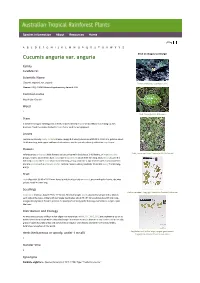
Species information Abo ut Reso urces Hom e A B C D E F G H I J K L M N O P Q R S T U V W X Y Z Cucumis anguria var. anguria Click on images to enlarge Family Cucurbitaceae Scientific Name Cucumis anguria L. var. anguria Flower and leaves. Copyright CSIRO Meeuse, A.D.J. (1958) Blumea Supplementary Series 4: 200. Common name West Indian Gherkin Weed * Fruit. Copyright K.R. McDonald Stem A slender trailing or climbing annual herb, all parts densely hispid; stems ribbed, to 3 m long x 4 mm diameter. Tendrils simple, clothed in hispid hairs; tendrils leaf-opposed. Leaves Leaf blades broadly ovate, cordate at base, deeply 3-5 lobed; blades about 35-95 x 40-90 mm, petioles about 15-60 mm long; both upper and lower leaf surfaces and the petioles densely clohted in hispid hairs. Flowers Inflorescences unisexual. Male flowers: solitary or borne in fascicles of 2-10 flowers, or in pedunculate Habit, leaves and fruit. Copyright K.R. McDonald groups; flowers about 8 mm diam; calyx tube (hypanthium) about 3-3.5 mm long, lobes linear about 0.5-2 mm long; corolla lobes ovate about 3.8-6 mm long, yellow; stamens 3, two stamens with 2-locular anthers and one stamen with a unilocular anther. Female flowers: solitary; pedicels 10-95 mm; ovary 7-9 mm long, bristly. Fruit Fruit ellipsoidal, 35-60 x 20-28 mm, densely and shortly prickly or warted, green with paler bands, ripening yellow; seeds 4-6 mm long. -

Distrito Regional De Manejo Integrado Cuervos Plan De
DISTRITO REGIONAL DE MANEJO INTEGRADO CUERVOS PLAN DE MANEJO Convenio Marco 423-2016, Acta de ejecución CT-2016-001532-10 - Cornare No 564-2017 Suscrito entre Cornare y EPM “Continuidad del convenio interadministrativo 423-2016 acta de ejecución CT-2016-001532-10 suscrito entre Cornare y EPM para la implementación de proyectos de conservación ambiental y uso sostenible de los recursos naturales en el Oriente antioqueño” PRESENTADO POR: GRUPO BOSQUES Y BIODIVERSIDAD CORNARE EL Santuario – Antioquia 2018 REALIZACIÓN Corporación Autónoma Regional de las Cuencas de los Ríos Negro y Nare – Cornare GRUPO BOSQUES Y BIODIVERSIDAD COORDINADORA DE GRUPO BOSQUES Y BIODIVERSIDAD ELSA MARIA ACEVEDO CIFUENTES Grupo Bosques y Biodiversidad SUPERVISOR DAVID ECHEVERRI LÓPEZ Biólogo (E), Grupo Bosques y Biodiversidad SUPERVISOR EPM YULIE ANDREA JÍMENEZ GUZMAN Ingeniera Forestal, Epm EQUIPO PROFESIONAL GRUPO BOSQUES Y BIODIVERSIDAD LUZ ÁNGELA RIVERO HENAO Ingeniera Forestal, Grupo Bosques y Biodiversidad EDUARDO ANTONIO RIOS PINEDO Ingeniero Forestal, Grupo Bosques y Biodiversidad DANIEL MARTÍNEZ CASTAÑO Biólogo, Grupo Bosques y Biodiversidad STIVEN BARRIENTOS GÓMEZ Ingeniero Ambiental, Grupo Bosques y Biodiversidad NICOLAS RESTREPO ROMERO Ingeniero Ambiental, Grupo Bosques y Biodiversidad JULIETH VELASQUEZ AGUDELO Ingeniera Forestal, Grupo Bosques y Biodiversidad SANTIAGO OSORIO YEPES Ingeniero Forestal, Grupo Bosques y Biodiversidad TABLA DE CONTENIDO 1. INTRODUCCIÓN .......................................................................................................... -

Targeted Vegetation Survey of Floodplains and Lower Slopes on the Far North Coast © Department of Environment and Climate Change (NSW), 2008
Comprehensive Coastal Assessment September 2008 Targeted Vegetation Survey of Floodplains and Lower Slopes on the Far North Coast © Department of Environment and Climate Change (NSW), 2008 This document may not be re-produced without prior written permission from the Department of Environment and Climate Change (NSW). Department of Environment and Climate Change (NSW) 59-61 Goulburn Street (PO Box A290) Sydney South NSW 1232 Phone: (02) 9995 5000 (switchboard) Phone: 131 555 (information & publications requests) TTY: (02) 9211 4723 Fax: (02) 9995 5999 Email: info@environment.nsw.gov.au Website: www.environment.nsw.gov.au Requests for information regarding this document are best directed to: Paul Sheringham Locked Bag 914 North East Branch Environmental Protection and Regulation Division Department of Environment and Climate Change Coffs Harbour NSW 2450 Phone: (02) 6659 8253 The documented may be cited as: Sheringham, P.R., Dr. Benwell, A., Gilmour, P., Graham, M.S., Westaway, J., Weber, L., Bailey, D., & Price, R. (2008). Targeted Vegetation Survey of Floodplains and Lower Slopes on the Far North Coast. A report prepared by the Department of Environment and Climate Change for the Comprehensive Coastal Assessment. Department of Environment and Climate Change (NSW), Coffs Harbour, NSW. Editing: P.J. Higgins. Design and layout: Dee Rogers ISBN 978 1 74122 857 1 DECC 2008/316 Printed on recycled paper CCA08 Far North Coast Targeted Vegetation Survey TARGETED VEGETATION SURVEY OF FLOODPLAINS AND LOWER SLOPES ON THE FAR NORTH COAST P.R. Sheringham, Dr. A. Benwell, P. Gilmour, M.S. Graham, J. Westaway, L. Weber, D. Bailey, & R. Price CCA08 SEPTEMBER 2008 CCA08 Far North Coast Targeted Vegetation Survey Credits Paul Sheringham: Botanist and project manager, and responsible for the survey and stratification of sites, data entry, numerical analysis and writing of this report. -

WRA Species Report
Family: Phytolaccaceae Taxon: Rivina humilis Synonym: Rivina laevis L. Common Name: bloodberry Coral berry pigeonberry rougeplant Questionaire : current 20090513 Assessor: Chuck Chimera Designation: H(Hawai'i) Status: Assessor Approved Data Entry Person: Chuck Chimera WRA Score 11 101 Is the species highly domesticated? y=-3, n=0 n 102 Has the species become naturalized where grown? y=1, n=-1 103 Does the species have weedy races? y=1, n=-1 201 Species suited to tropical or subtropical climate(s) - If island is primarily wet habitat, then (0-low; 1-intermediate; 2- High substitute "wet tropical" for "tropical or subtropical" high) (See Appendix 2) 202 Quality of climate match data (0-low; 1-intermediate; 2- High high) (See Appendix 2) 203 Broad climate suitability (environmental versatility) y=1, n=0 y 204 Native or naturalized in regions with tropical or subtropical climates y=1, n=0 y 205 Does the species have a history of repeated introductions outside its natural range? y=-2, ?=-1, n=0 y 301 Naturalized beyond native range y = 1*multiplier (see y Appendix 2), n= question 205 302 Garden/amenity/disturbance weed n=0, y = 1*multiplier (see Appendix 2) 303 Agricultural/forestry/horticultural weed n=0, y = 2*multiplier (see Appendix 2) 304 Environmental weed n=0, y = 2*multiplier (see y Appendix 2) 305 Congeneric weed n=0, y = 1*multiplier (see n Appendix 2) 401 Produces spines, thorns or burrs y=1, n=0 n 402 Allelopathic y=1, n=0 n 403 Parasitic y=1, n=0 n 404 Unpalatable to grazing animals y=1, n=-1 n 405 Toxic to animals y=1, n=0 406 -
Optimization of Conditions for Callus Induction and Indirect Organogenesis of Cucumis Anguria L
Available online a t www.pelagiaresearchlibrary.com Pelagia Research Library Asian Journal of Plant Science and Research, 2015, 5(11):53-61 ISSN : 2249-7412 CODEN (USA): AJPSKY Optimization of conditions for callus induction and indirect organogenesis of Cucumis anguria L. 1J. Jerome Jeyakumar * and 2L. Vivekanandan 1Department of Biotechnology, Pavendar Bharathidasan College of Arts & Science, Mathur, Pudukottai Road, Tiruchchirappalli, Tamil Nadu, India 2Plant Physiology and Biotechnology Division, UPASI TRF, Tea Research Institute, Nirar Dam P.O., Valparai, Tamil Nadu, India _____________________________________________________________________________________________ ABSTRACT An efficient procedure has been developed for callus induction and indirect organogenesis of Cucumis anguria L. Seedlings were grown under in vitro conditions and selection was carried out between the leaf and nodal segments for the explants in the seedlings. Different parameters like the explant source, hormones and sugars were checked for the optimization of cultures. Leaf explants which showed the maximum response to callus induction (42.0%) was thus, selected for the study. MS medium supplemented with 4.0 mg L -1 2,4-D and 4.0 mg L -1 NAA proved to be the most efficient hormone in promoting callus development from the leaf explants with 42.0% response and was the most favorable medium. Apart from the type of explant and growth regulators, different sugars and their concentrations were also checked for the induction of callus. 3% glucose produced highest rate of callus in the culture. In response to MS medium with 3.0 mg L -1 BAP and 0.5 mg L -1 Kn, best response of shoot induction was evoked with an average number of 5.02±0.76 shoots per callus. -

A Preliminary List of the Vascular Plants and Wildlife at the Village Of
A Floristic Evaluation of the Natural Plant Communities and Grounds Occurring at The Key West Botanical Garden, Stock Island, Monroe County, Florida Steven W. Woodmansee woodmansee@regionalconservation.org January 20, 2006 Submitted by The Institute for Regional Conservation 22601 S.W. 152 Avenue, Miami, Florida 33170 George D. Gann, Executive Director Submitted to CarolAnn Sharkey Key West Botanical Garden 5210 College Road Key West, Florida 33040 and Kate Marks Heritage Preservation 1012 14th Street, NW, Suite 1200 Washington DC 20005 Introduction The Key West Botanical Garden (KWBG) is located at 5210 College Road on Stock Island, Monroe County, Florida. It is a 7.5 acre conservation area, owned by the City of Key West. The KWBG requested that The Institute for Regional Conservation (IRC) conduct a floristic evaluation of its natural areas and grounds and to provide recommendations. Study Design On August 9-10, 2005 an inventory of all vascular plants was conducted at the KWBG. All areas of the KWBG were visited, including the newly acquired property to the south. Special attention was paid toward the remnant natural habitats. A preliminary plant list was established. Plant taxonomy generally follows Wunderlin (1998) and Bailey et al. (1976). Results Five distinct habitats were recorded for the KWBG. Two of which are human altered and are artificial being classified as developed upland and modified wetland. In addition, three natural habitats are found at the KWBG. They are coastal berm (here termed buttonwood hammock), rockland hammock, and tidal swamp habitats. Developed and Modified Habitats Garden and Developed Upland Areas The developed upland portions include the maintained garden areas as well as the cleared parking areas, building edges, and paths.