Gastropoda: Pulmonata: Zonitidae)
Total Page:16
File Type:pdf, Size:1020Kb
Load more
Recommended publications
-
National Monitoring Program for Biodiversity and Non-Indigenous Species in Egypt
UNITED NATIONS ENVIRONMENT PROGRAM MEDITERRANEAN ACTION PLAN REGIONAL ACTIVITY CENTRE FOR SPECIALLY PROTECTED AREAS National monitoring program for biodiversity and non-indigenous species in Egypt PROF. MOUSTAFA M. FOUDA April 2017 1 Study required and financed by: Regional Activity Centre for Specially Protected Areas Boulevard du Leader Yasser Arafat BP 337 1080 Tunis Cedex – Tunisie Responsible of the study: Mehdi Aissi, EcApMEDII Programme officer In charge of the study: Prof. Moustafa M. Fouda Mr. Mohamed Said Abdelwarith Mr. Mahmoud Fawzy Kamel Ministry of Environment, Egyptian Environmental Affairs Agency (EEAA) With the participation of: Name, qualification and original institution of all the participants in the study (field mission or participation of national institutions) 2 TABLE OF CONTENTS page Acknowledgements 4 Preamble 5 Chapter 1: Introduction 9 Chapter 2: Institutional and regulatory aspects 40 Chapter 3: Scientific Aspects 49 Chapter 4: Development of monitoring program 59 Chapter 5: Existing Monitoring Program in Egypt 91 1. Monitoring program for habitat mapping 103 2. Marine MAMMALS monitoring program 109 3. Marine Turtles Monitoring Program 115 4. Monitoring Program for Seabirds 118 5. Non-Indigenous Species Monitoring Program 123 Chapter 6: Implementation / Operational Plan 131 Selected References 133 Annexes 143 3 AKNOWLEGEMENTS We would like to thank RAC/ SPA and EU for providing financial and technical assistances to prepare this monitoring programme. The preparation of this programme was the result of several contacts and interviews with many stakeholders from Government, research institutions, NGOs and fishermen. The author would like to express thanks to all for their support. In addition; we would like to acknowledge all participants who attended the workshop and represented the following institutions: 1. -
ED45E Rare and Scarce Species Hierarchy.Pdf
104 Species 55 Mollusc 8 Mollusc 334 Species 181 Mollusc 28 Mollusc 44 Species 23 Vascular Plant 14 Flowering Plant 45 Species 23 Vascular Plant 14 Flowering Plant 269 Species 149 Vascular Plant 84 Flowering Plant 13 Species 7 Mollusc 1 Mollusc 42 Species 21 Mollusc 2 Mollusc 43 Species 22 Mollusc 3 Mollusc 59 Species 30 Mollusc 4 Mollusc 59 Species 31 Mollusc 5 Mollusc 68 Species 36 Mollusc 6 Mollusc 81 Species 43 Mollusc 7 Mollusc 105 Species 56 Mollusc 9 Mollusc 117 Species 63 Mollusc 10 Mollusc 118 Species 64 Mollusc 11 Mollusc 119 Species 65 Mollusc 12 Mollusc 124 Species 68 Mollusc 13 Mollusc 125 Species 69 Mollusc 14 Mollusc 145 Species 81 Mollusc 15 Mollusc 150 Species 84 Mollusc 16 Mollusc 151 Species 85 Mollusc 17 Mollusc 152 Species 86 Mollusc 18 Mollusc 158 Species 90 Mollusc 19 Mollusc 184 Species 105 Mollusc 20 Mollusc 185 Species 106 Mollusc 21 Mollusc 186 Species 107 Mollusc 22 Mollusc 191 Species 110 Mollusc 23 Mollusc 245 Species 136 Mollusc 24 Mollusc 267 Species 148 Mollusc 25 Mollusc 270 Species 150 Mollusc 26 Mollusc 333 Species 180 Mollusc 27 Mollusc 347 Species 189 Mollusc 29 Mollusc 349 Species 191 Mollusc 30 Mollusc 365 Species 196 Mollusc 31 Mollusc 376 Species 203 Mollusc 32 Mollusc 377 Species 204 Mollusc 33 Mollusc 378 Species 205 Mollusc 34 Mollusc 379 Species 206 Mollusc 35 Mollusc 404 Species 221 Mollusc 36 Mollusc 414 Species 228 Mollusc 37 Mollusc 415 Species 229 Mollusc 38 Mollusc 416 Species 230 Mollusc 39 Mollusc 417 Species 231 Mollusc 40 Mollusc 418 Species 232 Mollusc 41 Mollusc 419 Species 233 -
Revision of the Systematic Position of Lindbergia Garganoensis
Revision of the systematic position of Lindbergia garganoensis Gittenberger & Eikenboom, 2006, with reassignment to Vitrea Fitzinger, 1833 (Gastropoda, Eupulmonata, Pristilomatidae) Gianbattista Nardi Via Boschette 8A, 25064 Gussago (Brescia), Italy; gbnardi@libero.it [corresponding author] Antonio Braccia Via Ischia 19, 25100 Brescia, Italy; ant.brac@tin.it Simone Cianfanelli Museum System of University of Florence, Zoological Section “La Specola”, Via Romana 17, 50125 Firenze, Italy; simone.cianfanelli@unifi.it & Marco Bodon c/o Museum System of University of Florence, Zoological Section “La Specola”, Via Romana 17, 50125 Firenze, Italy; bodonm0@gmail.com Nardi, G., Braccia, A., Cianfanelli, S. & Bo- INTRODUCTION don, M., 2019. Revision of the systematic position of Lindbergia garganoensis Gittenberger & Eiken- Lindbergia garganoensis Gittenberger & Eikenboom, 2006 boom, 2006, with reassignment to Vitrea Fitzinger, is the first species of the genus, Lindbergia Riedel, 1959 to 1833 (Gastropoda, Eupulmonata, Pristilomatidae). be discovered in Italy. The genus Lindbergia encompasses – Basteria 83 (1-3): 19-28. Leiden. Published 6 April 2019 about ten different species, endemic to the Greek mainland, Crete, the Cycladic islands, Dodecanese islands, northern Aegean islands, and southern Turkey (Riedel, 1992, 1995, 2000; Welter-Schultes, 2012; Bank & Neubert, 2017). Due to Lindbergia garganoensis Gittenberger & Eikenboom, 2006, lack of anatomical data, some of these species remain ge- a taxon with mainly a south-Balkan distribution, is the only nerically questionable. Up to now, L. garganoensis was only Italian species assigned to the genus Lindbergia Riedel, 1959. known by the presence of very fine spiral striae on the tel- The assignment to this genus, as documented by the pecu- eoconch and by the general shape of its shell. -

About Bulgaria
Source: Zone Bulgaria (http://en.zonebulgaria.com/) About Bulgaria General Information about Bulgaria Bulgaria is a country in Southeastern Europe and is situated on the Balkan Peninsula. To the north the country borders Rumania, to the east – the Black Sea, to the south – Turkey and Greece, and to the west – Yugoslavia and Macedonia. Bulgaria is a parliamentary republic with a National Assembly (One House Parliament) of 240 national representatives. The President is Head of State. Geography of Bulgaria The Republic of Bulgaria covers a territory of 110 993 square kilometres. The average altitude of the country is 470 metres above sea level. The Stara Planina Mountain occupies central position and serves as a natural dividing line from the west to the east. It is a 750 km long mountain range stretching from the Vrushka Chuka Pass to Cape Emine and is part of the Alpine-Himalayan mountain range. It reaches the Black Sea to the east and turns to the north along the Bulgarian-Yugoslavian border. A natural boundary with Romania is the Danube River, which is navigable all along for cargo and passenger vessels. The Black Sea is the natural eastern border of Bulgaria and its coastline is 378 km long. There are clearly cut bays, the biggest two being those of Varna and Bourgas. About 25% of the coastline are covered with sand and hosts our seaside resorts. The southern part of Bulgaria is mainly mountainous. The highest mountain is Rila with Mt. Moussala being the highest peak on the Balkan Peninsula (2925 m). The second highest and the mountain of most alpine character in Bulgaria is Pirin with its highest Mt. -
Molluscs, by Michael J
Cambourne New Settlement Iron Age and Romano-British settlement on the clay uplands of west Cambridgeshire Volume 2: Specialist Appendices Web Report 15 Molluscs, by Michael J. Allen Cambourne New Settlement Iron Age and Romano-British Settlement on the Clay Uplands of West Cambridgeshire By James Wright, Matt Leivers, Rachael Seager Smith and Chris J. Stevens with contributions from Michael J. Allen, Phil Andrews, Catherine Barnett, Kayt Brown, Rowena Gale, Sheila Hamilton-Dyer, Kevin Hayward, Grace Perpetua Jones, Jacqueline I. McKinley, Robert Scaife, Nicholas A. Wells and Sarah F. Wyles Illustrations by S.E. James Volume 2: Specialist Appendices Part 1. Artefacts Part 2. Ecofacts Wessex Archaeology Report No. 23 Wessex Archaeology 2009 Published 2009 by Wessex Archaeology Ltd Portway House, Old Sarum Park, Salisbury, SP4 6EB http://www.wessexarch.co.uk Copyright © 2009 Wessex Archaeology Ltd All rights reserved ISBN 978-1-874350-49-1 Project website http://www.wessexarch.co.uk/projects/cambridgeshire/cambourne WA reports web pages http://www.wessexarch.co.uk/projects/cambridgeshire/cambourne/reports ii Contents Web pdf 1 Contents and Concordance of sites and summary details of archive ................................ iii Part 1. Artefacts 2 Prehistoric pottery, by Matt Leivers.....................................................................................1 2 Late Iron Age pottery, by Grace Perpetua Jones................................................................11 2 Romano-British pottery, by Rachael Seager Smith ...........................................................14 -

Bulgaria 2000
Welcome to Bulgaria 2000 ISTANBUL, Turkey May, 1999 By Whitney Mason With his stylishly coifed hair and well-cut clothes, Giorgi Kuzmov, known as "George" to his many foreign friends, might not look like someone interested in international affairs. My old friend Frederic, working at the French Embassy in Sofia as the attachd audiovisuel, had introduced me to George because, as one of Bulgaria's top TV executives, he knew a lot of Bulgarians who spoke English and most of them happened to be beautiful young women. But one of the joys of the Balkans, for a reporter, is that here politics is not a subject of interest only to specialists but a universally fascinating aspect of the drama of everyday life. And so it was perfectly natural that night, as Giorgi and I drove through Sofia's pot-holed streets in his Dodge Voyager van, that he brought up the sub- ject of Kosovo, where NATO would begin air strikes a few weeks later. Wasn't it hypocritical of the U.S. to moralize about Kosovo, Giorgi asked rhetorically, while never raising any opposition to Turkey's oppression of the Kurds? Since then, I have heard that question repeated many times; I have never had a re- sponse to offer. A cool acid jazz tune by US3 was playing loudly when we walked into E1 Cabana. Giorgi introduced me to three beautiful friends and ordered gin and tonics all around before segueing seamlessly back to Kosovo. "What would Americans say if blacks in New Orleans (where he'd just spent ten days) de- clared that they wanted independence?" Giorgi asked. -
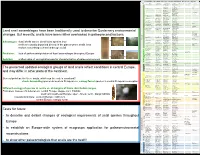
Ecological Groups of Snails – Use and Perspectives
The subdivision of all central European Holocene and Late Glacial land snail species to ecological groups ecological Glacial Early Holocene Middle Holocene Late Holocene (sensu Walker at al 2012) modern immigrants comment group Acanthinula aculeata Acanthinula aculeata Acanthinula aculeata Acanthinula aculeata Acicula parcelineata Acicula parcelineata Aegopinella epipedostoma one sites Aegopinella nitens Aegopinella nitens Aegopinella nitidula Aegopinella nitidula few sites Aegopinella pura Aegopinella pura Aegopinella pura Aegopinella pura Aegopis verticillus Ecological groups of snails Argna bielzi Argna bielzi Bulgarica cana Bulgarica cana Carpathica calophana Carpathica calophana one site; undated Causa holosericea Causa holosericea Clausilia bidentata no fossil data Clausilia cruciata Clausilia cruciata Clausilia cruciata – use and perspectives Cochlodina laminata Cochlodina laminata Cochlodina laminata Cochlodina laminata Cochlodina orthostoma Cochlodina orthostoma Cochlodina orthostoma Cochlodina orthostoma Daudebardia brevipes Daudebardia brevipes Daudebardia rufa Daudebardia rufa Daudebardia rufa Daudebardia rufa Discus perspectivus Discus perspectivus Discus perspectivus 1 2 1 1 ) Lucie Juřičková , Michal Horsák , Jitka Horáčková and Vojen Ložek Discus ruderatus Discus ruderatus Discus ruderatus Discus ruderatus Ena montana Ena montana Ena montana Ena montana forest Eucobresia nivalis Eucobresia nivalis Eucobresia nivalis Faustina faustina Faustina faustina Faustina faustina Faustina faustina Faustina rossmaessleri Faustina -
National Monitoring Program for Biodiversity and Non-Indigenous Species in Egypt
National monitoring program for biodiversity and non-indigenous species in Egypt January 2016 1 TABLE OF CONTENTS page Acknowledgements 3 Preamble 4 Chapter 1: Introduction 8 Overview of Egypt Biodiversity 37 Chapter 2: Institutional and regulatory aspects 39 National Legislations 39 Regional and International conventions and agreements 46 Chapter 3: Scientific Aspects 48 Summary of Egyptian Marine Biodiversity Knowledge 48 The Current Situation in Egypt 56 Present state of Biodiversity knowledge 57 Chapter 4: Development of monitoring program 58 Introduction 58 Conclusions 103 Suggested Monitoring Program Suggested monitoring program for habitat mapping 104 Suggested marine MAMMALS monitoring program 109 Suggested Marine Turtles Monitoring Program 115 Suggested Monitoring Program for Seabirds 117 Suggested Non-Indigenous Species Monitoring Program 121 Chapter 5: Implementation / Operational Plan 128 Selected References 130 Annexes 141 2 AKNOWLEGEMENTS 3 Preamble The Ecosystem Approach (EcAp) is a strategy for the integrated management of land, water and living resources that promotes conservation and sustainable use in an equitable way, as stated by the Convention of Biological Diversity. This process aims to achieve the Good Environmental Status (GES) through the elaborated 11 Ecological Objectives and their respective common indicators. Since 2008, Contracting Parties to the Barcelona Convention have adopted the EcAp and agreed on a roadmap for its implementation. First phases of the EcAp process led to the accomplishment of 5 steps of the scheduled 7-steps process such as: 1) Definition of an Ecological Vision for the Mediterranean; 2) Setting common Mediterranean strategic goals; 3) Identification of an important ecosystem properties and assessment of ecological status and pressures; 4) Development of a set of ecological objectives corresponding to the Vision and strategic goals; and 5) Derivation of operational objectives with indicators and target levels. -
New and Unpublished Data About Bulgarian Ground Beetles from the Tribes Pterostichini, Sphodrini, and Platynini (Coleoptera, Carabidae)
Acta Biologica Sibirica 7: 125–141 (2021) doi: 10.3897/abs.7.e67015 https://abs.pensoft.net RESEARCH ARTICLE New and unpublished data about Bulgarian ground beetles from the tribes Pterostichini, Sphodrini, and Platynini (Coleoptera, Carabidae) Teodora Teofilova1 1 Institute of Biodiversity and Ecosystem Research, Bulgarian Academy of Sciences, 1 Tsar Osvoboditel Blvd., 1000, Sofia, Bulgaria. Corresponding author: Teodora Teofilova (oberon_zoo@abv.bg) Academic editor: R. Yakovlev | Received 6 April 2021 | Accepted 22 April 2021 | Published 20 May 2021 http://zoobank.org/53E9E1F4-2338-494C-870D-F3DA4AA4360B Citation: Teofilova T (2021) New and unpublished data about Bulgarian ground beetles from the tribes Pterostichini, Sphodrini, and Platynini (Coleoptera, Carabidae). Acta Biologica Sibirica 7: 125–141. https://doi. org/10.3897/abs.7.e67015 Abstract Bulgarian ground beetle (Coleoptera, Carabidae) fauna is relatively well studied but there are still many species and regions in the country which are not well researched. The present study aims at complementing the data about the distribution of the carabids from the tribes Pterostichini, Spho- drini, and Platynini, containing many diverse, interesting, and endemic species. It gives new records for 67 species and 23 zoogeographical regions in Bulgaria. The material was collected in the period from 1926 to 2021 through different sampling methods. Twenty-three species are recorded for the first time in different regions. Six species are reported for the second time in the regions where they were currently collected. Thirty-one species have not been reported for more than 20 years in Eastern and Middle Stara Planina Mts., Kraishte region, Boboshevo-Simitli valley, Sandanski-Petrich valley, Lyulin Mts., Vitosha Mts., Rila Mts., Pirin Mts., Slavyanka Mts., Thracian Lowland, and Sakar-Tundzha re- gion. -

Fauna of New Zealand Website Copy 2010, Fnz.Landcareresearch.Co.Nz
aua o ew eaa Ko te Aiaga eeke o Aoeaoa IEEAE SYSEMAICS AISOY GOU EESEAIES O ACAE ESEAC ema acae eseac ico Agicuue & Sciece Cee P O o 9 ico ew eaa K Cosy a M-C aiièe acae eseac Mou Ae eseac Cee iae ag 917 Aucka ew eaa EESEAIE O UIESIIES M Emeso eame o Eomoogy & Aima Ecoogy PO o ico Uiesiy ew eaa EESEAIE O MUSEUMS M ama aua Eiome eame Museum o ew eaa e aa ogaewa O o 7 Weigo ew eaa EESEAIE O OESEAS ISIUIOS awece CSIO iisio o Eomoogy GO o 17 Caea Ciy AC 1 Ausaia SEIES EIO AUA O EW EAA M C ua (ecease ue 199 acae eseac Mou Ae eseac Cee iae ag 917 Aucka ew eaa Fauna of New Zealand Ko te Aitanga Pepeke o Aotearoa Number / Nama 38 Naturalised terrestrial Stylommatophora (Mousca Gasooa Gay M ake acae eseac iae ag 317 amio ew eaa 4 Maaaki Whenua Ρ Ε S S ico Caeuy ew eaa 1999 Coyig © acae eseac ew eaa 1999 o a o is wok coee y coyig may e eouce o coie i ay om o y ay meas (gaic eecoic o mecaica icuig oocoyig ecoig aig iomaio eiea sysems o oewise wiou e wie emissio o e uise Caaoguig i uicaio AKE G Μ (Gay Micae 195— auase eesia Syommaooa (Mousca Gasooa / G Μ ake — ico Caeuy Maaaki Weua ess 1999 (aua o ew eaa ISS 111-533 ; o 3 IS -7-93-5 I ie 11 Seies UC 593(931 eae o uIicaio y e seies eio (a comee y eo Cosy usig comue-ase e ocessig ayou scaig a iig a acae eseac M Ae eseac Cee iae ag 917 Aucka ew eaa Māoi summay e y aco uaau Cosuas Weigo uise y Maaaki Weua ess acae eseac O o ico Caeuy Wesie //wwwmwessco/ ie y G i Weigo o coe eoceas eicuaum (ue a eigo oaa (owe (IIusao G M ake oucio o e coou Iaes was ue y e ew eaIa oey oa ue oeies eseac -

Peregrine Earthworms (Clitellata: Lumbricidae) from Bulgaria and Turkey
Annuaire de l’Université de Sofia“ St. Kliment Ohridski” Faculte de Biologie 2017, volume 102, livre 4, pp. 45-53 Youth Scientific Conference “Kliment’s Days”, Sofia 2016 PEREGRINE EARTHWORMS (CLITELLATA: LUMBRICIDAE) FROM BULGARIA AND TURKEY METE MISIRLIOĞLU1, HRISTO VALCHOVSKI2* , RALITSA TSEKOVA3 1-Eskişehir Osmangazi University, Faculty of Science and Letters, Department of Biology, 26480 Eskişehir, Turkey. 2-Institute of Soil Science, Agrotechnologies and Plant Protection “N. Poushkarov”, 7 Shosse Bankya Str., 1080 Sofia, Bulgaria. 3-Sofia University, Faculty of Biology, Department of Ecology, 8 Dragan Tzankov blvd., 1164 Sofia, Bulgaria * Corresponding author: h_valchovski@abv.bg Keywords: Earthworms, Lumbricidae, Peregrine, Bulgaria, Turkey Abstract: In this paper we summarize the knowledge on peregrine earthworm fauna from the entire area of Bulgaria and Turkey. The peregrine lumbricids from Bulgaria and Turkey contains 16 taxa belonging to 7 genera. The most common peregrine taxa of Bulgaria are: Aporrectodea rosea (Savigny, 1826), Aporrectodea caliginosa (Savigny, 1826), Aporrectodea trapezoides, Lumbricus rubellus Hoffmeister, 1843, Lumbricus terrestris Linnaeus, 1758 and Octolasion lacteum (Örley, 1881). The most common peregrine earthworm taxa of Turkey are: Aporrectodea caliginosa (Savigny, 1826), Aporrectodea rosea (Savigny, 1826), Dendrobaena veneta veneta (Rosa, 1884), Eiseniella tetraedra (Savigny, 1826), and Lumbricus rubellus Hoffmeister, 1843. INTRODUCTION The earthworm fauna of Bulgaria remains unexplored. Rosa (1897) was the first who published data on the Bulgarian earthworms. His work was followed by Černosvitov (1934, 1937), Plisko (1963), Mihailova (1964, 1965, 1966, 1968), Zicsi and Csuzdi (1986), Duhlinska (1988), Kvavadze and Miloikova (1991), Šapkarev (1986), Deltchev et al. (1998). Recently Stojanović et al. (2012, 2013), 45 Valchovski (2012, 2014), Szederjesi (2013), Valchovski and Szederjesi (2016) elaborate knowledge of earthworm fauna of the country. -

Integrated Evaluation of Vegetation Drought Stress Through Satellite Remote Sensing †
Article Integrated Evaluation of Vegetation Drought Stress through Satellite Remote Sensing † Daniela Avetisyan 1,*, Denitsa Borisova 1 and Emiliya Velizarova 2 1 Space Research and Technology Institute of the Bulgarian Academy of Sciences, Acad. G. Bonchev Str. Bl. 1, 1113 Sofia, Bulgaria; dborisova@stil.bas.bg 2 Ministry of Environment and Water, Maria Luisa Blvd. 22, 1000 Sofia, Bulgaria; velizars@abv.bg * Correspondence: davetisyan@space.bas.bg † This paper is dedicated to the memory of Prof. Roumen Nedkov, a brilliant scientist, who thrived on helping and teaching others learn. Abstract: In the coming decades, Bulgaria is expected to be affected by higher air temperatures and decreased precipitation, which will significantly increase the risk of droughts, forest ecosystem degradation and loss of ecosystem services (ES). Drought in terrestrial ecosystems is characterized by reduced water storage in soil and vegetation, affecting the function of landscapes and the ES they provide. An interdisciplinary assessment is required for an accurate evaluation of drought impact. In this study, we introduce an innovative, experimental methodology, incorporating remote sensing methods and a system approach to evaluate vegetation drought stress in complex systems (landscapes and ecosystems) which are influenced by various factors. The elevation and land cover type are key climate-forming factors which significantly impact the ecosystem’s and vegetation’s response to drought. Their influence cannot be sufficiently gauged by a traditional remote sensing-based drought index. Therefore, based on differences between the spectral reflectance of the individual natural land cover types, in a near-optimal vegetation state and divided by elevation, we assigned coefficients for Citation: Avetisyan, D.; Borisova, D.; normalization.