Women's History 2016 Gazette
Total Page:16
File Type:pdf, Size:1020Kb
Load more
Recommended publications
-

State of the Union Not Good, Says Ford
PAGE SIXTEEN - MANCHESTER EVENING HERALD, Manchester, Conn,, Tues., Jan, 14, 1975 OBITUARIES Manning To Talk To Art Group Mrs. Theresa Brozna Fred Sharis, both of Windsor; The Tolland County Art Mrs. Theresa Babula Brozna, and nine grandchildren. A B O U T T O W N Association will have Robert 84, of 49 Salem Rd. died Sunday Funeral services are Manning as its guest speaker at at her home. Wednesday at 2 p.m. at the the meeting scheduled for today Mrs. Brozna was born in John F. Tierney Funeral Home, at 8 p.m. in the Edith Peck 219 W, Center St. Burial will be Manchester Philatelic Socie meet tonight at 8 at the home of room of the Rockville Public iianrljPHtFr Eupninn fcalh Austria and lived in Hartford Mrs. Vincent Diana, 141 Pitkin most of her life, coming to in East Cemetery. ty will meet tonight from 7 to 10 Library. at Mott’s Community Hall. The St. Manchester several years ago. Friends may call at the Manning will present a slide program will include informa MANCHESTER, CONN., WEDNESDAY, JANUARY 15, 1975- VOL. XCIV, No. 89 t w e n t y -FIG H T p a g e s — TW O s e c t io n s Survivors are 3 sons, Charles funeral home tonight from 7 to program on "Recent Trends in Manchester A City of Village Charm PRICE: FIFTEEN CENTS tion on basic identification, Brozna of Hartford, Stanely 9. Visual Fine Arts from Abstrac foreign countries and philatelic tion to Realism.” He is an Brozna of East Hartford and terms. -

Lymes' Senior Center
Lymes’ Senior Center ~March 2014 News & Events ~ Proudly serving seniors 60 & over since 1996 ENIOR S C ’ E S N E T M E R Y L In this issue: • Mohegan Sun Casino Trip • 25 Ways to Train your Brain for Enhanced Memory and Top Performance • AARP Tax Aide • What you need to know about Reverse Mortgages • AARP Drive Safety Class • 300 Years of Connecticut’s Remarkable Women • Birds and Butterflies • The Trolley Comes to Old Lyme…….and leave • Trailblazers Hiking Club Lymes’ Senior Center (860)434-4127 Open Monday-Friday 9am-3pm (unless otherwise noted) Letter from the Senior Center Coordinator Stephanie Lyon Wow, what a month we had! Today I sit at my desk for the first time in a month and am grateful to be back home at our center. After a month of being closed we are back to business! In the interim, it was wonderful to see our community pull together. I was able to hold many of our programs at different locations due to the generosity of many businesses in town. During our month away the Old Lyme Congregational Church, Lyme Art Association, Lymes’ Youth Service Bureau, Old Lyme Library, Old Lyme Town Hall, Rogers Lake and the Estuary Senior Center in Old Saybrook offered the use of their locations. I would like to offer them heartfelt thanks from the Board of Directors, the seniors and myself, without their assistance the seniors in our two towns would have been without any programs. Some of our bigger programs that could not take place this last month, have been rescheduled into your March calendar. -

Selected Highlights of Women's History
Selected Highlights of Women’s History United States & Connecticut 1773 to 2015 The Permanent Commission on the Status of Women omen have made many contributions, large and Wsmall, to the history of our state and our nation. Although their accomplishments are too often left un- recorded, women deserve to take their rightful place in the annals of achievement in politics, science and inven- Our tion, medicine, the armed forces, the arts, athletics, and h philanthropy. 40t While this is by no means a complete history, this book attempts to remedy the obscurity to which too many Year women have been relegated. It presents highlights of Connecticut women’s achievements since 1773, and in- cludes entries from notable moments in women’s history nationally. With this edition, as the PCSW celebrates the 40th anniversary of its founding in 1973, we invite you to explore the many ways women have shaped, and continue to shape, our state. Edited and designed by Christine Palm, Communications Director This project was originally created under the direction of Barbara Potopowitz with assistance from Christa Allard. It was updated on the following dates by PCSW’s interns: January, 2003 by Melissa Griswold, Salem College February, 2004 by Nicole Graf, University of Connecticut February, 2005 by Sarah Hoyle, Trinity College November, 2005 by Elizabeth Silverio, St. Joseph’s College July, 2006 by Allison Bloom, Vassar College August, 2007 by Michelle Hodge, Smith College January, 2013 by Andrea Sanders, University of Connecticut Information contained in this book was culled from many sources, including (but not limited to): The Connecticut Women’s Hall of Fame, the U.S. -

Inez Milholland “Gave Her Life to the Fight for Suffrage” August 6, 1886 – November 25, 1916
Inez Milholland “Gave her life to the fight for suffrage” August 6, 1886 – November 25, 1916 Inez Milholland was born on August 6, 1886 in Brooklyn, New York to wealthy parents. Milholland grew up in New York City and London. She met militant suffragist Emmeline Pankhurst in England, who converted Milholland into a political radical, a transfor- mation that would define her life. Milholland attended Vassar College, where she continued to be politically active. The school had a rule that banned discussion of suffrage on campus, so Milholland organized meetings in a local cemetery. Milholland was also very active in extracurriculars at school, performing as Romeo in Romeo and Juliet, as well as numerous roles in other productions. She was also a member of the Current Topics Club, the German Club, the debate team, and the unrecognized but very present Socialist Club. Additionally, Milholland played basketball, tennis, golf, and field hockey. She broke Vassar’s shot-put record in her sophomore year and won the college cup for best all-around athlete as a junior. After her graduation from Vassar in 1909, Milholland began to work as a suffrage orator in New York City, also advocating for women’s labor rights and was arrested for picketing alongside female workers during strikes in 1909 and 1910. During these strikes, Milholland used her status and resources as a mem- ber of the upper-class to pay bail for strikers and organize fundraisers. As a woman, she was rejected from several law schools but earned a law degree from New York University in 1912. -
Alice Paul: “I Was Arrested, of Course…”
Trusted Writing on History, Travel, Food and Culture Since 1949 BEFORE THE COLORS FADE Alice Paul: “I Was Arrested, Of Course…” An interview with the famed suffragette, Alice Paul Robert S. Gallagher February 1974, Volume 25, Issue 2 American women won the right to vote in 1920 largely through the controversial efforts of a young Quaker named Alice Paul. She was born in Moorestown, New Jersey, on January 11, 1885, seven years after the woman-suffrage amendment was first introduced in Congress. Over the years the so-called Susan B. Anthony amendment had received sporadic attention from the national legislators, but from 1896 until Miss Paul’s dramatic arrival in Washington in 1912 the amendment had never been reported out of committee and was considered moribund. As the Congressional Committee chairman of the National American Woman Suffrage Association, Miss Paul greeted incoming President Woodrow Wilson with a spectacular parade down Pennsylvania Avenue. Congress soon began debating the suffrage amendment again. For the next seven years— a tumultuous period of demonstrations, picketing, politicking, street violence, beatings, jailings, and hunger strikes—Miss Paul led a determined band of suffragists in the confrontation tactics she had learned from the militant British feminist Mrs. Emmeline Pankhurst. This unrelenting pressure on the Wilson administration finally paid off in 1918, when an embattled President Wilson reversed his position and declared that woman suffrage was an urgently needed “war measure.” The woman who, despite her modest disclaimers, is accorded major credit for adding the Nineteenth Amendment to the Constitution is a 1905 graduate of Swarthmore College. She received her master’s degree (1907) and her Ph.D. -
Interview with Governor Brendan T. Byrne by Michael Aron January 25
Center on the American Governor, Eagleton Institute of Politics, Rutgers University http://governors.rutgers.edu/ Interview with Governor Brendan T. Byrne by Michael Aron January 25, 2011 Michael Aron: It’s the morning of January 25th, 2011; I’m Michael Aron of NJN News here for the Rutgers program on the Governor, the Brendan T. Byrne archive. We are in Roseland, New Jersey at the offices of Carella Byrne. We’re in Governor Byrne’s personal office here; for our final interview with the Governor in this series that we started five years ago back in 2006, we’re going to talk about the end of the Byrne years, and what has the Governor focused on after leaving the Governor’s office. Before we get to the end of things, you wanted to tell a story about Jimmy Carter; go ahead. Brendan Byrne: I was very close to Carter, first Governor to support him. Now he gets elected. My great ambition is to play tennis on the White House tennis court. So now I figure I got the President is one of my best friends, I’m going to play tennis; never got the invitation to play tennis. The story I heard, and it’s probably not true, but the story I heard was that Jimmy Carter took tennis lessons from a man by the name of Frank Brennan who had also taught Billie Jean King and was from New Jersey. The story is that Carter asked Frank Brennan, did you ever see Brendan Byrne play tennis? And Brennan says, “Yes.” Carter says, “Do you think I could beat him?” And Brennan says, “No.” So I never got the invitation. -

PIONEERS of WOMEN’S RIGHTS in MANHATTAN Gale A
A WALKING TOUR PIONEERS OF WOMEN’S RIGHTS IN MANHATTAN Gale A. Brewer MANHATTAN BOROUGH PRESIDENT Brewer_WomensHistory_Final.indd 1 2/25/20 4:08 PM One Hundred Years of Voting A century has passed since American suffragists girded for their final push to win the ballot for women in every corner of the United States. Under the skilled and persistent direction of Carrie Chapman Catt, and spurred by the energy of Alice Paul’s National Woman Party, the 19th Amendment won approval on August 26, 1920. In this pamphlet, we find reminders of the struggles and achievements of New York women who spoke, marched, and even fought for the vote and the full panoply of rights. These were women who marched to Albany in the winter, or demonstrators who were jailed for their protests in Washington. Crystal Eastman, a young activist, spoke a large truth when she said, after ratification, “Now we can begin.” To complete one task is to encounter the next. Indeed, even after a hundred years we must still seek to complete the work of attaining women’s equality. Sincerely, Gale A. Brewer, Manhattan Borough President Brewer_WomensHistory_Final.indd 2 2/25/20 4:08 PM Sojourner Truth Preacher for Abolition and Suffrage Old John Street Chapel 1 Sojourner Truth was born Isabella Baumgold and lived as a Dutch-speaking slave in upstate New York. With difficulty, she won her freedom, moved to New York City, and joined the Methodist Church on John Street. She then changed her name to Sojourner Truth and spent the rest of her long life speaking against slavery and for women’s rights. -

She Gave to All... Unselfish Love' Polish Premier Ousted by Party
f%J>.to (Ennnecttcut Satltr (Eamnua Serving Storrs Since 1896 Vol.LXXXIVNo.78 University of Connecticut Tuesday, February 10,1980 She gave to all... unselfish love' WINDSOR LOCKS (UPI) - Ella Tambussi Grasso. the ;v".. nation's first woman governor elected in her own right, was buried Monday atop a sun-splashed slope in St. Mary's Cemetery next to her Italian immigrant parents. "She gave to all of you what she gave to me...a mother's gift of unselfish love and compassion," Mrs. Grasso's son, James, 29, said in delivering an eloquent eulogy to his mother who died Thursday of cancer complications. Mrs. Grasso, her body racked with cancer of the liver and intestinal tract after an almost year-long struggle, resigned in her second term on New Year's Eve. She died in Hartford Hospital with her husband, Dr. Thomas Grasso, an educator, and her children, James and Susane, at her bedside. She was 61. James Grasso said he took the "unusual step of paying tribute to my mother at her funeral because I'm so proud and privileged to have had Ella Tambussi Grasso as my mother." He described his mother as "a radiant ray of sunshine, whose warm and engaging smile brought a flow of love upon each day." And to his father, he said: "It goes without saying that my sister and I both realize that our father gave of himself so unselfishly to allow her to accomplish what no woman had ever dared to. "He was as she always said, 'My best friend.' " James Grasso, (left) son of the late former Gov. -

ED 078-451 AUTHOR TITLE DOCUMENT RESUME Weisman
DOCUMENT RESUME ED 078-451 AUTHOR Weisman, Martha TITLE Bow Women in Politics View the Role TheirSexPlays in the Impact of Their Speeches ,ontAudienees.. PUB DATE Mar 73 - - NOTE 15p.; Paper presented at the Annual Meeting of the Eastern Communication Assn. (New York, March 1973) - _ - EDRS PRICE MF-$0.65 HC-$3.29 DESCRIPTORS Communication (Thought Transfer; Females;_ Persuasive Discourse; *Political Attitudes;.Public Opinion; *Public Speaking; *Rhetorical Criticisn; *Sex Discrimination; Social Attitudes; *Speeches ABSTRACT While investigatingmaterialsfor a new course at City College of New York dealing with the rhetoric of women activists, women who were previously actively Involved in, the political scene* were asked to respoftd to the question, Does the fact that youare =awoolen affect the content, delivery, or reception of your ideas by theAudiences you haye addressed? If so, how? Women of diverse political and ethnic backgrounds replied.._Although the responses were highly subjective, many significant issues were recognized thatcallfor further investigation._While a number of women'denied that sex plays any role intheimpact of their ideas on audiences, others recognized the prejudices they face when delivering Speeches. At the same time* some women who identified the obstacles conceded that these prejudices can often be used to enhancetheir ethos. One of the-most-significant points emphasized was that we may have reached a new national. consciousness toward women politicians. _ FILMED FROM BEST AVAILABLECOPY . HOW WOMEN IN POLITICS -
Help Make a Difference Every Day for Those We Serve
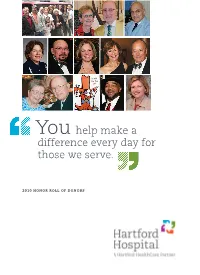
You help make a difference every day for those we serve. 2010 HONOR ROLL OF DONORS Philanthropic Facelift Benefits Patient, Family Experience Philanthropy was critically important to In addition, all of the Hospital’s public entrances transforming the face of Hartford Hospital in and its main cafeteria were renovated to provide 2010. The support of many generous donors a warm and welcoming décor for patients provided an essential boost to the first year of and families. Other major changes included HH2020, the Hospital’s 10-year modernization significant updates to the infrastructure of the plan. Their generosity helped: Conklin Building and the renovation of Heublein Add 8 ICU rooms and 9 step-down Hall in the Education and Resource Center (ERC). rooms on Bliss 9 and Bliss 11. A remarkably generous gift from a Farmington Expand the Emergency Department’s couple made possible the refurbishment of capacity by 10%, adding 5 front-end the entranceway and lobby of the ERC and an provider rooms, an additional exam adjacent conference room. (See story, page 23). room, 4 new triage desks and a new In all, with the help of charitable gifts, the discharge area – in the first phase Hospital renovated some 200,000 square feet of of the expansion plan for this vital area. space in the first year of HH2020. Create a new 26-bed inpatient unit for the Helen & Harry Gray Cancer Center on CB2. Establish the Center for Education, Simulation and Innovation for training tomorrow’s physicians today. We are pleased to have this opportunity to express the Our Honor Roll of Donors each year celebrates the appreciation of the Administration and the Board of tireless efforts of many dedicated volunteers and the Directors to our community of advocates, volunteers enormous generosity of our community. -

Alice Paul and Her Quaker Witness
Alice Paul and her Quaker witness by Roger Burns June 2, 2019 Please share this article with other Friends. Sharing this article is allowed and encouraged. See the copyright notice on the reverse side of this cover page. About the author: Roger Burns lives in Washington, DC. Like the subject of this article, he is a street activist as well as a Friend, being active in the affairs of his neighborhood and his city. Roger has a mystical bent. Several years ago during an Experiment With Light workshop he received a strong leading to promote racial reconciliation. Since then his major focus in the realm of social witness is on race issues. He has helped to manage a weekly public discussion about race that takes place at the church-run Potter's House Cafe in Washington. He serves on the Peace and Social Justice Committee of the Bethesda Friends Meeting. Roger was for a time a history major at college, and he later earned bachelor's and master's degrees in economics. Acknowledgements: I would like to thank the following for assisting with this article: Lucy Beard and Kris Myers of the Alice Paul Institute; the Bethesda Friends Meeting of Maryland; the many Friends of the Westbury Quaker Meeting; Alex Bell for going above and beyond; Ralph Steinhardt; Maya Porter; Rene Lape; June Purvis; David Zarembka; Stephanie Koenig. This article is available on the Internet at: http://www.bethesdafriends.org/Alice-Paul-and-her-Quaker-witness-2019.pdf Published by Roger Burns, 2800 Quebec St. NW, Washington, DC 20008 United States of America Phone: 202-966-8738 Email: rogerburns@pobox.com Date: June 2, 2019 COPYRIGHT NOTICE: © 2019 by Roger Burns. -

Celebrating Trailblazers Across Generations
Maryland Women’s Hall of Fame and Maryland Women of Tomorrow 2017 Induction and Awards Ceremony Celebrating Trailblazers Across Generations Thursday, March 16, 2017 Miller Senate Office Building 5:30 - 7:30 p.m. Ceremony Conference Room East 7:30 - 8:30 p.m. Reception Conference Room West Presented by Maryland Commission for Women Women Legislators of Maryland Maryland Department of Human Resources Friends of the Maryland Commission for Women Maryland Commission for Women 51 Monroe Street, Suite 1034 Rockville, MD 20850 301-610-4523 www.marylandwomen.org The Maryland Commission for Women was first established in 1965 and was set in state law in 1971. An office in the Department of Human Resources, the Commission is a 25-member advisory board whose duties outlined in its enabling legislation include: study the status of women in our state, recommend methods of overcoming discrimination, recognize women’s accomplishments and contributions, and provide informed advice to the executive and legislative branches of government on the issues concerning the women of our state. Commissioners are appointed to four-year terms by the Governor, with confirmation by the Maryland State Senate, and serve without compensation. Lee Bachu, Chair Officers: Mythili (Lee) Bachu, Chair, Montgomery County A. Diane Williams, Vice Chair, Prince George’s County Wandra Ashley-Williams, Secretary, Howard County Commissioners: Homayara Haque Aziz, M.D., Howard County Marion C. Manski, Baltimore County Tawanda A. Bailey, Frederick County April Nyman, Anne Arundel County Marianne Hyang Nam Brackney, Howard County Betsy H. Ramirez, Prince George’s County Tammy Bresnahan, Anne Arundel County Anita L. Riley, Carroll County Deborah L.