1 Cultural & Social Affairs Department Oic
Total Page:16
File Type:pdf, Size:1020Kb
Load more
Recommended publications
-
"Centrale Idéologique" Et Relations Avec Le RN. Où Vont Les Identitaires ?
"Centrale idéologique" et relations avec le RN. Où vont les https://www.contretemps.eu identitaires ? redaction Sûrement confortés par leur relaxe en appel le 16 décembre dernier, les militant-e-s de Génération Identitaire (GI) réitèrent leur opération de communication anti-réfugiés en montage. C’est cette fois dans les Pyrénées que le groupuscule d’extrême droite a décidé de jouer les supplétifs de la PAF (police de l’air et des frontières) devant les caméras et armé de sa tristement célèbre doudoune bleue. Si GI est bien loin de pouvoir mettre son programme en pratique, cette action illustre son orientation politique. Une opposition totale à la solidarité et à l’accueil des réfugiés qui reposent sur un racisme viscéral, doublée d’une assimilation de l’immigration au terrorisme. Cette action montre aussi que GI ne compte pas seulement sur l’État pour mettre en place son programme mais souhaiterait le faire par une intervention militante dont elle n’a, aujourd’hui, pas les moyens. Cet article, écrit la Commission nationale antifasciste du Nouveau parti anticapitaliste (NPA), revient sur les spécificités de GI car il importe, pour mieux les combattre, de mieux les comprendre *** En fin de matinée du 29 octobre 2020, après un nouvel attentat au couteau à Nice, les médias annoncent une seconde attaque à Avignon. Le RN s’est, dans un premier temps, empressé de dénoncer un nouvel attentat islamiste, à l’unisson des premiers messages sur les réseaux sociaux. Très vite, d’après plusieurs médias, dont Libération et Médiapart, l’assaillant semble être proche, voire militant du groupuscule d’extrême droite Génération Identitaire (GI) dont il porte un modèle de veste. -
Illiberalism Studies Program Working Papers
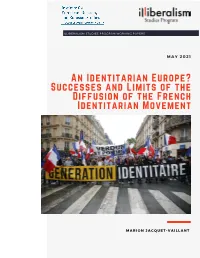
ILLIBERALISM STUDIES PROGRAM WORKING PAPERS M A Y 2 0 2 1 An Identitarian Europe? Successes and Limits of the Diffusion of the French Identitarian Movement M A R I O N J A C Q U E T - V A I L L A N T An Identitarian Europe? Successes and Limits of the Diffusion of the French Identitarian Movement Marion Jacquet-Vaillant Illiberalism Studies Program Working Papers no. 7 May 2021 Photo Cover: “Generation-identitaire” by Pulek1 licensed under CC BY-SA 4.0 ©IERES2021 The Identitarian Movement (IM) was born in France in 2002-2003, founded by Fabrice Robert, Guillaume Luyt, and Philippe Vardon in the weeks following the dissolution of the far-right group Unité radicale. Over the past 19 years, several associations have been involved in the French IM: Les Identitaires (LI) and the Bloc Identitaire (BI) have alternated as the “adult” organizations, while Les Jeunesses Identitaires (JI), Une Autre Jeunesse (UAJ), and Génération Identitaire (GI) have successively embodied its “youth” branch. Génération Identitaire (GI), founded in 2012, progressively became the figurehead of the IM before being administratively dissolved by the French government in March 2021. Since then, activists have been barred from carrying out any action in the name of Génération Identitaire. If the decision has not affected Les Identitaires or local associations (such as the Identitarian bars or cultural associations), it has thrown into jeopardy the GI brand they have successfully diffused throughout Europe. The French Identitarian movement1 claims an attachment to a certain civilizational identity linked to the European continent. In addition to structuring their movement into local chapters, each of which is responsible for the defense and promotion of local identities, the activists strive to embody this common European identity at the European level.2 They have, it seems, succeeded in doing so: since its creation, the French Identitarian movement has effectively maintained links with counterparts in Europe. -

Rechtsextreme Ideologien Rhetorische Textanalysen Als Weg Zur Erschließung Rechtsradikalen Und Rechtsextremistischen Schriftmaterials
RolfBachem Rechtsextreme Ideologien Rhetorische Textanalysen als Weg zur Erschließung rechtsradikalen und rechtsextremistischen Schriftmaterials 44 Rech ts extreme Ideologien Rhetorische Textanalysen BKA Redaktion: Heinrich Schielke Bundeskriminalamt Kriminalistisches Institut ISSN 0174-5433 Nachdruck und Vervielfaltigung, auch auszugsweise, nur mit Quellenangabe und mit Genehmigung des 13undeskriminalamts Gesamtherstellung: DruckVerlag Kettler GmbH, Bönen Rolf Bachern Rechtsextreme Ideologien Rhetorische Textanalysen als Weg zur Erschließung rechtsradikalen und rechtsextremistischen Schriftmaterials Bundeskrirninalarnt Wiesbaden 1999 BKA - Forschungsreihe herausgegeben vom Bundeskriminalamt Kriminalistisches Institut Band 44 Beirat: Prot. Dr. Hans-Jürgen Kerner Direktor des Instituts für Kriminologie der Universität Tübingen Wolfgang Sielatt Leiter des Landeskriminalamts Hamburg Prof. Dr. Dr. h. c. mulf. Klaus Tieäemann Direktor des Instituts für Kriminologie und Wirtschaftsstrafrecht der Universität Freiburg i. Sr. Klaus Jürgen Timm Direktor des Hessischen Landeskriminalarnts Vorwort Rechtsextremisten verbreiten ihre Ideologie nicht mehr nur mit traditionellen Mitteln wie Plakaten, Flugblättern, Aufklebern, Broschüren und Büchern. Die modeme Informationstechnologie hat ihnen eine Vielzahl neuer Möglichkeiten eröffnet. Massenhaft werden zum Beispiel Tonträger mit rassistischen Inhalten (vorwiegend im Ausland) produziert und verbreitet, Mailboxen oder das Internet für Propaganda, Agitation, den Austausch von Nachrichten und zur Verabredung -

La Mouvance Identitaire
LA MOUVANCE IDENTITAIRE La mouvance identitaire peut schématiquement être divisée en deux entités. D’un côté les théoriciens regroupés dans des fondations : Polémia dirigée par Jean-Yves Le Gallou ( ex GRECE, Club de L’Horloge, Fn, Mnr) et l ‘Institut Iliade « pour la longue mémoire européenne », présidé par Philippe Conrad ( ex GRECE, La Nouvelle Revue d’Histoire et TVLibertés) dans la lignée de Dominique Venner ( fondateur d’ Europe Action dans les années 60) et co fondé par Le Gallou , dans des revues : Terre et Peuple de Pierre Vial ( ex GRECE, FN, MNR ), Réfléchir et Agir, La Nouvelle Revue d’Histoire fondée par Dominique Venner, dont le premier numéro traitait de « 5000 ans de civilisation européenne », Synthèse Nationale dirigée par Roland Hélie ( ex Ordre Nouveau, PFN, FN Espace Nouveau ) et du côté des indépendantistes comme WAR RAOK ! La voix de la nation bretonne dirigée par Padrig Montauzier ( ex FLB et dirigeant de l’ ADSAV « le Parti de l’ indépendance bretonne ». De l’autre côté les activistes : GUD, Bloc identitaire et Génération identitaire. Le GUD, c’est un peu comme le monstre du Loch Ness, il apparait, il disparait et il réapparait (dernière apparition publique le 22 novembre 2014, le meeting « Réveil des Nations » avec les Grecs de l’Aube Dorée, les Belges de Nation Actuellement, il tente de se refaire une santé et intervient sous l’appellation Bastion Social sous l’impulsion de Steven Bissuel. (déféré devant la justice « pour violences aggravées »). Un communiqué annonce que « Le GUD , à l’échelle nationale, s’est mis en sommeil au profit du Bastion Social ». -
Because They Hate, Is “To the Jew First.” Offered on Page 3
HR PDF Number 0804, July 2008 ISAIAH 52:7 The family with a Jewish heart. Who says to Zion, “Your God reigns!” Welcome to the Family News from Sid Roth’s Messianic Vision and It’s Supernatural! Television with a Jewish Heart! Because In 1977, Sid Roth started Messianic Vision. Sid’s heart’s desire is to reach They Hate out with the good news of the By Brigitte Gabriel Messiah, “to the Jew first” (Romans 1:16 KJV). This is not just God’s historical order for spreading the gospel, but also His eternal spiritual order. When we follow this “law Brigitte Gabriel is a U.S.-based journalist of evangelism,” God opens a and news producer who started her career supernatural door to reach greater as an anchor for World News, an evening Arabic news program broadcast throughout numbers of Gentiles. God’s heart the Middle East. The following excerpts are is to reach all people. His strategy from her book entitled, Because They Hate, is “to the Jew first.” offered on page 3. Yeshua (Jesus) creates y book is a warning. “The One New Man” It is a warning that from Jews and Gentiles. what happened to Brigitte Gabriel M Jesus came to break down the wall me and my country of birth could, of separation between Jew and terrifyingly, happen here in America, my country of adoption. It is a warning about Gentile. The Messiah was a Jew, and what happened to countless other non-Muslims in the Middle East and what should the first believers were Jews. -

Download Download
DOI: 10.4119/ijcv-3805 IJCV: Vol. 14(2)/2020 Connecting Structures: Resistance, Heroic Masculinity and Anti-Feminism as Bridging Narratives within Group Radicalization David Meieringi david.meiering@hu-berlin.de Aziz Dzirii dziriazx@hu-berlin.de Naika Foroutani foroutan@hu-berlin.de i Berlin Institute for Integration and Migration Research (BIM) at the Humboldt University Berlin Vol. 14(2)/2020 The IJCV provides a forum for scientific exchange and public dissemination of up-to-date scien- tific knowledge on conflict and violence. The IJCV is independent, peer reviewed, open access, and included in the Social Sciences Citation Index (SSCI) as well as other rele- vant databases (e.g., SCOPUS, EBSCO, ProQuest, DNB). The topics on which we concentrate—conflict and violence—have always been central to various disciplines. Consequently, the journal encompasses contributions from a wide range of disciplines, including criminology, economics, education, ethnology, his- tory, political science, psychology, social anthropology, sociology, the study of reli- gions, and urban studies. All articles are gathered in yearly volumes, identified by a DOI with article-wise pagi- nation. For more information please visit www.ijcv.or g Suggested Citation: APA: Meiering, D., Dziri, A., & Foroutan, N. (2020). Connecting structures: Resistance, heroic masculinity and anti-feminism as bridging narratives within group radicaliza- tion. International Journal of Conflict and Violence, 14(2), 1-19. doi: 10.4119/ijcv-3805 Harvard: Meiering, David, Dziri, Aziz, Foroutan, Naika. 2020. Connecting Structures: Resistance, Heroic Masculinity and Anti-Feminism as Bridging Narratives within Group Radicalization. International Journal of Conflict and Violence 14(2): 1-19. doi: 10.4119/ijcv-3805 This work is licensed under the Creative Commons Attribution—NoDerivatives License. -

Human Rights Report 2019 International Human Rights Policy: Activities and Results
Human rights report 2019 International human rights policy: activities and results Human rights report 2019 | Human rights report 2019 | Human rights report 2019 | Human rights report 2019 | Human rights report 2019 | Human rights report 2019 | AccraVaticaanstadPortOfSpainHoustonPretoriaLaPazIstanboelBoedapestHamburgVancouverDhakaDubaiBangkokAnkaraAlgiersKhartoemDubaiKobeBrusselMexicoSt PetersburgParamariboAnkaraRabatBelgradoRabatAtheneHarareNewYorkAntwerpenBuenosBogotáKairoHarareLagosManaguaQuitoHamburgLagosColomboMexicoBr atislavaLusakaBangkokSarajevoDamascusHoustonBonnAnkaraBrusselDarEsSalaamKobeSofiaKoealaLoempoerWellingtonAlgiersAnkaraAbujaChicagoMuscatDakarSt ockholmKopenhagenCotonouBuenosAiresAddisAbebaLissabonParijsRabatDüsseldorfTokioLuxemburgMontevideoChicagoBagdadPortOfSpainBoekarestLuxemburgDak arHoustonAlmatyDubaiRomeBamakoBelgradoHamburgRomeDarEsSalaamSofiaDubaiColomboRabatAtheneDublinSydneyKobeBogotáPraagOuagadougouAlgiersKin gstonStPetersburgAmmanMilaanMexicoTeheranAbuDhabiFrankfurtAmMainBelgradoTorontoAddisAbebaAnkaraSarajevoPortOfSpainAiresStockholmAmsterdamAbeba TripoliLaPazKairoManaguaBagdadLosAngelesKievAnkaraColomboWarschauRomeBernKingstonLissabonBoedapestBoedapestNewYorkMaputoColomboNewYorkRiyad BamakoTelAvivKingstonMontevideoLaPazPraagDubaiWenenCotonouBerlijnLaPazDüsseldorfKampalaTeheranSeoelMontevideoBrasiliaPretoriaAnkaraBomaySofiaToro ntoRomeZagrebWashingtonAmmanAtheneLaPazMoskouAlgiersAbidjanParamariboMaputoManillaKinshasaBarcelonaCaracasManaguaBarcelonaLusakaAntwerpenSa oPauloBagdadLaPazParijsTorontoBrusselBerlijnPekingMontevideoAbuDhabiTelAvivLondenIstanboelAlmatyBangkokHelsinkiSanJoséParamariboAnkaraSaoPauloPretor -

Loving Hate. Report Anti-Muslim Extremism, Radical Islamism and the Spiral of Polarization
RESEARCH LOVING HATE. REPORT ANTI-MUSLIM EXTREMISM, RADICAL ISLAMISM AND THE SPIRAL OF POLARIZATION RESENTMENT PREJUDICE EXCLUSION DISCRIMINATION POLARIZATION STIGMATIZATION ESCALATION VICTIMIZATION DEMONIZATION CONSPIRACY RADICALIZATION VIOLENCE In cooperation with: by: Maik Fielitz, Julia Ebner, Jakob Guhl and Matthias Quent Jena/London/Berlin 2018 LOVING HATE. ANTI-MUSLIM EXTREMISM, RADICAL ISLAMISM AND THE SPIRAL OF POLARIZATION 1 EXECUTIVE SUMMARY Summary This report focuses on the interactional dynamics between anti-Muslim extremists and radical Islamists in Germany and beyond. It reveals ideological underpinnings, approaches to mobiliza- tion and communication patterns, which all prove to be analogous on both sides, and it places emphasis on the reciprocity of hate that may serve to intensify processes of individual and group radicalization. Our study presents the first systematic analysis of the interplay between both forms of extremism that plays out on different places on the Internet. It provides direct evidence showing that Islamist and far-right movements converge at different levels and mutually amplify one another. The analy- sis focuses on measuring the online interaction between extremist content, individuals and events. Overall, over 10,000 Islamist and far-right Facebook posts and over one million German anti-Muslim tweets between 1 January 2013 and 30 November 2017 were analyzed for this study. Additionally, we conducted three months of ethnographic research into encrypted pro-IS and pro-Al-Qaeda groups on Telegram as well as into far-right chat groups. Key Findings Radical Islamism and anti-Muslim racism, which manifest themselves in the form of far-right ex- tremism and right-wing populism exhibit a symbiotic relationship. -
Enhancing Real-Time Twitter Filtering and Classification Using a Semi-Automatic Dynamic Machine Learning Setup Approach
Enhancing Real-Time Twitter Filtering and Classification using a Semi-Automatic Dynamic Machine Learning setup approach Master’s Thesis Nick de Jong Enhancing Real-Time Twitter Filtering and Classification using a Semi-Automatic Dynamic Machine Learning setup approach THESIS submitted in partial fulfillment of the requirements for the degree of MASTER OF SCIENCE in COMPUTER SCIENCE TRACK SOFTWARE TECHNOLOGY by Nick de Jong born in Rotterdam, 1988 Web Information Systems Department of Software Technology Faculty EEMCS, Delft University of Technol- CrowdSense ogy Wilhelmina van Pruisenweg 104 Delft, the Netherlands The Hague, the Netherlands http://wis.ewi.tudelft.nl http://www.twitcident.com c 2015 Nick de Jong Enhancing Real-Time Twitter Filtering and Classification using a Semi-Automatic Dynamic Machine Learning setup approach Author: Nick de Jong Student id: 1308130 Email: ndjong2@gmail.com Abstract Twitter contains massive amounts of user generated content that also con- tains a lot of valuable information for various interested parties. Twitcident has been developed to process and filter this information in real-time for interested parties by monitoring a set of predefined topics, exploiting humans as sensors. An analysis of the relevant information by an operator can result in an estimation of severity, and an operator can act accordingly. However, among all relevant and useful content that is extracted, also a lot of irrelevant noise is present. Our goal is to improve the filter in such a way that the majority of information pre- sented by Twitcident is relevant. To this end we designed an artifact consisting of several components, developed within a dynamic framework. -

What Every Christian High School Student Should Know About Islam - an Introduction to Islamic History and Theology
WHAT EVERY CHRISTIAN HIGH SCHOOL STUDENT SHOULD KNOW ABOUT ISLAM - AN INTRODUCTION TO ISLAMIC HISTORY AND THEOLOGY __________________ A Thesis Presented to the Faculty of the School of Theology Liberty University __________________ In Partial Fulfillment of the Requirements for the Degree Doctor of Ministry __________________ by Bruce K. Forrest May 2010 Copyright © 2010 Bruce K. Forrest All rights reserved. Liberty University has permission to reproduce and disseminate this document in any form by any means for purposes chosen by the Seminary, including, without limitation, preservation or instruction. APPROVAL SHEET WHAT EVERY CHRISTIAN HIGH SCHOOL STUDENT SHOULD KNOW ABOUT ISLAM - AN INTRODUCTION TO ISLAMIC HISTORY AND THEOLOGY Bruce K. Forrest ______________________________________________________ "[Click and enter committee chairman name, 'Supervisor', official title]" ______________________________________________________ "[Click here and type committee member name, official title]" ______________________________________________________ "[Click here and type committee member name, official title]" ______________________________________________________ "[Click here and type committee member name, official title]" Date ______________________________ ACKNOWLEDGEMENT I would like to acknowledge all my courageous brothers and sisters in Christ who have come out of the Islamic faith and have shared their knowledge and experiences of Islam with us. The body of Christ is stronger and healthier today because of them. I would like to acknowledge my debt to Ergun Mehmet Caner, Ph.D. who has been an inspiration and an encouragement for this task, without holding him responsible for any of the shortcomings of this effort. I would also like to thank my wife for all she has done to make this task possible. Most of all, I would like to thank the Lord for putting this desire in my heart and then, in His timing, allowing me the opportunity to fulfill it. -

Teun Van Hout S1528513 Master Thesis Political Science: Nationalism, Ethnic Conflict & Development. Supervisor: Dr. Vasiliki
Teun van Hout S1528513 Master thesis Political Science: Nationalism, Ethnic Conflict & Development. Supervisor: Dr. Vasiliki Tsagkroni. Second reader: Dr. M.B. Longo. 10871 words. “The influence of cultural nationalism on the discourse of two Dutch political parties: The PvdA and VVD” Abstract. Since the early 2000’s cultural nationalism has a strong presence in the discourse of some Dutch political parties. While mostly associated with the far right, the past years cultural nationalist discourse has become mainstream. Under influence of public opinion other parties have started using it as well. As cultural nationalism is has an exclusive nature, this can be potentially harmful to groups in society. In this thesis the swing towards cultural nationalist discourse by the reaction of two centre parties formerly not associated with cultural nationalist discourse on law initiatives linked to Dutch culture, tradition, and identity will be examined. The initiatives, the Burqa Ban and the Black Pete law were both proposed by the PVV to protect Dutch culture. The parties used are the Dutch social democrats, the PvdA, and the Dutch liberals, the VVD. Table of contents. Abstract 1. Introduction. 2 2. Theory. 4 3. Literature Review. 7 4. Case selection & Method. 10 5. Analysis. a. Initiative proposal to ban burqa’s and niqabs from the public space (The Burqa Ban) (2007- 2016). 12 b. Initiative proposal for the protection of the tradition of Saint Nicholas and Black Pete (Black Pete law) (2014 – 2017). 15 6. Discussion. 17 7. Conclusion. 21 Bibliography. 23 1 1. Introduction In January 2017, just prior to the national elections (Second Chamber elections), the Dutch Prime Minister and frontman of the Dutch liberals (VVD) published a letter in which he asked people to ‘act normally’ (“Normaal. -
Horizons of the World : Imagining Coexistence in Language Through Understanding and Refiguring of Reality Ayman A
The University of San Francisco USF Scholarship: a digital repository @ Gleeson Library | Geschke Center Doctoral Dissertations Theses, Dissertations, Capstones and Projects 2008 Horizons of the world : imagining coexistence in language through understanding and refiguring of reality Ayman A. Moussa Follow this and additional works at: https://repository.usfca.edu/diss Part of the Education Commons Recommended Citation Moussa, Ayman A., "Horizons of the world : imagining coexistence in language through understanding and refiguring of reality" (2008). Doctoral Dissertations. 188. https://repository.usfca.edu/diss/188 This Dissertation is brought to you for free and open access by the Theses, Dissertations, Capstones and Projects at USF Scholarship: a digital repository @ Gleeson Library | Geschke Center. It has been accepted for inclusion in Doctoral Dissertations by an authorized administrator of USF Scholarship: a digital repository @ Gleeson Library | Geschke Center. For more information, please contact repository@usfca.edu. The University of San Francisco HORIZONS OF THE WORLD: IMAGINING COEXISTENCE IN LANGUAGE THROUGH UNDERSTANDING AND REFIGURING OF REALITY A Dissertation Presented to The Faculty of the School of Education Department of Leadership Studies Organization and Leadership Program In partial Fulfillment of the Requirements for the Degree of Doctor of Education by Ayman A. Moussa San Francisco May 2008 This dissertation, written under the direction of the candidate’s dissertation committee and approved by the members of the committee, has been presented to and accepted by the Faculty of the School of Education in partial fulfillment of the requirements for the degree of Doctor of Education. The content and research methodologies presented in this work represent the work of the candidate alone.