May 2018 . Orchid Specialist Group Newsletter
Total Page:16
File Type:pdf, Size:1020Kb
Load more
Recommended publications
-

Illustrated Flora of East Texas --- Taxa in Volume 1 (May 2004)
Illustrated Flora of East Texas --- Taxa in Volume 1 (May 2004) Family Genus Species Var. or Subsp. Native or Intro Ferns & Fern Allies Psilotaceae Psilotum nudum N Isoetaceae Isoetes butleri N Isoetaceae Isoetes melanopoda N Lycopodiaceae Lycopodiella alopecuroides N Lycopodiacae Lycopodiella appressa N Lycopodiaceae Lycopodiella prostrata N Lycopodiaceae Palhinhaea cernua N Lycopodiaceae Pseudolycopodiella caroliniana N Selaginellaceae Selaginella apoda var. apoda N Selaginellaceae Selaginella arenicola subsp. riddellii N Equisetaceae Equisetum hyemale subsp. affine N Equisetaceae Equisetum laevigatum N Anemiaceae Anemia mexicana N Aspleniaceae Asplenium platyneuron N Aspleniaceae Asplenium resiliens N Azollaceae Azolla caroliniana N Azollaceae Azolla mexicana N Blechnaceae Woodwardia areolata N Blechnaceae Woodwardia virginica N Dennstaedtiaceae Pteridium aquilinum var. pseudocaudatum N Dryopteridaceae Athyrium filix-femina subsp. asplenioides N Dryopteridaceae Cyrtomium falcatum I Dryopteridaceae Cystopteris protrusa N Dryopteridaceae Dryopteris celsa N Dryopteridaceae Dryopteris ludoviciana N Dryopteridaceae Nephrolepis exaltata I Dryopteridaceae Onoclea sensibilis N Dryopteridaceae Polystichum acrostichoides N Dryopteridaceae Tectaria heracleifolia N Dryopteridaceae Woodsia obtusa subsp. obtusa N Dryopteridaceae Woodsia obtusa subsp. occidentalis N Lygodiaceae Lygodium japonicum I Marsileaceae Marsilea macropoda N Marsileaceae Marsilea vestita N Marsileaceae Pilularia americana N Ophioglossaceae Botrychium biternatum N Ophioglossaceae -

Guide to the Flora of the Carolinas, Virginia, and Georgia, Working Draft of 17 March 2004 -- LILIACEAE
Guide to the Flora of the Carolinas, Virginia, and Georgia, Working Draft of 17 March 2004 -- LILIACEAE LILIACEAE de Jussieu 1789 (Lily Family) (also see AGAVACEAE, ALLIACEAE, ALSTROEMERIACEAE, AMARYLLIDACEAE, ASPARAGACEAE, COLCHICACEAE, HEMEROCALLIDACEAE, HOSTACEAE, HYACINTHACEAE, HYPOXIDACEAE, MELANTHIACEAE, NARTHECIACEAE, RUSCACEAE, SMILACACEAE, THEMIDACEAE, TOFIELDIACEAE) As here interpreted narrowly, the Liliaceae constitutes about 11 genera and 550 species, of the Northern Hemisphere. There has been much recent investigation and re-interpretation of evidence regarding the upper-level taxonomy of the Liliales, with strong suggestions that the broad Liliaceae recognized by Cronquist (1981) is artificial and polyphyletic. Cronquist (1993) himself concurs, at least to a degree: "we still await a comprehensive reorganization of the lilies into several families more comparable to other recognized families of angiosperms." Dahlgren & Clifford (1982) and Dahlgren, Clifford, & Yeo (1985) synthesized an early phase in the modern revolution of monocot taxonomy. Since then, additional research, especially molecular (Duvall et al. 1993, Chase et al. 1993, Bogler & Simpson 1995, and many others), has strongly validated the general lines (and many details) of Dahlgren's arrangement. The most recent synthesis (Kubitzki 1998a) is followed as the basis for familial and generic taxonomy of the lilies and their relatives (see summary below). References: Angiosperm Phylogeny Group (1998, 2003); Tamura in Kubitzki (1998a). Our “liliaceous” genera (members of orders placed in the Lilianae) are therefore divided as shown below, largely following Kubitzki (1998a) and some more recent molecular analyses. ALISMATALES TOFIELDIACEAE: Pleea, Tofieldia. LILIALES ALSTROEMERIACEAE: Alstroemeria COLCHICACEAE: Colchicum, Uvularia. LILIACEAE: Clintonia, Erythronium, Lilium, Medeola, Prosartes, Streptopus, Tricyrtis, Tulipa. MELANTHIACEAE: Amianthium, Anticlea, Chamaelirium, Helonias, Melanthium, Schoenocaulon, Stenanthium, Veratrum, Toxicoscordion, Trillium, Xerophyllum, Zigadenus. -

SUNY Cortland School of Arts and Sciences Annual Report 2018-19
SUNY Cortland School of Arts and Sciences Annual Report 2018-19 September 3, 2019 R. Bruce Mattingly, Dean Vincent DeTuri, Associate Dean Mary McGuire, Assistant Dean Meghan VanDeuson, Secretary II, Dean’s Office Michele Lella, Secretary I, Associate Dean’s Office i Table of Contents I. Introduction 2 II. Assessment and Student Learning Outcomes 2 III. Enrollment Trends and Budget Analysis 3 IV. Highlights and Major Accomplishments 4 A. Personnel Changes 4 B. Sabbatical Leaves and Other Leaves of Absence 5 C. Faculty Awards and Honors 6 D. Faculty Promotions effective Fall 2019 9 E. Alumni Awards and Honors 9 F. Department Highlights in Teaching, Research and Creative Activity 10 G. Faculty Service Activities 20 H. Associate Dean’s Report 21 Appendices 1. Academic Standing Data Tables 2. Faculty Publications and Creative Activities 3. Faculty Presentations 4. External Grants 5. Faculty Service Activities i I. Introduction We are pleased to present the 2018-19 Annual Report for the School of Arts and Sciences. This year, we were pleased to add a new member to our team, as Vincent DeTuri joined us as the new Associate Dean. Faculty across all eighteen departments continued their excellent work in all areas of responsibility. Christa Carsten, Mathematics, won the Non-Tenure Track Excellence in Teaching Award, and Scott Moranda, History, was the recipient of the Rozanne Brooks Dedicated Teaching Award. Tiantian Zheng, Sociology/Anthropology, was promoted to the rank of Distinguished Professor, and Donna West, Modern Languages, received the Chancellor’s Award for Excellence in Scholarship and Creative Activities. Kathleen Lawrence, Communication and Media Studies, won the Chancellor’s Award for Excellence in Faculty Service, and Jenn McNamara, Art and Art History, received the campus award for Outstanding Achievement in Service. -

Rare Plant Fact Sheet PMORC2B0J0 Maine Department of Conservation Natural Areas Program
Rare Plant Fact Sheet PMORC2B0J0 Maine Department of Conservation Natural Areas Program Spiranthes lucida (H.H. Eat.) Ames Shining Ladies'-tresses Habitat: Alluvial or damp rocky shores and slopes, rich damp thickets and meadows. [Non- tidal rivershore (non-forested, seasonally wet); Open wetland, not coastal nor rivershore (non-forested, wetland)] Range: New Brunswick to Ontario, south to Virginia, upland North Carolina and Tennessee, Indiana, and Illinois. Phenology: Flowers June - July, earliest Spiranthes to flower in our region. Ladies-tresses are leafy stemmed orchids with small, mostly white, flowers borne in spiralled racemes. Family: Orchidaceae Illustration from Britton & Brown’s Illustrated Flora of the Northern United States and Canada, 2nd ed. Aids to Identification: Spiranthes lucida has 3-5 erect, oblanceolate to oblong, shiny green, basal leaves. Its short, compact floral spike has 3-4 ranks of flowers. A broad yellow spot on the protruding lip brightens the waxy white tubular flowers. The flowers appear late-June to mid-July, earlier than most other species of Spiranthes. Ecological characteristics: Spiranthes lucida seems to prefer circumneutral damp soil, and may often be found on calcareous gravelly shores. It may be locally abundant but seems infrequent throughout its range, perhaps because it is easily overlooked growing among taller grassy weeds. One author points out that it is usually found in disturbed areas where the water supply is plentiful, as in wet cow pastures growing on hummocks of mud thrust up beside deep cow prints. Another author reports that attempts to grow S. lucida in home gardens have often failed because it "soon falls prey to fungi and slugs which are especially fond of it". -
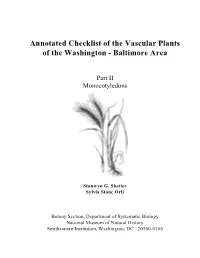
Annotated Checklist of the Vascular Plants of the Washington - Baltimore Area
Annotated Checklist of the Vascular Plants of the Washington - Baltimore Area Part II Monocotyledons Stanwyn G. Shetler Sylvia Stone Orli Botany Section, Department of Systematic Biology National Museum of Natural History Smithsonian Institution, Washington, DC 20560-0166 MAP OF THE CHECKLIST AREA Annotated Checklist of the Vascular Plants of the Washington - Baltimore Area Part II Monocotyledons by Stanwyn G. Shetler and Sylvia Stone Orli Department of Systematic Biology Botany Section National Museum of Natural History 2002 Botany Section, Department of Systematic Biology National Museum of Natural History Smithsonian Institution, Washington, DC 20560-0166 Cover illustration of Canada or nodding wild rye (Elymus canadensis L.) from Manual of the Grasses of the United States by A. S. Hitchcock, revised by Agnes Chase (1951). iii PREFACE The first part of our Annotated Checklist, covering the 2001 species of Ferns, Fern Allies, Gymnosperms, and Dicotyledons native or naturalized in the Washington-Baltimore Area, was published in March 2000. Part II covers the Monocotyledons and completes the preliminary edition of the Checklist, which we hope will prove useful not only in itself but also as a first step toward a new manual for the identification of the Area’s flora. Such a manual is needed to replace the long- outdated and out-of-print Flora of the District of Columbia and Vicinity of Hitchcock and Standley, published in 1919. In the preparation of this part, as with Part I, Shetler has been responsible for the taxonomy and nomenclature and Orli for the database. As with the first part, we are distributing this second part in preliminary form, so that it can be used, criticized, and updated while the two parts are being readied for publication as a single volume. -

Spiranthes Australis Austral Lady's Tresses
PLANT Spiranthes australis Austral Lady's Tresses AUS SA AMLR Endemism Life History Distribution and Population Also occurs in QLD, NSW, VIC and TAS. In SA occurs in - R E - Perennial SL and SE regions (and possibly KI region).2,4 More common in the eastern states.3 Family ORCHIDACEAE Confined in the AMLR to a few high rainfall areas, near coastal locations from the Adelaide Hills southward.3 Occurs in small populations in swamps and boglands. Uncommon.5 Two plants are also known from Bridgewater (K. Brewer/J. Smith pers. comm.). Post-1983 filtered AMLR records in Mount Compass and Inman Valley areas.6 Pre-1983 AMLR filtered additional record from north of Mount Compass.6 Habitat Restricted to peaty bogs and swampy creek-sides, often in locations that are inundated throughout winter. In some areas survives in paddocks grazed by stock.3 The best specimens are found on mowed firebreaks adjacent to swamps.3 Recorded from peat swamps in the Mount Compass area; growing near Carex gaudichaudiana and Photo: © Julia Bignall Leptospermum lanigerum at Tookayerta Creek; growing near Baumea rubiginosa, Lepidosperma Conservation Significance longitudinale and Leptospermum continental in a The AMLR distribution is disjunct, isolated from other swampy, damp creek line at Inman Valley.7 extant occurrences within SA. Within the AMLR the species’ relative area of occupancy is classified as Within the AMLR the preferred broad vegetation group ‘Very Restricted’. Relative to all AMLR extant species, is Wetland.6 the species' taxonomic uniqueness is classified as ‘High’.6 Within the AMLR the species’ degree of habitat specialisation is classified as ‘Very High’.6 Type form from eastern Australia is not strictly a swamp plant and has smaller, darker pink flowers. -

Native Plants for Wildlife Habitat and Conservation Landscaping Chesapeake Bay Watershed Acknowledgments
U.S. Fish & Wildlife Service Native Plants for Wildlife Habitat and Conservation Landscaping Chesapeake Bay Watershed Acknowledgments Contributors: Printing was made possible through the generous funding from Adkins Arboretum; Baltimore County Department of Environmental Protection and Resource Management; Chesapeake Bay Trust; Irvine Natural Science Center; Maryland Native Plant Society; National Fish and Wildlife Foundation; The Nature Conservancy, Maryland-DC Chapter; U.S. Department of Agriculture, Natural Resource Conservation Service, Cape May Plant Materials Center; and U.S. Fish and Wildlife Service, Chesapeake Bay Field Office. Reviewers: species included in this guide were reviewed by the following authorities regarding native range, appropriateness for use in individual states, and availability in the nursery trade: Rodney Bartgis, The Nature Conservancy, West Virginia. Ashton Berdine, The Nature Conservancy, West Virginia. Chris Firestone, Bureau of Forestry, Pennsylvania Department of Conservation and Natural Resources. Chris Frye, State Botanist, Wildlife and Heritage Service, Maryland Department of Natural Resources. Mike Hollins, Sylva Native Nursery & Seed Co. William A. McAvoy, Delaware Natural Heritage Program, Delaware Department of Natural Resources and Environmental Control. Mary Pat Rowan, Landscape Architect, Maryland Native Plant Society. Rod Simmons, Maryland Native Plant Society. Alison Sterling, Wildlife Resources Section, West Virginia Department of Natural Resources. Troy Weldy, Associate Botanist, New York Natural Heritage Program, New York State Department of Environmental Conservation. Graphic Design and Layout: Laurie Hewitt, U.S. Fish and Wildlife Service, Chesapeake Bay Field Office. Special thanks to: Volunteer Carole Jelich; Christopher F. Miller, Regional Plant Materials Specialist, Natural Resource Conservation Service; and R. Harrison Weigand, Maryland Department of Natural Resources, Maryland Wildlife and Heritage Division for assistance throughout this project. -

E. Biondi, L. Gubellini, M. Pinzi & S. Casavecchia the Vascular Flora Of
Fl. Medit. 22: 67-167 doi: 10.7320/FlMedit22.067 Version of Record published online on 28 December 2012 E. Biondi, L. Gubellini, M. Pinzi & S. Casavecchia The vascular flora of Conero Regional Nature Park (Marche, Central Italy) To Aldo J. B. Brilli-Cattarini, eminent botanist and expert resear- cher on the Marche region flora and par- ticularly on the Conero flora. He was the founder of the “Centro Ricerche Floristiche Marche” of Pesaro and Urbino Province. He has been a master for all of us even in the preparation of this work, with great gene rosity, he offered us his unique experience with enthusiasm. Abstract Biondi E., Gubellini L., Pinzi M. & Casavecchia, S.: The vascular flora of Conero Regional Nature Park (Marche, Central Italy). — Fl. Medit. 22: 67-167. 2012. — ISSN: 1120-4052 print- ed, 2240-4538 online. It is presented the vascular flora of Conero Regional Park. The paper starts with a brief presen- tation of the park territory (geography, geomorphology and bioclimate) that arises in the cen- tral Adriatic side of the Italian peninsula. The vegetation is briefly described thanks to the detailed phytosociological analysis carried out in the territory and to detailed maps on different scales. The description of vegetation allows indicating, for most of the species listed, their par- ticipation in the plant communities present in the area. The floristic list comprises 1169 entities, of specific and sub specific levels, that belong to 101 families and 507 genera. It also includes 64 species currently disappeared or not recently found in the study area, indicated by NP acronym (not present). -
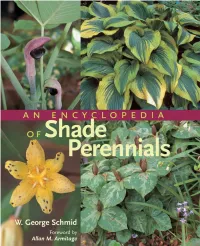
An Encyclopedia of Shade Perennials This Page Intentionally Left Blank an Encyclopedia of Shade Perennials
An Encyclopedia of Shade Perennials This page intentionally left blank An Encyclopedia of Shade Perennials W. George Schmid Timber Press Portland • Cambridge All photographs are by the author unless otherwise noted. Copyright © 2002 by W. George Schmid. All rights reserved. Published in 2002 by Timber Press, Inc. Timber Press The Haseltine Building 2 Station Road 133 S.W. Second Avenue, Suite 450 Swavesey Portland, Oregon 97204, U.S.A. Cambridge CB4 5QJ, U.K. ISBN 0-88192-549-7 Printed in Hong Kong Library of Congress Cataloging-in-Publication Data Schmid, Wolfram George. An encyclopedia of shade perennials / W. George Schmid. p. cm. ISBN 0-88192-549-7 1. Perennials—Encyclopedias. 2. Shade-tolerant plants—Encyclopedias. I. Title. SB434 .S297 2002 635.9′32′03—dc21 2002020456 I dedicate this book to the greatest treasure in my life, my family: Hildegarde, my wife, friend, and supporter for over half a century, and my children, Michael, Henry, Hildegarde, Wilhelmina, and Siegfried, who with their mates have given us ten grandchildren whose eyes not only see but also appreciate nature’s riches. Their combined love and encouragement made this book possible. This page intentionally left blank Contents Foreword by Allan M. Armitage 9 Acknowledgments 10 Part 1. The Shady Garden 11 1. A Personal Outlook 13 2. Fated Shade 17 3. Practical Thoughts 27 4. Plants Assigned 45 Part 2. Perennials for the Shady Garden A–Z 55 Plant Sources 339 U.S. Department of Agriculture Hardiness Zone Map 342 Index of Plant Names 343 Color photographs follow page 176 7 This page intentionally left blank Foreword As I read George Schmid’s book, I am reminded that all gardeners are kindred in spirit and that— regardless of their roots or knowledge—the gardening they do and the gardens they create are always personal. -

Bulletin of the Native Plant Society of Oregon Dedicated to the Enjoyment, Conservation and Study of Oregon’S Native Plants and Habitats
Bulletin of the Native Plant Society of Oregon Dedicated to the enjoyment, conservation and study of Oregon’s native plants and habitats VOLUME 39, NO. 8 AUGUST/SEPTEMBER 2006 Stalking the Ancient Asparagus: a.k.a. Spiranthes porrifolia by Lucy A. Dueck ack in 1949, William T. Baker col- fication, or links to distant relatives? had no luck. By this time my disap- B lected specimens of an orchid he While attending the Native Orchid pointment began to show, and Veva re- thought was Spiranthes romanzoffiana Conference (NOC) meeting in June membered she had taken a sample last (hooded ladies’-tresses) from a meadow 2006, conveniently held in Ashland, year from the meadow site for a USFS not far from Agness, Oregon, in Curry Oregon, I heard that the local S. por- herbarium specimen. So we stopped County. Those specimens later ended rifolia looked suspiciously like S. infer- by the USFS in Gold Beach and she up in the University of Idaho herbari- nalis. Now I had to get fresh samples graciously loaned me her specimen to um, but were re-identified there as Spi- of it to test the validity of Baker’s old sample. Driving back to Ashland via ranthes porrifolia (creamy ladies’-tresses) specimen! One group member offered the Redwood Highway that evening, by Dr. Charles Sheviak of the New a location for S. porrifolia in Agness, I was pleased that I didn’t get totally York State Museum, who specialized in and another member provided the skunked, but a fresh sample from that studying Spiranthes taxonomy. -

Diversity and Evolution of Monocots
Lilioids - petaloid monocots 4 main groups: Diversity and Evolution • Acorales - sister to all monocots • Alismatids of Monocots – inc. Aroids - jack in the pulpit ! • Lilioids (lilies, orchids, yams) – grade, non-monophyletic – petaloid . orchids and palms . ! • Commelinoids – Arecales – palms – Commelinales – spiderwort – Zingiberales –banana – Poales – pineapple – grasses & sedges Lilioids - petaloid monocots Asparagales: *Orchidaceae - orchids • finish the Asparagales by 1. Terrestrial/epiphytes: plants looking at the largest family - typically not aquatic the orchids 2. Geophytes: herbaceous above ground with below ground modified perennial stems: bulbs, corms, rhizomes, tubers 3. Tepals: showy perianth in 2 series of 3 each; usually all petaloid, or outer series not green and sepal-like & with no bracts 1 *Orchidaceae - orchids *Orchidaceae - orchids The family is diverse with about 880 genera and over 22,000 All orchids have a protocorm - a feature restricted to the species, mainly of the tropics family. Orchids are • structure formed after germination and before the mycotrophic (= fungi development of the seedling plant dependent) lilioids; • has no radicle but instead mycotrophic tissue some are obligate mycotrophs Cypripedium acaule Corallorhiza striata Stemless lady-slipper Striped coral root Dactylorhiza majalis protocorm *Orchidaceae - orchids *Orchidaceae - orchids Cosmopolitan, but the majority of species are found in the Survive in these epiphytic and other harsh environments via tropics and subtropics, ranging from sea -

Wildflowers and Ferns Along the Acton Arboretum Wildflower Trail and in Other Gardens FERNS (Including Those Occurring Naturally
Wildflowers and Ferns Along the Acton Arboretum Wildflower Trail and In Other Gardens Updated to June 9, 2018 by Bruce Carley FERNS (including those occurring naturally along the trail and both boardwalks) Royal fern (Osmunda regalis): occasional along south boardwalk, at edge of hosta garden, and elsewhere at Arboretum Cinnamon fern (Osmunda cinnamomea): naturally occurring in quantity along south boardwalk Interrupted fern (Osmunda claytoniana): naturally occurring in quantity along south boardwalk Maidenhair fern (Adiantum pedatum): several healthy clumps along boardwalk and trail, a few in other Arboretum gardens Common polypody (Polypodium virginianum): 1 small clump near north boardwalk Hayscented fern (Dennstaedtia punctilobula): aggressive species; naturally occurring along north boardwalk Bracken fern (Pteridium aquilinum): occasional along wildflower trail; common elsewhere at Arboretum Broad beech fern (Phegopteris hexagonoptera): up to a few near north boardwalk; also in rhododendron and hosta gardens New York fern (Thelypteris noveboracensis): naturally occurring and abundant along wildflower trail * Ostrich fern (Matteuccia pensylvanica): well-established along many parts of wildflower trail; fiddleheads edible Sensitive fern (Onoclea sensibilis): naturally occurring and abundant along south boardwalk Lady fern (Athyrium filix-foemina): moderately present along wildflower trail and south boardwalk Common woodfern (Dryopteris spinulosa): 1 patch of 4 plants along south boardwalk; occasional elsewhere at Arboretum Marginal