Hokkaido Nippon-Ham Fighters Consadole Sapporo
Total Page:16
File Type:pdf, Size:1020Kb
Load more
Recommended publications
-

Bjarkman Bibliography| March 2014 1
Bjarkman Bibliography| March 2014 1 PETER C. BJARKMAN www.bjarkman.com Cuban Baseball Historian Author and Internet Journalist Post Office Box 2199 West Lafayette, IN 47996-2199 USA IPhone Cellular 1.765.491.8351 Email bjarkman@mindspring.com Business phone 1.765.449.4221 Appeared in “No Reservations Cuba” (Travel Channel, first aired July 11, 2011) with celebrity chef Anthony Bourdain Featured in WALL STREET JOURNAL (11-09-2010) front page story “This Yanqui is Welcome in Cuba’s Locker Room” PERSONAL/BIOGRAPHICAL DATA Born: May 19, 1941 (72 years old), Hartford, Connecticut USA Terminal Degree: Ph.D. (University of Florida, 1976, Linguistics) Graduate Degrees: M.A. (Trinity College, 1972, English); M.Ed. (University of Hartford, 1970, Education) Undergraduate Degree: B.S.Ed. (University of Hartford, 1963, Education) Languages: English and Spanish (Bilingual), some basic Italian, study of Japanese Extensive International Travel: Cuba (more than 40 visits), Croatia /Yugoslavia (20-plus visits), Netherlands, Italy, Panama, Spain, Austria, Germany, Poland, Czech Republic, France, Hungary, Mexico, Ecuador, Colombia, Guatemala, Canada, Japan. Married: Ronnie B. Wilbur, Professor of Linguistics, Purdue University (1985) BIBLIOGRAPHY March 2014 MAJOR WRITING AWARDS 2008 Winner – SABR Latino Committee Eduardo Valero Memorial Award (for “Best Article of 2008” in La Prensa, newsletter of the SABR Latino Baseball Research Committee) 2007 Recipient – Robert Peterson Recognition Award by SABR’s Negro Leagues Committee, for advancing public awareness -

Revolution, Reform and Regionalism in Southeast Asia
Revolution, Reform and Regionalism in Southeast Asia Geographically, Cambodia, Laos and Vietnam are situated in the fastest growing region in the world, positioned alongside the dynamic economies of neighboring China and Thailand. Revolution, Reform and Regionalism in Southeast Asia compares the postwar political economies of these three countries in the context of their individual and collective impact on recent efforts at regional integration. Based on research carried out over three decades, Ronald Bruce St John highlights the different paths to reform taken by these countries and the effect this has had on regional plans for economic development. Through its comparative analysis of the reforms implemented by Cam- bodia, Laos and Vietnam over the last 30 years, the book draws attention to parallel themes of continuity and change. St John discusses how these countries have demonstrated related characteristics whilst at the same time making different modifications in order to exploit the strengths of their individual cultures. The book contributes to the contemporary debate over the role of democratic reform in promoting economic devel- opment and provides academics with a unique insight into the political economies of three countries at the heart of Southeast Asia. Ronald Bruce St John earned a Ph.D. in International Relations at the University of Denver before serving as a military intelligence officer in Vietnam. He is now an independent scholar and has published more than 300 books, articles and reviews with a focus on Southeast Asia, -

From Politics to Lifestyles: Japan in Print, Ii
, , , :c � !�,1--- , .• ..., rv CORN• L'..i-�- '· .. -� ! i 140 U R. ' • f .• ' I �!"', tih.l. i �. !THACA, N. Y 148·:� 3 FROM POLITICS TO LIFESTYLES: JAPAN IN PRINT, II EDITED BY FRANK BALDWIN. China-Japan Program Cornell University Ithaca, New York 14853 TheCornell East Asia Series is publishedby the Cornell University East Asia Program (distinct from Cornell University Press). We publishaffordably priced books on a variety of scholarly topics relating to East Asia as a serviceto the academic communityand the general public. Standing orders, which provide for automatic notificationand invoicing of each title in the series upon publication, are accepted. Ifafter review by internaland externalreaders a manuscript is accepted for publication, it ispublished on the basis of camera-ready copy provided by the volume author. Each author is thus responsible for any necessarycopy-editing and/or manuscript fo1·1natting. Address submissioninquiries to CEAS Editorial Board, East Asia Program, Cornell University, Ithaca, New York 14853-7601. Number 42 in the Cornell East Asia Series Online edition copyright© 2007, print edition copyright© 1986 Frank Baldwin. All rights reserved ISSN 1050-2955 (forrnerly 8756-5293) ISBN-13 978-0-939657-42-1 / ISBN-10 0-939657-42-2 CAUTION: Except for brief quotations in a review, no part of this book may be reproduced or utilized in any form without permission in writing fromthe author. Please address inquiries to Frank Baldwin in care of the East Asia Program, CornellUniversity, 140 Uris Hall, Ithaca, NY14853-7601 ACKNOWL EDGME?-.'TS The articles in this collection were produced by the Translation Service Center in Tokyo, and I am most grateful to the Japan-u.s. -
Pro Yakyu Gameday Packet
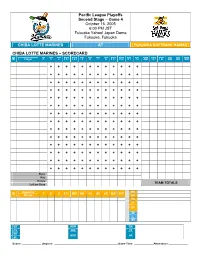
Pacific League Playoffs Second Stage – Game 4 October 16, 2005 6:00 PM JST Fukuoka Yahoo! Japan Dome Fukuoka, Fukuoka CHIBA LOTTE MARINES AT FUKUOKA SOFTBANK HAWKS CHIBA LOTTE MARINES – SCORECARD # Player P 1 2 3 4 5 6 7 8 9 10 11 12 AB R H RBI BB SO + + + + + + + + + + + + + + + + + + + + + + + + + + + + + + + + + + + + + + + + + + + + + + + + + + + + + + + + + + + + + + + + + + + + + + + + + + + + + + + + + + + + + + + + + + + + + + + + + + + + + + + + + + + + + + + + + + + + + + + + + + + + + + + + + + + + + + + + + + + + + + + + + + + + + + + + + + + + + + + + + + + + + + + + Runs Hits Errors TEAM TOTALS Left on Base Opposing BK # T IP H R ER BB SO HB HR BF PIT Pitcher WP PB E DP W L SV SB HBP DB CS IBB TP SH GDP HR SF Scorer: _____________ Umpires: ____________________________________________Game Time: _____________ Attendance:_____________ Pacific League Playoffs Second Stage – Game 4 October 16, 2005 6:00 PM JST Fukuoka Yahoo! Japan Dome Fukuoka, Fukuoka CHIBA LOTTE MARINES AT FUKUOKA SOFTBANK HAWKS FUKUOKA SOFTBANK HAWKS – SCORECARD # Player P 1 2 3 4 5 6 7 8 9 10 11 12 AB R H RBI BB SO + + + + + + + + + + + + + + + + + + + + + + + + + + + + + + + + + + + + + + + + + + + + + + + + + + + + + + + + + + + + + + + + + + + + + + + + + + + + + + + + + + + + + + + + + + + + + + + + + + + + + + + + + + + + + + + + + + + + + + + + + + + + + + + + + + + + + + + + + + + + + + + + + + + + + + + + + + + + + + + + + + + + + + + + Runs Hits Errors TEAM TOTALS Left on Base Opposing BK # T IP H R ER BB SO HB HR BF PIT Pitcher WP PB E DP W L SV -

Baseball-Carp
HIRO CLUB NEWS ・ SPORTS ★ BASEBALL The Toyo Carp (Hiroshima's professional baseball team) plays about 60 games at the MAZDA Zoom-Zoom Stadium Hiroshima every year. GAME SCHEDULE ◆: Interleague Play MAY JUNE Friday, 3rd, 6:00 pm / vs. Yomiuri Giants Saturday, 1st, 2:00 pm / vs. Hanshin Tigers Saturday, 4th, 2:00 pm / vs. Yomiuri Giants Sunday, 2nd, 1:30 pm / vs. Hanshin Tigers Sunday, 5th, 1:30 pm / vs. Yomiuri Giants ◆ Friday, 7th, 6:00 pm / vs. Fukuoka SoftBank Hawks Friday, 10th, 6:00 pm / vs. Yokohama DeNA Baystars ◆ Saturday, 8th, 2:00 pm / vs. Fukuoka SoftBank Hawks Saturday, 11th, 2:00 pm / vs. Yokohama DeNA Baystars ◆ Sunday, 9th, 1:30 pm / vs. Fukuoka SoftBank Hawks Sunday, 12th, 1:30 pm / vs. Yokohama DeNA Baystars ◆ Tuesday, 18th, 6:00 pm / vs. Chiba Lotte Marines Tuesday, 14th, 6:00 pm / vs. Tokyo Yakult Swallows ◆ Wednesday, 19th, 6:00 pm / vs. Chiba Lotte Marines Wednesday, 15th, 6:00 pm / vs. Tokyo Yakult Swallows ◆ Thursday, 20th, 6:00 pm / vs. Chiba Lotte Marines Wednesday, 22nd, 6:00 pm / vs. Chunichi Dragons ◆ Friday, 21st, 6:00 pm / vs. Orix Baffaloes Friday, 31st, 6:00 pm / vs. Hanshin Tigers ◆ Saturday, 22nd, 2:00 pm / vs. Orix Baffaloes ◆ Sunday, 23rd, 1:30 pm / vs. Orix Baffaloes JULY AUGUST nd Tuesday, 2nd, 6:00 pm / vs. Tokyo Yakult Swallows Friday, 2 , 6:00 pm / vs. Hanshin Tigers rd Wednesday, 3rd, 6:00 pm / vs. Tokyo Yakult Swallows Saturday, 3 , 6:00 pm / vs. Hanshin Tigers th Thursday, 4th, 6:00 pm / vs. Tokyo Yakult Swallows Sunday, 4 , 6:00 pm / vs. -

Virtual Stadium for 2002 FIFA World Cup Korea-Japan Michitaka Hirose
ICAT 2001 December 5-7, Tokyo, JAPAN Virtual Stadium for 2002 FIFA World Cup Korea-Japan Michitaka Hirose RCAST, University of Tokyo 4-6-1 Komaba, Meguro-ku, Tokyo 153-8904, Japan hirose@cyber.rcast.u-tokyo.ac.jp Abstract The most important keyword of the virtual stadium is “sensations”. In order to synthesize the sensations of This paper describes the short history of the virtual being at a specific location, there are several factors that stadium development. The virtual stadium is a virtual must be considered. First, a wide field of view is the reality theater system that provides an 2002 World Cup most essential component in generating a realistic visual audience who cannot attend a game. After the impression. Second, a high resolution is also important. introduction of system components, the results of the (For example, we may need to be able to see a uniform real-time image transmission experiments are briefly number of players.) Sometimes, a stereo image is also reported. very important. However, when viewing scenes of distant places, as in the case of the virtual stadium, this factor Key words: virtual stadium, realistic sensations, can be ignored. application of VR technology, HDTV 1. Introduction Table 1 History of Virtual Stadium The virtual stadium is a virtual reality theater system that provides an audience who cannot attend a game with the 1995 Japan vs. Korea competition to bring World Cup realistic sensations of being at a soccer stadium. Japan proposed “virtual stadium” concept Although this system was originally planned in order to 1996 Apr. Informal study group for virtual stadium was bring Federation Internationale de Football organized in HVC (High-tech Visual promotion Association(FIFA) World Cup games to Japan, it is also Center) under the sponsorship of MITI (Ministry expected to provide a new way to enjoy sports games via of International Trade and Industries) electronic media other than TV. -
Ticketing Guide
Ticketing Guide June 2021 1 Contents 1. Games Overview p2 2. Games Venue p3 3. Tickets Rules p7 4. Accessibility p8 5. Competition Schedule p9 6. Full Competition Schedule And Prices p10 Opening and Closing Ceremonies p10 Golf p41 Aquatics (Swimming) p11 Gymnastics (Artistic) p42 Aquatics (Diving) p13 Gymnastics (Rhythmic) p43 Aquatics (Artistic Swimming) p14 Gymnastics (Trampoline) p43 Aquatics (Water Polo) p15 Handball p44 Aquatics (Marathon Swimming) p17 Hockey p46 Archery p18 Judo p48 Athletics p19 Karate p50 Athletics (Marathon) (Race Walk) p21 Modern Pentathlon p51 Badminton p22 Rowing p52 Baseball p23 Rugby p53 Softball p24 Sailing p54 Basketball (3x3 Basketball) p25 Shooting p55 Basketball p26 Skateboarding(Park) p56 Boxing p28 Skateboarding(Street) p56 Canoe(Slalom) p30 Sport Climbing p57 Canoe(Sprint) p31 Surfing p58 Cycling(BMX Freestyle) p32 Table Tennis p59 Cycling(BMX Racing) p32 Taekwondo p61 Cycling(Mountain Bike) p33 Cycling(Road) p33 Tennis p62 Cycling(Track) p34 Triathlon p65 Equestrian/Eventing p35 Beach Volleyball p66 Equestrian/Dressage,Eventing,Jumping p35 Volleyball p68 Fencing p36 Weightlifting p70 Football p38 Wrestling p71 1 1. Games Overview Olympic Sports A total of 33 different sports will be contested at the Olympic Games Tokyo 2020. The 2020 Games are also the first time that the International Olympic Committee (IOC) has enabled the Organising Committee to propose additional sports for that edition of the Olympic Games. The Tokyo 2020 Organising Committee proposed the five additional sports of Baseball/Softball, Karate, Skateboarding, Sport Climbing and Surfing. All five were approved by the IOC for inclusion in the Tokyo 2020 Games. sports including Karate, Skateboarding, Sport Climbing and Surfing, which will be making their Olympic debuts at the Olympic Games Tokyo 2020 23 July – 8 August 2021 (17 days) 2 2. -

Baseball in Japan and the US History, Culture, and Future Prospects by Daniel A
Sports, Culture, and Asia Baseball in Japan and the US History, Culture, and Future Prospects By Daniel A. Métraux A 1927 photo of Kenichi Zenimura, the father of Japanese-American baseball, standing between Lou Gehrig and Babe Ruth. Source: Japanese BallPlayers.com at http://tinyurl.com/zzydv3v. he essay that follows, with a primary focus on professional baseball, is intended as an in- troductory comparative overview of a game long played in the US and Japan. I hope it will provide readers with some context to learn more about a complex, evolving, and, most of all, Tfascinating topic, especially for lovers of baseball on both sides of the Pacific. Baseball, although seriously challenged by the popularity of other sports, has traditionally been considered America’s pastime and was for a long time the nation’s most popular sport. The game is an original American sport, but has sunk deep roots into other regions, including Latin America and East Asia. Baseball was introduced to Japan in the late nineteenth century and became the national sport there during the early post-World War II period. The game as it is played and organized in both countries, however, is considerably different. The basic rules are mostly the same, but cultural differences between Americans and Japanese are clearly reflected in how both nations approach their versions of baseball. Although players from both countries have flourished in both American and Japanese leagues, at times the cultural differences are substantial, and some attempts to bridge the gaps have ended in failure. Still, while doubtful the Japanese version has changed the American game, there is some evidence that the American version has exerted some changes in the Japanese game. -

Asia in Motion: Geographies and Genealogies
Asia in Motion: Geographies and Genealogies Organized by With support from from PRIMUS Visual Histories of South Asia Foreword by Christopher Pinney Edited by Annamaria Motrescu-Mayes and Marcus Banks This book wishes to introduce the scholars of South Asian and Indian History to the in-depth evaluation of visual research methods as the research framework for new historical studies. This volume identifies and evaluates the current developments in visual sociology and digital anthropology, relevant to the study of contemporary South Asian constructions of personal and national identities. This is a unique and excellent contribution to the field of South Asian visual studies, art history and cultural analysis. This text takes an interdisciplinary approach while keeping its focus on the visual, on material cultural and on art and aesthetics. – Professor Kamran Asdar Ali, University of Texas at Austin 978-93-86552-44-0 u Royal 8vo u 312 pp. u 2018 u HB u ` 1495 u $ 71.95 u £ 55 Hidden Histories Religion and Reform in South Asia Edited by Syed Akbar Hyder and Manu Bhagavan Dedicated to Gail Minault, a pioneering scholar of women’s history, Islamic Reformation and Urdu Literature, Hidden Histories raises questions on the role of identity in politics and private life, memory and historical archives. Timely and thought provoking, this book will be of interest to all who wish to study how the diverse and plural past have informed our present. Hidden Histories powerfully defines and celebrates a field that has refused to be occluded by majoritarian currents. – Professor Kamala Visweswaran, University of California, San Diego 978-93-86552-84-6 u Royal 8vo u 324 pp. -

P.O.V. 19S Discussion Guide Kokoyakyu: High School Baseball a Film by Kenneth Eng
n o s a e P.O.V. 19S Discussion Guide Kokoyakyu: High School Baseball A Film by Kenneth Eng www.pbs.org/pov P.O.V. n o s Discussion Guide | Kokoyakyu: High School Baseball a e 19S Letter from the Filmmaker NEW YORK, SPRING 2006 Dear Colleague, It started back in January of 2001 while we were working in India on the Projectile Arts documentary Take Me to the River, about a phenomenal Hindu gathering. We wanted to make another film with Projectile Arts that would bring an inspiring cultural experience to America. Surrounded by 20 million Hindu pilgrims at the world’s largest religious festival, the “Kumbh Mela,” our thoughts naturally turned to baseball (we both grew up in Boston as hopeless Red Sox fans). Ichiro Suzuki was about to become the first Japanese position player in Major League history. We were fascinated — the whole idea of Japanese baseball was so mysterious to many Americans, and we knew it could be a great window into Japanese culture. Director Kenneth Eng Of course, Ichiro’s first season in the Majors Photo courtesy of Kenneth Eng turned out to be one for the record books — on top of the personal achievements (the batting title, the Gold Glove, the Rookie of the Year award, and Most Valuable Player), Ichiro led his team to an American League record 116 wins. We discovered Robert Whiting’s book You Gotta Have Wa and learned for the first time about Japan’s National High School Baseball Tournament, known as the Koshien Tournament for its famous stadium. -

RWTH Aachen Fachbereich 2 - Fakultät Für Architektur 2006 Promotion - „Sichtlinien Und Sicherheit“
„Sichtlinien und Sicherheit“ Dr.- Ing. Stefan Nixdorf (Architekt) Diese Dissertation ist auf den Internetseiten der Hochschulbibliothek online verfügbar. RWTH Aachen Fachbereich 2 - Fakultät für Architektur 2006 Promotion - „Sichtlinien und Sicherheit“ Promotion - „Sichtlinien und Sicherheit“ Dissertation „Sichtlinien und Sicherheit“ Tribünenprofile moderner Sport- und Veranstaltungsstätten Ein methodischer Vergleich der Stadien für die FIFA Fußball-Weltmeisterschaft 006™ zur gebäudetypologischen Ableitung zukünftiger Tribünenkonzepte Von der Fakultät für Architektur der Rheinisch-Westfälisch Technischen Hochschule RWTH Aachen genehmigte Dissertation zur Erlangung des akademischen Grades eines Doktors der Ingenieurwissenschaften von Dr.- Ing. Stefan Nixdorf (Architekt) Osnabrück, Niedersachsen vorgelegt im April 006 Mündliche Prüfung am 18.Oktober 006 Erster Berichter: Univ.-Prof. Volkwin Marg Zweiter Berichter: Univ.-Prof. U. Coersmeier Einleitung Promotion - „Sichtlinien und Sicherheit“ oben: 001. Sichtlinen-Konstruktion (Handskizze des Verfassers) Promotion - „Sichtlinien und Sicherheit“ Einleitung Exposé zur Dissertation Inhalt Aufgabenstellung Durch eine gebäudetypologische Untersu- In einem ersten Schritt wird der Bautypus in chung baulicher Strukturen und ihrer nutzungs- einen historischen, baugeschichtlichen Kontext spezifischer Organisation, werden planerisch gesetzt. Die Grundlagen des Sehens werden relevante Aspekte für die Entwicklung von erläutert, die Physiognomie des Auges und die Stadionkonzepten erläutert und deren -
The Disambiguation of the English Verbs Send and Open : a Study Based on the Object Oriented Method
Title: The disambiguation of the english verbs send and open : a study based on the object oriented method Author: Anna Drzazga Citation style: Drzazga Anna. (2012). The disambiguation of the english verbs send and open : a study based on the object oriented method. Praca doktorska. Katowice : Uniwersytet Śląski University of Silesia THE DISAMBIGUATION OF THE ENGLISH VERBS SEND and OPEN - A STUDY BASED ON THE OBJECT ORIENTED METHOD Anna Drzazga Advisor: Prof. dr hab. Wiesław Banyś Katowice, 2012 Uniwersytet Śląski DEZAMBIGUIZACJA ANGIELSKICH CZASOWNIKÓW OPEN i SEND W RAMACH UJĘCIA ZORIENTOWANEGO OBIEKTOWO Anna Drzazga Praca napisana pod kierunkiem: Prof. zw. dr hab. Wiesława Banysia Katowice, 2012 CONTENTS INTRODUCTION...............................................................................................................................4 1. Selected modern theories of lexical semantic analysis.......................................................... 8 1.1 .The Meaning-Text Theory and the Explanatory Combinatory Dictionary..................... 8 1.2. James Pustejovsky’s Generative Lexicon and Frame Semantics..................................... 39 1.3. The Object Oriented Approach proposed by Wiesław Banyś...........................................61 1.3.1. Application of the Object Oriented Approach to the disambiguation of verbs 76 2. Some of the available analyses of the English causative verbs and the presentation of causativity in the WordNet............................................................................................................