Georgios I. Zervakis & Giuseppe Venturella Adverse Effects Of
Total Page:16
File Type:pdf, Size:1020Kb
Load more
Recommended publications
-
Checklist of Argentine Agaricales 4
Checklist of the Argentine Agaricales 4. Tricholomataceae and Polyporaceae 1 2* N. NIVEIRO & E. ALBERTÓ 1Instituto de Botánica del Nordeste (UNNE-CONICET). Sargento Cabral 2131, CC 209 Corrientes Capital, CP 3400, Argentina 2Instituto de Investigaciones Biotecnológicas (UNSAM-CONICET) Intendente Marino Km 8.200, Chascomús, Buenos Aires, CP 7130, Argentina CORRESPONDENCE TO *: ealberto@intech.gov.ar ABSTRACT— A species checklist of 86 genera and 709 species belonging to the families Tricholomataceae and Polyporaceae occurring in Argentina, and including all the species previously published up to year 2011 is presented. KEY WORDS—Agaricomycetes, Marasmius, Mycena, Collybia, Clitocybe Introduction The aim of the Checklist of the Argentinean Agaricales is to establish a baseline of knowledge on the diversity of mushrooms species described in the literature from Argentina up to 2011. The families Amanitaceae, Pluteaceae, Hygrophoraceae, Coprinaceae, Strophariaceae, Bolbitaceae and Crepidotaceae were previoulsy compiled (Niveiro & Albertó 2012a-c). In this contribution, the families Tricholomataceae and Polyporaceae are presented. Materials & Methods Nomenclature and classification systems This checklist compiled data from the available literature on Tricholomataceae and Polyporaceae recorded for Argentina up to the year 2011. Nomenclature and classification systems followed Singer (1986) for families. The genera Pleurotus, Panus, Lentinus, and Schyzophyllum are included in the family Polyporaceae. The Tribe Polyporae (including the genera Polyporus, Pseudofavolus, and Mycobonia) is excluded. There were important rearrangements in the families Tricholomataceae and Polyporaceae according to Singer (1986) over time to present. Tricholomataceae was distributed in six families: Tricholomataceae, Marasmiaceae, Physalacriaceae, Lyophyllaceae, Mycenaceae, and Hydnaginaceae. Some genera belonging to this family were transferred to other orders, i.e. Rickenella (Rickenellaceae, Hymenochaetales), and Lentinellus (Auriscalpiaceae, Russulales). -

CZECH MYCOLOGY Publication of the Czech Scientific Society for Mycology
CZECH MYCOLOGY Publication of the Czech Scientific Society for Mycology Volume 57 August 2005 Number 1-2 Central European genera of the Boletaceae and Suillaceae, with notes on their anatomical characters Jo s e f Š u t a r a Prosetická 239, 415 01 Tbplice, Czech Republic Šutara J. (2005): Central European genera of the Boletaceae and Suillaceae, with notes on their anatomical characters. - Czech Mycol. 57: 1-50. A taxonomic survey of Central European genera of the families Boletaceae and Suillaceae with tubular hymenophores, including the lamellate Phylloporus, is presented. Questions concerning the delimitation of the bolete genera are discussed. Descriptions and keys to the families and genera are based predominantly on anatomical characters of the carpophores. Attention is also paid to peripheral layers of stipe tissue, whose anatomical structure has not been sufficiently studied. The study of these layers, above all of the caulohymenium and the lateral stipe stratum, can provide information important for a better understanding of relationships between taxonomic groups in these families. The presence (or absence) of the caulohymenium with spore-bearing caulobasidia on the stipe surface is here considered as a significant ge neric character of boletes. A new combination, Pseudoboletus astraeicola (Imazeki) Šutara, is proposed. Key words: Boletaceae, Suillaceae, generic taxonomy, anatomical characters. Šutara J. (2005): Středoevropské rody čeledí Boletaceae a Suillaceae, s poznámka mi k jejich anatomickým znakům. - Czech Mycol. 57: 1-50. Je předložen taxonomický přehled středoevropských rodů čeledí Boletaceae a. SuiUaceae s rourko- vitým hymenoforem, včetně rodu Phylloporus s lupeny. Jsou diskutovány otázky týkající se vymezení hřibovitých rodů. Popisy a klíče k čeledím a rodům jsou založeny převážně na anatomických znacích plodnic. -

Forest Fungi in Ireland
FOREST FUNGI IN IRELAND PAUL DOWDING and LOUIS SMITH COFORD, National Council for Forest Research and Development Arena House Arena Road Sandyford Dublin 18 Ireland Tel: + 353 1 2130725 Fax: + 353 1 2130611 © COFORD 2008 First published in 2008 by COFORD, National Council for Forest Research and Development, Dublin, Ireland. All rights reserved. No part of this publication may be reproduced, or stored in a retrieval system or transmitted in any form or by any means, electronic, electrostatic, magnetic tape, mechanical, photocopying recording or otherwise, without prior permission in writing from COFORD. All photographs and illustrations are the copyright of the authors unless otherwise indicated. ISBN 1 902696 62 X Title: Forest fungi in Ireland. Authors: Paul Dowding and Louis Smith Citation: Dowding, P. and Smith, L. 2008. Forest fungi in Ireland. COFORD, Dublin. The views and opinions expressed in this publication belong to the authors alone and do not necessarily reflect those of COFORD. i CONTENTS Foreword..................................................................................................................v Réamhfhocal...........................................................................................................vi Preface ....................................................................................................................vii Réamhrá................................................................................................................viii Acknowledgements...............................................................................................ix -
Changes in Polyamine Content and Localization of Pinus Sylvestris ADC
Journal of Experimental Botany Advance Access published July 25, 2006 Journal of Experimental Botany, Page 1 of 10 doi:10.1093/jxb/erl049 RESEARCH PAPER Changes in polyamine content and localization of Pinus sylvestris ADC and Suillus variegatus ODC mRNA transcripts during the formation of mycorrhizal interaction in an in vitro cultivation system Karoliina Niemi1,*, Suvi Sutela2, Hely Ha¨ggman2, Carolyn Scagel3, Jaana Vuosku2, Anne Jokela2 and Tytti Sarjala4 1 Department of Applied Biology, University of Helsinki, PO Box 27, 00014 University of Helsinki, Finland 2 Department of Biology, University of Oulu, PO Box 3000, 90014 University of Oulu, Finland 3 USDA, Agricultural Research Service, Horticultural Crops Research Laboratory, Corvallis, OR 97330, USA 4 Finnish Forest Research Institute, Parkano Research Unit, 39700 Parkano, Finland Received 24 October 2005; Accepted 27 April 2006 Abstract formation and main root elongation were greatest between the first and third week in dual culture, The involvement of polyamines (PAs) in the interaction coinciding with retarded accumulation or a decrease between Pinus sylvestris L. seedlings and an ectomy- of free PAs. These results show that accumulation of corrhizal fungus Suillus variegatus (Swatz: Fr.) O. Kunze PAs in the host plant is one of the first indicators of was studied in an in vitro cultivation system. PA the establishment of ectomycorrhizal interaction be- concentrations in seedlings were analysed after 1, 3, tween P. sylvestris and S. variegatus in the in vitro and 5 weeks in dual culture with S. variegatus, and system. changes in PA pools were compared with the growth of the seedlings. Pinus sylvestris arginine decarboxy- Key words: Arginine decarboxylase, ectomycorrhizas, lase (ADC) and S. -
Full-Text (PDF)
African Journal of Microbiology Research Vol. 5(31), pp. 5750-5756, 23 December, 2011 Available online at http://www.academicjournals.org/AJMR ISSN 1996-0808 ©2011 Academic Journals DOI: 10.5897/AJMR11.1228 Full Length Research Paper Leucocalocybe, a new genus for Tricholoma mongolicum (Agaricales, Basidiomycota) Xiao-Dan Yu1,2, Hui Deng1 and Yi-Jian Yao1,3* 1State Key Laboratory of Mycology, Institute of Microbiology, Chinese Academy of Sciences, Beijing, 100101, China. 2Graduate University of Chinese Academy of Sciences, Beijing, 100049, China. 3Royal Botanic Gardens, Kew, Richmond, Surrey TW9 3AB, United Kingdom. Accepted 11 November, 2011 A new genus of Agaricales, Leucocalocybe was erected for a species Tricholoma mongolicum in this study. Leucocalocybe was distinguished from the other genera by a unique combination of macro- and micro-morphological characters, including a tricholomatoid habit, thick and short stem, minutely spiny spores and white spore print. The assignment of the new genus was supported by phylogenetic analyses based on the LSU sequences. The results of molecular analyses demonstrated that the species was clustered in tricholomatoid clade, which formed a distinct lineage. Key words: Agaricales, taxonomy, Tricholoma, tricholomatoid clade. INTRODUCTION The genus Tricholoma (Fr.) Staude is typified by having were re-described. Based on morphological and mole- distinctly emarginate-sinuate lamellae, white or very pale cular analyses, T. mongolicum appears to be aberrant cream spore print, producing smooth thin-walled within Tricholoma and un-subsumable into any of the basidiospores, lacking clamp connections, cheilocystidia extant genera. Accordingly, we proposed to erect a new and pleurocystidia (Singer, 1986). Most species of this genus, Leucocalocybe, to circumscribe the unique genus form obligate ectomycorrhizal associations with combination of features characterizing this fungus and a forest trees, only a few species in the subgenus necessary new combination. -
Chemical Elements in Ascomycetes and Basidiomycetes
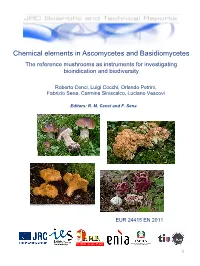
Chemical elements in Ascomycetes and Basidiomycetes The reference mushrooms as instruments for investigating bioindication and biodiversity Roberto Cenci, Luigi Cocchi, Orlando Petrini, Fabrizio Sena, Carmine Siniscalco, Luciano Vescovi Editors: R. M. Cenci and F. Sena EUR 24415 EN 2011 1 The mission of the JRC-IES is to provide scientific-technical support to the European Union’s policies for the protection and sustainable development of the European and global environment. European Commission Joint Research Centre Institute for Environment and Sustainability Via E.Fermi, 2749 I-21027 Ispra (VA) Italy Legal Notice Neither the European Commission nor any person acting on behalf of the Commission is responsible for the use which might be made of this publication. Europe Direct is a service to help you find answers to your questions about the European Union Freephone number (*): 00 800 6 7 8 9 10 11 (*) Certain mobile telephone operators do not allow access to 00 800 numbers or these calls may be billed. A great deal of additional information on the European Union is available on the Internet. It can be accessed through the Europa server http://europa.eu/ JRC Catalogue number: LB-NA-24415-EN-C Editors: R. M. Cenci and F. Sena JRC65050 EUR 24415 EN ISBN 978-92-79-20395-4 ISSN 1018-5593 doi:10.2788/22228 Luxembourg: Publications Office of the European Union Translation: Dr. Luca Umidi © European Union, 2011 Reproduction is authorised provided the source is acknowledged Printed in Italy 2 Attached to this document is a CD containing: • A PDF copy of this document • Information regarding the soil and mushroom sampling site locations • Analytical data (ca, 300,000) on total samples of soils and mushrooms analysed (ca, 10,000) • The descriptive statistics for all genera and species analysed • Maps showing the distribution of concentrations of inorganic elements in mushrooms • Maps showing the distribution of concentrations of inorganic elements in soils 3 Contact information: Address: Roberto M. -

Toxic Fungi of Western North America
Toxic Fungi of Western North America by Thomas J. Duffy, MD Published by MykoWeb (www.mykoweb.com) March, 2008 (Web) August, 2008 (PDF) 2 Toxic Fungi of Western North America Copyright © 2008 by Thomas J. Duffy & Michael G. Wood Toxic Fungi of Western North America 3 Contents Introductory Material ........................................................................................... 7 Dedication ............................................................................................................... 7 Preface .................................................................................................................... 7 Acknowledgements ................................................................................................. 7 An Introduction to Mushrooms & Mushroom Poisoning .............................. 9 Introduction and collection of specimens .............................................................. 9 General overview of mushroom poisonings ......................................................... 10 Ecology and general anatomy of fungi ................................................................ 11 Description and habitat of Amanita phalloides and Amanita ocreata .............. 14 History of Amanita ocreata and Amanita phalloides in the West ..................... 18 The classical history of Amanita phalloides and related species ....................... 20 Mushroom poisoning case registry ...................................................................... 21 “Look-Alike” mushrooms ..................................................................................... -
Trail Key to Common Agaricus Species of the Central California Coast
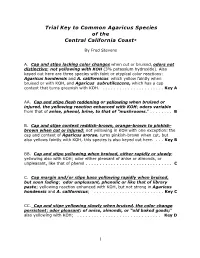
Trial Key to Common Agaricus Species of the Central California Coast* By Fred Stevens A. Cap and stipe lacking color changes when cut or bruised, odors not distinctive; not yellowing with KOH (3% potassium hydroxide). Also keyed out here are three species with faint or atypical color reactions: Agaricus hondensis and A. californicus which yellow faintly when bruised or with KOH, and Agaricus subrutilescens, which has a cap context that turns greenish with KOH. ......................Key A AA. Cap and stipe flesh reddening or yellowing when bruised or injured, the yellowing reaction enhanced with KOH; odors variable from that of anise, phenol, brine, to that of “mushrooms.” ........ B B. Cap and stipe context reddish-brown, orange-brown to pinkish- brown when cut or injured; not yellowing in KOH with one exception: the cap and context of Agaricus arorae, turns pinkish-brown when cut, but also yellows faintly with KOH, this species is also keyed out here. ...Key B BB. Cap and stipe yellowing when bruised, either rapidly or slowly; yellowing also with KOH; odor either pleasant of anise or almonds, or unpleasant, like that of phenol ............................... C C. Cap margin and/or stipe base yellowing rapidly when bruised, but soon fading; odor unpleasant, phenolic or like that of library paste; yellowing reaction enhanced with KOH, but not strong in Agaricus hondensis and A. californicus; .........................Key C CC. Cap and stipe yellowing slowly when bruised, the color change persistent; odor pleasant: of anise, almonds, or “old baked goods;” also yellowing with KOH; .............................. Key D 1 Key A – Species lacking obvious color changes and distinctive odors A. -

Flora Mediterranea 26
FLORA MEDITERRANEA 26 Published under the auspices of OPTIMA by the Herbarium Mediterraneum Panormitanum Palermo – 2016 FLORA MEDITERRANEA Edited on behalf of the International Foundation pro Herbario Mediterraneo by Francesco M. Raimondo, Werner Greuter & Gianniantonio Domina Editorial board G. Domina (Palermo), F. Garbari (Pisa), W. Greuter (Berlin), S. L. Jury (Reading), G. Kamari (Patras), P. Mazzola (Palermo), S. Pignatti (Roma), F. M. Raimondo (Palermo), C. Salmeri (Palermo), B. Valdés (Sevilla), G. Venturella (Palermo). Advisory Committee P. V. Arrigoni (Firenze) P. Küpfer (Neuchatel) H. M. Burdet (Genève) J. Mathez (Montpellier) A. Carapezza (Palermo) G. Moggi (Firenze) C. D. K. Cook (Zurich) E. Nardi (Firenze) R. Courtecuisse (Lille) P. L. Nimis (Trieste) V. Demoulin (Liège) D. Phitos (Patras) F. Ehrendorfer (Wien) L. Poldini (Trieste) M. Erben (Munchen) R. M. Ros Espín (Murcia) G. Giaccone (Catania) A. Strid (Copenhagen) V. H. Heywood (Reading) B. Zimmer (Berlin) Editorial Office Editorial assistance: A. M. Mannino Editorial secretariat: V. Spadaro & P. Campisi Layout & Tecnical editing: E. Di Gristina & F. La Sorte Design: V. Magro & L. C. Raimondo Redazione di "Flora Mediterranea" Herbarium Mediterraneum Panormitanum, Università di Palermo Via Lincoln, 2 I-90133 Palermo, Italy herbmed@unipa.it Printed by Luxograph s.r.l., Piazza Bartolomeo da Messina, 2/E - Palermo Registration at Tribunale di Palermo, no. 27 of 12 July 1991 ISSN: 1120-4052 printed, 2240-4538 online DOI: 10.7320/FlMedit26.001 Copyright © by International Foundation pro Herbario Mediterraneo, Palermo Contents V. Hugonnot & L. Chavoutier: A modern record of one of the rarest European mosses, Ptychomitrium incurvum (Ptychomitriaceae), in Eastern Pyrenees, France . 5 P. Chène, M. -
Welsh Dune Fungi: Data Collation, Evaluation and Conservation Priorities
Welsh Dune Fungi: Data Collation, Evaluation and Conservation Priorities S.E. Evans & P.J. Roberts Evidence Report No 134 About Natural Resources Wales Natural Resources Wales is the organisation responsible for the work carried out by the three former organisations, the Countryside Council for Wales, Environment Agency Wales and Forestry Commission Wales. It is also responsible for some functions previously undertaken by Welsh Government. Our purpose is to ensure that the natural resources of Wales are sustainably maintained, used and enhanced, now and in the future. We work for the communities of Wales to protect people and their homes as much as possible from environmental incidents like flooding and pollution. We provide opportunities for people to learn, use and benefit from Wales' natural resources. We work to support Wales' economy by enabling the sustainable use of natural resources to support jobs and enterprise. We help businesses and developers to understand and consider environmental limits when they make important decisions. We work to maintain and improve the quality of the environment for everyone and we work towards making the environment and our natural resources more resilient to climate change and other pressures. Page 2 of 57 www.naturalresourceswales.gov.uk Evidence at Natural Resources Wales Natural Resources Wales is an evidence based organisation. We seek to ensure that our strategy, decisions, operations and advice to Welsh Government and others are underpinned by sound and quality-assured evidence. We recognise that it is critically important to have a good understanding of our changing environment. We will realise this vision by: Maintaining and developing the technical specialist skills of our staff; Securing our data and information; Having a well resourced proactive programme of evidence work; Continuing to review and add to our evidence to ensure it is fit for the challenges facing us; and Communicating our evidence in an open and transparent way. -
Ectomycorrhizal Fungal Assemblages of Nursery-Grown Scots Pine Are Influenced by Age of the Seedlings
Article Ectomycorrhizal Fungal Assemblages of Nursery-Grown Scots Pine are Influenced by Age of the Seedlings Maria Rudawska * and Tomasz Leski Institute of Dendrology, Polish Academy of Sciences, Parkowa 5, 62-035 Kórnik, Poland; tleski@man.poznan.pl * Correspondence: mariarud@man.poznan.pl Abstract: Scots pine (Pinus sylvestris L.) is the most widely distributed pine species in Europe and is relevant in terms of planted areas and harvest yields. Therefore, each year the demand for planting stock of Scots pine is exceedingly high, and large quantities of seedlings are produced annually throughout Europe to carry out reforestation and afforestation programs. Abundant and diverse ectomycorrhizal (ECM) symbiosis is critical for the success of seedlings once planted in the field. To improve our knowledge of ECM fungi that inhabit bare-root nursery stock of Scots pine and understand factors that influence their diversity, we studied the assemblages of ECM fungi present across 23 bare-root forest nurseries in Poland. Nursery stock samples were characterized by a high level of ECM colonization (nearly 100%), and a total of 29 ECM fungal taxa were found on 1- and 2- year-old seedlings. The diversity of the ECM community depended substantially on the nursery and age of the seedlings, and species richness varied from 3–10 taxa on 1-year-old seedlings and 6–13 taxa on 2-year-old seedlings. The ECM fungal communities that developed on the studied nursery stock were characterized by the prevalence of Ascomycota over Basidiomycota members on 1-year-old seedlings. All ecological indices (diversity, dominance, and evenness) were significantly affected by age of the seedlings, most likely because dominant ECM morphotypes on 1-year-old seedlings (Wilcoxina mikolae) were replaced by other dominant ones (e.g., Suillus luteus, Rhizopogon roseolus, Thelephora terrestris, Hebeloma crustuliniforme), mostly from Basidiomycota, on 2-year-old seedlings. -

The Effect of Cytokinins and Auxins on the Growth of Mycorrhizal Fungus Suillus V Ariegatu S*
View metadata, citation and similar papers at core.ac.uk brought to you by CORE Acta Bot. Croat. 35 (1976) 129— 134 THE EFFECT OF CYTOKININS AND AUXINS ON THE GROWTH OF MYCORRHIZAL FUNGUS SUILLUS V ARIEGATU S* NADA GO GALA and FRANCI POHLEVEN (Biological Department of the Biotechnical Faculty and Biological Institute of the University Ljubljana) R e c e iv e d J a n u a ry 14, 1976 Introduction It is known that pine tree root exudate promotes the growth of the mycelium of mycorrhizal fungi. M e 1 i n (1959) considered that there were probably several components that influenced growth. In our earlier work (G o g a 1 a 1971), naturally occuring cytokinins, found in the exudate of pine tree seedlings (Pinus sylvestris), showed an influence on the growth of Boletus edulis. Following the fact that kinetin displays a similar effect (G o g a 1 a 1973), we tried to clarify the influence of the individual cytokinins extracted from the exudate on mycorrhizal fungi, as well as the effect of zeatin and zeatinriboside. Auxins, which are among the other hormones present in the exudate, were of special inte rest for us because of their potential common effect on mycelium. Materials and methods Pine tree seeds (Pinus sylvestris) were obtained from “Semesadike” Menges (1973). The sterile tissue of Suillus variegatus was taken from fruit-bodies in 1974 and grown on potato agar-agar culture media (Dif- co). The test on cytokinins was made by using the seeds of radish (Rap- hanus sativus ■— 1973).