ON 23(3) 375-383.Pdf
Total Page:16
File Type:pdf, Size:1020Kb
Load more
Recommended publications
-

Auto Guia Version Ingles
Parque Natural Metropolitano Tel: (507) 232-5516/5552 Fax: (507) 232-5615 www.parquemetropolitano.org Ave. Juan Pablo II final P.O. Box 0843-03129 Balboa, Ancón, Panamá República de Panamá 2 Taylor, L. 2006. Raintree Nutrition, Tropical Plant Database. http://www.rain- Welcome to the Metropolitan Natural Park, the lungs of Panama tree.com/plist.htm. Date accessed; February 2007 City! The park was established in 1985 and contains 232 hectares. It is one of the few protected areas located within the city border. Thomson, L., & Evans, B. 2006. Terminalia catappa (tropical almond), Species Profiles for Pacific Island Agroforestry. Permanent Agriculture Resources You are about to enter an ecosystem that is nearly extinct in Latin (PAR), Elevitch, C.R. (ed.). http://www.traditionaltreeorg . Date accessed March America: the Pacific dry forests. Whether your goals for this walk 2007-04-23 are a simple walk to keep you in shape or a careful look at the forest and its inhabitants, this guide will give you information about Young, A., Myers, P., Byrne, A. 1999, 2001, 2004. Bradypus variegatus, what can be commonly seen. We want to draw your attention Megalonychidae, Atta sexdens, Animal Diversity Web. http://animaldiversity.ummz.umich.edu/site/accounts/information/Bradypus_var toward little things that may at first glance seem hidden away. Our iegatus.html. Date accessed March 2007 hope is that it will raise your curiosity and that you’ll want to learn more about the mysteries that lie within the tropical forest. ACKNOWLEDGEMENTS The contents of this book include tree identifications, introductions Text and design: Elisabeth Naud and Rudi Markgraf, McGill University, to basic ecological concepts and special facts about animals you Montreal, Canada. -
A Comprehensive Species-Level Molecular Phylogeny of the New World
YMPEV 4758 No. of Pages 19, Model 5G 2 December 2013 Molecular Phylogenetics and Evolution xxx (2013) xxx–xxx 1 Contents lists available at ScienceDirect Molecular Phylogenetics and Evolution journal homepage: www.elsevier.com/locate/ympev 5 6 3 A comprehensive species-level molecular phylogeny of the New World 4 blackbirds (Icteridae) a,⇑ a a b c d 7 Q1 Alexis F.L.A. Powell , F. Keith Barker , Scott M. Lanyon , Kevin J. Burns , John Klicka , Irby J. Lovette 8 a Department of Ecology, Evolution and Behavior, and Bell Museum of Natural History, University of Minnesota, 100 Ecology Building, 1987 Upper Buford Circle, St. Paul, MN 9 55108, USA 10 b Department of Biology, San Diego State University, San Diego, CA 92182, USA 11 c Barrick Museum of Natural History, University of Nevada, Las Vegas, NV 89154, USA 12 d Fuller Evolutionary Biology Program, Cornell Lab of Ornithology, Cornell University, 159 Sapsucker Woods Road, Ithaca, NY 14950, USA 1314 15 article info abstract 3117 18 Article history: The New World blackbirds (Icteridae) are among the best known songbirds, serving as a model clade in 32 19 Received 5 June 2013 comparative studies of morphological, ecological, and behavioral trait evolution. Despite wide interest in 33 20 Revised 11 November 2013 the group, as yet no analysis of blackbird relationships has achieved comprehensive species-level sam- 34 21 Accepted 18 November 2013 pling or found robust support for most intergeneric relationships. Using mitochondrial gene sequences 35 22 Available online xxxx from all 108 currently recognized species and six additional distinct lineages, together with strategic 36 sampling of four nuclear loci and whole mitochondrial genomes, we were able to resolve most relation- 37 23 Keywords: ships with high confidence. -

Ecuador: HARPY EAGLE & EAST ANDEAN FOOTHILLS EXTENSION
Tropical Birding Trip Report Ecuador: HARPY EAGLE & East Andean Foothills Extension (Jan-Feb 2021) A Tropical Birding custom extension Ecuador: HARPY EAGLE & EAST ANDEAN FOOTHILLS EXTENSION th nd 27 January - 2 February 2021 The main motivation for this custom extension was this Harpy Eagle. This was one of an unusually accessible nesting pair near the Amazonian town of Limoncocha that provided a worthy add-on to The Andes Introtour in northwest Ecuador that preceded this (Jose Illanes/Tropical Birding Tours). Guided by Jose Illanes Birds in the photos within this report are denoted in RED, all photos were taken by the Tropical Birding guide. 1 www.tropicalbirding.com +1-409-515-9110 info@tropicalbirding.com Tropical Birding Trip Report Ecuador: HARPY EAGLE & East Andean Foothills Extension (Jan-Feb 2021) INTRODUCTION This custom extension trip was set up for one person who simply could not get enough of Ecuador…John had just finished Ecuador: The Andes Introtour, in the northwest of the country, and also joined the High Andes Extension to that tour, which sampled the eastern highlands too. However, he was still missing vast chunks of this small country that is bursting with bird diversity. Most importantly, he was keen to get in on the latest “mega bird” in Ecuador, a very accessible Harpy Eagle nest, near a small Amazonian town, which had been hitting the local headlines and drawing the few birding tourists in the country at this time to come see it. With this in mind, TROPICAL BIRDING has been offering custom add-ons to all of our Ecuador offerings (for 2021 and 2022) to see this Harpy Eagle pair, with only three extra days needed to see it. -

List of the Birds of Peru Lista De Las Aves Del Perú
LIST OF THE BIRDS OF PERU LISTA DE LAS AVES DEL PERÚ By/por MANUEL A. -
Spatuletails, Owlet Lodge & More 2018
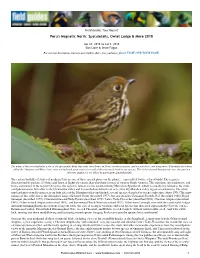
Field Guides Tour Report Peru's Magnetic North: Spatuletails, Owlet Lodge & More 2018 Jun 23, 2018 to Jul 5, 2018 Dan Lane & Jesse Fagan For our tour description, itinerary, past triplists, dates, fees, and more, please VISIT OUR TOUR PAGE. The name of this tour highlights a few of the spectacular birds that make their homes in Peru's northern regions, and we saw these, and many more! This might have been called the "Antpittas and More" tour, since we had such great views of several of these formerly hard-to-see species. This Ochre-fronted Antpitta was one; she put on a fantastic display for us! Photo by participant Linda Rudolph. The eastern foothills of Andes of northern Peru are one of those special places on the planet… especially if you’re a fan of birds! The region is characterized by pockets of white sand forest at higher elevations than elsewhere in most of western South America. This translates into endemism, and hence our interest in the region! Of course, the region is famous for the award-winning Marvelous Spatuletail, which is actually not related to the white sand phenomenon, but rather to the Utcubamba valley and its rainshadow habitats (an arm of the dry Marañon valley region of endemism). The white sand endemics actually span areas on both sides of the Marañon valley and include several species described to science only since about 1976! The most famous of this collection is the diminutive Long-whiskered Owlet (described 1977), but also includes Cinnamon Screech-Owl (described 1986), Royal Sunangel (described 1979), Cinnamon-breasted Tody-Tyrant (described 1979), Lulu’s Tody-Flycatcher (described 2001), Chestnut Antpitta (described 1987), Ochre-fronted Antpitta (described 1983), and Bar-winged Wood-Wren (described 1977). -

Breeding Success of Eeding Success of Cacicus
Breeding success of Cacicus haemorrhous (Linnaeus) (Aves: Icteridae) in different environments in an Atlantic Forest reserve in Southeast Brazil Charles Duca 1 & Miguel Ângelo Marini 2 1 Programa de Pós-Graduação em Ecologia, Conservação e Manejo da Vida Silvestre, Universidade Federal de Minas Gerais. Caixa Postal 486, 30161-970 Belo Horizonte, Minas Gerais, Brasil. E-mail: chduca@ig.com.br 2 Corresponding author. Departamento de Zoologia, Instituto de Biologia, Universidade de Brasília. 70910-900 Brasília, Distrito Federal, Brasil. ABSTRACT. Several factors, including the site where the colony was established and number of active nests can influence directly or indirectly the breeding success of colonial birds. The red-rumped cacique, Cacicus haemorrhous (Linnaeus, 1766), is a passerine (Icteridae) that breeds in colonies in different environments. The objective of this study was to evaluate the breeding success of red-rumped cacique in relation to three environments (lake edge, forest and swamp) in which colonies were established in an Atlantic Forest reserve in southeast Brazil. Seven colonies from the three environments were monitored during the breeding season of 2001. Overall probability of nest survival was 40.5%. We found that colonies established in the swamp presented higher nest survival than the others and the ones in the lake edge had lower survival. Nest predation was the most important cause of nest failure, representing 46.5% of all nest losses. Other failure causes were abandonment and fall of nests, representing 6.6% and 6.1% of the losses, respectively. Red-rumped cacique had higher success breeding in colonies located in the swamp. KEY WORDS. -

Neotropical News Neotropical News
COTINGA 1 Neotropical News Neotropical News Brazilian Merganser in Argentina: If the survey’s results reflect the true going, going … status of Mergus octosetaceus in Argentina then there is grave cause for concern — local An expedition (Pato Serrucho ’93) aimed extinction, as in neighbouring Paraguay, at discovering the current status of the seems inevitable. Brazilian Merganser Mergus octosetaceus in Misiones Province, northern Argentina, During the expedition a number of sub has just returned to the U.K. Mergus tropical forest sites were surveyed for birds octosetaceus is one of the world’s rarest — other threatened species recorded during species of wildfowl, with a population now this period included: Black-fronted Piping- estimated to be less than 250 individuals guan Pipile jacutinga, Vinaceous Amazon occurring in just three populations, one in Amazona vinacea, Helmeted Woodpecker northern Argentina, the other two in south- Dryocopus galeatus, White-bearded central Brazil. Antshrike Biata s nigropectus, and São Paulo Tyrannulet Phylloscartes paulistus. Three conservation biologists from the U.K. and three South American counter PHIL BENSTEAD parts surveyed c.450 km of white-water riv Beaver House, Norwich Road, Reepham, ers and streams using an inflatable boat. Norwich, NR10 4JN, U.K. Despite exhaustive searching only one bird was located in an area peripheral to the species’s historical stronghold. Former core Black-breasted Puffleg found: extant areas (and incidently those with the most but seriously threatened. protection) for this species appear to have been adversely affected by the the Urugua- The Black-breasted Puffleg Eriocnemis í dam, which in 1989 flooded c.80 km of the nigrivestis has been recorded from just two Río Urugua-í. -
Chapter One: Introduction
Nocturnal Adventures Curriculum Manual 2013 Updated by Kimberly Mosgrove 3/28/2013 1 TABLE OF CONTENTS CHAPTER 1: INTRODUCTION……………………………………….……….…………………… pp. 3-4 CHAPTER 2: THE NUTS AND BOLTS………………………………………….……………….pp. 5-10 CHAPTER 3: POLICIES…………………………………………………………………………………….p. 11 CHAPTER 4: EMERGENCY PROCEDURES……………..……………………….………….pp. 12-13 CHAPTER 5: GENERAL PROGRAM INFORMATION………………………….………..pp.14-17 CHAPTER 6: OVERNIGHT TOURS I - Animal Adaptations………………………….pp. 18-50 CHAPTER 7: OVERNIGHT TOURS II - Sleep with the Manatees………..………pp. 51-81 CHAPTER 8: OVERNIGHT TOURS III - Wolf Woods…………….………….….….pp. 82-127 CHAPTER 9: MORNING TOURS…………………………………………………………….pp.128-130 Updated by Kimberly Mosgrove 3/28/2013 2 CHAPTER ONE: INTRODUCTION What is the Nocturnal Adventures program? The Cincinnati Zoo and Botanical Garden’s Education Department offers a unique look at our zoo—the zoo at night. We offer three sequential overnight programs designed to build upon students’ understanding of the natural world. Within these programs, we strive to combine learning with curiosity, passion with dedication, and advocacy with perspective. By sharing our knowledge of, and excitement about, environmental education, we hope to create quality experiences that foster a sense of wonder, share knowledge, and advocate active involvement with wildlife and wild places. Overnight experiences offer a deeper and more profound look at what a zoo really is. The children involved have time to process what they experience, while encountering firsthand the wonderful relationships people can have with wild animals and wild places. The program offers three special adventures: Animal Adaptations, Wolf Woods, and Sleep with the Manatees, including several specialty programs. Activities range from a guided tour of zoo buildings and grounds (including a peek behind-the-scenes), to educational games, animal demonstrations, late night hikes, and presentations of bio-facts. -

Panorama Regional Y Descripción De Los Sitios
rapid inventories 29 RAPID BIOLOGICAL and SOCIAL INVENTORIES A FIELD MUSEUM PUBLICATION rapid inventories 29 rapid biological and social inventories rapid biological and social inventories 30 Colombia: Bajo Caguán-Caquetá Colombia: Bajo Caquán-Caquetá Instituciones participantes/Participating Institutions Field Museum Fundación para la Conservación y Desarrollo Sostenible (FCDS) Gobernación de Caquetá Corporación para el Desarrollo Sostenible del Sur de la Amazonia (CORPOAMAZONIA) Amazon Conservation Team-Colombia Parques Nacionales Naturales de Colombia ACAICONUCACHA ASCAINCA The Nature Conservancy-Colombia Proyecto Corazón de la Amazonia (GEF) Universidad de la Amazonia Pontificia Universidad Javeriana Universidad Nacional de Colombia Wildlife Conservation Society World Wildlife Fund-Colombia Esta publicación ha sido financiada en parte por el apoyo generoso de un donante anónimo, Bobolink Foundation, Hamill Family Foundation, Connie y Dennis Keller, Gordon and Betty Moore Inventories and Social Biological Rapid Foundation y el Field Museum./This publication has been funded in part by the generous support of an anonymous donor, Bobolink Foundation, Hamill Family Foundation, Connie and Dennis Keller, Gordon and Betty Moore Foundation, and the Field Museum. Field Museum Keller Science Action Center Science and Education 1400 South Lake Shore Drive Chicago, Illinois 60605-2496, USA T 312.665.7430 F 312.665.7433 www.fieldmuseum.org THE FIELD MUSEUM THE FIELD ISBN 978-0-9828419-8-3 90000> 9 780982 841983 INFORME/REPORT NO. 30 Colombia: Bajo Caguán-Caquetá Nigel Pitman, Alejandra Salazar Molano, Felipe Samper Samper, Corine Vriesendorp, Adriana Vásquez Cerón, Álvaro del Campo, Theresa L. Miller, Elio Antonio Matapi Yucuna, Michelle E. Thompson, Lesley de Souza, Diana Alvira Reyes, Ana Lemos, Douglas F. -

Isospora Guaxi N. Sp. and Isosp
Syst Parasitol (2017) 94:151–157 DOI 10.1007/s11230-016-9688-y Some remarks on the distribution and dispersion of Coccidia from icterid birds in South America: Isospora guaxi n. sp. and Isospora bellicosa Upton, Stamper & Whitaker, 1995 (Apicomplexa: Eimeriidae) from the red-rumped cacique Cacicus haemorrhous (L.) (Passeriformes: Icteridae) in southeastern Brazil Lidiane Maria da Silva . Mariana Borges Rodrigues . Irlane Faria de Pinho . Bruno do Bomfim Lopes . Hermes Ribeiro Luz . Ildemar Ferreira . Carlos Wilson Gomes Lopes . Bruno Pereira Berto Received: 27 May 2016 / Accepted: 19 November 2016 Ó Springer Science+Business Media Dordrecht 2016 Abstract A new species of coccidian, Isospora guaxi residuum are absent, but a polar granule is present. n. sp., and Isospora bellicosa Upton, Stamper & Sporocysts are ellipsoidal, measuring on average Whitaker, 1995 (Protozoa: Apicomplexa: Eimeriidae) 19.3 9 13.8 lm. Stieda body is knob-like and sub- are recorded from red-rumped caciques Cacicus haem- Stieda body is prominent and compartmentalized. orrhous (L.) in the Parque Nacional do Itatiaia, Brazil. Sporocyst residuum is composed of scattered granules. Isospora guaxi n. sp. has sub-spheroidal oo¨cysts, mea- Sporozoites are vermiform, with one refractile body and suring on average 30.9 9 29.0 lm, with smooth, bi- anucleus.Isospora bellicosa has sub-spheroidal to layered wall c.1.9 lm thick. Micropyle and oo¨cyst ovoidal oo¨cysts, measuring on average 27.1 9 25.0 lm, with smooth, bi-layered wall c.1.5 lm thick. Micropyle and oo¨cyst residuum are absent, but one or two polar L. M. da Silva Á M. -

1 COVER PAGE I. Project Name Planting for the Future: Financially
COVER PAGE i. project name Planting for the Future: Financially sustainable agroforestry systems and payments for ecosystem services ii. project location (country, sub‐national jurisdiction(s)) Current Instances: Loreto and Ucayali, Peru Wider Geographical Area for Programmatic Approach expansion – multiple provinces in Peru iii. Project Proponent (organization and contact name with email address and phone number) Proponent: Plant your Future Contact Person: Jenny Henman Email: jennyhenman@plantyourfuture.org.uk Tel: 07828 608711 iv. Auditor (organization and contact name with email address and phone number) Auditor: Rainforest Alliance Contact Person: Campbell Moore Email: cmoore@ra.org Tel: +1 202.903.0717 v. project start date, GHG accounting period and lifetime January 16, 2012 The project lifetime is 30 years, and the GHG accounting period, as well as biodiversity and community benefits assessment period are the same. vi. whether the document relates to a full validation or a gap validation Full validation 1 vii. history of CCB Status, where appropriate, including issuance date(s) of earlier Validation/ Verification Statements etc. First Validation viii. the edition of the CCB Standards being used for this validation 3rd Edition ix. a brief summary of the project’s expected climate, community and biodiversity benefits Deforestation of 7.9 million hectares was recorded in the Peruvian Amazon from 2000‐2009 (MINAM, 20111). This has caused substantial biodiversity loss, contributed to climate change, and perpetuated poverty amongst local communities. Unsustainable smallholder agriculture and ranching are the principle drivers of deforestation and degradation in the Amazon basin of Peru. Planting for the Future aims to relieve smallholders of their reliance on these activities by implementing a market‐orientated agroforestry model following a programmatic approach. -

Cockroaches ¡N French Guiana Icteridae Birds Nests
AMAZONIANA XVII ( l/2): 243-248 Kiel. Dezember 2002 Cockroaches ¡n French Guiana Icteridae birds nests by J. van Baaren, P. Deleporte & P. Grandcolas Dr. Joan van Baaren, UMR 6552, Ethologie Evolution Ecologie, Université de Rennes I, Campus de Beaulieu, Avenue du Général Leclerc, 35042 Rennes Cedex" France; e- mail: joan.van-baaren@univ-rennesl.fr Dr. P. Deleporte, UMR 6552, Ethologie Evolution Ecologie, Station Biologique de Paimpont, 35380 Paimpont, France; e-mail: pierre.deleporte@sbp.univ-rennesl.fr Dr. P. Grandcolas, ESA 8043 CNRS, Laboratoire d'Entomologie, Muséum National d'Histoire Naturelle, 45 rue Buffon, 75005 Paris, France; e-mail: pg@mnhn"fr (Accepted for publication: July, 2001 ). Abstract We present here the cockroaches found rn 55 nests of Icferidae birds in French Guiana in July I 998. Five species of cockroaches were found, Schultesia nitor (Zetoborinae), Phoetaliu pcl1lrla (Blaberinae), Pelmatosilpha guianae (Blattinae), Chorisoneura n.sp. aff. gutunae (Pseudophyllodromiidae) and Epilum- pra griseo (Epilamprinae). The two dominant species, S nitor and P. pallida, were f'ound together in the same nests, and seem to be scavengers. The ecology of S. nitor was compared with those o{ S. lontp.rri- difonnis, a sister species found in the same type ofhabitat in Brazil. Key words: Bird nest, cockroach, Schultesia, Zetoborinae, Phoetøliø, Blaberinae. Resumo Apresentamos aqui as baratas encontradas em 55 ninhos de pássaros lcteridae na Guiana Francesa em Ji¡lho de 1998. Cinco espécies de baratas foram encontradas: Schultesia nitor (Zetoborinae), Phoetuliu pullida (Blaberinae), Pelmato.silpha guianae (Blattinae), Chorisoneut'a n.sp. aff . gotnnue (Pseudophyllodromiidae) e Epilantpra griseo (Epilamprinae). As duas espécies dominantes, S.