The Classical Era in World History: the Big Picture 500 B.C.E
Total Page:16
File Type:pdf, Size:1020Kb
Load more
Recommended publications
-

The Deconstruction of Sunnite Theory of Caliphate Spreading the Rule of Law on the Earth
JISMOR 6 Hassan Ko Nakata The deconstruction of Sunnite Theory of Caliphate Spreading the Rule of Law on the Earth Hassan Ko Nakata Abstract The concept of the Sunnicaliphate is self-defined as the notion that a caliph is selected by the people (ikhtiyār) and is based on the denial of the concept of the Shiite Imamate that an imam is appointed by God (naṣṣ). In today’s academic society in the field of Islamic politics, Sunni political scholars, by taking this notion of the caliphate as a starting point, attempt to position the caliphate system as a variant of the Western democracy that selects leaders through election. On the other hand, the Western scholars criticize the caliphate system as a form of dictatorship on several grounds, including the lifetime tenure of the caliph. This paper aims to deconstruct the concept of the Sunni caliphate in the context of globalism and to redefine it as “a mechanism to bring about the Rule of Law on Earth,” taking hints from the thought of Ibn Taymīyah (d.1328), who reconstructed the concept of Islamic - politics as “politics based on Sharī‘ah” by shifting the focus of the concept of Islamic politics from a caliphate to Sharī ah (≒Islamic law). If the caliphate system is to be understood as “a mechanism to bring about the Rule of Law on Earth,” we should be aware that the concepts (such as democracy and dictatorship) of modern Western political science originate in the Western tradition dating from the age of ancient Greece, which regards politics as a means to rule people by people. -

Chapter 16: India and the Indian Ocean Basin During the Postclassical Period There Emerged in India No Long-Lasting Imperial
Chapter 16: India and the Indian Ocean Basin During the postclassical period there emerged in India no long‐lasting imperial authority, as there were in China and the Islamic world. Regional kingdoms were the norm. Nevertheless, Indian society exerted a profound influence on the cultures of south and southeast Asia. Through the extensive trade networks of the Indian Ocean basin, Indian forms of political organization, religion, and economic practices spread throughout the region. Several developments in India during this era gradually spread throughout the larger culture zone. • Dramatic agricultural growth fueled population growth and urbanization. These phenomena, combined with specialized industrial production and trade, resulted in unprecedented economic growth for the region. • Indiaʹs central position in the Indian Ocean basin resulted in it becoming a major clearinghouse for products of the voluminous maritime trade network that encompassed east Africa, Arabia, Persia, southeast Asia, and Malaysia as well as the entire Indian subcontinent. • Islam originally appeared in India through a variety of conduits, and it eventually became the primary religion of one quarter of the population. From India, Islam, along with Hinduism and Buddhism, spread to southeast Asia and the nearby islands. THE CHAPTER IN PERSPECTIVE India, just as did Greece, Rome, Constantinople, and China, played an influential role in shaping neighboring societies, in this case south and Southeast Asia. The great difference between the situation in India and that of the other states was that no Indian state would develop to rival the political authority of the Tang or Roman states. Nevertheless, India’s distinctive political, cultural, and religious traditions continued to evolve and influence its neighbors. -

Africans: the HISTORY of a CONTINENT, Second Edition
P1: RNK 0521864381pre CUNY780B-African 978 0 521 68297 8 May 15, 2007 19:34 This page intentionally left blank ii P1: RNK 0521864381pre CUNY780B-African 978 0 521 68297 8 May 15, 2007 19:34 africans, second edition Inavast and all-embracing study of Africa, from the origins of mankind to the AIDS epidemic, John Iliffe refocuses its history on the peopling of an environmentally hostilecontinent.Africanshavebeenpioneersstrugglingagainstdiseaseandnature, and their social, economic, and political institutions have been designed to ensure their survival. In the context of medical progress and other twentieth-century innovations, however, the same institutions have bred the most rapid population growth the world has ever seen. The history of the continent is thus a single story binding living Africans to their earliest human ancestors. John Iliffe was Professor of African History at the University of Cambridge and is a Fellow of St. John’s College. He is the author of several books on Africa, including Amodern history of Tanganyika and The African poor: A history,which was awarded the Herskovits Prize of the African Studies Association of the United States. Both books were published by Cambridge University Press. i P1: RNK 0521864381pre CUNY780B-African 978 0 521 68297 8 May 15, 2007 19:34 ii P1: RNK 0521864381pre CUNY780B-African 978 0 521 68297 8 May 15, 2007 19:34 african studies The African Studies Series,founded in 1968 in collaboration with the African Studies Centre of the University of Cambridge, is a prestigious series of monographs and general studies on Africa covering history, anthropology, economics, sociology, and political science. -

2 the Assyrian Empire, the Conquest of Israel, and the Colonization of Judah 37 I
ISRAEL AND EMPIRE ii ISRAEL AND EMPIRE A Postcolonial History of Israel and Early Judaism Leo G. Perdue and Warren Carter Edited by Coleman A. Baker LONDON • NEW DELHI • NEW YORK • SYDNEY 1 Bloomsbury T&T Clark An imprint of Bloomsbury Publishing Plc Imprint previously known as T&T Clark 50 Bedford Square 1385 Broadway London New York WC1B 3DP NY 10018 UK USA www.bloomsbury.com Bloomsbury, T&T Clark and the Diana logo are trademarks of Bloomsbury Publishing Plc First published 2015 © Leo G. Perdue, Warren Carter and Coleman A. Baker, 2015 All rights reserved. No part of this publication may be reproduced or transmitted in any form or by any means, electronic or mechanical, including photocopying, recording, or any information storage or retrieval system, without prior permission in writing from the publishers. Leo G. Perdue, Warren Carter and Coleman A. Baker have asserted their rights under the Copyright, Designs and Patents Act, 1988, to be identified as Authors of this work. No responsibility for loss caused to any individual or organization acting on or refraining from action as a result of the material in this publication can be accepted by Bloomsbury or the authors. British Library Cataloguing-in-Publication Data A catalogue record for this book is available from the British Library. ISBN: HB: 978-0-56705-409-8 PB: 978-0-56724-328-7 ePDF: 978-0-56728-051-0 Library of Congress Cataloging-in-Publication Data A catalogue record for this book is available from the British Library. Typeset by Forthcoming Publications (www.forthpub.com) 1 Contents Abbreviations vii Preface ix Introduction: Empires, Colonies, and Postcolonial Interpretation 1 I. -

List of World Heritage Sites in America
Area SNo Site Location Criteria Year Description ha (acre) Agave The site consists of a living, working Jalisco, Mexico 34,019 Landscape and landscape of blue agave fields and 20°51′47″N Cultural: (84,060); Ancient distilleries in Tequila, El Arenal and 1 103°46′43″W / (ii), (iv), buffer zone 2006 Industrial Amatitán where tequila is produced. It 20.86306°N (v), (vi) 51,261 Facilities of reflects more than 2,000 years of 103.77861°W (126,670) Tequila commercial use of the agave plant. The park exhibits a wide array of CubaHolguín and 69,341 geology types. It contains many Alejandro de Guantánamo, (171,350); Natural: biological species, including 16 of 2 Humboldt Cuba buffer zone 2001 (ix), (x) Cuba's 28 endemic plant species, as National Park 20°27′N 75°0′W / 34,330 well as animal species such as the 20.450°N 75.000°W (84,800) endangered Cuban Solenodon. 3,000 Calakmul is an important Maya site Ancient Maya Campeche, Mexico Cultural: (7,400); with a number of well preserved City of 18°7′21″N 89°47′0″W / 3 (i), (ii), buffer zone 2002 monuments that bear testimony to Calakmul, 18.12250°N (iii), (iv) 147,195 twelve centuries of Maya cultural and Campeche 89.78333°W (363,730) political development. Founded in the early 16th century, Antigua was the capital of the Kingdom of Guatemala and its GuatemalaSacatepéquez cultural, economic, religious, political Department, Cultural: Antigua and educational centre until a 4 Guatemala (ii), (iii), 49 (120) 1979 Guatemala devastating earthquake in 1773. -
The Caste System
Name ______________________________ Mod ____ Global Studies Ms. Pojer HGHS The caste system In ancient India, society was organized so that each specialized job was performed by a specific group, or caste. The interdependence of all of the various castes was recognized, and each one was considered necessary to the society as a whole. In the earliest known mention of caste, perhaps dating from about 1000 B.C.E., the metaphor (symbol) of the human body was used to describe Indian society. This metaphor stresses the idea of hierarchy as well as that of interdependence. The brahman, or priestly, caste represents society's head; the kshatriya, or warrior, caste are its arms; the vaishya caste—traders and landowners—are the legs; and the sudra caste—the servants of the other three—are the feet. These four castes—brahman, kshatriya, vaishya, and sudra—are the classical four divisions of Hindu society. In practice, however, there have always been many subdivisions (J'atis) of these castes. 1. THE FOUR VARNA: The word caste comes from the Portuguese word castas, meaning "pure." This Portuguese word expresses one of the most central values of Indian society: the idea of ritual purity. In India, however, the word varna, or "color," denotes the fourfold division of Indian society. The word varna may have been used because each of the four castes was assigned a specific color as its emblem. In Hindu religious texts, the dharma—the law, or duty—of each varna is described. It was thought that this dharma was an inherited, or inborn, quality. Consequently, people thought that if intermarriages took place, there would be much confusion as to the dharma of the next generation of children. -

Ancient Fennoscandian Genomes Reveal Origin and Spread of Siberian Ancestry in Europe
ARTICLE DOI: 10.1038/s41467-018-07483-5 OPEN Ancient Fennoscandian genomes reveal origin and spread of Siberian ancestry in Europe Thiseas C. Lamnidis1, Kerttu Majander1,2,3, Choongwon Jeong1,4, Elina Salmela 1,3, Anna Wessman5, Vyacheslav Moiseyev6, Valery Khartanovich6, Oleg Balanovsky7,8,9, Matthias Ongyerth10, Antje Weihmann10, Antti Sajantila11, Janet Kelso 10, Svante Pääbo10, Päivi Onkamo3,12, Wolfgang Haak1, Johannes Krause 1 & Stephan Schiffels 1 1234567890():,; European population history has been shaped by migrations of people, and their subsequent admixture. Recently, ancient DNA has brought new insights into European migration events linked to the advent of agriculture, and possibly to the spread of Indo-European languages. However, little is known about the ancient population history of north-eastern Europe, in particular about populations speaking Uralic languages, such as Finns and Saami. Here we analyse ancient genomic data from 11 individuals from Finland and north-western Russia. We show that the genetic makeup of northern Europe was shaped by migrations from Siberia that began at least 3500 years ago. This Siberian ancestry was subsequently admixed into many modern populations in the region, particularly into populations speaking Uralic languages today. Additionally, we show that ancestors of modern Saami inhabited a larger territory during the Iron Age, which adds to the historical and linguistic information about the population history of Finland. 1 Department of Archaeogenetics, Max Planck Institute for the Science of Human History, 07745 Jena, Germany. 2 Institute for Archaeological Sciences, Archaeo- and Palaeogenetics, University of Tübingen, 72070 Tübingen, Germany. 3 Department of Biosciences, University of Helsinki, PL 56 (Viikinkaari 9), 00014 Helsinki, Finland. -

National History Bee Official Study Guide 2017-2018
8 OFFICIAL STUDY GUIDE 2017-18 PART 2 - World (PART 1 - U.S.) CANADA & CENTRAL & SOUTH AMERICA Ancient immigrants crossed the Bering land bridge and populated what is now Canada and the United States, then trickled down through the North American continent and to Central and South America. These peoples flourished until the arrival of European settlers. Europeans brought guns, germs and steel, decimating these original settlers, and colonized the continents. European influence significantly impacted the continent, permanently altering its ethnic makeup, customs and language, and it would be centuries before these regions began to shake off the reins of colonialism. CANADA Canada* Norsemen under Leif Eriksson established Inuit the first European settlement on the North Iroquois Confederacy American continent, L'Anse aux Meadows. War of Spanish Succession Quebec City, the first European settlement French & Indian War since Eriksson, was established by French Pontiac's Rebellion explorer Samuel de Champlain in 1608. The War of 1812 French were entrenched in fur trading across Dominion of Canada this region, and this caused a rivalry with the Royal Canadian Mounties British. The British controlled the Maritime Canadian Pacifi c Railway provinces, and the French colonists, known Klondike Gold Rush as Acadians, were expelled in the mid-18th North Pole exploration Roald Amundsen century. Many of these people migrated south to what is now Louisiana. Today, World War I Canada remains a self-governed dominion of Britain, although the province of Robert Service Quebec maintains much of its French character. World War II * Terms shown are for research purposes and not guaranteed to be on any offi cial test. -
Caste and Mate Selection in Modern India Online Appendix
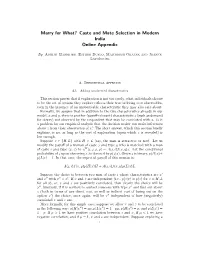
Marry for What? Caste and Mate Selection in Modern India Online Appendix By Abhijit Banerjee, Esther Duflo, Maitreesh Ghatak and Jeanne Lafortune A. Theoretical Appendix A1. Adding unobserved characteristics This section proves that if exploration is not too costly, what individuals choose to be the set of options they explore reflects their true ordering over observables, even in the presence of an unobservable characteristic they may also care about. Formally, we assume that in addition to the two characteristics already in our model, x and y; there is another (payoff-relevant) characteristic z (such as demand for dowry) not observed by the respondent that may be correlated with x. Is it a problem for our empirical analysis that the decision-maker can make inferences about z from their observation of x? The short answer, which this section briefly explains, is no, as long as the cost of exploration (upon which z is revealed) is low enough. Suppose z 2 fH; Lg with H > L (say, the man is attractive or not). Let us modify the payoff of a woman of caste j and type y who is matched with a man of caste i and type (x; z) to uW (i; j; x; y) = A(j; i)f(x; y)z. Let the conditional probability of z upon observing x, is denoted by p(zjx): Given z is binary, p(Hjx)+ p(Ljx) = 1: In that case, the expected payoff of this woman is: A(j; i)f(x; y)p(Hjx)H + A(j; i)f(x; y)p(Ljx)L: Suppose the choice is between two men of caste i whose characteristics are x0 and x00 with x00 > x0. -

"Peruvian 2 Heritage Month" in Flor
FLORIDA HOUSE OF REP RESENTATIVE S HR 8071 2017 1 House Resolution 2 A resolution recognizing July 2017 as "Peruvian 3 Heritage Month" in Florida. 4 5 WHEREAS, Peru has a deep and rich heritage and is the home 6 of ancient cultures spanning from the Norte Chico civilization 7 in Caral, one of the oldest civilizations in the world, to the 8 Inca Empire, the largest state in Pre-Columbian America, and 9 WHEREAS, the Peruvian landscape is vibrant and varied, 10 featuring arid plains, the Andes Mountains, the tropical Amazon 11 Basin rainforest, and the Amazon River, and has influenced and 12 inspired the Peruvian history and culture, including the many 13 Peruvian Americans who have brought their talents and history to 14 this great state and nation, and 15 WHEREAS, counted among the many influential sons and 16 daughters of Peru are the fifth Secretary-General of the United 17 Nations, Javier Felipe Ricardo Pérez de Cuéllar Guerra; World 18 War II hero, Arthur Chin; artist and activist, Favianna 19 Rodriguez; American astronaut, Carlos Noriega; composer, Daniel 20 Alomia Robles; singer, Yma Sumac; economist, Hernando de Soto 21 Polar; actor and advocate, Q'orianka Kilcher; Chef, Emmanuel 22 Piqueras; photographer, Mario Testino; sportsman, Alex Olmedo; 23 and Olympian, Daniel Alarcon, and 24 WHEREAS, Florida is home to the largest Peruvian population 25 in the country and as educators, authors, community leaders, Page 1 of 2 hr8071-00 FLORIDA HOUSE OF REP RESENTATIVE S HR 8071 2017 26 business owners, activists, athletes, artists, musicians, -

Byzantine Dream of Athenian Politicians (Xix-Xx Centuries)
Güney-Doğu Avrupa Araştırmaları Dergisi Yıl: 2017-1 Sayı: 31 S. 35-47 BYZANTINE DREAM OF ATHENIAN POLITICIANS (XIX-XX CENTURIES) Olga Petrunina* Abstract The political elite of the Kingdom of Greece interpreted the Eastern Question in a specific manner, i.e., as an expectation of collecting territories considered to be Greek in one state. This perception, conceptualized in the Megale Idea, had its goals, methods and opponents. It was the guideline of Greek foreign policy the whole 19th century until 1922 and had at least two attempts of its revival later. Keywords: Balkan studies, Modern Greek Studies, Megale Idea, Greek-Turkish Rela- tions, Eastern Question The Eastern Question since it emerged in the European affairs in the 18th century was associated with the future of the European provinces of the weakening Ottoman Empire. The first nation-states in the Balkans appeared in the first half of the th19 century as a result of the early approaches to solve the Eastern Question. Certainly, the main players of the game were the most powerful European countries, the so-called great powers. So, the process of nation-state building in the Balkans was not an independent one, but was closely related to their interests and international conflicts in general. An enrichment of the political map of Europe by the Kingdom of Greece seems to be the result of an attempt to cure the sick man of Europe1 amputating one of his limbs. The detailed research, however, shows the case was more complicated. The Greek War of Independence played a great role in achieving political freedom and the role of the great powers was not little either. -

Revisiting the Achievements of the Ancient Celts
University of Louisville ThinkIR: The University of Louisville's Institutional Repository College of Arts & Sciences Senior Honors Theses College of Arts & Sciences 5-2013 Revisiting the achievements of the Ancient Celts : evidence that the Celtic civilization surpassed contemporary European civilizations in its technical sophistication and social complexity, and continues to influence later cultures. Adam Dahmer University of Louisville Follow this and additional works at: https://ir.library.louisville.edu/honors Part of the Political Science Commons Recommended Citation Dahmer, Adam, "Revisiting the achievements of the Ancient Celts : evidence that the Celtic civilization surpassed contemporary European civilizations in its technical sophistication and social complexity, and continues to influence later cultures." (2013). College of Arts & Sciences Senior Honors Theses. Paper 11. http://doi.org/10.18297/honors/11 This Senior Honors Thesis is brought to you for free and open access by the College of Arts & Sciences at ThinkIR: The University of Louisville's Institutional Repository. It has been accepted for inclusion in College of Arts & Sciences Senior Honors Theses by an authorized administrator of ThinkIR: The University of Louisville's Institutional Repository. This title appears here courtesy of the author, who has retained all other copyrights. For more information, please contact thinkir@louisville.edu. Dahmer 1 A Lost Civilization as Great as Any Scholars traditionally associate the advancement of Western culture from antiquity to the Renaissance with the innovations of the Romans and their Mediterranean cultural predecessors, the Greeks and Etruscans, to the extent that the word "civilization" often seems synonymous with Romanization. In doing so, historians unfairly discount the cultural achievements of other Indo-European peoples who achieved civilization in their own right and contributed much to ancient and modern life.