Libert, Authority, and the New Politics
Total Page:16
File Type:pdf, Size:1020Kb
Load more
Recommended publications
-

Libertarianism, Culture, and Personal Predispositions
Undergraduate Journal of Psychology 22 Libertarianism, Culture, and Personal Predispositions Ida Hepsø, Scarlet Hernandez, Shir Offsey, & Katherine White Kennesaw State University Abstract The United States has exhibited two potentially connected trends – increasing individualism and increasing interest in libertarian ideology. Previous research on libertarian ideology found higher levels of individualism among libertarians, and cross-cultural research has tied greater individualism to making dispositional attributions and lower altruistic tendencies. Given this, we expected to observe positive correlations between the following variables in the present research: individualism and endorsement of libertarianism, individualism and dispositional attributions, and endorsement of libertarianism and dispositional attributions. We also expected to observe negative correlations between libertarianism and altruism, dispositional attributions and altruism, and individualism and altruism. Survey results from 252 participants confirmed a positive correlation between individualism and libertarianism, a marginally significant positive correlation between libertarianism and dispositional attributions, and a negative correlation between individualism and altruism. These results confirm the connection between libertarianism and individualism observed in previous research and present several intriguing questions for future research on libertarian ideology. Key Words: Libertarianism, individualism, altruism, attributions individualistic, made apparent -
What Is Social Democracy and What Is It Good For?
Bottom-Up Workshop: What is Social Democracy and what is it good for? Organizing Researchers: Francesco Colombo (francesco.colombo@eui.eu), Timo Seidl (timo.seidl@eui.eu) Sponsoring Professor: Ellen Immergut Instructor: Konstantin Vössing Place and Date: 24.05.2019 (Friday), 27.05.2019 (Monday) Course Description In 1983, Ralf Dahrendorf declared the “end of the social-democratic century”. Social democracy, he argued, was a victim of its own success. Having transformed Western societies in its own image, it was simply no longer needed. The operation was successful, only the surgeon had died. Almost half a century later, the social democratic surgeon is indeed on its electoral deathbed, while the capitalist patient seems more alive than ever. In this workshop, we want to take a step back from this immediate crisis of social democracy, and ask ourselves: What is social democracy and what is it good for? In the first section, we will look at how key protagonists of social democratic thought have answered this question. These thinkers have, in their own ways and in their own time, addressed a tension that, we argue, lies at the heart of social democracy: between a reformist and pragmatic strand on the one hand; and a radical and idealistic strand on the other. In the second section, we will look at how contemporary social scientists have analysed the current predicament of social democracy, and which solutions they suggest. Has social democracy abandoned its political radicalism in favour of a more technocratic reformism? Or does it need to develop better (and more radical) reform ideas again? In a third section, we will apply these insights from the past and present of social democracy to the challenges that await social democrats in the future. -
Markets Not Capitalism Explores the Gap Between Radically Freed Markets and the Capitalist-Controlled Markets That Prevail Today
individualist anarchism against bosses, inequality, corporate power, and structural poverty Edited by Gary Chartier & Charles W. Johnson Individualist anarchists believe in mutual exchange, not economic privilege. They believe in freed markets, not capitalism. They defend a distinctive response to the challenges of ending global capitalism and achieving social justice: eliminate the political privileges that prop up capitalists. Massive concentrations of wealth, rigid economic hierarchies, and unsustainable modes of production are not the results of the market form, but of markets deformed and rigged by a network of state-secured controls and privileges to the business class. Markets Not Capitalism explores the gap between radically freed markets and the capitalist-controlled markets that prevail today. It explains how liberating market exchange from state capitalist privilege can abolish structural poverty, help working people take control over the conditions of their labor, and redistribute wealth and social power. Featuring discussions of socialism, capitalism, markets, ownership, labor struggle, grassroots privatization, intellectual property, health care, racism, sexism, and environmental issues, this unique collection brings together classic essays by Cleyre, and such contemporary innovators as Kevin Carson and Roderick Long. It introduces an eye-opening approach to radical social thought, rooted equally in libertarian socialism and market anarchism. “We on the left need a good shake to get us thinking, and these arguments for market anarchism do the job in lively and thoughtful fashion.” – Alexander Cockburn, editor and publisher, Counterpunch “Anarchy is not chaos; nor is it violence. This rich and provocative gathering of essays by anarchists past and present imagines society unburdened by state, markets un-warped by capitalism. -
13 Conclusion
13 Conclusion Overall patterns of globalization and development In this volume I have depicted a narrowing followed by a widening of the ideological spectrum, capitalist triumph and tribulations, the decline of inter- state wars and their replacement by either peace or civil wars, the intensifi- cation of national citizenship, and the replacement of all empires save one by nation-states. All this was happening on an increasingly global scale – a series of globalizations, which sometimes reinforced, sometimes undercut, and always differed from each other. As a result, the world is more interconnected, though it is not harmonious, and it is nowhere near being a single global sys- tem. It is a process of universal but polymorphous globalization. My second volume identified capitalism and nation-states as the two main power organizations of the long nineteenth century in the advanced countries. In Volume 3 and here I have expanded my horizons to the globe and added empires. The entwined dynam- ics of capitalism, nation-states, and empires brought disastrous world wars and revolutions in the first half of the twentieth century. This was followed by a fairly sharp break after 1945 as power relations subsided into a short “golden age” of democratic capitalism, in which occurred the collapse of all but two empires, a degree of class compromise within capitalism, the institutionaliza- tion of both capitalism and state socialism, the emergence of mass social citi- zenship, and global economic and population growth. The principal military confrontation eased into a merely cold war, which eased further as the Soviet Union stagnated. This plus the advent of nuclear weapons brought a decline in usable military power and a rapid decline in interstate wars across the world . -

Democratic Capitalism
Democratic Capitalism Why Political and Economic Freedom Need Each Other IAIN MURRAY The Competitive Enterprise Institute promotes the institutions of liberty and works to remove government-created barriers to economic freedom, innovation, and prosperity through timely analysis, effective advocacy, inclusive coalition- building, and strategic litigation. COMPETITIVE ENTERPRISE INSTITUTE 1310 L Street NW, 7th Floor Washington, DC 20005 202-331-1010 cei.org PROFILES IN CAPITALISM OCTOBER 2019 | NO. 4 Democratic Capitalism Why Political and Economic Freedom Need Each Other Iain Murray Competitive Enterprise Institute 2019 Murray: Democratic Capitalism 2 Murray: Democratic Capitalism EXECUTIVE SUMMARY Is capitalism destroying democracy? It is an old question that political thinkers have long wrestled with. Yet, it gained recent prominence with the publication of Duke University historian Nancy MacLean’s widely discussed book, Democracy in Chains: The Deep History of the Radical Right’s Stealth Plan for America, which unleashed heated debate over its claim that libertarian economists, funded by capitalist billionaires, have worked to subvert American democracy over the past four decades. Critics of the free market contend that democracy, as they conceive it, should not be constrained. Yet, it turns out that American democracy is already enchained—by design. We have explicitly rejected the idea of “unfettered democracy.” We accept limitations on the democratic will of the majority in all sorts of areas. We do not allow a democratic majority to use its power to ban any form of political speech, to segregate their communities on the basis of race, or to impose religious views or obligations on others. These constraints on government are the political expression of rights. -

Understanding Social Democracy
1 Understanding Social Democracy By Sheri Berman Associate Professor of Political Science Barnard College Columbia University 3009 Broadway New York, NY 10027-6598 (212) 854-2158 2 For the first half of the twentieth century, Europe was the most turbulent region on earth, convulsed by war, economic crisis, and social and political conflict. For the second half of the century, it was among the most placid, a study in harmony and prosperity. What changed? Two narratives commonly emerge in answer to this question. The first focuses on the struggle between democracy and its alternatives, pitting liberalism against fascism, National Socialism, and Marxist-Leninism. The second focuses on competition between capitalism and its alternatives, pitting liberals against socialists and communists. Democratic capitalism is simply the best, indeed the “natural” form of societal organization, these stories assert, and once Western Europe fully embraced it, all was well. This account obviously contains some truth: the century did witness a struggle between democracy and its enemies and the market and its alternatives. But it is only a partial truth, because it overlooks a crucial point: democracy and capitalism were historically at odds. An indispensable element of their joint victory, therefore, was the discovery of some way for them to coexist. In practice, that turned out to mean a willingness to use political power to protect citizens from the ravages of untrammeled markets. The ideology that triumphed was not liberalism, as the “End of History” folks would have it, it was social democracy. If this sounds surprising or overblown it is because social democracy rarely gets either the respect or in-depth ideological analysis it deserves. -

Libertarian Socialism
Libertarian Socialism Politics in Black and Red Editors: Alex Prichard, Ruth Kinna, Saku Pinta, and David Berry The history of anarchist-Marxist relations is usually told as a history of faction- alism and division. These essays, based on original research and written espe- cially for this collection, reveal some of the enduring sores in the revolutionary socialist movement in order to explore the important, too often neglected left- libertarian currents that have thrived in revolutionary socialist movements. By turns, the collection interrogates the theoretical boundaries between Marxism and anarchism and the process of their formation, the overlaps and creative ten- sions that shaped left-libertarian theory and practice, and the stumbling blocks to movement cooperation. Bringing together specialists working from a range of political perspectives, the book charts a history of radical twentieth-century socialism, and opens new vistas for research in the twenty-first. Contributors examine the political and social thought of a number of leading socialists— Marx, Morris, Sorel, Gramsci, Guérin, C.L.R. James, Hardt and Negri—and key movements including the Situationist International, Socialisme ou Barbarie and Council Communism. Analysis of activism in the UK, Australasia, and the U.S. serves as the prism to discuss syndicalism, carnival anarchism, and the anarchistic currents in the U.S. civil rights movement. Contributors include Paul Blackledge, Lewis H. Mates, Renzo Llorente, Carl SUBJECT CATEGORY Levy, Christian Høgsbjerg, Andrew Cornell, Benoît Challand, Jean-Christophe Politics-Anarchism/Politics-Socialism Angaut, Toby Boraman, and David Bates. PRICE ABOUT THE EDITORS $26.95 Alex Prichard is senior lecturer in International Relations at the University of Exeter. -
Socialism and the Blockchain
future internet Article Socialism and the Blockchain Steve Huckle * and Martin White Creative Technology Group, Department of Informatics, University of Sussex, Chichester 1, 128, Falmer, Brighton BN1 9QT, UK; m.white@sussex.ac.uk * Correspondence: s.huckle@sussex.ac.uk; Tel.: +44-0-1273-606755 Academic Editor: Carmen de Pablos Heredero Received: 5 August 2016; Accepted: 10 October 2016; Published: 18 October 2016 Abstract: Bitcoin (BTC) is often cited as Libertarian. However, the technology underpinning Bitcoin, blockchain, has properties that make it ideally suited to Socialist paradigms. Current literature supports the Libertarian viewpoint by focusing on the ability of Bitcoin to bypass central authority and provide anonymity; rarely is there an examination of blockchain technology’s capacity for decentralised transparency and auditability in support of a Socialist model. This paper conducts a review of the blockchain, Libertarianism, and Socialist philosophies. It then explores Socialist models of public ownership and looks at the unique cooperative properties of blockchain that make the technology ideal for supporting Socialist societies. In summary, this paper argues that blockchain technologies are not just a Libertarian tool, they also enhance Socialist forms of governance. Keywords: Bitcoin; blockchain; cryptocurrency; fiat money; libertarianism; socialism; Marxism; anarchism 1. Introduction Bitcoin (BTC) is referred to as cryptocurrency because it is a form of electronic cash that relies on cryptography. Since its inception in early 2009 [1], it has achieved a degree of prominence, not least in terms of market value; at the time of writing, its total market capitalisation was over US $6 billion [2]. Furthermore, governmental institutions are beginning to examine the blockchain technology underpinning BTC [3] because some of its properties, which we discuss below, may have implications that extend beyond economics and into social, political and humanitarian domains [4]. -

Finnish Studies Volume 18 Number 2 July 2015 ISSN 1206-6516 ISBN 978-1-937875-95-4
JOURNAL OF INNISH TUDIES F S International Influences in Finnish Working-Class Literature and Its Research Guest Editors Kirsti Salmi-Niklander and Kati Launis Theme Issue of the Journal of Finnish Studies Volume 18 Number 2 July 2015 ISSN 1206-6516 ISBN 978-1-937875-95-4 JOURNAL OF FINNISH STUDIES EDITORIAL AND BUSINESS OFFICE Journal of Finnish Studies, Department of English, 1901 University Avenue, Evans 458 (P.O. Box 2146), Sam Houston State University, Huntsville, TX 77341-2146, USA Tel. 1.936.294.1420; Fax 1.936.294.1408 SUBSCRIPTIONS, ADVERTISING, AND INQUIRIES Contact Business Office (see above & below). EDITORIAL STAFF Helena Halmari, Editor-in-Chief, Sam Houston State University; halmari@shsu.edu Hanna Snellman, Co-Editor, University of Helsinki; Hanna.Snellman@helsinki.fi Scott Kaukonen, Assoc. Editor, Sam Houston State University; kaukonen@shsu.edu Hilary Joy Virtanen, Asst. Editor, Finlandia University; hilary.virtanen@finlandia. edu Sheila Embleton, Book Review Editor, York University; embleton@yorku.ca EDITORIAL BOARD Börje Vähämäki, Founding Editor, JoFS, Professor Emeritus, University of Toronto Raimo Anttila, Professor Emeritus, University of California, Los Angeles Michael Branch, Professor Emeritus, University of London Thomas DuBois, Professor, University of Wisconsin Sheila Embleton, Distinguished Research Professor, York University Aili Flint, Emerita Senior Lecturer, Associate Research Scholar, Columbia University Titus Hjelm, Lecturer, University College London Richard Impola, Professor Emeritus, New Paltz, New York Daniel Karvonen, Senior Lecturer, University of Minnesota, Minneapolis Andrew Nestingen, Associate Professor, University of Washington, Seattle Jyrki Nummi, Professor, Department of Finnish Literature, University of Helsinki Juha Pentikäinen, Professor, Institute for Northern Culture, University of Lapland Oiva Saarinen, Professor Emeritus, Laurentian University, Sudbury George Schoolfield, Professor Emeritus, Yale University Beth L. -

Anarchism and Libertarianism
CHAPTER 10 Anarchism and Libertarianism Roderick T. Long Introduction “Libertarianism,” understood as a term for a specific political ideology, origi- nated as a synonym for anarchism, and more precisely the communist anar- chism of Joseph Déjacque (1821–1864), whose use of “libertaire” in this sense dates to 18571—though individualist anarchists soon picked up the term as well.2 Nowadays, however, the term “libertarianism” is frequently associated, particularly in English-speaking countries, with a movement favoring free mar- kets, private property, and economic laissez-faire, generally resting either on the efficiency of the price system in coordinating individuals’ plans,3 or else on an ethical principle of self-ownership or non-aggression4 which is taken to define individuals’ rights against forcible interference with their persons and (justly acquired) property. This is the sense in which the term “libertarian” will be employed here. (Today French actually has two words corresponding to the English libertarian: “libertaire,” meaning an anarchist, particularly a left-wing anarchist, and “libertarien,” for the free-market advocate.) It is with the relation of libertarianism (in the free-market sense) to anarchism that this chapter is concerned. While sometimes considered a form of conservatism, libertarianism dif- fers from typical versions of conservatism in endorsing a broad range of social liberties, and thus opposing, e.g., drug laws, censorship laws, laws restricting consensual sexual activity, and the like. (Libertarians usually, though not al- ways, differ from typical conservatives in opposing military interventionism 1 Joseph Déjacque, De l’être-humain mâle et femelle: Lettre à P.J. Proudhon (New Orleans: Lamarre, 1857). -
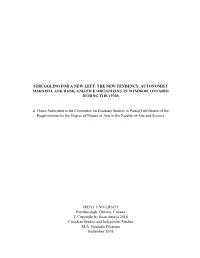
The New Tendency, Autonomist Marxism, and Rank-And-File Organizing in Windsor, Ontario During the 1970S
STRUGGLING FOR A NEW LEFT: THE NEW TENDENCY, AUTONOMIST MARXISM, AND RANK-AND-FILE ORGANIZING IN WINDSOR, ONTARIO DURING THE 1970S A Thesis Submitted to the Committee on Graduate Studies in Partial Fulfillment of the Requirements for the Degree of Master of Arts in the Faculty of Arts and Science TRENT UNIVERSITY Peterborough, Ontario, Canada © Copyright by Sean Antaya 2018 Canadian Studies and Indigenous Studies M.A. Graduate Program September 2018 ABSTRACT Thesis Title: Struggling for a New Left: The New Tendency, Autonomist Marxism, and Rank- and-File Organizing in Windsor, Ontario during the 1970s Author’s Name: Sean Antaya Summary: This study examines the emergence of the New Left organization, The New Tendency, in Windsor, Ontario during the 1970s. The New Tendency, which developed in a number of Ontario cities, represents one articulation of the Canadian New Left’s turn towards working-class organizing in the early 1970s after the student movement’s dissolution in the late 1960s. Influenced by dissident Marxist theorists associated with the Johnson-Forest Tendency and Italian workerism, The New Tendency sought to create alternative forms of working-class organizing that existed outside of, and often in direct opposition to, both the mainstream labour movement and Old Left organizations such as the Communist Party and the New Democratic Party. After examining the roots of the organization and the important legacies of class struggle in Windsor, the thesis explores how The New Tendency contributed to working-class self activity on the shop-floor of Windsor’s auto factories and in the community more broadly. However, this New Left mobilization was also hampered by inner-group sectarianism and a rapidly changing economic context. -
If Not Left-Libertarianism, Then What?
COSMOS + TAXIS If Not Left-Libertarianism, then What? A Fourth Way out of the Dilemma Facing Libertarianism LAURENT DOBUZINSKIS Department of Political Science Simon Fraser University 8888 University Drive Burnaby, B.C. Canada V5A 1S6 Email: dobuzins@sfu.ca Web: http://www.sfu.ca/politics/faculty/full-time/laurent_dobuzinskis.html Bio-Sketch: Laurent Dobuzinskis’ research is focused on the history of economic and political thought, with special emphasis on French political economy, the philosophy of the social sciences, and public policy analysis. Abstract: Can the theories and approaches that fall under the more or less overlapping labels “classical liberalism” or “libertarianism” be saved from themselves? By adhering too dogmatically to their principles, libertarians may have painted themselves into a corner. They have generally failed to generate broad political or even intellectual support. Some of the reasons for this isolation include their reluctance to recognize the multiplicity of ways order emerges in different contexts and, more 31 significantly, their unshakable faith in the virtues of free markets renders them somewhat blind to economic inequalities; their strict construction of property rights and profound distrust of state institutions leave them unable to recommend public policies that could alleviate such problems. The doctrine advanced by “left-libertarians” and market socialists address these substantive weaknesses in ways that are examined in detail in this paper. But I argue that these “third way” movements do not stand any better chance than libertari- + TAXIS COSMOS anism tout court to become a viable and powerful political force. The deeply paradoxical character of their ideas would make it very difficult for any party or leader to gain political traction by building an election platform on them.