75 AD PHOCION 402?-317 B.C. Plutarch Translated by John Dryden
Total Page:16
File Type:pdf, Size:1020Kb
Load more
Recommended publications
-
Plutarch's 'Lives' and the Critical Reader
Plutarch's 'Lives' and the critical reader Book or Report Section Published Version Duff, T. (2011) Plutarch's 'Lives' and the critical reader. In: Roskam, G. and Van der Stockt, L. (eds.) Virtues for the people: aspects of Plutarch's ethics. Plutarchea Hypomnemata (4). Leuven University Press, Leuven, pp. 59-82. ISBN 9789058678584 Available at http://centaur.reading.ac.uk/24388/ It is advisable to refer to the publisher’s version if you intend to cite from the work. See Guidance on citing . Publisher: Leuven University Press All outputs in CentAUR are protected by Intellectual Property Rights law, including copyright law. Copyright and IPR is retained by the creators or other copyright holders. Terms and conditions for use of this material are defined in the End User Agreement . www.reading.ac.uk/centaur CentAUR Central Archive at the University of Reading Reading’s research outputs online Reprint from Virtues for the People. Aspects of Plutarchan Ethics - ISBN 978 90 5867 858 4 - Leuven University Press virtues for the people aspects of plutarchan ethics Reprint from Virtues for the People. Aspects of Plutarchan Ethics - ISBN 978 90 5867 858 4 - Leuven University Press PLUTARCHEA HYPOMNEMATA Editorial Board Jan Opsomer (K.U.Leuven) Geert Roskam (K.U.Leuven) Frances Titchener (Utah State University, Logan) Luc Van der Stockt (K.U.Leuven) Advisory Board F. Alesse (ILIESI-CNR, Roma) M. Beck (University of South Carolina, Columbia) J. Beneker (University of Wisconsin, Madison) H.-G. Ingenkamp (Universität Bonn) A.G. Nikolaidis (University of Crete, Rethymno) Chr. Pelling (Christ Church, Oxford) A. Pérez Jiménez (Universidad de Málaga) Th. -

Marathon 2,500 Years Edited by Christopher Carey & Michael Edwards
MARATHON 2,500 YEARS EDITED BY CHRISTOPHER CAREY & MICHAEL EDWARDS INSTITUTE OF CLASSICAL STUDIES SCHOOL OF ADVANCED STUDY UNIVERSITY OF LONDON MARATHON – 2,500 YEARS BULLETIN OF THE INSTITUTE OF CLASSICAL STUDIES SUPPLEMENT 124 DIRECTOR & GENERAL EDITOR: JOHN NORTH DIRECTOR OF PUBLICATIONS: RICHARD SIMPSON MARATHON – 2,500 YEARS PROCEEDINGS OF THE MARATHON CONFERENCE 2010 EDITED BY CHRISTOPHER CAREY & MICHAEL EDWARDS INSTITUTE OF CLASSICAL STUDIES SCHOOL OF ADVANCED STUDY UNIVERSITY OF LONDON 2013 The cover image shows Persian warriors at Ishtar Gate, from before the fourth century BC. Pergamon Museum/Vorderasiatisches Museum, Berlin. Photo Mohammed Shamma (2003). Used under CC‐BY terms. All rights reserved. This PDF edition published in 2019 First published in print in 2013 This book is published under a Creative Commons Attribution-NonCommercial- NoDerivatives (CC-BY-NC-ND 4.0) license. More information regarding CC licenses is available at http://creativecommons.org/licenses/ Available to download free at http://www.humanities-digital-library.org ISBN: 978-1-905670-81-9 (2019 PDF edition) DOI: 10.14296/1019.9781905670819 ISBN: 978-1-905670-52-9 (2013 paperback edition) ©2013 Institute of Classical Studies, University of London The right of contributors to be identified as the authors of the work published here has been asserted by them in accordance with the Copyright, Designs and Patents Act 1988. Designed and typeset at the Institute of Classical Studies TABLE OF CONTENTS Introductory note 1 P. J. Rhodes The battle of Marathon and modern scholarship 3 Christopher Pelling Herodotus’ Marathon 23 Peter Krentz Marathon and the development of the exclusive hoplite phalanx 35 Andrej Petrovic The battle of Marathon in pre-Herodotean sources: on Marathon verse-inscriptions (IG I3 503/504; Seg Lvi 430) 45 V. -
Agorapicbk-17.Pdf
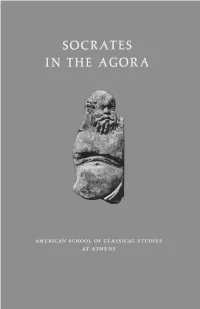
Excavations of the Athenian Agora Picture Book No. 17 Prepared by Mabel L. Lang Dedicated to Eugene Vanderpool o American School of Classical Studies at Athens ISBN 87661-617-1 Produced by the Meriden Gravure Company Meriden, Connecticut COVER: Bone figure of Socrates TITLE PAGE: Hemlock SOCRATES IN THE AGORA AMERICAN SCHOOL OF CLASSICAL STUDIES AT ATHENS PRINCETON, NEW JERSEY 1978 ‘Everything combines to make our knowledge of Socrates himself a subject of Socratic irony. The only thing we know definitely about him is that we know nothing.’ -L. Brunschvicg As FAR AS we know Socrates himselfwrote nothing, yet not only were his life and words given dramatic attention in his own time in the Clouds of Ar- istophanes, but they have also become the subject of many others’ writing in the centuries since his death. Fourth-century B.C. writers who had first-hand knowledge of him composed either dialogues in which he was the dominant figure (Plato and Aeschines) or memories of his teaching and activities (Xe- nophon). Later authors down even to the present day have written numerous biographies based on these early sources and considering this most protean of philosophers from every possible point of view except perhaps the topograph- ical one which is attempted here. Instead of putting Socrates in the context of 5th-century B.C. philosophy, politics, ethics or rhetoric, we shall look to find him in the material world and physical surroundings of his favorite stamping- grounds, the Athenian Agora. Just as ‘agora’ in its original sense meant ‘gathering place’ but came in time to mean ‘market place’, so the agora itself was originally a gathering place I. -

Poetry and the Dēmos: State Regulation of a Civic Possession
is is a version of an electronic document, part of the series, Dēmos: Clas- sical Athenian Democracy, a publicationpublication ofof e Stoa: a consortium for electronic publication in the humanities [www.stoa.org]. e electronic version of this article off ers contextual information intended to make the study of Athenian democracy more accessible to a wide audience. Please visit the site at http:// www.stoa.org/projects/demos/home. Poetry and the Dēmos: State Regulation of a Civic Possession S is article argues that poetry – the Homeric epics and the works of the tragedians – enjoyed an importance to the democratic government of Athens equal to that of the city’s laws. Like laws, poetry was powerful. Like the law, too, poetry was regulated and, at times, manipulated ac- cording to the political needs of the city and its rulers. P C e pervasive civic importance of poetry in Athenian democracy during the fi h and fourth centuries has been obvious since ancient times. e fi gure Demades in Plutarch calls the theoric fund, which paid for the entrance fee into dramatic festivals for all citizens, the “glue of the democracy” (ὡς ἔλεγε Δημάδης, κόλλαν ὀνομάζων τὰ θεωρικὰ τῆς δημοκρατίας) (Plut. Platonic Questions b). Casey Dué, “Poetry and the Dēmos: state regulation of a civic possession,” in C. Blackwell, ed., Dēmos: Classical Athenian Democracy (A.(A. MahoneyMahoney andand R.R. Scaife,Scaife, edd.,edd., e Stoa: a consortium for electronic publication in the humanities [www.stoa.org], . © , C. Dué. In Aeschines’s oration Against Timarchus, Aeschines asks his jury to apply wisdom from the poetry of Euripides in their judgment of the case before them: Σκέψασθε δέ, ὦ Ἀθηναῖοι, τὰς γνῶμας ἃς ἀποφαίνεται ὁ ποιητής. -

Sviatoslav Dmitriev the Theoric Fund, the Athenian Finance in the 330S
Sviatoslav Dmitriev The Theoric Fund, the Athenian fi nance in the 330s, and Apollodorus Abstract This article examines the history and role of the Theoric Fund in Athens, focusing on evidence and arguments in the long-running debate about whether a legal prohibition existed against channeling the surplus budget money designated for the Theoric Fund to military purposes. The argument here is that Libanius’ reference to this prohibition as being enforced by the death penalty for at least some time in the 340s cannot simply be rejected by adducing the evidence about either the proposal to have a public vote on diverting this money for military purposes, as was moved by Apollodorus in the early 340s, or the way in which the Theoric Fund operated in the 330s and 320s. Quite a lot has been written about the Theoric Fund, whose main declared purpose was to distribute money for public entertainment to qualifi ed Athe- nians, primarily for two reasons: the contested dating of its establishment, and the uncertainty about whether there existed a prohibition on diverting its money for other purposes. The foundation of the Theoric Fund is variously attributed to Pericles, to Agyrrhius in the early fourth century, or, according to the ma- jority opinion, to Diophantus and Eubulus in the mid-350s.1 Pinpointing the exact date of its establishment might not be as important as some think, since it is likely that the Fund, and the very idea of fi nancing public entertainment, evolved over time, paralleling the progress of Athenian democracy, which is 1 Pericles: Schol. -

The Late Fourth Century BCE
chapter 7 The Late Fourth Century BCE The system of military training and service described in the Ath. Pol. and docu- mented in the over thirty extant inscriptions of the Lykourgan Period is not only one of the better attested phases of the institution, but has set a high standard by which scholars have evaluated its later iterations. The Lykourgan ephebeia was also very short-lived, lasting a little over a decade. The following chapters explore the Hellenistic ephebeia at Athens, an institution that per- sisted nearly three hundred years and in which generations of young members from Athenian elite families participated. Pélékidis attempted a similar histo- ry, but was limited in part by the paucity of inscriptions from the late fourth to the early second centuries BCE. Understandably, this led to a focus on the later second and first centuries, for which the epigraphic evidence is richer, and a tendency to project later developments back on to the earlier, less well attested periods. Since the publication of his history, new epigraphical evidence has been unearthed, shedding much needed light on periods of history that were previously veiled in darkness. In addition to new evidence, recent publications by Habicht and others have clarified much of the history of Hellenistic Athens and have provided a framework with which to contextualize any new history of the Athenian ephebeia of this period. As will be discussed in the following chapters, the ephebeia that appears in the later evidence is significantly different than the Lykourgan. Before turning attention to it, however, this chapter addresses the fate of the Lykourgan ephe- beia and considers the pressing question regarding the origin of its Hellenistic successor. -

Mercenaries, Poleis, and Empires in the Fourth Century Bce
The Pennsylvania State University The Graduate School College of the Liberal Arts ALL THE KING’S GREEKS: MERCENARIES, POLEIS, AND EMPIRES IN THE FOURTH CENTURY BCE A Dissertation in History and Classics and Ancient Mediterranean Studies by Jeffrey Rop © 2013 Jeffrey Rop Submitted in Partial Fulfillment of the Requirements for the Degree of Doctor of Philosophy May 2013 ii The dissertation of Jeffrey Rop was reviewed and approved* by the following: Mark Munn Professor of Ancient Greek History and Greek Archaeology, Classics and Ancient Mediterranean Studies Dissertation Advisor Chair of Committee Gary N. Knoppers Edwin Erle Sparks Professor of Classics and Ancient Mediterranean Studies, Religious Studies, and Jewish Studies Garrett G. Fagan Professor of Ancient History and Classics and Ancient Mediterranean Studies Kenneth Hirth Professor of Anthropology Carol Reardon George Winfree Professor of American History David Atwill Associate Professor of History and Asian Studies Graduate Program Director for the Department of History *Signatures are on file in the Graduate School iii ABSTRACT This dissertation examines Greek mercenary service in the Near East from 401- 330 BCE. Traditionally, the employment of Greek soldiers by the Persian Achaemenid Empire and the Kingdom of Egypt during this period has been understood to indicate the military weakness of these polities and the superiority of Greek hoplites over their Near Eastern counterparts. I demonstrate that the purported superiority of Greek heavy infantry has been exaggerated by Greco-Roman authors. Furthermore, close examination of Greek mercenary service reveals that the recruitment of Greek soldiers was not the purpose of Achaemenid foreign policy in Greece and the Aegean, but was instead an indication of the political subordination of prominent Greek citizens and poleis, conducted through the social institution of xenia, to Persian satraps and kings. -

Public Finance and Democratic Ideology in Fourth-Century BC Athens by Christopher Scott Welser BA, Sw
Dēmos and Dioikēsis: Public Finance and Democratic Ideology in Fourth-Century B.C. Athens By Christopher Scott Welser B.A., Swarthmore College, 1994 M.A., University of Maryland, 1999 Submitted in partial fulfillment of the requirements for the degree of Doctor of Philosophy in the Department of Classics at Brown University, Providence, Rhode Island. May, 2011 © Copyright 2011 by Christopher Scott Welser This dissertation by Christopher Scott Welser is accepted in its present form by the Department of Classics as satisfying the dissertation requirement for the degree of Doctor of Philosophy. Date________________ _______________________________________ Adele C. Scafuro, Advisor Recommended to the Graduate Council Date________________ _______________________________________ Alan L. Boegehold, Reader Date________________ _______________________________________ David Konstan, Reader Approved by the Graduate Council Date________________ _______________________________________ Peter M. Weber, Dean of the Graduate School iii CURRICULUM VITAE Christopher Scott Welser was born in Romeo, Michigan in 1971. He attended Roeper City and Country School in Bloomfield Hills, Michigan, and in 1994 he graduated from Swarthmore College, earning an Honors B.A. in Economics (his major) and Biology (his minor). After working for several years at public policy research firms in Pennsylvania and New Jersey, he decided to pursue the study of Classics, an interest of his since childhood. Upon earning an M.A. with Distinction in Latin and Greek from the University of Maryland at College Park in 1999, he enrolled in the Ph.D. program in Classics at Brown University. While working on his Ph.D., he spent two years as Seymour Fellow (2002-2003) and Capps Fellow (2004-2005) at the American School of Classical Studies at Athens and participated in the summer program of the American Academy in Rome (2000). -

The Military Policy of the Hellenistic Boiotian League
The Military Policy of the Hellenistic Boiotian League Ruben Post Department of History and Classical Studies McGill University, Montreal December, 2012 A thesis submitted to McGill University in partial fulfillment of the requirements of the degree Master of Arts ©Ruben Post, 2012. Table of Contents Abstract ............................................................................................................................. 3 Abrégé ............................................................................................................................... 4 Acknowledgements ............................................................................................................ 5 Introduction ...................................................................................................................... 7 Sources .........................................................................................................................11 Chapter One .....................................................................................................................16 Agriculture and Population in Late Classical and Hellenistic Boiotia .........................16 The Fortification Building Program of Epameinondas ................................................31 Conclusion ...................................................................................................................43 Chapter Two ....................................................................................................................48 -
The Making of the Hellenistic World
Part I THE MAKING OF THE HELLENISTIC WORLD K2 cch01.inddh01.indd 1111 99/14/2007/14/2007 55:03:23:03:23 PPMM K2 cch01.inddh01.indd 1122 99/14/2007/14/2007 55:03:23:03:23 PPMM 1 First Steps 325 300 275 250 225 200 175 150 125 100 75 50 25 June 323 Death of Alexander the Great; outbreak of Lamian War 322 Battle of Krannon; end of Lamian War 320 Death of Perdikkas in Egypt; settlement of Triparadeisos 319 Death of Antipater 317 Return of Olympias to Macedonia; deaths of Philip Arrhidaios and Eurydike 316/15 Death of Eumenes of Kardia in Iran 314 Antigonos’ declaration of Tyre; fi rst coalition war (Kas- sander, Lysimachos, and Ptolemy against Antigonos) 312 Battle of Gaza; Seleukos retakes Babylon 311 Treaty ends coalition war 310 Deaths of Alexander IV and Roxane I From Babylon to Triparadeisos The sudden death of the Macedonian king Alexander, far away from home at Babylon in Mesopotamia on June 10, 323, caught the world he ruled fully unprepared for the ensuing crisis. Only two of the men who founded the dynas- ties of kings which dominated the history of the Hellenistic world were even present at Babylon when he died, and only one of them was suffi ciently promi- nent among the offi cers who assembled to debate the future to be given an independent provincial command: Ptolemy, now in his early forties, was appointed to distant Egypt (though with Alexander’s established governor, Kleomenes, as his offi cial deputy). Seleukos, also present at Babylon, but some K2 cch01.inddh01.indd 1133 99/14/2007/14/2007 55:03:23:03:23 PPMM 14 PART I THE MAKING OF THE HELLENISTIC WORLD ten years younger, became cavalry commander in the central government, a post which under Alexander had been equivalent to the king’s deputy but now was envisaged as being purely military. -

The Regime of Demetrius of Phalerum in Athens, 317–307
Th e Regime of Demetrius of Phalerum in Athens, 317–307 BCE Mnemosyne Supplements History and Archaeology of Classical Antiquity Edited by Susan E. Alcock, Brown University Th omas Harrison, Liverpool Willem M. Jongman, Groningen H.S. Versnel, Leiden VOLUME 318 Th e Regime of Demetrius of Phalerum in Athens, 317–307 BCE A Philosopher in Politics By Lara O’Sullivan LEIDEN • BOSTON 2009 On the cover: Detail of the Parthenon. Photo: Author. Th is book is printed on acid-free paper. Library of Congress Cataloging-in-Publication Data O’Sullivan, Lara. Th e rule of Demetrius of Phalerum in Athens, 317-307 B.C. : a philosopher in politics / by Lara O’Sullivan. p. cm. — (Mnemosyne supplements. History and archaeology of classical antiquity, ISSN 0169-8958 ; v. 318) Includes bibliographical references and index. ISBN 978-90-04-17888-5 (hbk. : alk. paper) 1. Demetrius, of Phaleron, b. ca. 350 B.C. 2. Demetrius, of Phaleron, b. ca. 350 B.C.—Political and social views. 3. Governors—Greece—Athens—Biography. 4. Statesmen—Greece—Athens— Biography. 5. Orators—Greece—Athens—Biography. 6. Philosophers, Ancient— Biography. 7. Athens (Greece)—Politics and government. 8. Philosophy, Ancient. 9. Athens (Greece)—Relations—Macedonia. 10. Macedonia—Relations—Greece— Athens. I. Title. II. Series. DF235.48.D455O87 2009 938’.508092—dc22 [B] 2009033560 ISSN 0169-8958 ISBN 978 90 04 17888 5 Copyright 2009 by Koninklijke Brill NV, Leiden, Th e Netherlands. Koninklijke Brill NV incorporates the imprints Brill, Hotei Publishing, IDC Publishers, Martinus Nijhoff Publishers and VSP. All rights reserved. No part of this publication may be reproduced, translated, stored in a retrieval system, or transmitted in any form or by any means, electronic, mechanical, photocopying, recording or otherwise, without prior written permission from the publisher. -
Medical Language in the Speeches of Demosthenes Allison Das a Dissertation Submitted in Partial Fulfillment of the Requirement
Medical Language in the Speeches of Demosthenes Allison Das A dissertation submitted in partial fulfillment of the requirements for the degree of Doctor of Philosophy University of Washington 2015 Reading Committee: Ruby Blondell, Chair Deborah Kamen Alexander Hollmann Program Authorized to Offer Degree: Classics Department Allison Das ii ©Copyright 2015 Allison E. Das Allison Das iii University of Washington Abstract Medical Language in the Speeches of Demosthenes Allison E. Das Chair of Supervisory Committee Dr. Ruby Blondell Classics Department Introduction This project is intended as an examination of medical language and imagery in the speeches of Demosthenes, with special attention given to his speeches against his political opponent Aeschines, Against the False Embassy (19) and On the Crown (18). In Chapter 1, I contextualize his use of such language and imagery by exploring the influence of Hippocratic medicine on fourth- and fifth-century non-medical literature. I argue that the shared anxieties of medicine and politics, namely that both arts demand quick action and foresight on the part of the good practitioner, and the rich new vocabulary of suffering and disease, made Hippocratic medicine an enticing model for the political writer, that is, the historian, philosopher, and orator. Demosthenes' medical language and imagery should thus be seen as part of a tradition of analogizing the two arts, which began during the circulation of the first Hippocratic treatises and continued well into and past his own day. Allison Das iv In Chapter 2, I look at medical language and imagery in Demosthenes' prosecution of Aeschines for political misconduct during the Second Embassy to Philip II of Macedon, On the False Embassy.