Abigail Adams: Life, Accomplishments, and Ideas Sharon K
Total Page:16
File Type:pdf, Size:1020Kb
Load more
Recommended publications
-

John Adams, Alexander Hamilton, and the Quasi-War with France
John Adams, Alexander Hamilton, and the Quasi-War with France David Loudon General University Honors Professor Robert Griffith, Faculty Advisor American University, Spring 2010 1 John Adams, Alexander Hamilton, and the Quasi-War with France Abstract This paper examines the split of the Federalist Party and subsequent election defeat in 1800 through the views of John Adams and Alexander Hamilton on the Quasi-War with France. More specifically, I will be focusing on what caused their split on the French issue. I argue that the main source of conflict between the two men was ideological differences on parties in contemporary American politics. While Adams believed that there were two parties in America and his job was to remain independent of both, Hamilton saw only one party (the Republicans), and believed that it was the goal of all “real” Americans to do whatever was needed to defeat that faction. This ideological difference between the two men resulted in their personal disdain for one another and eventually their split on the French issue. Introduction National politics in the early American republic was a very uncertain venture. The founding fathers had no historical precedents to rely upon. The kind of government created in the American constitution had never been attempted in the Western World; it was a piecemeal system designed in many ways more to gain individual state approval than for practical implementation. Furthermore, while the fathers knew they wanted opposition within their political system, they rejected political parties as evil and dangerous to the public good. This tension between the belief in opposition and the rejection of party sentiment led to confusion and high tensions during the early American republic. -

A Massachusetts Yankee in the Court of Charleston Jasper Adams, College President in Antebellum South Carolina” Historical Journal of Massachusetts Volume 35, No
Gerald Vaughn, “A Massachusetts Yankee in the Court of Charleston Jasper Adams, College President in Antebellum South Carolina” Historical Journal of Massachusetts Volume 35, No. 2 (Summer 2007). Published by: Institute for Massachusetts Studies and Westfield State University You may use content in this archive for your personal, non-commercial use. Please contact the Historical Journal of Massachusetts regarding any further use of this work: masshistoryjournal@westfield.ma.edu Funding for digitization of issues was provided through a generous grant from MassHumanities. Some digitized versions of the articles have been reformatted from their original, published appearance. When citing, please give the original print source (volume/ number/ date) but add "retrieved from HJM's online archive at http://www.westfield.ma.edu/mhj. A Massachusetts Yankee in the Court of Charleston: Jasper Adams, College President in Antebellum South Carolina By Gerald Vaughn Massachusetts clergyman and educator Jasper Adams (1793-1841) was among the line of notable descendants of Henry Adams (1583- 1646), who fled persecution in England circa 1630 and settled on a farm in the Braintree area, then part of Boston. The most notable of Henry Adams’s descendants include U.S. presidents John Adams, John Quincy Adams, Millard Fillmore, William Howard Taft, and Calvin Coolidge, and Vice-President Richard Cheney. John Adams erected a monument in Henry Adams’s honor in Quincy, Massachusetts. Jasper Adams grew to manhood in Massachusetts. His travels in adult life took him from Massachusetts to South Carolina, where he gained his renown. While his career was spent mostly in the south he was a Member of the American Academy of Arts and Sciences, at Boston, and a Corresponding Member of the Massachusetts’ Historical Society. -
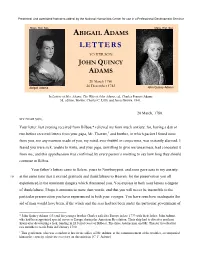
Abigail Adams, Letters to from John Adams and John Quincy Adams
___Presented, and asterisked footnotes added, by the National Humanities Center for use in a Professional Development Seminar___ Mass. Hist. Soc. Mass. Hist. Soc. ABIGAIL ADAMS LETTERS TO HER SON JOHN QUINCY ADAMS 20 March 1780 Abigail Adams 26 December 1783 John Quincy Adams In Letters of Mrs. Adams, The Wife of John Adams, ed., Charles Francis Adams 3d. edition, Boston: Charles C. Little and James Brown, 1841. 20 March, 1780. MY DEAR SON, Your letter, last evening received from Bilboa,* relieved me from much anxiety; for, having a day or two before received letters from your papa, Mr. Thaxter,1 and brother, in which packet I found none from you, nor any mention made of you, my mind, ever fruitful in conjectures, was instantly alarmed. I feared you were sick, unable to write, and your papa, unwilling to give me uneasiness, had concealed it from me; and this apprehension was confirmed by every person’s omitting to say how long they should continue in Bilboa. Your father’s letters came to Salem, yours to Newburyport, and soon gave ease to my anxiety, 10 at the same time that it excited gratitude and thankfulness to Heaven, for the preservation you all experienced in the imminent dangers which threatened you. You express in both your letters a degree of thankfulness. I hope it amounts to more than words, and that you will never be insensible to the particular preservation you have experienced in both your voyages. You have seen how inadequate the aid of man would have been, if the winds and the seas had not been under the particular government of * John Quincy Adams (13) and his younger brother Charles sailed to Europe in late 1779 with their father, John Adams, who had been appointed special envoy to Europe during the American Revolution. -

Massachusetts Historical Society, Adams Papers Editorial Project
Narrative Section of a Successful Application The attached document contains the grant narrative of a previously funded grant application, which conforms to a past set of grant guidelines. It is not intended to serve as a model, but to give you a sense of how a successful application may be crafted. Every successful application is different, and each applicant is urged to prepare a proposal that reflects its unique project and aspirations. Prospective applicants should consult the application guidelines for instructions. Applicants are also strongly encouraged to consult with the NEH Division of Research Programs staff well before a grant deadline. Note: The attachment only contains the grant narrative, not the entire funded application. In addition, certain portions may have been redacted to protect the privacy interests of an individual and/or to protect confidential commercial and financial information and/or to protect copyrighted materials. Project Title: Adams Papers Editorial Project Institution: Massachusetts Historical Society Project Director: Sara Martin Grant Program: Scholarly Editions and Translations Program Statement of Significance and Impact The Adams Papers Editorial Project is sponsored by and located at the Massachusetts Historical Society (MHS). The Society’s 300,000-page Adams Family Papers manuscript collection, which spans more than a century of American history from the Revolutionary era to the last quarter of the nineteenth century, is consulted during the entire editing process, making the project unique among large-scale documentary editions. The Adams Papers has published 52 volumes to date and will continue to produce one volume per year. Free online access is provided by the MHS and the National Archives. -

Download Download
Book Reviews 307 Pressly deserves praise for his accomplishment in pre- senting this survey of intellectual history, and for providing the student and general reader with a useful summary of the major literature of the Civil War. And, considering the world in which Pressly writes, it is a matter of moment to have this important reminder that honest men may differ in their interpretations of events. Earlham College Harold M. Hyman The Writing of American History. By Michael Kraus. (Norman, Oklahoma : University of Oklahoma Press, 1953, pp. x, 386. Index. $5.50.) American historiography began with the Norse sagas but with the Spanish historians there began a chain of narration that links with our own day, and Richard Hakluyt was to write volumes about imperial expansion before the English began their colonization of America. With this introduction Michael Kraus takes up the historians of the first settle- ments-John Smith, William Bradford, John Winthrop, and on through the Mathers. The chapters that follow, in the main, proceed chronologically : The Era of Colonialism ; The Growing National Spirit: 1750-1800 ; Gathering the Records- Awaiting the National Historian ; Patriots, Romantics-and Hildreth; Francis Parkman; The Rise of the “Scientific School” ; Henry Adams ; The Nationalist School ; The Imperial School of Colonial History ; The Frontier and Sectional Histor- ians ; Biography ; and Contemporary Trends. In 1891 James Franklin Jameson published a sketch of American historical writing, carrying his study to the 1880’s. In 1917 John Spencer Bassett published his The Middle Group of American Historians, chiefly concerned with Sparks, Bancroft, and Peter Force. Not until 1937 when Michael Kraus published his A History of American History was any survey of the whole field of American historical writing available. -

DONOVAN, Timothy Paul. HENRY ADAMS and BROOKS ADAMS: the SEARCH for a LAW
This dissertation has beenmicrofilmed exactly asreceived Mic 60-5186 DONOVAN, Timothy Paul. HENRY ADAMS AND BROOKS ADAMS: THE SEARCH FOR A LAW. The University of Oklahoma, Ph.D., 1960 History, general University Microfilms, Inc., Ann Arbor, Michigan THE UNIVERSITY OF OKLAHOMA GRADUATE COLLEGE HENRY ADAMS AND BROOKS ADAMS: THE SEARCH FOR A LAIV A DISSERTATION SUBMITTED TO THE GRADUATE FACULTY in partial fulfillment of the requirements for the degree of DOCTOR OF PHILOSOPHY BY TIMOTHY PAUL DONOVAN Norman, Oklahoma i960 HENRY ADAMS AND BROOKS ADAMS; THE SEARCH FOR A LAW APPROVED BY c : A , bvL'iZ ^2if7S^ DISSERTATION COMMITTEE TABLE OF CONTENTS Chapter Page I. AMERICA AND AMERICAN HISTORY.... ..................... 1 II. HENRY ADAMS: THE SEARCH .............................. 25 III. BROOKS ADAMS: THE SEARCH ............................ 63 INTERLUDE .................... 99 IV. HENRY ADAMS: THE LAW ................................. IO8 V. BROOKS ADAMS: THE L A W ................................ I38 INTERLUDE .......................................... 16? VI. THE ADAMSES AND THE AMERICAN DREAM ................. 175 VII. THE ADAMSES AND AMERICAN HISTORIOGRAPHY ............. 211 BIBLIOGRAPHY ............................................... 222 iix ACKNOWLEDGEMENTS The author would like to express his deep gratitude to Dr. John S. Ezell who first showed him the fascination of intel lectual history and who was of immeasurable aid in the direction of the dissertation. I would also like to thank Dr. Donnell M. Owings who read the first draft and made many valuable suggestions. Thanks are due to the other members of the committee, Dr. Herbert J. Ellison, Dr. Cortez A. M. Ewing, and Dr. William E. Livezey for their advice and counsel. A special debt is owed to Dr. Bert James Loewenberg of Sarah Lawrence College who by correspondence and interview directed the author's attention to the significance of Henry and Brooks Adams. -

Presidents' Day Family
Schedule at a Glance Smith Center Powers Room Learning Center The Pavilion Exhibit Galleries Accessibility: Performances Hands-on | Crafts Performances | Activities “Make and Take” Craft Activities Special Activities Learning Wheelchairs are available Shaping A New Nation Suffrage Centennial Center at the Visitor Admission 10:00 Desk on a first come, first served basis. Video Popsicle presentations in the Museum Stick Flags 10:30 Mini RFK 10:00 – 11:00 Foyer Elevators are captioned for visitors John & Abigail Adams WPA Murals Smith Center who are deaf or hard 10:30 – 11:10 Suffragist 10:00 – 11:30 Kennedy Scrimshaw of hearing. 11:00 Read Aloud Sashes & Campaign Hats 10:30 – 11:30 10:45 – 11:15 Sunflowers & Buttons James & Dolley Madison 10:00 – 12:30 10:00 – 12:15 Powers Café 11:30 11:10 – 11:50 Colonial Clothes Lucretia Mott Room 11:00 – 12:15 11:15 – 11:40 Adams Astronaut Museum Tour 11:15 – 12:20 Helmets 11:30 – 12:15 12:00 Eleanor Roosevelt 11:15 – 12:30 Restrooms 11:50 – 12:30 PT 109 Cart 12:30 Sojourner Truth Protest Popsicle 12:00 – 1:00 Presidential Press Conference 12:15 – 1:00 Posters Stick Flags 12:30 – 1:00 Museum Evaluation Station Presidential 12:00 – 1:30 12:00 – 1:30 Homes Store 1:00 James & Dolley Madison 12:30 – 1:30 Pavilion Adams Letter Writing 1:00 – 1:30 Astronaut Museum 1:00 – 1:40 to the President Space Cart Lucretia Mott Helmets Lobby 12:30 – 2:15 1:00 – 2:00 1:30 Eleanor Roosevelt 1:15 – 1:45 1:00 – 2:00 Entrance 1:30 – 2:00 2:00 John & Abigail Adams Sojourner Truth 2:00 – 2:30 2:00-2:30 Museum Tour Zines Scrimshaw 2:00 – 2:45 1:00 – 3:30 Mini 2:00 – 3:00 Sensory 2:30 Powerful Women Jeopardy WPA Murals Accommodations: 2:30 – 3:00 2:00 – 3:30 Kennedy The John F. -

Ranking America's First Ladies Eleanor Roosevelt Still #1 Abigail Adams Regains 2 Place Hillary Moves from 2 to 5 ; Jackie
For Immediate Release: Monday, September 29, 2003 Ranking America’s First Ladies Eleanor Roosevelt Still #1 nd Abigail Adams Regains 2 Place Hillary moves from 2 nd to 5 th ; Jackie Kennedy from 7 th th to 4 Mary Todd Lincoln Up From Usual Last Place Loudonville, NY - After the scrutiny of three expert opinion surveys over twenty years, Eleanor Roosevelt is still ranked first among all other women who have served as America’s First Ladies, according to a recent expert opinion poll conducted by the Siena (College) Research Institute (SRI). In other news, Mary Todd Lincoln (36 th ) has been bumped up from last place by Jane Pierce (38 th ) and Florence Harding (37 th ). The Siena Research Institute survey, conducted at approximate ten year intervals, asks history professors at America’s colleges and universities to rank each woman who has been a First Lady, on a scale of 1-5, five being excellent, in ten separate categories: *Background *Integrity *Intelligence *Courage *Value to the *Leadership *Being her own *Public image country woman *Accomplishments *Value to the President “It’s a tracking study,” explains Dr. Douglas Lonnstrom, Siena College professor of statistics and co-director of the First Ladies study with Thomas Kelly, Siena professor-emeritus of American studies. “This is our third run, and we can chart change over time.” Siena Research Institute is well known for its Survey of American Presidents, begun in 1982 during the Reagan Administration and continued during the terms of presidents George H. Bush, Bill Clinton and George W. Bush (http://www.siena.edu/sri/results/02AugPresidentsSurvey.htm ). -

Founding Fathers" in American History Dissertations
EVOLVING OUR HEROES: AN ANALYSIS OF FOUNDERS AND "FOUNDING FATHERS" IN AMERICAN HISTORY DISSERTATIONS John M. Stawicki A Thesis Submitted to the Graduate College of Bowling Green State University in partial fulfillment of the requirements for the degree of MASTER OF ARTS December 2019 Committee: Andrew Schocket, Advisor Ruth Herndon Scott Martin © 2019 John Stawicki All Rights Reserved iii ABSTRACT Andrew Schocket, Advisor This thesis studies scholarly memory of the American founders and “Founding Fathers” via inclusion in American dissertations. Using eighty-one semi-randomly and diversely selected founders as case subjects to examine and trace how individual, group, and collective founder interest evolved over time, this thesis uniquely analyzes 20th and 21st Century Revolutionary American scholarship on the founders by dividing it five distinct periods, with the most recent period coinciding with “founders chic.” Using data analysis and topic modeling, this thesis engages three primary historiographic questions: What founders are most prevalent in Revolutionary scholarship? Are social, cultural, and “from below” histories increasing? And if said histories are increasing, are the “New Founders,” individuals only recently considered vital to the era, posited by these histories outnumbering the Top Seven Founders (George Washington, Thomas Jefferson, John Adams, James Madison, Alexander Hamilton, Benjamin Franklin, and Thomas Paine) in founder scholarship? The thesis concludes that the Top Seven Founders have always dominated founder dissertation scholarship, that social, cultural, and “from below” histories are increasing, and that social categorical and “New Founder” histories are steadily increasing as Top Seven Founder studies are slowly decreasing, trends that may shift the Revolutionary America field away from the Top Seven Founders in future years, but is not yet significantly doing so. -

Abigail Adams As a Typical Massachusetts Woman at the Close of the Colonial Era
V/ax*W ad Close + K*CoW\*l ^V*** ABIGAIL ADAMS AS A TYPICAL MASSACHUSETTS WOMAN AT THE CLOSE OF THE COLONIAL ERA BY MARY LUCILLE SHAY THESIS FOR THE DEGREE OF BACHELOR OF ARTS HISTORY COLLEGE OF LIBERAL ARTS AND SCIENCES UNIVERSITY OF ILLINOIS 1917 - UNIVERSITY OF ILLINOIS m^ji .9../. THIS IS TO CERTIFY THAT THE THESIS PREPARED UNDER MY SUPERVISION BY ./?^..f<r*T) 5^.f*.l^.....>> .&*r^ ENTITLED IS APPROVED BY ME AS FULFILLING THIS PART OF THE REQUIREMENTS FOR THE DEGREE OF i^S^«4^jr..^^ UA^.tltht^^ Instructor in Charge Approved :....<£*-rTX??. (QS^h^r^r^. lLtj— HEAD OF DEPARTMENT OF ZL?Z?.f*ZZS. 376674 * WMF ABIGAIL ARAMS AS A TYPICAL MASSACHUSETTS '.70MJEN AT THE CLOSE OP THE COLONIAL ERA Page. I. Introduction. "The Woman's Part." 1 II. Chapter 1. Domestic Life in Massachusetts at the Close of the Colonial Era. 2 III. Chapter 2. Prominent V/omen. 30 IV. Chapter 3. Abigail Adacs. 38 V. Bibliography. A. Source References 62 B. Secondary References 67 I Digitized by the Internet Archive in 2013 http://archive.org/details/abigailadamsastyOOshay . 1 ABIJAIL ARAMS A3 A ISP1CAL MASSACHUSETTS .VOMAIJ aT THE GLOSS OF THE COLOHIAL SEA. I "The Woman's Part" It was in the late eighteenth century that Abigail Adams lived. It was a time not unlike our own, a time of disturbed international relations, of war. School hoys know the names of the heroes and the statesmen of '76, but they have never heard the names of the women. Those names are not men- tioned; they are forgotten. -

John Quincy Adams Influence on Washington's Farewell Address: A
La Salle University La Salle University Digital Commons Undergraduate Research La Salle Scholar Winter 1-7-2019 John Quincy Adams Influence on ashingtW on’s Farewell Address: A Critical Examination Stephen Pierce La Salle University, pierces5@student.lasalle.edu Follow this and additional works at: https://digitalcommons.lasalle.edu/undergraduateresearch Part of the Constitutional Law Commons, First Amendment Commons, International Law Commons, Law and Politics Commons, Law and Society Commons, Legal History Commons, Legislation Commons, Military History Commons, Military, War, and Peace Commons, National Security Law Commons, President/Executive Department Commons, and the United States History Commons Recommended Citation Pierce, Stephen, "John Quincy Adams Influence on ashingtW on’s Farewell Address: A Critical Examination" (2019). Undergraduate Research. 33. https://digitalcommons.lasalle.edu/undergraduateresearch/33 This Article is brought to you for free and open access by the La Salle Scholar at La Salle University Digital Commons. It has been accepted for inclusion in Undergraduate Research by an authorized administrator of La Salle University Digital Commons. For more information, please contact careyc@lasalle.edu. John Quincy Adams Influence on Washington’s Farewell Address: A Critical Examination By Stephen Pierce In the last official letter to President Washington as Minister to the Netherlands in 1797, John Quincy Adams expressed his deepest thanks and reverence for the appointment that was bestowed upon him by the chief executive. As Washington finished his second and final term in office, Adams stated, “I shall always consider my personal obligations to you among the strongest motives to animate my industry and invigorate my exertions in the service of my country.” After his praise to Washington, he went into his admiration of the president’s 1796 Farewell Address. -
From Abigail Adams to John Adams
The Library of America • Story of the Week Both letters by Abigail Adams are from Abigail Adams: Letters (Library of America, 2016), 90–93, 93–95. John Adams’s response is from John Adams: Revolutionary Writings 1775–1783 (Library of America, 2011), 57–59. The texts are reprinted from Adams Family Correspondence, volume 1 (1963), edited by J. H. Butterfield. Copyright © 1963 Massachusetts Historical Society. “REMEMBER THE LADIES” From Abigail Adams to John Adams Braintree March 31 1776 I wish you would ever write me a Letter half as long as I write you; and tell me if you may where your Fleet are gone? What sort of Defence Virginia can make against our common Enemy? Whether it is so situated as to make an able Defence? Are not the Gentery Lords and the common people vassals, are they not like the uncivilized Natives Brittain represents us to be? I hope their Riffel Men who have shewen themselves very savage and even Blood thirsty; are not a specimen of the Generality of the people. I am willing to allow the Colony great merrit for having produced a Washington but they have been shamefully duped by a Dunmore. I have sometimes been ready to think that the passion for Liberty cannot be Eaquelly Strong in the Breasts of those who have been accustomed to deprive their fellow Creatures of theirs. Of this I am certain that it is not founded upon that generous and christian principal of doing to others as we would that others should do unto us. Do not you want to see Boston; I am fearfull of the small pox, or I should have been in before this time.