Montenegro: Vassal Or Sovereign?
Total Page:16
File Type:pdf, Size:1020Kb
Load more
Recommended publications
-

Federal Republic of Yugoslavia
Public Disclosure Authorized FEDERAL REPUBLIC OF YUGOSLAVIA BREAKING WITH THE PAST: THE PATH TO STABILITY AND GROWTH Volume II: Assistance Priorities and Public Disclosure Authorized Sectoral Analyses Public Disclosure Authorized Public Disclosure Authorized ii TABLE OF CONTENTS ABBREVIATIONS AND ACRONYMS………………………………………………………...viii ACKNOWLEDGEMENT……………………………………………………………………….. ix CHAPTER 1. AN OVERVIEW OF THE ECONOMIC RECOVERY AND TRANSITION PROGRAM…………………………………………………………………………………….... 1 A. Introduction……………………………………………………………………………..... 1 B. The Government’s medium-term Challenges…………………………………………..... 3 C. Medium-term External Financing Requirements………………………………….……... 4 D. The 2001 Program………………………………………………………………………... 8 E. Implementing the Program………………………………………………………….…....13 CHAPTER 2. FISCAL POLICY AND MANAGEMENT………………….…………………..15 A. Reducing Quasi Fiscal Deficits and Hidden Risks…………………………………….. ..16 B. Transparency and Accountability of Public Spending………………….………………..27 C. Public Debt Management………………………………………………………………...34 D. Tax Policy and Administration…………………………………………….…………... ..39 CHAPTER 3. TRADE………………………………………...…………………….…………..48 A. Patterns of Trade in Goods and Services ……………………………..………..……… ..48 B. Trade Policies: Reforms to date and plans for the future………………………………...51 C. Capacity to Trade: Institutional and other constraints to implementation…………….....55 D. Market Access: The global, European and regional dimension……………………….. ..57 E. Policy recommendations………………………………………………………………....60 F. Donor Program……………………………………………………………….…………..62 -

SEA of Montenegro's National Climate Change Strategy
The European Union’s IPA Programme for Montenegro SEA of Montenegro’s National Climate Change Strategy (NCCS) EuropeAid/127054/C/SER/multi SEA Report Prepared by: Juan Palerm, Jiří Dusík, Ivana Šarić, Gordan Golja and Marko Slokar Ref. Contract N° 2014/354504 Final Report 14 September, 2015 Development of the Strategic Environment Assessment (SEA) for the Project Title: National Climate Change Strategy by 2030 (EuropeAid/127054/C/SER/multi) Financing: IPA Reference No: (EuropeAid/127054/C/SER/multi) Starting Date: February 2015 End Date (Duration): June 2015 Contract Number: 2014/354504 Contracting Authority: Delegation of the European Union to Montenegro Task Manager: Mr. Sladjan MASLAĆ, Task Manager Address: Vuka Karadžića 12, 81000 Podgorica Phone: + 382 (0) 20 444 600 Fax: + 382 (0) 20 444 666 E-mail: Sladjan.MASLAC@eeas.europa.eu Beneficiary: Ministry of Sustainable Development and Tourism [MSDT] Head of PSC: Ivana VOJINOVIC Address: IV Proleterske brigade 19, 81000 Podgorica Phone: + 382 (0) 20 446 208 Fax: + 382 (0) 20 446 215 E-mail: ivana.Vojinovic@mrt.gov.me Contractor: Particip GmbH Address: Merzhauser Str. 183, D - 79100 Freiburg, Germany Phone: +49 761 79074 0 Fax: +49 761 79074 90 Project Director: Martin GAYER E-mail address: martin.gayer@particip.de Date of report: 27/03/2015 Revision NA Author of the report: Juan PALERM .............................................. Controlled by: Martin GAYER .............................................. Approved: Mr. Siniša STANKOVIĆ [Head PSC] .............................................. Approved: Mr. Slađan MASLAĆ [Task Manager of EUD] .............................................. Disclaimer: The opinions expressed in this Report are those of the authors and do not necessarily reflect the opinions of the EU Delegation or any other organisation mentioned in the report. -

DAFTAR PUSTAKA Buku Baylis, John, Et Al. the Globalization of World Politics: an Introduction to International Relations. Oxford
DAFTAR PUSTAKA Buku Baylis, John, et al. The Globalization of World Politics: An Introduction to International Relations. Oxford. Oxford University Press. 2008. Bremer, Ian. The J Curve (Soft Cover) Strategi untuk Memahami Mengapa Bangsa- Bangsa Berjaya dan Jatuh. Jakarta. Gramedia Pustaka Utama. 2013. C, C, Rodee. Pengantar Ilmu Politik. Jakarta. Rajawali. 2002. Coplin, D, William. Pengantar Politik Internasional: Suatu Telaah Teoritis. Bandung. CV. Sinar Baru. 1992. Djaja, Wahjudi. Sejarah Eropa : Dari Eropa Kuno Hingga Eropa Modern. Yogyakarta. Penerbit Ombak. 2012. Endaswara, Suwardi. Metode, Teori, Teknik Penelitian Kebudayaan. Yogyakarta. Pustaka Widyatama. 2006. Holsti, K.J. Politik International: Suatu Kerangka Analisis. Bandung. Bina Cipta. 1992. Jackson, Robert dan Sorensen, Gorge. Pengantar Studi Hubungan Internasional. Yogyakarta. Pustaka Pelajar. 2005. Keohane, O, Robert. International Institutions and State Power (Essay in International Relations Theory). London. Westvie Press. 1989. Maso’ed, Mochtar. Ilmu Hubungan Internasional: Disiplin dan Metodologi. Jakarta. LP3ES. 1990. Moleong, Lexy J. Metode Penelitian Kualitatif. Bandung. Remaja Rosdakarya. 2007. Murdiyatmoko, Janu. Sosiologi : Memahami dan Mengkaji Masyarakat. Bandung. Grafindo Media Pratama. 2007. Rudy, T, May. Study Strategis Dalam Transformasi Sistem Internasional Pasca Perang Dingin. Bandung : Refika Aditama. 2002. Russet, Bruce dan Starr, Harvey. World Politics: The Menu for Choice. 2nd ed. New York. W.H.Freeman and Co. 1988. Sugiyono. Cara Mudah Menyusun : Skripsi, Tesis dan Disertasi. Bandung. Alfabeta. 2014. 134 135 Sugiyono. Metode Penelitian Kuantitatif Kualitatif dan R&D. Bandung. Alfabeta. 2009. Perwita, Anak Agung Banyu dan Yani, Yanyan M. Pengantar Ilmu Hubungan Internasional. Bandung. Rosda Karya. 2006. Jurnal Commission, European. EU Enlargement Strategy. Strategy Paper. Brussels, Belgium. 2015. Commission, European. How the European Union works. -

Socio Economic Analysis of Northern Montenegrin Region
SOCIO ECONOMIC ANALYSIS OF THE NORTHERN REGION OF MONTENEGRO Podgorica, June 2008. FOUNDATION F OR THE DEVELOPMENT O F NORTHERN MONTENEGRO (FORS) SOCIO -ECONOMIC ANLY S I S O F NORTHERN MONTENEGRO EXECUTIVE DIRECTOR : Veselin Šturanović STUDY REVIEWER S : Emil Kočan, Nebojsa Babovic, FORS Montenegro; Zoran Radic, CHF Montenegro IN S TITUTE F OR STRATEGIC STUDIE S AND PROGNO S E S ISSP’S AUTHOR S TEAM : mr Jadranka Kaluđerović mr Ana Krsmanović mr Gordana Radojević mr Ivana Vojinović Milica Daković Ivan Jovetic Milika Mirković Vojin Golubović Mirza Mulešković Marija Orlandić All rights reserved. No part of this publication may be reproduced or distributed in any form or by any means wit- hout the prior written permission of FORS Montenegro. Published with support from the United States Agency for International Development (USAID) through the CHF International, Community Revitalization through Democratic Action – Economy (CRDA-E) program. The opinions expressed herein are those of the authors and do not necessarily reflect the views of the U.S. Agency for Interna- tional Development. For more information please contact FORS Montenegro by email at mailbox@forsmontenegro.org or: FORS Montenegro, Berane FORS Montenegro, Podgorica Dušana Vujoševića Vaka Đurovića 84 84300, Berane, Montenegro 81000, Podgorica, Montenegro +382 51 235 977 +382 20 310 030 SOCIO ECONOMIC ANALYSIS OF THE NORTHERN REGION OF MONTENEGRO CONTENTS ABBREVIATIONS: ............................................................................................................................................................... -

Call from Members of the Nizami Ganjavi International Centre to the United Nations Security Council to Support the UN Secretary
Call from Members of the Nizami Ganjavi International Centre to the United Nations Security Council to Support the UN Secretary-General’s Urgent Call for an Immediate Global Ceasefire amid the COVID-19 Pandemic We are deeply alarmed that the United Nations Security Council has not been able to reach agreement on a draft resolution put before it on COVID-19. This draft resolution called for an end to hostilities worldwide so that there could be a full focus on fighting the Covid-19 pandemic. If passed it would have given powerful backing to the call made earlier by the Secretary-General. Yet, agreement could not be reached on the resolution in the Security Council because of its reference to “the urgent need to support…. all relevant entities of the United Nations system, including specialized health agencies” in the fight against the pandemic. The failure to reach agreement saddens us at this time when our world is in crisis. The Covid-19 pandemic has brought about immense human suffering and is having a devastating impact on economies and societies. It is exactly at times like this that the leadership of the Security Council is needed. It should not be silent in the face of the serious threat to global peace and security which Covid-19 represents. Global action and partnership are vital now to deal with the global pandemic and its aftermath. This is the time for the premier institution responsible for leading on global security to show strength, not weakness. We support UN Secretary-General António Guterres in his call for an immediate global ceasefire, in all corners of the world, amid the COVID-19 pandemic. -

LETTER to G20, IMF, WORLD BANK, REGIONAL DEVELOPMENT BANKS and NATIONAL GOVERNMENTS
LETTER TO G20, IMF, WORLD BANK, REGIONAL DEVELOPMENT BANKS and NATIONAL GOVERNMENTS We write to call for urgent action to address the global education emergency triggered by Covid-19. With over 1 billion children still out of school because of the lockdown, there is now a real and present danger that the public health crisis will create a COVID generation who lose out on schooling and whose opportunities are permanently damaged. While the more fortunate have had access to alternatives, the world’s poorest children have been locked out of learning, denied internet access, and with the loss of free school meals - once a lifeline for 300 million boys and girls – hunger has grown. An immediate concern, as we bring the lockdown to an end, is the fate of an estimated 30 million children who according to UNESCO may never return to school. For these, the world’s least advantaged children, education is often the only escape from poverty - a route that is in danger of closing. Many of these children are adolescent girls for whom being in school is the best defence against forced marriage and the best hope for a life of expanded opportunity. Many more are young children who risk being forced into exploitative and dangerous labour. And because education is linked to progress in virtually every area of human development – from child survival to maternal health, gender equality, job creation and inclusive economic growth – the education emergency will undermine the prospects for achieving all our 2030 Sustainable Development Goals and potentially set back progress on gender equity by years. -

Montenegro Guidebook
MONTENEGRO PREFACE Podgorica, the capital of Montenegro, lies in a broad plain crossed by five rivers and surrounded by mountains, just 20 kilometers from the Albanian border. The city has a population of around 180,000 people. Bombed into rubble during World War II, Podgorica was rebuilt into a modern urban center, with high-rise apartment buildings and new office and shopping developments. While the latest Balkan war had a low impact on the physical structures, the economic sanctions had a devastating effect on employment and infrastructure. With the help of foreign investment, urban renewal is evident throughout the city, but much of it may still appear run down. Podgorica has a European-style town center with a pedestrian- only walking street (mall) and an assortment of restaurants, cafes, and boutiques. To many, its principal attraction is as a base for the exploration of Montenegro’s natural beauty, with mountains and wild countryside all around and the stunning Adriatic coastline less than an hour away. This is a mountainous region with barren moorlands and virgin forests, with fast-flowing rivers and picturesque lakes; Skadar Lake in particular is of ecological significance. The coastline is known for its sandy beaches and dramatic coves: for example, Kotor – the city that is protected by UNESCO and the wonderful Cathedral of Saint Typhoon; the unique baroque Perast; Saint George and Our Lady of the Rock islands – all locations that tell a story of a lasting civilization and the wealth of the most wonderful bay in the world. The area around the city of Kotor is a UNESCO World Heritage site for its natural beauty and historic significance. -
Development and Approval of the Budget in Water Supply System
DEVELOPMENT AND APPROVAL OF THE BUDGET IN WATER SUPPLY SYSTEM Authors: Božo Đikanović /Finance Director/d.o.o “Vodovod i kanalizacija” Podgorica, Podgorica, /Montenegro Jadranka Pavićević /Head of Center for Quality/DOO “Vodovod i kanalizacija – Cetinje”, Cetinje /Montenegro Marjana Kaluđerović /Head of Sector of Ecology and integrated management systems/Kombinat aluminijuma Podgorica, Podgorica/Montenegro B.ĐIKANOVIĆ, J.PAVIĆEVIĆ AND M.KALUĐEROVIĆ - DEVELOPMENT AND APPROVAL OF THE BUDGET IN WATER SUPPLY SYSTEM INTRODUCTION | Water is precious natural resorce. The Goverment has formulated Strategy sustainable rearsch for ensuring suinstable use of water resources. Our company is to support the municipality in meeting these goals with functions continuous water supply for citizens with good water quality. In order to achieve the set goals of principles of sustainability of the water supply and public health protection it must be achieved all the specific goals in specific processes. | It is necessary for the planned activities at the level of all processes make a plan of action and assessment of fixed costs and investments. For achieve economy and efficiency of operations will be used resistance da ta from other water systems. Prepara tion of the operating bu dge t and capital budget are a major segment of the financial activity, and is of great significance monitoring challenges arising in the EU accession process. It should also be noted first of all given to training for the accumula tion of know le dge and skills to achieve the set tar ge t. | The implementation Scada applications support the management of production and distribution of water, and water quality monitoring. -

World Bank Document
Document of The World Bank Report No: 40088 Public Disclosure Authorized PROJECT BRIEF ON A Public Disclosure Authorized PROPOSED GRANT FROM THE GLOBAL ENVIRONMENT FACILITY TRUST FUND IN THE AMOUNT OF US$ 4.55 MILLION TO THE GOVERNMENT OF ALBANIA AND THE GOVERNMENT OF MONTENEGRO FOR A Public Disclosure Authorized LAKE SKADAR-SHKODER INTEGRATED ECOSYSTEM MANAGEMENT PROJECT May 8, 2007 Sustainable Development Unit Public Disclosure Authorized Europe and Central Asia Region (ECSSD) CURRENCY EQUIVALENTS (Exchange Rate Effective {Date}) Currency Unit = Serbian Dinar (CSD) 70.33 CSD = USD 1 FISCAL YEAR January 1 – December 31 ABBREVIATIONS AND ACRONYMS BLMC Bilateral Lake Management Committee (Albania and Montenegro) CAS Country Assistance Strategy CETI Center for Ecotoxicological Research (Montenegro) EAR European Agency for Reconstruction EIA Environmental Impact Assessment EPA Environmental Protection Agency (Montenegro) EU European Union FAO Food and Agriculture Organization (United Nations) GEF Global Environment Facility GoA Government of Republic of Albania GoM Government of Republic of Montenegro GTZ Gesellschaft fur Technische Zusammenarbeit (Germany) IBRD International Bank for Reconstruction and Development IDA International Development Association IUCN World Conservation Union KAP Kombinat Aluminijuma Podgorica KFW Kredit fur Wiederaufbau (Germany) MEFWA Ministry of Environment, Forests and Water Administration (Albania) MESTAP Montenegro Environmentally Sensitive Tourism Areas Project (World Bank) MTEP Ministry of Tourism and Environmental -
A Multiscalar Research Project, Following an Ancient Decumanus in Montenegro
2020 IMEKO TC-4 International Conference on Metrology for Archaeology and Cultural Heritage Trento, Italy, October 22-24, 2020 A multiscalar research project, following an ancient decumanus in Montenegro Lucia Alberti1, Francesca Colosi2, Pasquale Merola 3 1 Institute of Heritage Sciences, National Research Council of Italy – Area della Ricerca Roma 1, Via Salaria km 29,300 CP 10 – 00015 Monterotondo St., ITALY, lucia.alberti@cnr.it 2 Institute of Heritage Sciences, National Research Council of Italy – Area della Ricerca Roma 1, Via Salaria km 29,300 CP 10 – 00015 Monterotondo St., ITALY, francesca.colosi@cnr.it 3 Institute of Heritage Sciences, National Research Council of Italy – University Campus of Lecce, via per Monteroni, Lecce, ITALY, pasquale.merola@cnr.it Abstract – A multidisciplinary project is being carried knowledge of the site and then to fashion and carry through out by an Italian-Montenegrin team in the Roman town an improved design for a sustainable plan on its relaunch. of Doclea in Montenegro. Applying a multi- and After establishing a diachronic reconstruction of Doclea interdisciplinary approach and multiscalar analysis to and the cultural landscape of its valley from the Bronze the site and its surrounding territory, it has been Age to the medieval period, our ultimate goal is to make possible to identify traces of the decumanus maximus, the territory more visible, making it more attractive for the not only in the public centre of the city, where the main application of new technologies. Through these last the road was partially already excavated, but also outside knowledge gained can be circulated, the populace the walls of the town, even into the suburbs of the revitalized and cultural tourism encouraged. -

“Thirty Years After Breakup of the SFRY: Modern Problems of Relations Between the Republics of the Former Yugoslavia”
RUSSIAN ACADEMY OF SCIENCES, INSTITUTE OF ECONOMICS “Thirty years after breakup of the SFRY: modern problems of relations between the republics of the former Yugoslavia” 15th independence anniversary of Montenegro: achievements and challenges Prof. dr Gordana Djurovic University of Monenegro 21 May 2021 1 An overview: from Doclea to the Kingdom of Montenegro (1) • During the Roman Empire, the territory of Montenegro was actually the territory of Duklja (DOCLEA). Doclea was originally the name of the Roman city on the site of modern Podgorica (Ribnica), built by Roman Emperor Diocletian, who hailed from this region of Roman Dalmatia. • With the arrival of the Slovenes in the 7th century, Christianity quickly gained primacy in this region. • Doclea (Duklja) gradually became a Principality (Knezevina - Arhontija) in the second part of the IX century. • The first known prince (knez-arhont) was Petar (971-990), (or Petrislav, according to Kingdom of Doclea by 1100, The Chronicle of the Priest of Dioclea or Duklja , Ljetopis popa Dukljanina, XIII century). In 1884 a during the rule of King Constantine Bodin lead stamp was found, on which was engraved in Greek "Petar prince of Doclea"; In that period, Doclea (Duklja) was a principality (Byzantine vassal), and Petar was a christianized Slav prince (before the beginning of the Slavic mission of Cirilo and Metodije in the second part of the IX century (V.Nikcevic, Crnogorski jezik, 1993). • VOJISLAVLJEVIĆ DYNASTY (971-1186) - The first ruler of the Duklja state was Duke Vladimir (990 – 1016.). His successor was duke Vojislav (1018-1043), who is considered the founder of Vojislavljević dynasty, the first Montenegrin dynasty. -
Shorezone Functionality Skadar/Shkodra Lake Implementing the EU Water Framework Directive in South-Eastern Europe
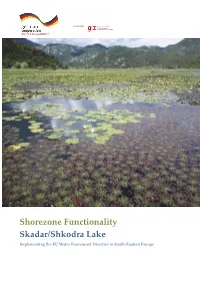
, Shorezone Functionality Skadar/Shkodra Lake Implementing the EU Water Framework Directive in South-Eastern Europe Shorezone Functionality Skadar/Shkodra Lake Implementing the EU Water Framework Directive in South-Eastern Europe Shorezone Functionality – Skadar/Shkodra Lake Acknowledgements The present report is the result of transboundary collaboration of experts from Albania, Macedonia and Montenegro. The experts are acknowledged for both their professionalism and spirit of cooperation. Special thanks to Ralf Peveling and Holger Densky for their encouragement and significant feedback, and to the National Coordinators of CSBL, Alkida Prodani, Jelena ²° and Nikoleta Bogatinovska who provided constant support during project implementation. Many thanks also to Mihallaq S. Qirjo, Vasil Male and Olsi Duma from Prespa National Park, Kosta Trajce and Arjan Cinari from the Fisheries Management Organization (FMO) of Prespa and Shkodra, respectively, and Vladimir Sjekloca from the National Park of Skadar Lake for their assistance during data collection Barbara Zennaro, Key Expert Disclaimer The views and management recommendations expressed in the present report are those of the authors and do not necessarily reflect those of GIZ, the Governments of Albania, Macedonia and Montenegro, nor the national competent authorities in charge of implementing the EU Water Framework Directive. The use of particular designations of hydrogeomorphological areas does not imply any judgement by the publisher, the GIZ, as to the legal status of such water bodies,