Retirement of Mr. Justice Nelson
Total Page:16
File Type:pdf, Size:1020Kb
Load more
Recommended publications
-
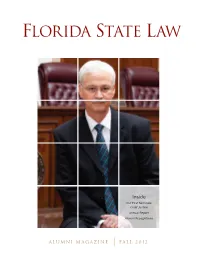
Fall 2012 Florida State Law Magazine
FLORIDA STATE LAW Inside Our First Seminole Chief Justice Annual Report Alumni Recognitions ALUMNI MAGAZINE FALL 2012 Message from the Dean Jobs, Alumni, Students and Admissions Players in the Jobs Market Admissions and Rankings This summer, the Wall Street The national press has highlighted the related phenomena Journal reported that we are the of the tight legal job market and rising student indebtedness. nation’s 25th best law school when it More prospective applicants are asking if a law degree is worth comes to placing our new graduates the cost, and law school applications are down significantly. in jobs that require law degrees. Just Ours have fallen by approximately 30% over the past two years. this month, Law School Transparency Moreover, our “yield” rate has gone down, meaning that fewer ranked us the nation’s 26th best law students are accepting our offers of admission. Our research school in terms of overall placement makes clear: prime competitor schools can offer far more score, and Florida’s best. Our web generous scholarship packages. To attract the top students, page includes more detailed information on our placement we must limit our enrollment and increase scholarship awards. outcomes. In short, we rank very high nationally in terms We are working with our university administration to limit of the number of students successfully placed. Although our our enrollment, which of course has financial implications average starting salary of $58,650 is less than those at the na- both for the law school and for the central university. It is tion’s most elite private law schools, so is our average student also imperative to increase our endowment in a way that will indebtedness, which is $73,113. -

Reform of the Elected Judiciary in Boss Tweed’S New York
File: 3 Lerner - Corrected from Soft Proofs.doc Created on: 10/1/2007 11:25:00 PM Last Printed: 10/7/2007 6:34:00 PM 2007] 109 FROM POPULAR CONTROL TO INDEPENDENCE: REFORM OF THE ELECTED JUDICIARY IN BOSS TWEED’S NEW YORK Renée Lettow Lerner* INTRODUCTION.......................................................................................... 111 I. THE CONSTITUTION OF 1846: POPULAR CONTROL...................... 114 II. “THE THREAT OF HOPELESS BARBARISM”: PROBLEMS WITH THE NEW YORK JUDICIARY AND LEGAL SYSTEM AFTER THE CIVIL WAR .................................................. 116 A. Judicial Elections............................................................ 118 B. Abuse of Injunctive Powers............................................. 122 C. Patronage Problems: Referees and Receivers................ 123 D. Abuse of Criminal Justice ............................................... 126 III. THE CONSTITUTIONAL CONVENTION OF 1867-68: JUDICIAL INDEPENDENCE............................................................. 130 A. Participation of the Bar at the Convention..................... 131 B. Natural Law Theories: The Law as an Apolitical Science ................................... 133 C. Backlash Against the Populist Constitution of 1846....... 134 D. Desire to Lengthen Judicial Tenure................................ 138 E. Ratification of the Judiciary Article................................ 143 IV. THE BAR’S REFORM EFFORTS AFTER THE CONVENTION ............ 144 A. Railroad Scandals and the Times’ Crusade.................... 144 B. Founding -

Reminiscences of the United States Supreme Court
YALE LAW JO URNAL. REMINISCENCES OF THE UNITED STATES SUPREME COURT. On motion of Reverdy Johnson, at one time Attorney-General and afterward Senator in Congress from Maryland, I was admitted to the bar of the Supreme Court in 1865. Salmon P. Chase was then Chief Justice, and the associates were James M. Wayne, Robert C. Grier, Noah H. Swayne, David Davis, Samuel Nelson, Nathan Clifford, Samuel F. Miller and Stephen J. Field. All of these, ex- cepting Justice Field,* are now dead. I was in Washington at the inauguration of Franklin Pierce in 1853 and attended some of the sessions of the Supreme Court at that time. That court then con- sisted of Roger B. Taney, Chief Justice; John McLean, James M. Wayne, John Catron, Peter V. Daniel, Samuel Nelson, Robert C. Grier, Benjamin R. Curtis and John A. Campbell, associates, none of whom are now living. I never saw Taney, Catron or Daniel afterward, and have no very distinct impressions as to Catron or Daniel, but Chief Justice Taney was a noticeable man and his ap- pearance is still daguerreotyped upon my memory. He was a tall, angular and exceedingly slim man. Apparently there was little or no flesh upon his bones and his face was deeply furrowed by the ravages of time. His eyes surmounted by shaggy eyebrows were deeply set under a remarkably low forehead. There was a rough and rugged distinctness about all his features. He was appointed Chief Justice in 1836 and died in office when he was 88 years old. He was 8o years of age when he delivered the opinion of the court in the celebrated Dred Scott case. -

The Surprising History of the Preponderance Standard of Civil Proof, 67 Fla
Florida Law Review Volume 67 | Issue 5 Article 2 March 2016 The urS prising History of the Preponderance Standard of Civil Proof John Leubsdorf Follow this and additional works at: http://scholarship.law.ufl.edu/flr Part of the Evidence Commons Recommended Citation John Leubsdorf, The Surprising History of the Preponderance Standard of Civil Proof, 67 Fla. L. Rev. 1569 (2016). Available at: http://scholarship.law.ufl.edu/flr/vol67/iss5/2 This Article is brought to you for free and open access by UF Law Scholarship Repository. It has been accepted for inclusion in Florida Law Review by an authorized administrator of UF Law Scholarship Repository. For more information, please contact outler@law.ufl.edu. Leubsdorf: The Surprising History of the Preponderance Standard of Civil Pro THE SURPRISING HISTORY OF THE PREPONDERANCE STANDARD OF CIVIL PROOF John Leubsdorf * Abstract Although much has been written on the history of the requirement of proof of crimes beyond a reasonable doubt, this is the first study to probe the history of its civil counterpart, proof by a preponderance of the evidence. It turns out that the criminal standard did not diverge from a preexisting civil standard, but vice versa. Only in the late eighteenth century, after lawyers and judges began speaking of proof beyond a reasonable doubt, did references to the preponderance standard begin to appear. Moreover, U.S. judges did not start to instruct juries about the preponderance standard until the mid-nineteenth century, and English judges not until after that. The article explores these developments and their causes with the help of published trial transcripts and newspaper reports that have only recently become accessible. -

Supreme Court Justices
The Supreme Court Justices Supreme Court Justices *asterick denotes chief justice John Jay* (1789-95) Robert C. Grier (1846-70) John Rutledge* (1790-91; 1795) Benjamin R. Curtis (1851-57) William Cushing (1790-1810) John A. Campbell (1853-61) James Wilson (1789-98) Nathan Clifford (1858-81) John Blair, Jr. (1790-96) Noah Haynes Swayne (1862-81) James Iredell (1790-99) Samuel F. Miller (1862-90) Thomas Johnson (1792-93) David Davis (1862-77) William Paterson (1793-1806) Stephen J. Field (1863-97) Samuel Chase (1796-1811) Salmon P. Chase* (1864-73) Olliver Ellsworth* (1796-1800) William Strong (1870-80) ___________________ ___________________ Bushrod Washington (1799-1829) Joseph P. Bradley (1870-92) Alfred Moore (1800-1804) Ward Hunt (1873-82) John Marshall* (1801-35) Morrison R. Waite* (1874-88) William Johnson (1804-34) John M. Harlan (1877-1911) Henry B. Livingston (1807-23) William B. Woods (1881-87) Thomas Todd (1807-26) Stanley Matthews (1881-89) Gabriel Duvall (1811-35) Horace Gray (1882-1902) Joseph Story (1812-45) Samuel Blatchford (1882-93) Smith Thompson (1823-43) Lucius Q.C. Lamar (1883-93) Robert Trimble (1826-28) Melville W. Fuller* (1888-1910) ___________________ ___________________ John McLean (1830-61) David J. Brewer (1890-1910) Henry Baldwin (1830-44) Henry B. Brown (1891-1906) James Moore Wayne (1835-67) George Shiras, Jr. (1892-1903) Roger B. Taney* (1836-64) Howell E. Jackson (1893-95) Philip P. Barbour (1836-41) Edward D. White* (1894-1921) John Catron (1837-65) Rufus W. Peckham (1896-1909) John McKinley (1838-52) Joseph McKenna (1898-1925) Peter Vivian Daniel (1842-60) Oliver W. -

Common Law Judicial Office, Sovereignty, and the Church Of
1 Common Law Judicial Office, Sovereignty, and the Church of England in Restoration England, 1660-1688 David Kearns Faculty of Arts and Social Sciences The University of Sydney A thesis submitted to fulfil requirements for the degree of Doctor of Philosophy 2019 2 This is to certify that to the best of my knowledge, the content of this thesis is my own work. This thesis has not been submitted for any degree or other purposes. I certify that the intellectual content of this thesis is the product of my own work and that all the assistance received in preparing this thesis and sources have been acknowledged. David Kearns 29/06/2019 3 Authorship Attribution Statement This thesis contains material published in David Kearns, ‘Sovereignty and Common Law Judicial Office in Taylor’s Case (1675)’, Law and History Review, 37:2 (2019), 397-429, and material to be published in David Kearns and Ryan Walter, ‘Office, Political Theory, and the Political Theorist’, The Historical Journal (forthcoming). The research for these articles was undertaken as part of the research for this thesis. I am the sole author of the first article and sole author of section I of the co-authored article, and it is the research underpinning section I that appears in the thesis. David Kearns 29/06/2019 As supervisor for the candidature upon which this thesis is based, I can confirm that the authorship attribution statements above are correct. Andrew Fitzmaurice 29/06/2019 4 Acknowledgements Many debts have been incurred in the writing of this thesis, and these acknowledgements must necessarily be a poor repayment for the assistance that has made it possible. -

Cromwellian Anger Was the Passage in 1650 of Repressive Friends'
Cromwelliana The Journal of 2003 'l'ho Crom\\'.Oll Alloooluthm CROMWELLIANA 2003 l'rcoklcnt: Dl' llAlUW CO\l(IA1© l"hD, t'Rl-llmS 1 Editor Jane A. Mills Vice l'l'csidcnts: Right HM Mlchncl l1'oe>t1 l'C Profcssot·JONN MOlUUU.., Dl,llll, F.13A, FlU-IistS Consultant Peter Gaunt Professor lVAN ROOTS, MA, l~S.A, FlU~listS Professor AUSTIN WOOLll'YCH. MA, Dlitt, FBA CONTENTS Professor BLAIR WORDEN, FBA PAT BARNES AGM Lecture 2003. TREWIN COPPLESTON, FRGS By Dr Barry Coward 2 Right Hon FRANK DOBSON, MF Chairman: Dr PETER GAUNT, PhD, FRHistS 350 Years On: Cromwell and the Long Parliament. Honorary Secretary: MICHAEL BYRD By Professor Blair Worden 16 5 Town Farm Close, Pinchbeck, near Spalding, Lincolnshire, PEl 1 3SG Learning the Ropes in 'His Own Fields': Cromwell's Early Sieges in the East Honorary Treasurer: DAVID SMITH Midlands. 3 Bowgrave Copse, Abingdon, Oxon, OX14 2NL By Dr Peter Gaunt 27 THE CROMWELL ASSOCIATION was founded in 1935 by the late Rt Hon Writings and Sources VI. Durham University: 'A Pious and laudable work'. By Jane A Mills · Isaac Foot and others to commemorate Oliver Cromwell, the great Puritan 40 statesman, and to encourage the study of the history of his times, his achievements and influence. It is neither political nor sectarian, its aims being The Revolutionary Navy, 1648-1654. essentially historical. The Association seeks to advance its aims in a variety of By Professor Bernard Capp 47 ways, which have included: 'Ancient and Familiar Neighbours': England and Holland on the eve of the a. -

John Sadler (1615-1674) Religion, Common Law, and Reason in Early Modern England
THE PETER TOMASSI ESSAY john sadler (1615-1674) religion, common law, and reason in early modern england pranav kumar jain, university of chicago (2015) major problems. First, religion—the pivotal force I. INTRODUCTION: RE-THINKING EARLY that shaped nearly every aspect of life in seventeenth- MODERN COMMON LAW century England—has received very little attention in ost histories of Early Modern English most accounts of common law. As I will show in the common law focus on a very specific set next section, either religion is not mentioned at all of individuals, namely Justices Edward or treated as parallel to common law. In other words, MCoke and Matthew Hale, Sir Francis Bacon, Sir Henry historians have generally assumed a disconnect Finch, Sir John Doddridge, and-very recently-John between religion and common law during this Selden.i The focus is partly explained by the immense period. Even works that have attempted to examine influence most of these individuals exercised upon the intersection of religion and common law have the study and practice of common law during the argued that the two generally existed in harmony seventeenth century.ii Moreover, according to J.W. or even as allies in service to political motives. Tubbs, such a focus is unavoidable because a great The possibility of tensions between religion and majority of common lawyers left no record of their common law has not been considered at all. Second, thoughts.1 It is my contention that Tubbs’ view is most historians have failed to consider emerging unwarranted. Even if it is impossible to reconstruct alternative ways in which seventeenth-century the thoughts of a vast majority of common lawyers, common lawyers conceptualized the idea of reason there is no reason to limit our studies of common as a foundational pillar of English common law. -
2018 Table of Contents I. Articles
AALS Law and Religion Section Annual Bibliography: 2018 Table of Contents I. Journal Articles ........................................................................................................................................................... 1 III. Special Journal Issues ............................................................................................................................................ 7 III. Monographs ............................................................................................................................................................... 9 IV. Edited Volumes ...................................................................................................................................................... 11 I. Articles Zoe Adams & John Olusegun Adenitire, Ideological Neutrality in the Workplace, 81 MODERN L. REV. 348 (2018) Ryan T. Anderson, A Brave New World of Transgender Policy, 41 HARV. J. L. & PUBLIC POLICY 309 (2018) Ruth Arlow, Kuteh v. Dartfod and Gravesham NHS Trust, 20 ECCLESIASTICAL L. J. 113 (2018) Ruth Arlow, The Reverend J. Gould v. Trustees of St. John’s, Downshire Hill, 20 ECCLESIASTICAL L. J. 241 (2018) Ruth Arlow, Scott v. Stevenson & Reid Ltd: Northern Ireland Fair Employment Tribunal, 20 ECCLESIASTICAL L. J. 245 (2018) Giorgia Baldi, Re-conceptualizing Equality in the Work Place: A Reading of the Latest CJEU’s Opinions over the Practice of Veiling, 7 OXFORD J. L. & RELIG. 296 (2018) Luke Beck, The Role of Religion in the Law of Royal Succession in Canada and -

The Constitution in the Supreme Court: Civil War and Reconstruction, 1865-1873 David P
The Constitution in the Supreme Court: Civil War and Reconstruction, 1865-1873 David P. Curriet The appointment of Salmon P. Chase as Chief Justice in De- cember 1864, like that of his predecessor in 1836, marked the be- ginning of a new epoch in the Court's history. Not only had the Civil War altered the legal landscape dramatically; Chase was to preside over an essentially new complement of Justices. Of those who had sat more than a few years with Chief Justice Roger Ta- ney, only Samuel Nelson and Robert Grier were to remain for a significant time. With them were six newcomers appointed be- tween 1858 and 1864, five of them by Abraham Lincoln and four of them Republicans: Nathan Clifford, Noah H. Swayne, Samuel F. Miller, David Davis, Stephen J. Field, and Chase himself. These eight Justices were to sit together through most of the period until Chase's death in 1873. Taney's longtime colleagues James M. Wayne and John Catron were gone by 1867; William Strong, Jo- seph P. Bradley, and Ward Hunt, appointed at the end of Chase's tenure, played relatively minor roles. The work of the Chase period was largely done by eight men.1 Chase was Chief Justice for less than nine years, but his ten- ure was a time of important constitutional decisions. Most of the significant cases fall into three categories. The best known cases, which serve as the subject of this article, involve a variety of ques- tions arising out of the Civil War itself. Less dramatic but of com- parable impact on future litigation and of comparable jurispruden- tial interest were a number of decisions determining the inhibitory effect of the commerce clause on state legislation. -

Justices of the Supreme Court Justices of the Supreme Court, 1789 to 2014 1
ø1970¿ 1970 JUSTICES OF THE SUPREME COURT JUSTICES OF THE SUPREME COURT, 1789 TO 2014 1 Years 2 State whence ap- Date of com- Date service Name 3 of pointed mission terminated service CHIEF JUSTICES 1. John Jay ................................. New York .............. Sept. 26, 1789 June 29, 1795 5 2. John Rutledge ........................ South Carolina ..... July 1, 1795 Dec. 15, 1795 (4)(5) 3. Oliver Ellsworth .................... Connecticut ........... Mar. 4, 1796 Dec. 15, 1800 4 4. John Marshall ........................ Virginia ................. Jan. 31, 1801 July 6, 1835 34 5. Roger Brooke Taney .............. Maryland ............... Mar. 15, 1836 Oct. 12, 1864 28 6. Salmon Portland Chase ........ Ohio ....................... Dec. 6, 1864 May 7, 1873 8 7. Morrison Remick Waite ........ ....do ....................... Jan. 21, 1874 Mar. 23, 1888 14 8. Melville Weston Fuller .......... Illinois ................... July 20, 1888 July 4, 1910 21 9. Edward Douglas White ......... Louisiana .............. Dec. 12, 1910 May 19, 1921 5 10 10. William Howard Taft ............ Connecticut ........... June 30, 1921 Feb. 3, 1930 8 11. Charles Evans Hughes .......... New York .............. Feb. 13, 1930 June 30, 1941 5 11 12. Harlan Fiske Stone ............... ......do ..................... July 3, 1941 Apr. 22, 1946 5 4 13. Fred Moore Vinson ................ Kentucky ............... June 21, 1946 Sept. 8, 1953 7 14. Earl Warren ........................... California .............. Oct. 2, 1953 June 23, 1969 15 15. Warren E. Burger .................. Virginia ................. June 23, 1969 Sept. 26, 1986 17 16. William Hubbs Rehnquist .... Virginia ................. Sept. 25, 1986 Sept. 3, 2005 5 19 17. John G. Roberts, Jr ............... Maryland ............... Sept. 29, 2005 ........................ ............ ASSOCIATE JUSTICES 1. John Rutledge ........................ South Carolina ..... Sept. 26, 1789 Mar. 5, 1791 1 2. William Cushing .................... Massachusetts ...... Sept. 27, 1789 Sept. -

The Constitution in the Supreme Court: Contracts and Commerce, 1836-1864
Pue aiu vurnal VOLUME 1983 JUNE NUMBER 3 THE CONSTITUTION IN THE SUPREME COURT: CONTRACTS AND COMMERCE, 1836-1864 DAVID P. CURRIE* Continuing a study of thefirst hundredyears of constitutionalliti- gation, Professor Currie explores the decisions of the Taneyperiod re- specting the Contract and Commerce Clauses. Though early decisions ofthe Taney Courtseemed to portenda departurefromthe nationalism of its predecessor, the author argues that the impression was largely misleading. In general,for example, the Court under Taney proved rathersympathetic to contractrights. In Commerce Clause cases, after being badly split, the Court was able to agree on a longlastingformula that acknowledged an implicit limitation on statepower, and although in the Taney periodthe Court never clearly struck down a state law on Commerce Clausegrounds, itfoundother ways to protect the interest in unobstructedcommerce. The fourth installment of a critical examination of early Supreme Court constitutional decisions,' this article begins to deal with the nearly thirty-year period during which Roger B. Taney was Chief Jus- tice. Taney's appointment in 1836 marked a watershed in the member- * Harry N. Wyatt Professor of Law, University of Chicago. My thanks to the Duke University School of Law, where this paper was delivered as the Brainerd Currie Memorial Lecture; to my colleagues Frank Easterbrook, Dennis Hutchinson, and Rayman Solomon for their helpful criticism; and to Mark Holmes and Roy Underhill for valuable research assistance. 1. See Currie, The Constitution in the Supreme Court, 1789-1801, 48 U. CHI. L. REv. 819 (1981) [hereinafter cited as Currie, Supreme Court, 1789-1801]; Currie, The Constitution in the Supreme Court: The Powers of the Federal Courts, 1801-1835, 49 U.