Mark Scheme Summer 2017
Total Page:16
File Type:pdf, Size:1020Kb
Load more
Recommended publications
-
The German North Sea Ports' Absorption Into Imperial Germany, 1866–1914
From Unification to Integration: The German North Sea Ports' absorption into Imperial Germany, 1866–1914 Henning Kuhlmann Submitted for the award of Master of Philosophy in History Cardiff University 2016 Summary This thesis concentrates on the economic integration of three principal German North Sea ports – Emden, Bremen and Hamburg – into the Bismarckian nation- state. Prior to the outbreak of the First World War, Emden, Hamburg and Bremen handled a major share of the German Empire’s total overseas trade. However, at the time of the foundation of the Kaiserreich, the cities’ roles within the Empire and the new German nation-state were not yet fully defined. Initially, Hamburg and Bremen insisted upon their traditional role as independent city-states and remained outside the Empire’s customs union. Emden, meanwhile, had welcomed outright annexation by Prussia in 1866. After centuries of economic stagnation, the city had great difficulties competing with Hamburg and Bremen and was hoping for Prussian support. This thesis examines how it was possible to integrate these port cities on an economic and on an underlying level of civic mentalities and local identities. Existing studies have often overlooked the importance that Bismarck attributed to the cultural or indeed the ideological re-alignment of Hamburg and Bremen. Therefore, this study will look at the way the people of Hamburg and Bremen traditionally defined their (liberal) identity and the way this changed during the 1870s and 1880s. It will also investigate the role of the acquisition of colonies during the process of Hamburg and Bremen’s accession. In Hamburg in particular, the agreement to join the customs union had a significant impact on the merchants’ stance on colonialism. -

Cambridge International Examinations Cambridge International General Certificate of Secondary Education
Cambridge International Examinations Cambridge International General Certificate of Secondary Education HISTORY 0470/22 Paper 2 October/November 2014 2 hours No Additional Materials are required. *9824000361* READ THESE INSTRUCTIONS FIRST An answer booklet is provided inside this question paper. You should follow the instructions on the front cover of the answer booklet. If you need additional answer paper ask the invigilator for a continuation booklet. This paper has two options. Choose one option, and answer all of the questions on that topic. Option A: 19th Century topic [p2–p7] Option B: 20th Century topic [p8–p13] The number of marks is given in brackets [ ] at the end of each question or part question. This document consists of 13 printed pages, 3 blank pages and 1 insert. DC (NF/SW) 84788/4 © UCLES 2014 [Turn over 2 Option A: 19th Century topic WHAT WAS THE ATTITUDE OF FREDERICK WILLIAM TOWARDS THE DEMANDS OF THE REFORMERS IN 1848–49? Study the Background Information and the sources carefully, and then answer all the questions. Background Information Frederick William, King of Prussia, was a strange mixture. He believed in the divine right of kings but had a romantic idea of his position and of his relationship with his people. When revolution broke out in Prussia in March 1848 he seemed to be unsure of what to do and his reactions were inconsistent. For example, he called a national assembly but later dissolved it. Because of his actions, his attitudes towards liberal reforms and unifying Germany are unclear. The people also had mixed feelings about him. -

How Britain Unified Germany: Geography and the Rise of Prussia
— Early draft. Please do not quote, cite, or redistribute without written permission of the authors. — How Britain Unified Germany: Geography and the Rise of Prussia After 1815∗ Thilo R. Huningy and Nikolaus Wolfz Abstract We analyze the formation oft he German Zollverein as an example how geography can shape institutional change. We show how the redrawing of the European map at the Congress of Vienna—notably Prussia’s control over the Rhineland and Westphalia—affected the incentives for policymakers to cooperate. The new borders were not endogenous. They were at odds with the strategy of Prussia, but followed from Britain’s intervention at Vienna regarding the Polish-Saxon question. For many small German states, the resulting borders changed the trade-off between the benefits from cooperation with Prussia and the costs of losing political control. Based on GIS data on Central Europe for 1818–1854 we estimate a simple model of the incentives to join an existing customs union. The model can explain the sequence of states joining the Prussian Zollverein extremely well. Moreover we run a counterfactual exercise: if Prussia would have succeeded with her strategy to gain the entire Kingdom of Saxony instead of the western provinces, the Zollverein would not have formed. We conclude that geography can shape institutional change. To put it different, as collateral damage to her intervention at Vienna,”’Britain unified Germany”’. JEL Codes: C31, F13, N73 ∗We would like to thank Robert C. Allen, Nicholas Crafts, Theresa Gutberlet, Theocharis N. Grigoriadis, Ulas Karakoc, Daniel Kreßner, Stelios Michalopoulos, Klaus Desmet, Florian Ploeckl, Kevin H. -

The Age of Realpolitik: 1848-1871
AP European History: Unit 8.1 HistorySage.com The Age of Realpolitik : 1848-1871 Politics in the “Long 19 th Century”: 1789 -1914 Use space below for notes French Rev & “Age of “Age of “Age of Mass Napoleon Metternich” Realpolitik” Politics” (1789-1815) (1815-1848) (1848-1871) (1871-1914) • Nat’l • Concert of • Second • French Third Assembly Europe French Republic (1789-1791) • Revolutions of Empire • German • Legislative 1830 and • Crimean War Empire Assembly 1848 • Unification of • Imperialism (1791-1792) • Reforms in Germany • Rise of • Nat’l Britain • Unification of socialist • Convention Liberalism/ Italy parties (1792-1795) Nationalism • Ausgleich: • Increased • Directory vs. Austro- suffrage = (1795-1799) Conservatism Hungarian mass politics • Consulate • Romanticism Empire (1799-1804) • Empire (1804-1815) Main Theme: Nationalism became a dominant force in Western society after 1850. I. Failure of the Revolutions of 1848 A. Germany 1. Nationalists and liberals of the Frankfurt Parliament failed to get the support of Prussian king Frederick William IV for a unified Germany • Frederick William refused to “accept the crown from the gutter” and instead claimed “divine right” 2. “Humiliation of Olmutz”: Frederick William IV proposed a plan for German unity. a. Austria would accept a plan for German unity only if Prussia accepted the leadership of the German Bund (which Austria dominated) b. Prussia could not accept its loss of sovereignty and stepped back HistorySage.com AP Euro Lecture Notes Page 2 Unit 8.1: Age of Realpolitik (1848-1871) B. Italy Use space below for 1. Austrian forces were driven out of northern Italy notes while French forces were removed from southern Italy and Sicily. -

Country Coding Units
INSTITUTE Country Coding Units v11.1 - March 2021 Copyright © University of Gothenburg, V-Dem Institute All rights reserved Suggested citation: Coppedge, Michael, John Gerring, Carl Henrik Knutsen, Staffan I. Lindberg, Jan Teorell, and Lisa Gastaldi. 2021. ”V-Dem Country Coding Units v11.1” Varieties of Democracy (V-Dem) Project. Funders: We are very grateful for our funders’ support over the years, which has made this ven- ture possible. To learn more about our funders, please visit: https://www.v-dem.net/en/about/ funders/ For questions: contact@v-dem.net 1 Contents Suggested citation: . .1 1 Notes 7 1.1 ”Country” . .7 2 Africa 9 2.1 Central Africa . .9 2.1.1 Cameroon (108) . .9 2.1.2 Central African Republic (71) . .9 2.1.3 Chad (109) . .9 2.1.4 Democratic Republic of the Congo (111) . .9 2.1.5 Equatorial Guinea (160) . .9 2.1.6 Gabon (116) . .9 2.1.7 Republic of the Congo (112) . 10 2.1.8 Sao Tome and Principe (196) . 10 2.2 East/Horn of Africa . 10 2.2.1 Burundi (69) . 10 2.2.2 Comoros (153) . 10 2.2.3 Djibouti (113) . 10 2.2.4 Eritrea (115) . 10 2.2.5 Ethiopia (38) . 10 2.2.6 Kenya (40) . 11 2.2.7 Malawi (87) . 11 2.2.8 Mauritius (180) . 11 2.2.9 Rwanda (129) . 11 2.2.10 Seychelles (199) . 11 2.2.11 Somalia (130) . 11 2.2.12 Somaliland (139) . 11 2.2.13 South Sudan (32) . 11 2.2.14 Sudan (33) . -

A.J.P. Taylor:The Course of German History
The Course of German History A.J.P. Taylor July 27-30, 2015 Taylor does not suffer from as much as he enjoys Germophobia. The book was written just after the end of the War which he sees as the logical conclusion of German destiny. This rather tendentious survey makes for good reading and entertainment, the author generously drops his sarcasms as so many high-explosives and spreads his ’bon mots’ around as artillery fire. The nation of Germany is probably older than the nation of either England and France, due to the formation of the Holy Roman Empire. It can be traced back to Charlemagne, and was of course a feudal contraption of vassals under the nominal authority of the Emperor. The high point of Germany was during the Middle-Ages, according to Taylor. A time of prosperity and local self-government and a proud tradition of independent towns and cities. And also the high-point of the Hanseatic League monopolizing trade on the Baltic. But early on there were two Germanies, the author reminds the reader. The Germany of the West, and the Germany of the East. It is the former with which most westerners are familiar, it is the civilized country of culture and achievement, while the Germany of the East, whom the Slavs would encounter to their peril, was an expansive and brutal power intent on expansion and subjugation, relentlessly and inexorably driving the Slavs eastwards. This ’Drang nach Osten’ is hence something that Taylor identifies as a defining character of the German fate. Luther was a catastrophe for Germany, Taylor claims. -
The Failure of a Revolution France, Germany and the Netherlands in 1848: a Comparative Analysis
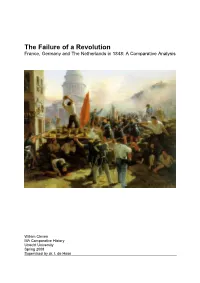
The Failure of a Revolution France, Germany and The Netherlands in 1848: A Comparative Analysis Willem Cleven MA Comparative History Utrecht University Spring 2008 Supervised by dr. I. de Haan Image on front page: Horace Vernet – Barricade at Rue Soufflot, Paris 1848. 2 Table of Contents Chapter 1. Introduction……………………………………………..……………………..1 Chapter 2. The Comparative Method………………………………………………….10 2.1 Units of Historical Study 2.2 What is a Revolution? 2.3 Outline Chapter 3. The Events of the Revolutions...…………………………………………..20 3.1 Spring 1848: Revolution 3.2 Confrontation Chapter 4. Why the Revolution Failed…………………………………………………32 4.1 Internal Coherence of the Revolutionary Faction 4.2 Internal Coherence of the Incumbent Faction 4.3 Control over Sources of Power 4.4 External Intervention Chapter 5. Conclusion: A Theory of Failed Revolutions?...…………………………48 Bibliography 3 Chapter 1. Introduction “The tricolor republic now bears only one color, the color of the defeated, the color of blood.” 1 Karl Marx after the June Days uprising (Neue Rheinische Zeitung, 29 June 1848) As I am writing this opening paragraph, it is 160 years ago to the day that the French National Guard ended a bloody uprising among the Parisian workers. Sometimes labeled a ‘class war’2, the so-called ‘June Days’ uprising posited the urban working class against the Provisional Government of the French Second Republic. It shall become clear in the following chapters that this clash between the revolutionary regime and the masses which had been vital in its victory four months prior, ultimately represented the failure of that revolution, a revolution which made an end to the French monarchy, instated universal male suffrage for a short time and set off a wave of revolutions across the continent. -
Economic Geography and Its Effect on the Development of the German
Economic Geography and its Effect on the Development of the German States from the Holy Roman Empire to the German Zollverein (Wirtschaftsgeographie und ihr Einfluss auf die Entwicklung der deutschen Staaten vom Heiligen Romischen¨ Reich bis zum Deutschen Zollverein) DISSERTATION zur Erlangung des akademischen Grades doctor rerum politicarum (Doktor der Wirtschaftswissenschaft) eingereicht an der WIRTSCHAFTSWISSENSCHAFTLICHEN FAKULTAT¨ DER HUMBOLDT-UNIVERSITAT¨ ZU BERLIN von THILO RENE´ HUNING M.SC. Pr¨asidentin der Humboldt-Universit¨at zu Berlin: Prof. Dr.-Ing. Dr. Sabine Kunst Dekan der Wirtschaftwissenschaftlichen Fakult¨at: Prof. Dr. Daniel Klapper Gutachter: 1. Prof. Dr. Nikolaus Wolf 2. Prof. Barry Eichengreen, Ph.D. Tag des Kolloqiums: 02. Mai 2018 Zusammenfassung Die vorliegende Dissertation setzt sich mit dem Einfluß okonomischer¨ Geographie auf die Geschichte des Heiligen Romischen¨ Reichs deutscher Nation bis zum Deutschen Zollverein auseinander. Die Dissertation besteht aus drei Kapiteln. Im ersten Kapitel werden die Effekte von Heterogenitat¨ in der Beobacht- barkeit der Bodenqualitat¨ auf Besteuerung und politischen Institutionen erlautert,¨ theoretisch betrachtet und empirisch anhand von Kartendaten analysiert. Es wird ein statistischer Zusammenhang zwischen Beobachtbarkeit der Bodenqualitat¨ und Große¨ und Uberlebenswahrschenlichkeit¨ von mittelalterlichen Staaten hergestelt. Das zweite Kapitel befasst sich mit dem Einfluß dieses Mechanismus auf die spezielle Geschichte Brandenburg-Preußens, und erlautert¨ die Rolle der Beobachtbarkeut der Bodenqualitat¨ auf die Entwicklung zentraler Institutionen nach dem Dreißigjahrigen¨ Krieg. Im empirischen Teil wird anhand von Daten zu Provinzkontributionen ein statistisch signifikanter Zusammenhang zwischen Bodenqualitat¨ und Besteuerug erst im Laufe des siebzehnten Jahrhundert deutlich. Das dritte Kapitel befasst sich mit dem Einfluß relativer Geographie auf die Grundung¨ des Deutschen Zollvereins als Folge des Wiener Kongresses. -
1 Introduction
Cambridge University Press 0521632277 - The Logic of Regional Integration: Europe and Beyond Walter Mattli Excerpt More information 1 Introduction 1 The phenomenon of regional integration Regional integration schemes have multiplied in the past few years and the importance of regional groups in trade, money, and politics is increasing dramatically. Regional integration, however, is no new phenomenon. Examples of StaatenbuÈnde, Bundesstaaten, Eidgenossen- schaften, leagues, commonwealths, unions, associations, pacts, confed- eracies, councils and their like are spread throughout history. Many were established for defensive purposes, and not all of them were based on voluntaryassent. This book looks at a particular set of regional integration schemes. The analysis covers cases that involve the voluntary linking in the economic and political domains of two or more formerly independent states to the extent that authorityover keyareas of national policyis shifted towards the supranational level. The ®rst major voluntaryregional integration initiatives appeared in the nineteenth century. In 1828, for example, Prussia established a customs union with Hesse-Darmstadt. This was followed successively bythe Bavaria WuÈrttemberg Customs Union, the Middle German Commercial Union, the German Zollverein, the North German Tax Union, the German MonetaryUnion, and ®nallythe German Reich. This wave of integration spilled over into what was to become Switzer- land when an integrated Swiss market and political union were created in 1848. It also brought economic and political union to Italyin the risorgimento movement. Integration fever again struck Europe in the last decade of the nineteenth century, when numerous and now long- forgotten projects for European integration were concocted. In France, Count Paul de Leusse advocated the establishment of a customs union in agriculture between Germanyand France, with a common tariff bureau in Frankfurt.1 Other countries considered for membership were Belgium, Switzerland, Holland, Austria-Hungary, Italy, and Spain. -

History Chapter – 1 the Rise of Nationalism in Europe
HISTORY CHAPTER – 1 THE RISE OF NATIONALISM IN EUROPE Question and Answers from the text book I. Write in Brief 1. Write a Note on: a) Giuseppe Mazzini: Giuseppe Mazzini was an Italian revolutionary, born in Genoa in 1807. He was a member of the secret society of the Carbonari. At the age of 24, he was sent into exile in 1831 for attempting a revolution in Liguria. He founded underground societies named ‘Young Italy’ in Marseilles and ‘Young Europe’ in Berne, whose members were like- minded young men from Poland, France, Italy and the German States. b) Count Camilo de Cavour: Cavour was chief misnister of Sardinia-Piedmont state who led the movement to unify the regions of Italy. He was neither a revolutionary nor a democrat. Like many other wealthy and educated members of the Italian elite, he spoke French much better than he did Italian. He engineered a careful diplomatic alliance with France, which helped Sardinia-Piedmont defeat the Austrian forces in 1859, and thereby free the northern part of Italy from the Austrian Habsburgs. c) The Greek War of Independence: This was a successful war of independence waged by Greek revolutionaries between 1821 and 1829 against the Ottoman Empire. The Greeks were supported by the West European countries, while poets and artists hailed Greece as the cradle of European civilisation. Finally, the Treaty of Constantinople of 1832 recognised Greece as an independent nation. d) The Frankfurt Parliament: It was an all-German National Assembly formed by the middle- class professionals, businessmen and prosperous artisans belonging to the different German regions. -

The Degree of Growth of German Nationalism an Assessment up to 1850 Definition of Nationalism
The Degree of Growth of German Nationalism An assessment up to 1850 Definition of Nationalism The belief that people with a common culture, language and history should constitute an independent nation free of foreign domination Main Factors • Supporters of nationalism • Opponents of nationalism • Attitudes of the peasants • Political turmoil of the 1840s • The Frankfurt Parliament • The collapse of the 1848 revolutions Supporters of Nationalism • University intellectuals promoting nationalism were the new middle class and their protests relied on the support of a middle class audience • The upper classes were more interested in conserving their individual powers • The Romantic Movement only reached a literate audience Attitudes of the Peasants • Majority of the German population was illiterate peasantry leading traditional lives in farming communities • Those in Eastern states had the status of serfs, bound to their landowners • Unable to participate in the cultural life of the middle classes they made no contribution to the rise of nationalism • However they were an untapped ‘potential’ if their national consciousness could be awakened • 19th century progression meant the movement of the peasantry from the countryside to the new industrial towns, as a result of technological changes such as commercial farming, unlocked the realisation that they had power in numbers and could instigate political unrest Opponents of Nationalism • At the Congress of Vienna in 1815, the main European powers ensured no individual or state could exercise too -

The Growth of German Nationalism 1815-50
The Growth of German Nationalism 1815-50 • 962 – 1806: Central Europe occupied and controlled by the Holy Roman Empire • 1806 – 1815: Holy Roman Empire conquered by Napoleon Bonaparte • Napoleon reduces the 400 German states to 39 • Creates the Confederation of the Rhine from 16 of these states • 1815 Napoleon defeated at Waterloo by coalition of European forces • 1815 Congress of Vienna establishes national boundaries of Central Europe and maintains the status quo to the 39 states The Growth of German Nationalism • Cultural factors • Romantic Movement • Shared language and culture • Spread of nationalist ideas • Economic factors • Zollverein Union • Prussian economic expansion • Industrialisation & population changes • Technology and transport improvements • Political factors • Defeat of Napoleon • Hatred of Prince Metternich • Student societies • 1848 revolutions Collect a copy of the ‘Growth of Nationalism’ starter image to stick in your jotter Definition of Nationalism.. The desire of people sharing the same language and culture (heritage ,traditions, history) to be independent and ruled over by their own government, free from any control by other countries. Most countries were ruled by Autocratic rulers - there was little concept of democracy. Most people in Europe had no knowledge or understanding of nationalism. Society was still largely dominated by Feudalism – dominated by a small aristocracy ruling over a vast peasantry. Social class had a far greater significance that nationality. The peasants had no concept of the nation as they rarely moved out of their local area The aristocracy regarded themselves as an international elite who shared common values no matter which country they came from. Impact of the French Revolution French Revolution was an explosive outburst against the old corrupt order of Autocracy.