INTERDISCIPLINARY JOURNAL of DECADENCE STUDIES Volume 3
Total Page:16
File Type:pdf, Size:1020Kb
Load more
Recommended publications
-

Hadrian and the Greek East
HADRIAN AND THE GREEK EAST: IMPERIAL POLICY AND COMMUNICATION DISSERTATION Presented in Partial Fulfillment of the Requirements for the Degree Doctor of Philosophy in the Graduate School of the Ohio State University By Demetrios Kritsotakis, B.A, M.A. * * * * * The Ohio State University 2008 Dissertation Committee: Approved by Professor Fritz Graf, Adviser Professor Tom Hawkins ____________________________ Professor Anthony Kaldellis Adviser Greek and Latin Graduate Program Copyright by Demetrios Kritsotakis 2008 ABSTRACT The Roman Emperor Hadrian pursued a policy of unification of the vast Empire. After his accession, he abandoned the expansionist policy of his predecessor Trajan and focused on securing the frontiers of the empire and on maintaining its stability. Of the utmost importance was the further integration and participation in his program of the peoples of the Greek East, especially of the Greek mainland and Asia Minor. Hadrian now invited them to become active members of the empire. By his lengthy travels and benefactions to the people of the region and by the creation of the Panhellenion, Hadrian attempted to create a second center of the Empire. Rome, in the West, was the first center; now a second one, in the East, would draw together the Greek people on both sides of the Aegean Sea. Thus he could accelerate the unification of the empire by focusing on its two most important elements, Romans and Greeks. Hadrian channeled his intentions in a number of ways, including the use of specific iconographical types on the coinage of his reign and religious language and themes in his interactions with the Greeks. In both cases it becomes evident that the Greeks not only understood his messages, but they also reacted in a positive way. -

Civic Responses to the Rise and Fall of Sol Elagabal in the Roman Empire
EMPIRE OF THE SUN? CIVIC RESPONSES TO THE RISE AND FALL OF SOL ELAGABAL IN THE ROMAN EMPIRE Martijn Icks During its long and turbulent history, the city of Rome witnessed many changes in its religious institutions and traditions. For many centuries, these came to pass under the benevolent eye of Iupiter Optimus Maximus, the city‟s supreme deity since time immemorial. Not until the fourth century AD would Iupiter finally loose this position to the monotheistic, omnipotent God of Christianity. However, the power of the thunder god had been challenged before. The first deity who temporarily conquered his throne was Sol Invictus Elagabal, a local sun god from the Syrian town of Emesa. This unlikely usurper was the personal god of the emperor Marcus Aurelius Antoninus, whose short-lived reign lasted from 218 to 222 AD, and who has been nicknamed Elagabalus for his affiliation with Elagabal. Even before his rise to power, Elagabalus served as Elagabal‟s high priest. The deity was worshipped in the form of a conical black stone, a so-called baitylos or “house of god”, which resided in a big temple in Emesa. Elagabalus, at that time a fourteen-year-old boy, performed ritual dances in honour of his god. By doing so, he drew the attention of Roman soldiers who were stationed near the town. They proclaimed the boy emperor under the false pretense that he was a bastard son of emperor Caracalla (211-217 AD). Elagabalus won sufficient military support, defeated the reigning emperor and thus gained the throne. He installed himself in Rome and took his god with him. -

Emperor Elagabalus and Traditional Roman Religion
Emperor Elagabalus and Traditional Roman Religion The Roman emperor Marcus Aurelius Antoninus Augustus is best-known to history as Elagabalus due to his affiliation with the Syrian god of the same name. As a youth he became a priest of Elagabalus in Syria, and he brought the worship of this god along with himself to the Roman capital. There the god Elagabalus was assimilated with different aspects of the Roman sun-god Sol (especially Sol Invictus or the “unconquered sun”). This, in turn, led to affiliation with the Greek sun-god Helios, from which we get an alternative name for both the emperor and god, Heliogabalus. Recent scholarship has also pushed to reclaim the identification of this emperor by his birth-name, Varius Avitus Bassianus, and examinations of his life as Varian studies (de Arrizabalaga y Prado, 2005). All of these distinctions are used for an emperor who only ruled the Roman Empire for four years (218-222 CE), and is most noted for his religious preference for the god Elagabalus, a questionable sexual identity, and a lack of mental stability. This paper examines Elagabalus and his interactions with traditional Roman religious practices. As emperor he was also pontifex maximus or high priest of and responsible for overseeing Rome’s traditional cults, festivals and sacred objects. Holding multiple priesthoods would not have been in and of itself a problem for most Romans. However, Elagabalus showed overwhelming preference for his god, who was relatively unknown in the capital but at the clear expense of Rome’s traditional religions. The Historia Augusta provides the fullest account of Elagabalus’s outrages including the transfer of sacred objects to his god’s temple including the emblem of the Mother Goddess, fire of Vesta, Palladium, and sacred shields (3.4). -

Collector's Checklist for Roman Imperial Coinage
Liberty Coin Service Collector’s Checklist for Roman Imperial Coinage (49 BC - AD 518) The Twelve Caesars - The Julio-Claudians and the Flavians (49 BC - AD 96) Purchase Emperor Denomination Grade Date Price Julius Caesar (49-44 BC) Augustus (31 BC-AD 14) Tiberius (AD 14 - AD 37) Caligula (AD 37 - AD 41) Claudius (AD 41 - AD 54) Tiberius Nero (AD 54 - AD 68) Galba (AD 68 - AD 69) Otho (AD 69) Nero Vitellius (AD 69) Vespasian (AD 69 - AD 79) Otho Titus (AD 79 - AD 81) Domitian (AD 81 - AD 96) The Nerva-Antonine Dynasty (AD 96 - AD 192) Nerva (AD 96-AD 98) Trajan (AD 98-AD 117) Hadrian (AD 117 - AD 138) Antoninus Pius (AD 138 - AD 161) Marcus Aurelius (AD 161 - AD 180) Hadrian Lucius Verus (AD 161 - AD 169) Commodus (AD 177 - AD 192) Marcus Aurelius Years of Transition (AD 193 - AD 195) Pertinax (AD 193) Didius Julianus (AD 193) Pescennius Niger (AD 193) Clodius Albinus (AD 193- AD 195) The Severans (AD 193 - AD 235) Clodius Albinus Septimus Severus (AD 193 - AD 211) Caracalla (AD 198 - AD 217) Purchase Emperor Denomination Grade Date Price Geta (AD 209 - AD 212) Macrinus (AD 217 - AD 218) Diadumedian as Caesar (AD 217 - AD 218) Elagabalus (AD 218 - AD 222) Severus Alexander (AD 222 - AD 235) Severus The Military Emperors (AD 235 - AD 284) Alexander Maximinus (AD 235 - AD 238) Maximus Caesar (AD 235 - AD 238) Balbinus (AD 238) Maximinus Pupienus (AD 238) Gordian I (AD 238) Gordian II (AD 238) Gordian III (AD 238 - AD 244) Philip I (AD 244 - AD 249) Philip II (AD 247 - AD 249) Gordian III Trajan Decius (AD 249 - AD 251) Herennius Etruscus -
Calendar of Roman Events
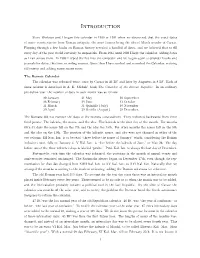
Introduction Steve Worboys and I began this calendar in 1980 or 1981 when we discovered that the exact dates of many events survive from Roman antiquity, the most famous being the ides of March murder of Caesar. Flipping through a few books on Roman history revealed a handful of dates, and we believed that to fill every day of the year would certainly be impossible. From 1981 until 1989 I kept the calendar, adding dates as I ran across them. In 1989 I typed the list into the computer and we began again to plunder books and journals for dates, this time recording sources. Since then I have worked and reworked the Calendar, revising old entries and adding many, many more. The Roman Calendar The calendar was reformed twice, once by Caesar in 46 BC and later by Augustus in 8 BC. Each of these reforms is described in A. K. Michels’ book The Calendar of the Roman Republic. In an ordinary pre-Julian year, the number of days in each month was as follows: 29 January 31 May 29 September 28 February 29 June 31 October 31 March 31 Quintilis (July) 29 November 29 April 29 Sextilis (August) 29 December. The Romans did not number the days of the months consecutively. They reckoned backwards from three fixed points: The kalends, the nones, and the ides. The kalends is the first day of the month. For months with 31 days the nones fall on the 7th and the ides the 15th. For other months the nones fall on the 5th and the ides on the 13th. -

Magic and the Roman Emperors
1 MAGIC AND THE ROMAN EMPERORS (1 Volume) Submitted by Georgios Andrikopoulos, to the University of Exeter as a thesis/dissertation for the degree of Doctor of Philosophy in Classics, July 2009. This thesis is available for Library use on the understanding that it is copyright material and that no quotation from the thesis may be published without proper acknowledgement. I certify that all material in this thesis which is not my own work has been identified and that no material has previously been submitted and approved for the award of a degree by this or any other University. ..................................... (signature) 2 Abstract Roman emperors, the details of their lives and reigns, their triumphs and failures and their representation in our sources are all subjects which have never failed to attract scholarly attention. Therefore, in view of the resurgence of scholarly interest in ancient magic in the last few decades, it is curious that there is to date no comprehensive treatment of the subject of the frequent connection of many Roman emperors with magicians and magical practices in ancient literature. The aim of the present study is to explore the association of Roman emperors with magic and magicians, as presented in our sources. This study explores the twofold nature of this association, namely whether certain emperors are represented as magicians themselves and employers of magicians or whether they are represented as victims and persecutors of magic; furthermore, it attempts to explore the implications of such associations in respect of the nature and the motivations of our sources. The case studies of emperors are limited to the period from the establishment of the Principate up to the end of the Severan dynasty, culminating in the short reign of Elagabalus. -

Name Reign Succession Died
Name Reign Succession Died March 20, 235 CE - Proclaimed emperor by German legions April 238 CE; Assasinated by Praetorian Maximinus I April 238 CE after the murder of Severus Alexander Guard Proclaimed emperor, whilst Pro-consul in Africa, during a revolt against Maximinus. Ruled jointly with his son Gordian II, and in opposition to Maximinus. Technically a usurper, but March 22, 238 CE - retrospectively legitimised by the April 238 CE; Committed suicide upon Gordian I April 12, 238 CE accession of Gordian III hearing of the death of Gordian II. Proclaimed emperor, alongside father March 22, 238 CE - Gordian I, in opposition to Maximinus by April 238 CE; Killed during the Battle of Gordian II April 12, 238 CE act of the Senate Carthage fighting a pro-Maximinus army Proclaimed joint emperor with Balbinus by the Senate in opposition to April 22, 238 AD – Maximinus; later co-emperor with July 29, 238 CE; Assassinated by the Pupienus July 29, 238 AD Balbinus. Praetorian Guard Proclaimed joint emperor with Pupienus by the Senate after death of Gordian I & April 22, 238 AD – II, in opposition to Maximinus; later co- July 29, 238 CE; Assassinated by the Balbinus July 29, 238 AD emperor with Pupienus and Gordian III Praetorian Guard Proclaimed emperor by supporters of April 22, 238 AD – Gordian I & II, then by the Senate; joint February 11, 244 emperor with Pupienus and Balbinus February 11, 244 CE; Unknown, possibly Gordian III AD until July 238 AD. murdered on orders of Philip I February 244 AD – Praetorian Prefect to Gordian III, took September/October -

Coins of Gerizim
Copyright for personal use only of Larry Rynearson 2014 Coins of Gerizim Hadrian (Latin: Publius Aelius Hadrianus Augustus 24 January, 76 AD – 10 July, 138 AD) was Roman Emperor from 117 to 138. http://en.wikipedia.org/wiki/Hadrian Left: 250 ---Hadrian. 117-138. Æ23.5. Laur bust right/Zeus seated left, nude in Tetra-style temple, 101=119/120 [The location to my knowledge of this temple shown here is unidentified, it could possibly be that of Gerizim but most likely minted at a different location] Right: Jewish Medalian Æ medallion; 48 mm; 56.3 gr.; Obv.: Laureate draped and cuirassed bust of Antoninus Pius to r.; Greek legend upwards from bottom left: [ANTω]NINOC CEBAC EYCE AY[TOK KA]I(C)AP Rev.: Mount Gerizim is represented as two mountain peaks, separated by a sloping roadway. A steep, broad stairway leads up between houses to a temple seen in three-quarters perspective. Below is a colonnade with eleven pillars and two arches over the columns. The entrance leads to a square with a horned altar. A path leads to the right from the center of the road to a higher hill with a second horned altar. Greek legend from bottom left upwards: ΦΔ NEACΠOΔEωC CYPIAC ΠAΔAICTINE[C] ET ΠH (“Fl[avia] Neapolis [which is in] Syria-Palestine, year 88 [160 CE]”) 1 See http://www.archaeological-center.com/en/monographs/m21 ~~~~~~~~~~~~~~~ Antoninus Pius (Latin: Titus Fulvius Aelius Hadrianus Antoninus Augustus Pius; born 19 September, 86 AD – died 7 March, 161 AD), also known as Antoninus, was Roman Emperor from 138 to 161. -

ROMAN JURISTS and the CRISIS of the THIRD CENTURY A.D. in the ROMAN EMPIRE by LUKAS DE BLOIS
ROMAN JURISTS AND THE CRISIS OF THE THIRD CENTURY A.D. IN THE ROMAN EMPIRE By LUKAS DE BLOIS In this paper I would like to discuss the following questions: did the crisis of the third century A.D. in the Roman Empire finish the strong position of jurists and juridically skilled bureaucrats at the Roman imperial court? Did this crisis usher in the end oftheir scholarly production? The period ofthe Severan dynasty, which preceded the Third Century crisis, has always been regarded as the great age of juridically trained administrators, when Rome's most noted jurists of all time, all of them equites. were appointed to important posts and dominated the imperial council. At least three of them, Papinian, Messius, and Ulpian, became praefecti praetorio'. Even though most of the praetorian prefects during the early third century were not lawyers, the influence of jurists was out of all proportion to their numbers and to the length of time during which they were praetorian prefects2• After about A.D. 240, however, original scholarly work of learned jurists almost vanished from the earth and military men took the lead in the imperial council and in other key positions. Why did this happen? Severan emperors regularly appointed two praetorian prefects, a military man next to a jurist or an administrator. This was just a matter of practical expediency, not a fixed system3• The jurists among the men they appointed belonged to a kind of learned group, within which the younger ones borrowed ideas from their predecessors and which produced books and treatises that have become classics' in Roman law. -

Ancient Rome - AD 238 Pupienus AR Denarius NGC MS Fine Style Ex
Ancient Rome - AD 238 Pupienus AR Denarius NGC MS Fine Style Ex. Kern SKU: 3819713017 Stock Qty: 0 Retail Price: $3,975.00 PCGS #: Product Description Pupienus (Marcus Clodius Pupienus Maximus Augustus, c. 165/170--29 July 238), also known as Pupienus Maximus, was Roman Emperor with Balbinus for three months during 238, the Year of the Six Emperors. A member of the aristocracy, he served in several important positions during the rule of the Severan dynasty. While serving as governor in one of the German provinces, Pupienus became very popular and won military victories over the Sarmatians and German tribes. The year 234 saw him appointed Urban Prefect of Rome, gaining a reputation for harshness that made him unpopular with the Roman mob. After Gordian I and his son were proclaimed Emperors in Africa, the Senate created a committee of 20 senators to organize operations against Maximinus Thrax, the much-hated Emperor who was being pushed out of power, until the Gordians arrived in Rome. In 238, after news of the Gordians' defeat and deaths, however, the Senate met in a closed session and voted for two committee members, Pupienus and Balbinus, to rule as co-emperors. Pupienus was a soldier and Balbinus a civilian. However they were forced to take on Gordian III as a colleague. This was because there were factions within the Senate, however, that had hoped to profit from the rule of Gordian I and II. To that end, they did their best to turn the people and the Praetorian Guard against Pupienus and Balbinus, and promoted the idea of making the 13-year-old Gordian III Emperor. -
Elagabalus (218–222 AD): East Meets West with the Assassination of Caracalla, Macrinus Became Emperor, but the Powerful Sever
Elagabalus (218–222 AD): East Meets West With the assassination of Caracalla, Macrinus became emperor, but the powerful Severan family would not accept the loss of power so easily. They immediately began plotting. In response, Macrinus expelled the family from Antioch and Julia Domna, already seriously ill, starved herself to death. Her sister, Julia Maesa, began to spread the rumor that her grandson, Varius Avitus Bassianus, son of her daughter Julia Soaemias, was the secret child of Caracalla. The child was the high priest of the Syrian god El-Gabal, and thus he was called Elagabalus. Sometimes he is also called Heliogabalus, from the Greek god Helios, who was considered the Greek equivalent of El-Gabal. Julia Maesa convinced the Third Legion and its general, Comazon, to proclaim Elagabalus emperor. More legions followed, discontent that Macrinus had ended the ill- conceived war against Parthia and revoked the high salaries Caracalla had bestowed on the troops. The legions loyal to Elagabalus and Julia met Macrinus’s forces at Antioch and defeated the emperor. Macrinus fled but was captured and executed. Elagabalus was hailed by all as emperor. Before Elagabalus and his family arrived in Italy, his supporters sent a painting of him to the Roman Senate. Elagabalus was portrayed with mascara and priestly robes, characteristics of an Easterner, which was offensive to traditional Roman values. This impression was made worse when the new emperor actually arrived. Elagabalus entered the city on foot while a meteorite, the embodiment of his god, was carried on a triumphal chariot in a bed of priceless gems. -

THE EMERGENCE of IMPERIAL and CATHOLIC ORDER Elagabalus and Callistus
CHAPTER EIGHT THE EMERGENCE OF IMPERIAL AND CATHOLIC ORDER Elagabalus and Callistus: A Monarchian Episcopate for an Imperial Monarclry In A.D. 218, following the assassination of Caracalla the year before, Varius Avitus Bassianus as emperor assumed the title of Marcus Aurelius Antoninus. He took the additional title of Elagabalus, the name of his favoured deity, and attempted to introduce into Rome the cult of Sol Invictus Elagabal, that is to say the cult of Sol Invictus in its specifically Syrian form, as the universal religion of the Empire. That attempt, characterised by the imposition of the specific ritual and priestly dress of the form of a cult that was alien to Roman culture, failed for that reason. It is important however to emphasise that it was not a failure of the process of syncretism itself, however much this might be suggested by the damnatio memoriae of Elagabalus himself, but the failure of a kind of fundamentalism in its own way inimical to such a syncretism. Parallel with these events, we have, described in Pseudo-Hippolytus, Re.fotatio, IX, 6-13,2, an attempted religious reformation of the Roman community by Callistus, in which we have a movement towards monarchical episcopate accompanied by an advocacy of J.Wvapxia in the godhead. Callistus appeared to Tertullian as behaving like a pagan Pontifex Maximus in trying to become episcopus episcoporum. 1 In doing so he, as putative bishop of Rome, was but making similar claims to those of the emperor Elagabalus, as Pontifex Maximus of a syncretism that found its final expression in the Baal of Emesa as Sol Invictus.