Biologie Anacampsis Populella (Clerck)
Total Page:16
File Type:pdf, Size:1020Kb
Load more
Recommended publications
-

Working List of Prairie Restricted (Specialist) Insects in Wisconsin (11/26/2015)
Working List of Prairie Restricted (Specialist) Insects in Wisconsin (11/26/2015) By Richard Henderson Research Ecologist, WI DNR Bureau of Science Services Summary This is a preliminary list of insects that are either well known, or likely, to be closely associated with Wisconsin’s original native prairie. These species are mostly dependent upon remnants of original prairie, or plantings/restorations of prairie where their hosts have been re-established (see discussion below), and thus are rarely found outside of these settings. The list also includes some species tied to native ecosystems that grade into prairie, such as savannas, sand barrens, fens, sedge meadow, and shallow marsh. The list is annotated with known host(s) of each insect, and the likelihood of its presence in the state (see key at end of list for specifics). This working list is a byproduct of a prairie invertebrate study I coordinated from1995-2005 that covered 6 Midwestern states and included 14 cooperators. The project surveyed insects on prairie remnants and investigated the effects of fire on those insects. It was funded in part by a series of grants from the US Fish and Wildlife Service. So far, the list has 475 species. However, this is a partial list at best, representing approximately only ¼ of the prairie-specialist insects likely present in the region (see discussion below). Significant input to this list is needed, as there are major taxa groups missing or greatly under represented. Such absence is not necessarily due to few or no prairie-specialists in those groups, but due more to lack of knowledge about life histories (at least published knowledge), unsettled taxonomy, and lack of taxonomic specialists currently working in those groups. -

Boyne Valley Provincial Park
BOYNE VALLEY PROVINCIAL PARK One Malaise trap was deployed at Boyne Valley Provincial Park in 2014 (44.11563, -80.12777, 468m ASL; Figure 1). This trap collected arthropods for twenty weeks from April 28 – September 19, 2014. All 10 Malaise trap samples were processed; every other sample was analyzed using the individual specimen protocol while the second half was analyzed via bulk analysis. A total of 1571 BINs were obtained. Over half the BINs captured were flies (Diptera), followed by bees, ants and wasps (Hymenoptera), moths and butterflies (Lepidoptera), and beetles (Coleoptera; Figure 2). In total, 427 arthropod species were named, representing 29% of the BINs from the site (Appendix 1). All BINs were assigned at least to Figure 1. Malaise trap deployed at Boyne Valley family, and 66.6% were assigned to a genus (Appendix Provincial Park in 2014. 2). Specimens collected from Boyne Valley represent 183 different families and 558 genera. Figure 2. Taxonomy breakdown of BINs captured in the Malaise trap at Boyne Valley. APPENDIX 1. TAXONOMY REPORT Class Order Family Genus Species Arachnida Araneae Clubionidae Clubiona Clubiona obesa Philodromidae Philodromus Philodromus rufus Theridiidae Mesostigmata Digamasellidae Dinychidae Halolaelapidae Parasitidae Phytoseiidae Opiliones Phalangiidae Sclerosomatidae Leiobunum Sarcoptiformes Acaridae Oribatulidae Phenopelopidae Scheloribatidae Trombidiformes Anystidae Cunaxidae Cunaxoides Erythraeidae Leptus Hygrobatidae Atractides Scutacaridae Tarsonemidae Tetranychidae Tetranychus Trombidiidae -

Sherwood Forest Lepidoptera Species List
Sherwood Forest Lepidoptera Historical and modern species lists and records - First Edition 2009 T. and D. Pendleton Introduction to Sherwood Forest Lepidoptera First edition 2009 One aspect of recording which has not changed since the 1800’s, is the lack of attention given by Lepidopterists to the site’s micro lepidoptera. Virtually all This publication is aimed at providing an accurate record of all Sherwood Forest micro records sourced from Carr’s book were attributed to R.E. Brameld, who Lepidoptera recorded from the 1800‘s, the 1900’s, post-2000 records and must have spent many hours in the field recording. Without his work, then much completely up to date with the inclusion of the latest records from 2008 and larger gaps would have appeared in the records. As it is, much work is still follows the same format as we have used in the accompanying publication required to record the many leaf-mining species which Sherwood Forest Sherwood Forest Coleoptera - 2009 Edition. undoubtedly holds. It is by no means a complete list and should not be treated as so, but Recent Lepidoptera surveys and recording represents a hopeful start on the way to producing a definitive Sherwood Forest site list, by trying to gather all available Lepidoptera records in one document. A great deal of moth trapping and recording took place at the Visitor Centre during the 1980’s and has provided some very useful data, which at some time This is the first edition of this project and includes traceable public records in the future, will perhaps be used to enable a comparison with more recent and those held privately by local naturalists and our thanks go to those records and numbers. -
Testing DNA Barcode Performance in 1000 Species of European Lepidoptera: Large Geographic Distances Have Small Genetic Impacts
RESEARCH ARTICLE Testing DNA Barcode Performance in 1000 Species of European Lepidoptera: Large Geographic Distances Have Small Genetic Impacts Peter Huemer1*, Marko Mutanen2, Kristina M. Sefc3, Paul D. N. Hebert4 1. Tiroler Landesmuseen-Betriebsges.m.b.H., Naturwissenschaftliche Sammlungen, Innsbruck, Austria, 2. Biodiversity Unit, Department of Biology, University of Oulu, Oulu, Finland, 3. University of Graz, Institute of Zoology, Graz, Austria, 4. Biodiversity Institute of Ontario, University of Guelph, Guelph, ON, Canada OPEN ACCESS *p.huemer@tiroler-landesmuseen.at Citation: Huemer P, Mutanen M, Sefc KM, Hebert PDN (2014) Testing DNA Barcode Performance in 1000 Species of European Lepidoptera: Large Geographic Distances Have Small Genetic Impacts. PLoS ONE 9(12): e115774. doi:10.1371/ Abstract journal.pone.0115774 Editor: Bernd Schierwater, University of Veterinary This study examines the performance of DNA barcodes (mt cytochrome c oxidase Medicine Hanover, Germany 1 gene) in the identification of 1004 species of Lepidoptera shared by two localities Received: September 3, 2014 (Finland, Austria) that are 1600 km apart. Maximum intraspecific distances for the Accepted: November 20, 2014 pooled data were less than 2% for 880 species (87.6%), while deeper divergence Published: December 26, 2014 was detected in 124 species. Despite such variation, the overall DNA barcode Copyright: ß 2014 Huemer et al. This is an open- library possessed diagnostic COI sequences for 98.8% of the taxa. Because a access article distributed under the terms of the reference library based on Finnish specimens was highly effective in identifying Creative Commons Attribution License, which permits unrestricted use, distribution, and repro- specimens from Austria, we conclude that barcode libraries based on regional duction in any medium, provided the original author and source are credited. -

The Entomologist's Record and Journal of Variation
. JVASV^iX ^ N^ {/) lSNrNVIN0SHilWS*^S3ldVaan^LIBRARIES SMITHSONIAN INSTITUTION Ni <n - M ^^ <n 5 CO Z ^ ^ 2 ^—^ _j 2 -I RIES SMITHSONIAN INSTITUTION NOIinillSNI NVINOSHilWS S3iyVdan U r- ^ ^ 2 CD 4 A'^iitfwN r: > — w ? _ ISNI NVINOSHilWS SBiyVdan LIBRARIES'SMITHSONIAN INSTITUTION f^ <rt .... CO 2 2 2 s;- W to 2 C/J • 2 CO *^ 2 RIES SMITHSONIAN_INSTITUTlON NOIiniliSNI_NVINOSHilWS S3liiVyan_L; iiSNi"^NViNOSHiiNS S3iyvaan libraries smithsonian'^institution i^ 33 . z I/' ^ ^ (^ RIES SMITHSONIAN INSTITUTION NOIiniliSNI NVINOSHilWS S3lbVHan Li CO — -- — "> — IISNI NVINOSHimS S3IMVHan LIBRARIES SMITHSONIAN INSTITUTION N' 2 -J 2 _j 2 RIES SMITHSONIAN INSTITUTION NOIifllliSNI NVINOSHIIWS SSIMVyail L! MOTITI IT I f\t _NviN0SHiiws'^S3iMvaan libraries'^smithsonian^institution NOlin z \ '^ ^—s^ 5 <^ ^ ^ ^ '^ - /^w\ ^ /^^\ - ^^ ^ /^rf^\ - /^ o ^^^ — x.ii:i2Ji^ o ??'^ — \ii Z ^^^^^""-^ o ^^^^^ -» 2 _J Z -J , ; SMITHSONIAN INSTITUTION NOIXniliSNI NVINOSHillMS $3 I M VH 8 !!_ LI BR = C/> ± O) ^. ? CO I NVINOSHimS S3iaVHan libraries SMITHSONIAN INSTITUTION NOIlf CO ..-. CO 2 Z z . o .3 :/.^ C/)o Z u. ^^^ i to Z CO • z to * z > SMITHS0NIAN_1NSTITUTI0N NOIiniliSNI_NVINOSHimS S3 I d ViJ 8 n_LI B R UJ i"'NViNOSHiiws S3ibvyan libraries smithsonian"^institution Noiir r~ > z r- Z r- 2: . CO . ^ ^ ^ ^ ; SMITHSONIAN INSTITUTION NOIiniliSNI NVINOSHillNS SSiyVMail LI BR CO . •» Z r, <^ 2 z 5 ^^4ii?^^ ^' X^W o ^"^- x life ^<ji; o ^'f;0: i >^ _NVIN0SHiIlMs'^S3iyVdan^LIBRARIEs'^SMITHS0NlAN INSTITUTION NOlif Z \ ^'^ ^-rr-^ 5 CO n CO CO o z > SMITHSONIAN INSTITUTION NOIiniliSNI NVINOSHimS S3 I ^Vd 8 11 LI BR >" _ . z 3 ENTOMOLOGIST'S RECORD AND Journal of Variation Edited by P.A. SOKOLOFF fre s Assistant Editors J.A. -

Beavers, Bugs and Chemistry: a Mammalian Herbivore Changes Chemistry Composition and Arthropod Communities in Foundation Tree Species
Article Beavers, Bugs and Chemistry: A Mammalian Herbivore Changes Chemistry Composition and Arthropod Communities in Foundation Tree Species Rachel M. Durben 1,2, Faith M. Walker 1,2,3, Liza Holeski 1,2,4, Arthur R. Keith 1,2, Zsuzsi Kovacs 1,2, Sarah R. Hurteau 5, Richard L. Lindroth 4 , Stephen M. Shuster 1,2 and Thomas G. Whitham 1,2,* 1 The Environmental Genetics and Genomics Laboratory, Department of Biological Sciences, Northern Arizona University, P.O. Box 5640, Flagstaff, AZ 86011, USA; rdurben@gmail.com (R.M.D.); faith.walker@nau.edu (F.M.W.); Liza.Holeski@nau.edu (L.H.); arthur.keith@nau.edu (A.R.K.); sik5@nau.edu (Z.K.); Stephen.Shuster@nau.edu (S.M.S.) 2 The Center for Adaptable Western Landscapes, Department of Biological Sciences, Northern Arizona University, P.O. Box 5640, Flagstaff, AZ 86011, USA 3 School of Forestry, Northern Arizona University, Flagstaff, AZ 86001, USA 4 Department of Entomology, University of Wisconsin-Madison, Madison, WI 53706, USA; richard.lindroth@wisc.edu 5 Geography and Environmental Studies Department, University of New Mexico, Albuquerque, NM 87131, USA; sarah.hurteau@tnc.org * Correspondence: Thomas.Whitham@nau.edu Citation: Durben, R.M.; Walker, F.M.; Abstract: The North American beaver (Castor canadensis Kuhl) and cottonwoods (Populus spp.) are Holeski, L.; Keith, A.R.; Kovacs, Z.; foundation species, the interactions of which define a much larger community and affect a threatened Hurteau, S.R.; Lindroth, R.L.; riparian habitat type. Few studies have tested the effect of these interactions on plant chemistry Shuster, S.M.; Whitham, T.G. -

Anacampsis Rhoifructella
Zootaxa 3794 (4): 545–555 ISSN 1175-5326 (print edition) www.mapress.com/zootaxa/ Article ZOOTAXA Copyright © 2014 Magnolia Press ISSN 1175-5334 (online edition) http://dx.doi.org/10.11646/zootaxa.3794.4.5 http://zoobank.org/urn:lsid:zoobank.org:pub:DE6AB76C-5FB2-46FD-AEDA-E1C35C33BB42 Anacampsis rhoifructella (Clemens): clarification of its identity and larval biology, and differentiation from a similar species, Anacampsis consonella (Zeller), revised status (Lepidoptera: Gelechiidae) TERRY L. HARRISON1,2 & MAY R. BERENBAUM1 1Department of Entomology, University of Illinois, 320 Morrill Hall, 505 South Goodwin Avenue, Urbana, IL 61801, USA E-mail: (TLH) tharriso@illinois.edu; (MRB) maybe@illinois.edu 2Corresponding author Abstract Anacampsis rhoifructella (Clemens) (Lepidoptera: Gelechiidae) was described from individuals reared from larvae col- lected in fruit racemes of staghorn sumac, Rhus typhina (Anacardiaceae). Rearing efforts in central Illinois, however, have established that A. rhoifructella actually feeds on leaves of Viburnum prunifolium (Caprifoliaceae). Furthermore, a second Anacampsis species also feeds on leaves of V. prunifolium. The second species is very similar to A. rhoifructella in external appearance of the adult and in larval feeding mode but is readily differentiated on basis of larval appearance, phenology, and genital morphology of both genders. Examination of type specimens of Gelechia consonella Zeller, G. quadrimacule- lla Chambers, and G. ochreocostella Chambers, all of which were previously designated as junior synonyms of A. rhoi- fructella, revealed that the valid name of the second species is Anacampsis consonella (Zeller, 1873), revised status; G. ochreocostella and G. quadrimaculella are assigned as junior synonyms of A. consonella. We provide descriptions and illustrations of characters that reliably differentiate A. -

Proceedings of the United States National Museum
PROCEEDINGS OF THE UNITED STATES NATIONAL MUSEUM issued |i;|\X^H by the SMITHSONIAN INSTITUTION U. S. NATIONAL MUSEUM Vol.86 Washington: 1939 No. 3064 RESTRICTION OF THE GENUS GELECHIA (LEPIDOP- TERA: GELECHIIDAE), WITH DESCRIPTIONS OF NEW GENERA By August Busck The genus Gelechm Hiibiier/ type G. rhomhella (Schiffermiiller), has become, in the course of years since its erection, a "wastebasket" ^ for hundreds of heterogeneous species of gelechiids that could not readily be assigned to other genera on wing or palpal characters. The result is an aggregation of more than 400 such species under the generic name Gelechia. Quite aside from the inconvenience of such an unwieldy number of species in one genus, it is apparent that this lumping does not represent a natural grouping, but that many of the included species are less related to their associates in the check lists under that genus than they are to the species placed in other genera. Gnorimoschema Busck {Phthorimaea Meyrick), for example, which has been correctly separated for many years on obvious pterogostic and oral characters, is clearly more closely related to Gelechia proper than most of the genera here eliminated from the concept. For this reason it is included in the synoptic tables in this paper, and figures of the genitalia are given for comparison (pi. 68, fig. 2; pi. 65, fig. 36). Several sound attempts have been made by workers in continental Europe, notably Heinemann,^ to make a more natural classification by the erection of separate genera for species with certain slight modi- fications of wing structure and palpal characters in common, but the 1 Verzeichniss bekannter Schmetterlinge, p. -
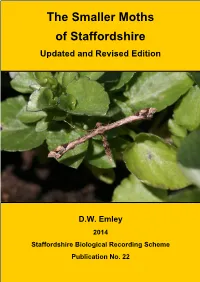
The Smaller Moths of Staffordshire Updated and Revised Edition
The Smaller Moths of Staffordshire Updated and Revised Edition D.W. Emley 2014 Staffordshire Biological Recording Scheme Publication No. 22 1 The Smaller Moths of Staffordshire Updated and Revised Edition By D.W. Emley 2014 Staffordshire Biological Recording Scheme Publication No. 22 Published by Staffordshire Ecological Record, Wolseley Bridge, Stafford Copyright © D.W. Emley, 2014 ISBN (online version): 978-1-910434-00-0 Available from : http://www.staffs-ecology.org.uk Front cover : Beautiful Plume Amblyptilia acanthadactyla, Dave Emley Introduction to the up-dated and revised edition ............................................................................................ 1 Acknowledgements ......................................................................................................................................... 2 MICROPTERIGIDAE ...................................................................................................................................... 3 ERIOCRANIIDAE ........................................................................................................................................... 3 NEPTICULIDAE .............................................................................................................................................. 4 OPOSTEGIDAE .............................................................................................................................................. 6 HELIOZELIDAE ............................................................................................................................................. -
THE MICROLEPIDOPTERA Section 2 COSMOPTERIGIDAE THROUGH HEPIALIDAE
The University of Maine DigitalCommons@UMaine Technical Bulletins Maine Agricultural and Forest Experiment Station 8-1-1984 TB114: A List of the Lepidoptera of Maine--Part 2: The icrM olepidoptera Section 2 Cosmopterigidae through Hepialidae Auburn E. Brower Follow this and additional works at: https://digitalcommons.library.umaine.edu/aes_techbulletin Part of the Entomology Commons Recommended Citation Brower, A.E. 1984. A list of the Lepidoptera of Maine--Part 2: The icrM olepidoptera section 2 Cosmopterigidae through Hepialidae. Maine Agricultural Experiment Station Technical Bulletin 114. This Article is brought to you for free and open access by DigitalCommons@UMaine. It has been accepted for inclusion in Technical Bulletins by an authorized administrator of DigitalCommons@UMaine. For more information, please contact um.library.technical.services@maine.edu. ISSN 0734-9556 A LIST OF THE LEPIDOPTERA OF MAINE Part 2 THE MICROLEPIDOPTERA Section 2 COSMOPTERIGIDAE THROUGH HEPIALIDAE Auburn E. Brower A GHOST MOTH — Sthenopis argenteomaculatus Harris A JOINT PUBLICATION OF THE (MAINE DEPARTMENT OF CONSERVATION Maine Forest Service Division of Entomology, Augusta, Maine and the DEPARTMENT OF ENTOMOLOGY, ORONO August 1984 Inquiries concerning this bulletin may be sent to: Dr. Auburn E. Brower 8 Hospital Street Augusta, ME A LIST OF THE LEPIDOPTERA OF MAINE Part 2 THE MICROLEPIDOPTERA Section 2 COSMOPTERIGIDAE THROUGH HEPIALIDAE Auburn E. Brower A JOINT PUBLICATION OF THE MAINE DEPARTMENT OF CONSERVATION Maine Forest Service Division of Entomology, -

Download PDF ( Final Version , 1Mb )
Nieuwe en interessante Microlepidoptera uit Nederland in hoofdzaak van de jaren 1997 en 1998 (Lepidoptera) K. J. Huisman & J. C. Koster HUISMAN K J & J C KOSTER, 2000. NEW AND INTERESTING MICROLEPIDOPTERA FROM THE NETHERLANDS IN PARTICULAR FROM THE YEARS 1997 AND 1998 (LEPIDOPTERA). ENT. BER.. AMST. 60 (11): 193-216. Abstract: Th.s is the eleventh compilation of interesting Microlepidoptera collected in The Netherlands,,covering main¬ ly the years 1997 and 1998, but also including some older data, as well as the year 1999 y Lnolech7odespseudogemmellus (Gelechiidae) is recorded for the first time from The Netherlands. This species has re¬ cently been described and specimens were found amongst senes of the well-known Stenolechia Semmea^ Thaumatotibia leucotreta (Tortricidae) is recorded for the first time as an inadvertently introduced species. New records of the following 99 rare and/or interesting species are given or summarised: Stigmella centifohella Ectoedemm atrifrontella, E. longicaudella (Nepticulidae), Nemophora ochsenheimerella, Nematopogon robertella^ pronia fuscatella (Prodoxidae), Emmetia heinemanni (Tischenidae), Nemapogon wolffieila, ; Bucculatrix nigricomella (Bucculatncidae), Acrocercops brongniardella, Uucospilapteryx omisse la Phyllonorycter muelleriella P spinicolella, P. leucographella, P. mespilella (Gracillariidae), Yponomeuta irrorella, Argyresthia sor- biella A. fundella, A. pulchella,A. semifusca (Yponomentidae), Glyphipterixforsterella (Glyphiptengidae), Leucoptera spartifoliella (Lyonetiidae), Ethmia quadrillella -

Search: Thu Nov 5 14:40:21 2020Page 1 Of
Search: Thu Nov 5 14:40:21 2020 Page 1 of 180 10 % Athalia cornubiae|[1]|GBSYM1130-12|Hymenoptera|BOLD:AAJ9512 Sciaridae|[2]|CNFNR1642-14|Diptera|BOLD:ACM8049 Sciaridae|[3]|CNPPB684-12|Diptera|BOLD:ACC8493 Sciaridae|[4]|GMGSL144-13|Diptera|BOLD:ACC8327 Sciaridae|[5]|GMOJG309-15|Diptera|BOLD:ACX6391 Tetraneura nigriabdominalis|[6]|ASHMT220-11|Hemiptera|BOLD:AAG3896 Tetraneura ulmi|[7]|CNJAE749-12|Hemiptera|BOLD:AAG3894 Prociphilus caryae|[8]|PHOCT611-11|Hemiptera|BOLD:ABY5255 Prociphilus tessellatus|[9]|TTSOW205-10|Hemiptera|BOLD:AAD7311 Grylloprociphilus imbricator|[10]|RDBA378-06|Hemiptera|BOLD:AAY2624 Subsaltusaphis virginica|[11]|RFBAC272-07|Hemiptera|BOLD:AAH9929 Euceraphis papyrifericola|[12]|BBHCN315-10|Hemiptera|BOLD:AAH2870 Euceraphis|[13]|CNPAI428-13|Hemiptera|BOLD:AAX7972 Calaphis betulaecolens|[14]|ASAHE150-12|Hemiptera|BOLD:AAC3672 Callipterinella calliptera|[15]|RDBA165-05|Hemiptera|BOLD:AAB6094 Periphyllus negundinis|[16]|CNEIB825-12|Hemiptera|BOLD:AAD3938 Sipha elegans|[17]|CNEIF3636-12|Hemiptera|BOLD:AAG1528 Aphididae|[18]|GMGSW027-13|Hemiptera|BOLD:ACD2286 Drepanaphis|[19]|RRMFE3184-15|Hemiptera|BOLD:ABY0945 Drepanaphis|[20]|RDBA009-05|Hemiptera|BOLD:AAH2879 Drepanaphis|[21]|BBHEM601-10|Hemiptera|BOLD:AAX8898 Drepanaphis|[22]|GMGSA077-12|Hemiptera|BOLD:ACA3956 Drepanaphis|[23]|ASAHE012-12|Hemiptera|BOLD:ABY1338 Drepanaphis|[24]|RRSSA5353-15|Hemiptera|BOLD:AAI6141 Drepanaphis parva|[25]|CNSLF196-12|Hemiptera|BOLD:AAX8895 Drepanaphis|[26]|CNPEE1905-14|Hemiptera|BOLD:ACL5395 Drepanaphis acerifoliae|[27]|RFBAG183-11|Hemiptera|BOLD:AAH2868