Federal Register/Vol. 77, No. 169/Thursday, August 30, 2012/Proposed Rules
Total Page:16
File Type:pdf, Size:1020Kb
Load more
Recommended publications
-

Freshwater Invertebrate Life History Strategies for Surviving Desiccation
MURDOCH RESEARCH REPOSITORY This is the author’s final version of the work, as accepted for publication following peer review but without the publisher’s layout or pagination. The definitive version is available at http://dx.doi.org/10.1007/s40362-015-0031-9 Strachan, S.R., Chester, E.T. and Robson, B.J. (2015) Freshwater invertebrate life history strategies for surviving desiccation. Springer Science Reviews, 3 (1). pp. 57-75. http://researchrepository.murdoch.edu.au/30319/ Copyright: © Springer International Publishing AG 2015. It is posted here for your personal use. No further distribution is permitted. 1 Freshwater invertebrate life history strategies for surviving desiccation 2 Scott R. Strachan, Edwin T. Chester, Belinda J. Robson 3 Environmental and Conservation Science, Murdoch University, South Street, Murdoch, Western Australia, 6150 4 5 PhD student: Mr Scott Strachan (affiliation above): s.strachan@murdoch.edu.au 6 Supervisors: Dr Ed Chester & Dr Belinda Robson (affiliation above) 7 Start date: 14/02/11 8 Literature review completion date – 2014 9 Word count: 7,453 10 Motivation 11 • Climate change is prolonging dry periods in intermittent rivers and wetlands in many regions across the world, 12 increasing the potential for desiccation stress in the fauna. Invertebrates comprise the greatest proportion of 13 biodiversity in these systems, but there are no recent reviews on the response of invertebrates to desiccation in the 14 context of climate change. 15 • This review elaborates on the idea that the degree of desiccation that fauna experience is likely to be critical for 16 survival as climates dry because this idea has not previously been considered in the literature. -
Statement of Need and Reasonableness: August 10, 2012
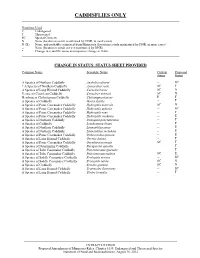
CADDISFLIES ONLY Notations Used E Endangered T Threatened SC Special Concern N None (location records maintained by DNR, in most cases) N (X) None, and probably extirpated from Minnesota (location records maintained by DNR, in most cases) -- None (location records not yet maintained by DNR) * Change in scientific name accompanies change in status CHANGE IN STATUS; STATUS SHEET PROVIDED Common Name Scientific Name Current Proposed Status Status A Species of Northern Caddisfly Anabolia ozburni -- SC * A Species of Northern Caddisfly Asynarchus rossi SC T A Species of Long Horned Caddisfly Ceraclea brevis SC N Vertrees's Ceraclean Caddisfly Ceraclea vertreesi SC N Headwaters Chilostigman Caddisfly Chilostigma itascae E T A Species of Caddisfly Goera stylata -- T A Species of Purse Casemaker Caddisfly Hydroptila novicola SC N A Species of Purse Casemaker Caddisfly Hydroptila quinola -- SC A Species of Purse Casemaker Caddisfly Hydroptila rono -- T A Species of Purse Casemaker Caddisfly Hydroptila waskesia -- E A Species of Northern Caddisfly Ironoquia punctatissima -- T A Species of Caddisfly Lepidostoma libum -- T A Species of Northern Caddisfly Limnephilus janus -- E A Species of Northern Caddisfly Limnephilus secludens -- E A Species of Purse Casemaker Caddisfly Ochrotrichia spinosa -- E A Species of Long Horned Caddisfly Oecetis ditissa -- T A Species of Purse Casemaker Caddisfly Oxyethira ecornuta SC T A Species of Netspinning Caddisfly Parapsyche apicalis -- T A Species of Tube Casemaker Caddisfly Polycentropus glacialis -- T A Species -
Labidesthes Sicculus
Version 2, 2015 United States Fish and Wildlife Service Lower Great Lakes Fish and Wildlife Conservation Office 1 Atherinidae Atherinidae Sand Smelt Distinguishing Features: — (Atherina boyeri) — Sand Smelt (Non-native) Old World Silversides Old World Silversides Old World (Atherina boyeri) Two widely separated dorsal fins Eye wider than Silver color snout length 39-49 lateral line scales 2 anal spines, 13-15.5 rays Rainbow Smelt (Non -Native) (Osmerus mordax) No dorsal spines Pale green dorsally Single dorsal with adipose fin Coloring: Silver Elongated, pointed snout No anal spines Size: Length: up to 145mm SL Pink/purple/blue iridescence on sides Distinguishing Features: Dorsal spines (total): 7-10 Brook Silverside (Native) 1 spine, 10-11 rays Dorsal soft rays (total): 8-16 (Labidesthes sicculus) 4 spines Anal spines: 2 Anal soft rays: 13-15.5 Eye diameter wider than snout length Habitat: Pelagic in lakes, slow or still waters Similar Species: Rainbow Smelt (Osmerus mordax), 75-80 lateral line scales Brook Silverside (Labidesthes sicculus) Elongated anal fin Images are not to scale 2 3 Centrarchidae Centrarchidae Redear Sunfish Distinguishing Features: (Lepomis microlophus) Redear Sunfish (Non-native) — — Sunfishes (Lepomis microlophus) Sunfishes Red on opercular flap No iridescent lines on cheek Long, pointed pectoral fins Bluegill (Native) Dark blotch at base (Lepomis macrochirus) of dorsal fin No red on opercular flap Coloring: Brownish-green to gray Blue-purple iridescence on cheek Bright red outer margin on opercular flap -

A Fish Habitat Partnership
A Fish Habitat Partnership Strategic Plan for Fish Habitat Conservation in Midwest Glacial Lakes Engbretson Underwater Photography September 30, 2009 This page intentionally left blank. 2 TABLE OF CONTENTS EXECUTIVE SUMMARY 4 I. BACKGROUND 7 II. VALUES OF GLACIAL LAKES 8 III. OVERVIEW OF IMPACTS TO GLACIAL LAKES 9 IV. AN ECOREGIONAL APPROACH 14 V. MULTIPLE INTERESTS WITH COMMON GOALS 23 VI. INVASIVES SPECIES, CLIMATE CHANGE 23 VII. CHALLENGES 25 VIII. INTERIM OBJECTIVES AND TARGETS 26 IX. INTERIM PRIORITY WATERSHEDS 29 LITERATURE CITED 30 APPENDICES I Steering Committee, Contributing Partners and Working Groups 33 II Fish Habitat Conservation Strategies Grouped By Themes 34 III Species of Greatest Conservation Need By Level III Ecoregions 36 Contact Information: Pat Rivers, Midwest Glacial Lakes Project Manager 1601 Minnesota Drive Brainerd, MN 56401 Telephone 218-327-4306 pat.rivers@dnr.state.mn.us www.midwestglaciallakes.org 3 Executive Summary OUR MISSION The mission of the Midwest Glacial Lakes Partnership is to work together to protect, rehabilitate, and enhance sustainable fish habitats in glacial lakes of the Midwest for the use and enjoyment of current and future generations. Glacial lakes (lakes formed by glacial activity) are a common feature on the midwestern landscape. From small, productive potholes to the large windswept walleye “factories”, glacial lakes are an integral part of the communities within which they are found and taken collectively are a resource of national importance. Despite this value, lakes are commonly treated more as a commodity rather than a natural resource susceptible to degradation. Often viewed apart from the landscape within which they occupy, human activities on land—and in water—have compromised many of these systems. -

The Round Goby (Neogobius Melanostomus):A Review of European and North American Literature
ILLINOI S UNIVERSITY OF ILLINOIS AT URBANA-CHAMPAIGN PRODUCTION NOTE University of Illinois at Urbana-Champaign Library Large-scale Digitization Project, 2007. CI u/l Natural History Survey cF Library (/4(I) ILLINOIS NATURAL HISTORY OT TSrX O IJX6V E• The Round Goby (Neogobius melanostomus):A Review of European and North American Literature with notes from the Round Goby Conference, Chicago, 1996 Center for Aquatic Ecology J. Ei!en Marsden, Patrice Charlebois', Kirby Wolfe Illinois Natural History Survey and 'Illinois-Indiana Sea Grant Lake Michigan Biological Station 400 17th St., Zion IL 60099 David Jude University of Michigan, Great Lakes Research Division 3107 Institute of Science & Technology Ann Arbor MI 48109 and Svetlana Rudnicka Institute of Fisheries Varna, Bulgaria Illinois Natural History Survey Lake Michigan Biological Station 400 17th Sti Zion, Illinois 6 Aquatic Ecology Technical Report 96/10 The Round Goby (Neogobius melanostomus): A Review of European and North American Literature with Notes from the Round Goby Conference, Chicago, 1996 J. Ellen Marsden, Patrice Charlebois1, Kirby Wolfe Illinois Natural History Survey and 'Illinois-Indiana Sea Grant Lake Michigan Biological Station 400 17th St., Zion IL 60099 David Jude University of Michigan, Great Lakes Research Division 3107 Institute of Science & Technology Ann Arbor MI 48109 and Svetlana Rudnicka Institute of Fisheries Varna, Bulgaria The Round Goby Conference, held on Feb. 21-22, 1996, was sponsored by the Illinois-Indiana Sea Grant Program, and organized by the -

Summary Report of Freshwater Nonindigenous Aquatic Species in U.S
Summary Report of Freshwater Nonindigenous Aquatic Species in U.S. Fish and Wildlife Service Region 4—An Update April 2013 Prepared by: Pam L. Fuller, Amy J. Benson, and Matthew J. Cannister U.S. Geological Survey Southeast Ecological Science Center Gainesville, Florida Prepared for: U.S. Fish and Wildlife Service Southeast Region Atlanta, Georgia Cover Photos: Silver Carp, Hypophthalmichthys molitrix – Auburn University Giant Applesnail, Pomacea maculata – David Knott Straightedge Crayfish, Procambarus hayi – U.S. Forest Service i Table of Contents Table of Contents ...................................................................................................................................... ii List of Figures ............................................................................................................................................ v List of Tables ............................................................................................................................................ vi INTRODUCTION ............................................................................................................................................. 1 Overview of Region 4 Introductions Since 2000 ....................................................................................... 1 Format of Species Accounts ...................................................................................................................... 2 Explanation of Maps ................................................................................................................................ -

(Trichoptera: Limnephilidae) in Western North America By
AN ABSTRACT OF THE THESIS OF Robert W. Wisseman for the degree of Master ofScience in Entomology presented on August 6, 1987 Title: Biology and Distribution of the Dicosmoecinae (Trichoptera: Limnsphilidae) in Western North America Redacted for privacy Abstract approved: N. H. Anderson Literature and museum records have been reviewed to provide a summary on the distribution, habitat associations and biology of six western North American Dicosmoecinae genera and the single eastern North American genus, Ironoquia. Results of this survey are presented and discussed for Allocosmoecus,Amphicosmoecus and Ecclisomvia. Field studies were conducted in western Oregon on the life-histories of four species, Dicosmoecusatripes, D. failvipes, Onocosmoecus unicolor andEcclisocosmoecus scvlla. Although there are similarities between generain the general habitat requirements, the differences or variability is such that we cannot generalize to a "typical" dicosmoecine life-history strategy. A common thread for the subfamily is the association with cool, montane streams. However, within this stream category habitat associations range from semi-aquatic, through first-order specialists, to river inhabitants. In feeding habits most species are omnivorous, but they range from being primarilydetritivorous to algal grazers. The seasonal occurrence of the various life stages and voltinism patterns are also variable. Larvae show inter- and intraspecificsegregation in the utilization of food resources and microhabitatsin streams. Larval life-history patterns appear to be closely linked to seasonal regimes in stream discharge. A functional role for the various types of case architecture seen between and within species is examined. Manipulation of case architecture appears to enable efficient utilization of a changing seasonal pattern of microhabitats and food resources. -

Biodiversity of Minnesota Caddisflies (Insecta: Trichoptera)
Conservation Biology Research Grants Program Division of Ecological Services Minnesota Department of Natural Resources BIODIVERSITY OF MINNESOTA CADDISFLIES (INSECTA: TRICHOPTERA) A THESIS SUBMITTED TO THE FACULTY OF THE GRADUATE SCHOOL OF THE UNIVERSITY OF MINNESOTA BY DAVID CHARLES HOUGHTON IN PARTIAL FULFILLMENT OF THE REQUIREMENTS FOR THE DEGREE OF DOCTOR OF PHILOSOPHY Ralph W. Holzenthal, Advisor August 2002 1 © David Charles Houghton 2002 2 ACKNOWLEDGEMENTS As is often the case, the research that appears here under my name only could not have possibly been accomplished without the assistance of numerous individuals. First and foremost, I sincerely appreciate the assistance of my graduate advisor, Dr. Ralph. W. Holzenthal. His enthusiasm, guidance, and support of this project made it a reality. I also extend my gratitude to my graduate committee, Drs. Leonard C. Ferrington, Jr., Roger D. Moon, and Bruce Vondracek, for their helpful ideas and advice. I appreciate the efforts of all who have collected Minnesota caddisflies and accessioned them into the University of Minnesota Insect Museum, particularly Roger J. Blahnik, Donald G. Denning, David A. Etnier, Ralph W. Holzenthal, Jolanda Huisman, David B. MacLean, Margot P. Monson, and Phil A. Nasby. I also thank David A. Etnier (University of Tennessee), Colin Favret (Illinois Natural History Survey), and Oliver S. Flint, Jr. (National Museum of Natural History) for making caddisfly collections available for my examination. The laboratory assistance of the following individuals-my undergraduate "army"-was critical to the processing of the approximately one half million caddisfly specimens examined during this study and I extend my thanks: Geoffery D. Archibald, Anne M. -

Aiian D. Dawson 1955
A COMPARISON OF THE INSECT COMMUNITIES 0F CONIFEROUS AND DECIDUOUS WOODLOTS Thesis hr the Dawn of M. S. MICHIGAN STATE UNIVERSITY AIIan D. Dawson 1955- IHESlS IIIIIIIIIIIIIIIIIIIIIIIIIIIIIIII r ,A COMPARISON OF THE INSECT communes or conmous AND IDECIDUOUS woomm's by Allen D. Dmon AN ABSTRACT Submitted to the School of Graduate Studies of nichigm state university of Agriculture and Applied Science in partial fulfillment of the requirements for the degree of MASTER OF SCIENCE Department of Entomolog 1955 ABSTRACT This study surveyed and compared qualitatively a sample of the insect species of three different forest insect comunities. The three forest types surveyed included a red pine woodlot, a red pine- white pine woodlot and an oak-hickory woodlot. Bach woodlot was approximately ten acres in size. The woodlots studied are located in the Kellogg Forest, Kalamazoo County, Michigan. They were surveyed, using the same methods in each, from June 20 to August 19, 1951. and from April 30 to June 19, 1955. ' collecting of the insects was done mainly by sweeping the herbs, shrubs, and lower tree strata with a thirty-centimeter insect net. other insects were taken after direct observation. In addi- tion, night collecting was done by using automobile headlights as attractants from various locations on logging roads throughout each area. An attempt was ends to collect as many insects as possible from each woodlot. Due to the nunbers involved and the fact that the surveys did not cover an entire year, the insects collected represent only a sample of the woodlot insect commities. Of the animals collected, only adult or identifiable imature forms of insects were recorded. -
Appendix Page
NORTH CAROLINA DEPARTMENT OF ENVIRONMENT AND NATURAL RESOURCES Division of Water Quality Environmental Sciences Section August 2004 This page was intentionally left blank NCDENR, Division of Water Quality Basinwide Assessment Report – Cape Fear River Basin - August 2004 1 TABLE OF CONTENTS Page LIST OF APPENDICIES ........................................................................................................................ 5 LIST OF TABLES................................................................................................................................... 7 LIST OF FIGURES .............................................................................................................................. 11 OVERVIEW OF THE WATER QUALITY OF THE CAPE FEAR RIVER BASIN.....................................17 EXECUTIVE SUMMARIES BY PROGRAM AREA.................................................................................27 FISHERIES ...................................................................................................................................... 27 BENTHIC MACROINVERTEBRATES............................................................................................. 30 LAKE ASSESSMENT....................................................................................................................... 32 PHYTOPLANKTON MONITORING................................................................................................. 33 AMBIENT MONITORING................................................................................................................ -

This Document Is Made Available Electronically by the Minnesota Legislative Reference Library As Part of an Ongoing Digital Archiving Project
This document is made available electronically by the Minnesota Legislative Reference Library as part of an ongoing digital archiving project. http://www.leg.state.mn.us/lrl/lrl.asp Cover photography: Blanding’s turtle (Emys blandingii) hatchling, Camp Ripley Training Center, August 2018. Photography by Camp Ripley Envrionmental staff. Minnesota Army National Guard Camp Ripley Training Center and Arden Hills Army Training Site 2018 Conservation Program Report January 1 – December 31, 2018 Division of Ecological and Water Resources Minnesota Department of Natural Resources for the Minnesota Army National Guard MINNESOTA DEPARTMENT OF NATURAL RESOURCES CAMP RIPLEY SERIES REPORT NO. 28 ©2019, State of Minnesota Contact Information: MNDNR Information Center 500 Lafayette Road Saint Paul, MN 55155-4040 (651) 296-6157 Toll Free 1-888-MINNDNR (646-6367) TYY (Hearing Impaired) (651) 296-5484 1-800-657-3929 www.dnr.state.mn.us This report should be cited as follows: Minnesota Department of Natural Resources and Minnesota Army National Guard. 2019. Minnesota Army National Guard, Camp Ripley Training Center and Arden Hills Army Training Site, 2018 Conservation Program Report, January 1 – December 31, 2018. Compiled by Katie Retka, Camp Ripley Series Report No. 28, Little Falls, MN, USA. 234 pp. Table of Contents Executive Summary .................................................................................................................................................... 1 Camp Ripley Training Center ..................................................................................................................................... -

Bibliographia Trichopterorum
Entry numbers checked/adjusted: 23/10/12 Bibliographia Trichopterorum Volume 4 1991-2000 (Preliminary) ©Andrew P.Nimmo 106-29 Ave NW, EDMONTON, Alberta, Canada T6J 4H6 e-mail: carita.nybom@welho.net [As at 25/3/14] 2 LITERATURE CITATIONS [*indicates that I have a copy of the paper in question] 0001 Anon. 1993. Studies on the structure and function of river ecosystems of the Far East, 2. Rep. on work supported by Japan Soc. Promot. Sci. 1992. 82 pp. TN. 0002 * . 1994. Gunter Brückerman. 19.12.1960 12.2.1994. Braueria 21:7. [Photo only]. 0003 . 1994. New kind of fly discovered in Man.[itoba]. Eco Briefs, Edmonton Journal. Sept. 4. 0004 . 1997. Caddis biodiversity. Weta 20:40-41. ZRan 134-03000625 & 00002404. 0005 . 1997. Rote Liste gefahrdeter Tiere und Pflanzen des Burgenlandes. BFB-Ber. 87: 1-33. ZRan 135-02001470. 0006 1998. Floods have their benefits. Current Sci., Weekly Reader Corp. 84(1):12. 0007 . 1999. Short reports. Taxa new to Finland, new provincial records and deletions from the fauna of Finland. Ent. Fenn. 10:1-5. ZRan 136-02000496. 0008 . 2000. Entomology report. Sandnats 22(3):10-12, 20. ZRan 137-09000211. 0009 . 2000. Short reports. Ent. Fenn. 11:1-4. ZRan 136-03000823. 0010 * . 2000. Nattsländor - Trichoptera. pp 285-296. In: Rödlistade arter i Sverige 2000. The 2000 Red List of Swedish species. ed. U.Gärdenfors. ArtDatabanken, SLU, Uppsala. ISBN 91 88506 23 1 0011 Aagaard, K., J.O.Solem, T.Nost, & O.Hanssen. 1997. The macrobenthos of the pristine stre- am, Skiftesaa, Haeylandet, Norway. Hydrobiologia 348:81-94.