BIRDING ABROAD CORSICA 28 APRIL – 3 MAY 2016 Our
Total Page:16
File Type:pdf, Size:1020Kb
Load more
Recommended publications
-
Evolution and Presence of Diurnal Predatory Birds in the Carpathian Basin
Ornis Hungarica 2018. 26(1): 102–123. DOI: 10.1515/orhu-2018-0008 Evolution and presence of diurnal predatory birds in the Carpathian Basin Jenő (Eugen) KESSLER Received: February 05, 2018 – Revised: May 03, 2018 – Accepted: May 08, 2018 Kessler, J. (E.) 2018. Evolution and presence of diurnal predatory birds (Ord. Accipitriformes, and Falconiformes) in the Carpathian Basin. – Ornis Hungarica 26(1): 102–123. DOI: 10.1515/ orhu-2018-0008 Abstract The author describes the presence of the oldest extinct diurnal birds of prey species in the world and fossilized representatives of different families, as well as the presence of recent species in the Car- pathian Basin among fossilized remains. In case of ospreys, one of the oldest known materials is classified as a new extinct species named Pandion pannonicus. The text is supplemented by a plate and a size chart. Keywords: birds of prey, evolution, Carpathian Basin, Osprey, eagles, buzzards, vultures, falcons, Pandion pan- nonicus sp.n. Összefoglalás A szerző bemutatja a nappali ragadozók kihalt fajait és a különböző családok fosszilis képviselő- it, valamint a recens fajok Kárpát-medencei jelenlétét a fosszilis maradványokban. A halászsasok között itt kerül először leírásra egy új faj is (Pandion pannonicus), amely egyben az egyik legrégebbi is az eddig ismert anyagok- ból. A szöveget egy ábra és egy mérettáblázat egészíti ki. Kulcsszavak: ragadozó madarak, evolúció, Kárpát-medence, halászsas, sas, ölyv, keselyű, sólyom, Pandion pan- nonicus sp.n. Department of Paleontology, Eötvös Loránd University, 1117 Budapest, Pázmány Péter sétány 1/c, Hungary, e-mail: kessler_jeno@yahoo.com Introduction Accipitridae is the most populous family in terms of species (eagles, goshawks, kites, harri- ers and vultures belong in the group). -

Tinamiformes – Falconiformes
LIST OF THE 2,008 BIRD SPECIES (WITH SCIENTIFIC AND ENGLISH NAMES) KNOWN FROM THE A.O.U. CHECK-LIST AREA. Notes: "(A)" = accidental/casualin A.O.U. area; "(H)" -- recordedin A.O.U. area only from Hawaii; "(I)" = introducedinto A.O.U. area; "(N)" = has not bred in A.O.U. area but occursregularly as nonbreedingvisitor; "?" precedingname = extinct. TINAMIFORMES TINAMIDAE Tinamus major Great Tinamou. Nothocercusbonapartei Highland Tinamou. Crypturellus soui Little Tinamou. Crypturelluscinnamomeus Thicket Tinamou. Crypturellusboucardi Slaty-breastedTinamou. Crypturellus kerriae Choco Tinamou. GAVIIFORMES GAVIIDAE Gavia stellata Red-throated Loon. Gavia arctica Arctic Loon. Gavia pacifica Pacific Loon. Gavia immer Common Loon. Gavia adamsii Yellow-billed Loon. PODICIPEDIFORMES PODICIPEDIDAE Tachybaptusdominicus Least Grebe. Podilymbuspodiceps Pied-billed Grebe. ?Podilymbusgigas Atitlan Grebe. Podicepsauritus Horned Grebe. Podicepsgrisegena Red-neckedGrebe. Podicepsnigricollis Eared Grebe. Aechmophorusoccidentalis Western Grebe. Aechmophorusclarkii Clark's Grebe. PROCELLARIIFORMES DIOMEDEIDAE Thalassarchechlororhynchos Yellow-nosed Albatross. (A) Thalassarchecauta Shy Albatross.(A) Thalassarchemelanophris Black-browed Albatross. (A) Phoebetriapalpebrata Light-mantled Albatross. (A) Diomedea exulans WanderingAlbatross. (A) Phoebastriaimmutabilis Laysan Albatross. Phoebastrianigripes Black-lootedAlbatross. Phoebastriaalbatrus Short-tailedAlbatross. (N) PROCELLARIIDAE Fulmarus glacialis Northern Fulmar. Pterodroma neglecta KermadecPetrel. (A) Pterodroma -
Dieter Thomas Tietze Editor How They Arise, Modify and Vanish
Fascinating Life Sciences Dieter Thomas Tietze Editor Bird Species How They Arise, Modify and Vanish Fascinating Life Sciences This interdisciplinary series brings together the most essential and captivating topics in the life sciences. They range from the plant sciences to zoology, from the microbiome to macrobiome, and from basic biology to biotechnology. The series not only highlights fascinating research; it also discusses major challenges associated with the life sciences and related disciplines and outlines future research directions. Individual volumes provide in-depth information, are richly illustrated with photographs, illustrations, and maps, and feature suggestions for further reading or glossaries where appropriate. Interested researchers in all areas of the life sciences, as well as biology enthusiasts, will find the series’ interdisciplinary focus and highly readable volumes especially appealing. More information about this series at http://www.springer.com/series/15408 Dieter Thomas Tietze Editor Bird Species How They Arise, Modify and Vanish Editor Dieter Thomas Tietze Natural History Museum Basel Basel, Switzerland ISSN 2509-6745 ISSN 2509-6753 (electronic) Fascinating Life Sciences ISBN 978-3-319-91688-0 ISBN 978-3-319-91689-7 (eBook) https://doi.org/10.1007/978-3-319-91689-7 Library of Congress Control Number: 2018948152 © The Editor(s) (if applicable) and The Author(s) 2018. This book is an open access publication. Open Access This book is licensed under the terms of the Creative Commons Attribution 4.0 International License (http://creativecommons.org/licenses/by/4.0/), which permits use, sharing, adaptation, distribution and reproduction in any medium or format, as long as you give appropriate credit to the original author(s) and the source, provide a link to the Creative Commons license and indicate if changes were made. -
Best of the Baltic - Bird List - July 2019 Note: *Species Are Listed in Order of First Seeing Them ** H = Heard Only
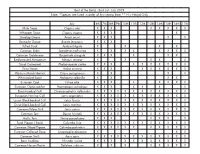
Best of the Baltic - Bird List - July 2019 Note: *Species are listed in order of first seeing them ** H = Heard Only July 6th 7th 8th 9th 10th 11th 12th 13th 14th 15th 16th 17th Mute Swan Cygnus olor X X X X X X X X Whopper Swan Cygnus cygnus X X X X Greylag Goose Anser anser X X X X X Barnacle Goose Branta leucopsis X X X Tufted Duck Aythya fuligula X X X X Common Eider Somateria mollissima X X X X X X X X Common Goldeneye Bucephala clangula X X X X X X Red-breasted Merganser Mergus serrator X X X X X Great Cormorant Phalacrocorax carbo X X X X X X X X X X Grey Heron Ardea cinerea X X X X X X X X X Western Marsh Harrier Circus aeruginosus X X X X White-tailed Eagle Haliaeetus albicilla X X X X Eurasian Coot Fulica atra X X X X X X X X Eurasian Oystercatcher Haematopus ostralegus X X X X X X X Black-headed Gull Chroicocephalus ridibundus X X X X X X X X X X X X European Herring Gull Larus argentatus X X X X X X X X X X X X Lesser Black-backed Gull Larus fuscus X X X X X X X X X X X X Great Black-backed Gull Larus marinus X X X X X X X X X X X X Common/Mew Gull Larus canus X X X X X X X X X X X X Common Tern Sterna hirundo X X X X X X X X X X X X Arctic Tern Sterna paradisaea X X X X X X X Feral Pigeon ( Rock) Columba livia X X X X X X X X X X X X Common Wood Pigeon Columba palumbus X X X X X X X X X X X Eurasian Collared Dove Streptopelia decaocto X X X Common Swift Apus apus X X X X X X X X X X X X Barn Swallow Hirundo rustica X X X X X X X X X X X Common House Martin Delichon urbicum X X X X X X X X White Wagtail Motacilla alba X X -
The Importance of Landscape Structure for Nest Defence in the Eurasian Treecreeper Certhia Familiaris
Ornis Fennica 84:145–154. 2007 The importance of landscape structure for nest defence in the Eurasian Treecreeper Certhia familiaris Ari Jäntti, Harri Hakkarainen, Markku Kuitunen*, Jukka Suhonen Jäntti, A., Department of Biological and Environmental Science, P. O. Box 35 (YAC), Survontie 9, FI-40014, University of Jyväskylä, Finland Hakkarainen, H., Section of Ecology, Department of Biology, University of Turku, FI- 20014 Turku, Finland Kuitunen, M., Department of Biological and Environmental Science, P.O. Box 35 (YAC), Survontie 9, FI-40014, University of Jyväskylä, Finland. markku.kuitunen@jyu.fi (*Cor- responding author) Suhonen, J., Department of Biological and Environmental Science, P. O. Box 35 (YAC), Survontie 9, FI-40014, University of Jyväskylä, Finland. Current address: Section of Ecology, Department of Biology, University of Turku, FI-20014 Turku, Finland Received 19 April 2006, revised 9 August 2007, accepted 20 August 2007 Forest loss and fragmentation induces harmful ecological effects especially for species preferring mature forests. The Eurasian Treecreeper, Certhia familiaris, is highly special- ised in foraging on large tree trunks and can only occasionally forage outside of mature fo- rests. We quantified nest defence behaviour of Treecreeper parents toward a stuffed model of Great Spotted Woodpecker Dendrocopos major in central Finland. We used a Geographical Information System (GIS) to measure the landscape structure within a 200 m radius around the nest. We found that females with more fledged offspring gave alarm calls from farther away from the predator model than did females with fewer fledged off- spring. The alarming distance of females was longer when the forest patch around the nest was larger. -
CISO-COI Check-List of Italian Birds - 2020
https://doi.org/10.30456/AVO.2021_checklist_en Avocetta 45: 21 - 82 (2021) CISO-COI Check-list of Italian birds - 2020 Nicola Baccetti1*, Giancarlo Fracasso2* & Commissione Ornitologica Italiana (COI) 1ISPRA - Istituto Superiore per la Ricerca e la Protezione Ambientale - Via Ca’ Fornacetta 9, 40064 Ozzano dell’Emilia (BO), Italy 2Gruppo Nisoria - c/o Museo naturalistico-archeologico, Contrà S. Corona 4, 36100 Vicenza, Italy *corresponding authors: nicola.baccetti@isprambiente.it, giancarlofracasso@virgilio.it NB 0000-0001-6579-6060, GF 0000-0002-6837-5752 Abstract - This paper upgrades and updates the checklist of the bird species recorded in Italy between 1800 and 2019. For the first time, it also includes subspecies. The classification, taxonomy and English names are based on «The Handbook of the Birds of the World & BirdLife International Checklist». The Italian list contains at present 551 species and 702 taxonomic units, including in the latter both the subspecies and the monotypic species. Each of them has been allocated to the AERC categories A, B or C according to four different frequency codes. Since the publication of the previous list (2009), 25 species have been added. The currently breeding avifauna includes 287 species: additional 10 species are regarded as nationally extinct breeders. The Italian checklist, that will be regularly updated, is available on the website of the CISO-COI (https://ciso-coi.it/coi/ checklist-ciso-coi-degli-uccelli-italiani/). INTRODUCTION coded A, B or C, we avoided adding an E status to all Ten years after the publication of the first CISO-COI cases of non-natural occurrence of A or C species. -

European Red List of Birds
European Red List of Birds Compiled by BirdLife International Published by the European Commission. opinion whatsoever on the part of the European Commission or BirdLife International concerning the legal status of any country, Citation: Publications of the European Communities. Design and layout by: Imre Sebestyén jr. / UNITgraphics.com Printed by: Pannónia Nyomda Picture credits on cover page: Fratercula arctica to continue into the future. © Ondrej Pelánek All photographs used in this publication remain the property of the original copyright holder (see individual captions for details). Photographs should not be reproduced or used in other contexts without written permission from the copyright holder. Available from: to your questions about the European Union Freephone number (*): 00 800 6 7 8 9 10 11 (*) Certain mobile telephone operators do not allow access to 00 800 numbers or these calls may be billed Published by the European Commission. A great deal of additional information on the European Union is available on the Internet. It can be accessed through the Europa server (http://europa.eu). Cataloguing data can be found at the end of this publication. ISBN: 978-92-79-47450-7 DOI: 10.2779/975810 © European Union, 2015 Reproduction of this publication for educational or other non-commercial purposes is authorized without prior written permission from the copyright holder provided the source is fully acknowledged. Reproduction of this publication for resale or other commercial purposes is prohibited without prior written permission of the copyright holder. Printed in Hungary. European Red List of Birds Consortium iii Table of contents Acknowledgements ...................................................................................................................................................1 Executive summary ...................................................................................................................................................5 1. -

Partial Migration in the Mediterranean Storm Petrel Hydrobates Pelagicus Melitensis
Lago et al.: Partial migration in Mediterranean Storm Petrel 105 PARTIAL MIGRATION IN THE MEDITERRANEAN STORM PETREL HYDROBATES PELAGICUS MELITENSIS PAULO LAGO*, MARTIN AUSTAD & BENJAMIN METZGER BirdLife Malta, 57/28 Triq Abate Rigord, Ta’ Xbiex XBX 1120, Malta *(paulolagobarreiro@gmail.com) Received 27 November 2018, accepted 05 February 2019 ABSTRACT LAGO, P., AUSTAD, M. & METZGER, B. 2019. Partial migration in the Mediterranean Storm Petrel Hydrobates pelagicus melitensis. Marine Ornithology 47: 105–113. Studying the migration routes and wintering areas of seabirds is crucial to understanding their ecology and to inform conservation efforts. Here we present results of a tracking study carried out on the little-known Mediterranean Storm Petrel Hydrobates pelagicus melitensis. During the 2016 breeding season, Global Location Sensor (GLS) tags were deployed on birds at the largest Mediterranean colony: the islet of Filfla in the Maltese Archipelago. The devices were retrieved the following season, revealing hitherto unknown movements and wintering areas of this species. Most individuals remained in the Mediterranean throughout the year, with birds shifting westwards or remaining in the central Mediterranean during winter. However, one bird left the Mediterranean through the Strait of Gibraltar and wintered in the North Atlantic. Our results from GLS tracking, which are supported by data from ringed and recovered birds, point toward a system of partial migration with high inter-individual variation. This highlights the importance of trans-boundary marine protection for the conservation of vulnerable seabirds. Key words: Procellariformes, movement, geolocation, wintering, Malta, capture-mark-recovery INTRODUCTION The Mediterranean Storm Petrel has been described as sedentary, because birds are present in their breeding areas throughout the year The Mediterranean Storm Petrel Hydrobates pelagicus melitensis is (Zotier et al. -
Multiple Fragmented Habitat-Patch Use in an Urban Breeding Passerine, the Short-Toed Treecreeper
RESEARCH ARTICLE Multiple fragmented habitat-patch use in an urban breeding passerine, the Short-toed Treecreeper Katherine R. S. SnellID*, Rie B. E. Jensen, Troels E. Ortvad, Mikkel Willemoes, Kasper Thorup Center for Macroecology, Evolution and Climate, Natural History Museum of Denmark, University of Copenhagen, Copenhagen, Denmark a1111111111 * katherine.snell@snm.ku.dk a1111111111 a1111111111 a1111111111 a1111111111 Abstract Individual responses of wild birds to fragmented habitat have rarely been studied, despite large-scale habitat fragmentation and biodiversity loss resulting from widespread urbanisa- tion. We investigated the spatial ecology of the Short-toed Treecreeper Certhia brachydac- OPEN ACCESS tyla, a tiny, resident, woodland passerine that has recently colonised city parks at the Citation: Snell KRS, Jensen RBE, Ortvad TE, northern extent of its range. High resolution spatiotemporal movements of this obligate tree- Willemoes M, Thorup K (2020) Multiple living species were determined using radio telemetry within the urbanized matrix of city fragmented habitat-patch use in an urban breeding passerine, the Short-toed Treecreeper. PLoS ONE parks in Copenhagen, Denmark. We identified regular edge crossing behaviour, novel in 15(1): e0227731. https://doi.org/10.1371/journal. woodland birds. While low numbers of individuals precluded a comprehensive characterisa- pone.0227731 tion of home range for this population, we were able to describe a consistent behaviour Editor: Jorge RamoÂn LoÂpez-Olvera, Universitat which has consequences for our understanding of animal movement in urban ecosystems. Autònoma de Barcelona, SPAIN We report that treecreepers move freely, and apparently do so regularly, between isolated Received: July 10, 2019 habitat patches. This behaviour is a possible driver of the range expansion in this species Accepted: December 29, 2019 and may contribute to rapid dispersal capabilities in certain avian species, including Short- toed Treecreepers, into northern Europe. -

EUROPEAN BIRDS of CONSERVATION CONCERN Populations, Trends and National Responsibilities
EUROPEAN BIRDS OF CONSERVATION CONCERN Populations, trends and national responsibilities COMPILED BY ANNA STANEVA AND IAN BURFIELD WITH SPONSORSHIP FROM CONTENTS Introduction 4 86 ITALY References 9 89 KOSOVO ALBANIA 10 92 LATVIA ANDORRA 14 95 LIECHTENSTEIN ARMENIA 16 97 LITHUANIA AUSTRIA 19 100 LUXEMBOURG AZERBAIJAN 22 102 MACEDONIA BELARUS 26 105 MALTA BELGIUM 29 107 MOLDOVA BOSNIA AND HERZEGOVINA 32 110 MONTENEGRO BULGARIA 35 113 NETHERLANDS CROATIA 39 116 NORWAY CYPRUS 42 119 POLAND CZECH REPUBLIC 45 122 PORTUGAL DENMARK 48 125 ROMANIA ESTONIA 51 128 RUSSIA BirdLife Europe and Central Asia is a partnership of 48 national conservation organisations and a leader in bird conservation. Our unique local to global FAROE ISLANDS DENMARK 54 132 SERBIA approach enables us to deliver high impact and long term conservation for the beneit of nature and people. BirdLife Europe and Central Asia is one of FINLAND 56 135 SLOVAKIA the six regional secretariats that compose BirdLife International. Based in Brus- sels, it supports the European and Central Asian Partnership and is present FRANCE 60 138 SLOVENIA in 47 countries including all EU Member States. With more than 4,100 staf in Europe, two million members and tens of thousands of skilled volunteers, GEORGIA 64 141 SPAIN BirdLife Europe and Central Asia, together with its national partners, owns or manages more than 6,000 nature sites totaling 320,000 hectares. GERMANY 67 145 SWEDEN GIBRALTAR UNITED KINGDOM 71 148 SWITZERLAND GREECE 72 151 TURKEY GREENLAND DENMARK 76 155 UKRAINE HUNGARY 78 159 UNITED KINGDOM ICELAND 81 162 European population sizes and trends STICHTING BIRDLIFE EUROPE GRATEFULLY ACKNOWLEDGES FINANCIAL SUPPORT FROM THE EUROPEAN COMMISSION. -
Wetland Aliens Cause Bird Extinction
PRESS RELEASE Embargoed until 00:01 GMT on 26 May 2010 Wetland aliens cause bird extinction Gland, Switzerland and Cambridge, UK, 26 May, 2010 (IUCN/BirdLife) - BirdLife International announces today, in an update to the IUCN Red List of Threatened Species™ for birds, the extinction of Alaotra Grebe Tachybaptus rufolavatus. Restricted to a tiny area of east Madagascar, this species declined rapidly after carnivorous fish were introduced to the lakes in which it lived. This, along with the use of nylon gill-nets by fisherman which caught and drowned birds, has driven this species into the abyss. “No hope now remains for this species. It is another example of how human actions can have unforeseen consequences”, says Dr Leon Bennun, BirdLife International’s Director of Science, Policy and Information. “Invasive alien species have caused extinctions around the globe and remain one of the major threats to birds and other biodiversity.” Another wetland species suffering from the impacts of introduced aliens is Zapata Rail Cyanolimnas cerverai from Cuba. It has been uplisted to Critically Endangered and is under threat from introduced mongooses and exotic catfish. An extremely secretive marsh-dwelling species, the only nest ever found of this species was described by James Bond, a Caribbean ornithologist and the source for Ian Fleming’s famous spy’s name. And it’s not just aliens. Wetlands the world over, and the species found in them, are under increasing pressures. In Asia and Australia, numbers of once common wader species such as Great Knot Calidris tenuirostris and Far Eastern Curlew Numenius madagascariensis are dropping rapidly as a result of drainage and pollution of coastal wetlands. -

Certhia Familiaris
Report under the Article 12 of the Birds Directive European Environment Agency Period 2008-2012 European Topic Centre on Biological Diversity Certhia familiaris Annex I No International action plan No Eurasian Treecreeper, Certhia familiaris, is a species of passerine bird in the treecreeper family found in woodland and forest ecosystems. It is a widespread breeder across much of Europe, but patchily distributed in the South-West. This species inhabits forest and woodland, generally requiring well-grown trees with many cracks and crevices in the bark for foraging, roosting and nesting. It tends to favour older stands of spruce (Picea), but habitat preferences are complex and apparently affected by presence or absence of Certhia brachydactyla (European Red List 2015). Certhia familiaris has a breeding population size of 2790000-5460000 pairs and a breeding range size of 2240000 square kilometres in the EU27. The breeding population trend in the EU27 is Stable in the short term and Stable in the long term. The EU population status of Certhia familiaris was assessed as Secure, because the species does not meet any of the IUCN Red List criteria for threatened or Near Threatened, or the criteria for Depleted or Declining (the EU27 population or range has not declined by 20% or more since 1980). Page 1 Certhia familiaris Report under the Article 12 of the Birds Directive Assessment of status at the European level Breeding Breeding range Winter population Winter Breeding population trend Range trend trend Population population population size area status Short Long Short Long size Short Long term term term term term term 2790000 - 5460000 p 0 0 2240000 Secure See the endnotes for more informationi Page 2 Certhia familiaris Report under the Article 12 of the Birds Directive Page 3 Certhia familiaris Report under the Article 12 of the Birds Directive Trends at the Member State level Breeding Breeding range Winter population Winter % in Breeding population trend Range trend trend MS/Ter.