Epiphyte Or Not Chilean Cinderellas Thelocephala Hardy Bromeliads
Total Page:16
File Type:pdf, Size:1020Kb
Load more
Recommended publications
-
Macroscale Analysis of Mistletoe Host Ranges in the Andean‐Patagonian
DR. GUILLERMO AMICO (Orcid ID : 0000-0002-3709-3111) Article type : Research Paper handling Editor: Dr. Diane Byers Macroscale Analysis of Mistletoe Host Ranges in the Andean-Patagonian Forest Article Guillermo C. Amico1*, Daniel L. Nickrent2 and Romina Vidal-Russell1 1 Laboratorio Ecotono, INIBIOMA CONICET (Universidad Nacional del Comahue) Quintral 1250, Bariloche, Río Negro, Argentina 2 Department of Plant Biology, Southern Illinois University, Carbondale, IL 62901-6509 Corresponding author Corresponding author’s e-mail address: guillermo.amico@comahue-conicet.gob.ar This article has been accepted for publication and undergone full peer review but has not been through the copyediting, typesetting, pagination and proofreading process, which may lead to differences between this version and the Version of Record. Please cite this article as Accepted doi: 10.1111/plb.12900 This article is protected by copyright. All rights reserved. ABSTRACT The number of host species infected by a mistletoe (host range) is critical in that it influences prevalence, virulence and overall distribution of the parasite; however, macroecological analyses of this life history feature are lacking for many regions. The Andean-Patagonian forest, found along the southern Andes from 35˚S to Tierra del Fuego 55˚S, contains twelve mistletoe species in three families (Loranthaceae, Misodendraceae and Santalaceae). By tabulating herbarium records, the host ranges and geographical distributions of these mistletoes were explored. Our results show that these parasites occur on 43 plant species in 24 families but with varying degrees of specificity. All Misodendrum species and Desmaria mutabilis (Loranthaceae) are specialists that use Nothofagus as their primary hosts. Tristerix and Article Notanthera (Loranthaceae) and Antidaphne and Lepidoceras (Santalaceae) are generalists parasitizing more than six host species from several genera and families. -

Epiparasitism in Phoradendron Durangense and P. Falcatum (Viscaceae) Clyde L
Aliso: A Journal of Systematic and Evolutionary Botany Volume 27 | Issue 1 Article 2 2009 Epiparasitism in Phoradendron durangense and P. falcatum (Viscaceae) Clyde L. Calvin Rancho Santa Ana Botanic Garden, Claremont, California Carol A. Wilson Rancho Santa Ana Botanic Garden, Claremont, California Follow this and additional works at: http://scholarship.claremont.edu/aliso Part of the Botany Commons Recommended Citation Calvin, Clyde L. and Wilson, Carol A. (2009) "Epiparasitism in Phoradendron durangense and P. falcatum (Viscaceae)," Aliso: A Journal of Systematic and Evolutionary Botany: Vol. 27: Iss. 1, Article 2. Available at: http://scholarship.claremont.edu/aliso/vol27/iss1/2 Aliso, 27, pp. 1–12 ’ 2009, Rancho Santa Ana Botanic Garden EPIPARASITISM IN PHORADENDRON DURANGENSE AND P. FALCATUM (VISCACEAE) CLYDE L. CALVIN1 AND CAROL A. WILSON1,2 1Rancho Santa Ana Botanic Garden, 1500 North College Avenue, Claremont, California 91711-3157, USA 2Corresponding author (carol.wilson@cgu.edu) ABSTRACT Phoradendron, the largest mistletoe genus in the New World, extends from temperate North America to temperate South America. Most species are parasitic on terrestrial hosts, but a few occur only, or primarily, on other species of Phoradendron. We examined relationships among two obligate epiparasites, P. durangense and P. falcatum, and their parasitic hosts. Fruit and seed of both epiparasites were small compared to those of their parasitic hosts. Seed of epiparasites was established on parasitic-host stems, leaves, and inflorescences. Shoots developed from the plumular region or from buds on the holdfast or subjacent tissue. The developing endophytic system initially consisted of multiple separate strands that widened, merged, and often entirely displaced its parasitic host from the cambial cylinder. -

Embriologia De Tillandsia Aeranthos (Lois.) L
UNIVERSIDADE FEDERAL DE SANTA MARIA CENTRO DE CIÊNCIAS NATURAIS E EXATAS PROGRAMA DE PÓS-GRADUAÇÃO EM AGROBIOLOGIA EMBRIOLOGIA DE TILLANDSIA AERANTHOS (LOIS.) L. B. SM. (TILLANDSIOIDEAE- BROMELIACEAE) DISSERTAÇÃO DE MESTRADO Cristiele Spat Santa Maria, RS, Brasil 2012 EMBRIOLOGIA DE TILLANDSIA AERANTHOS (LOIS.) L. B. SM. (TILLANDSIOIDEAE-BROMELIACEAE) Cristiele Spat Dissertação apresentada ao Curso de Mestrado do Programa de Pós-Graduação em Agrobiologia, da Universidade Federal de Santa Maria (UFSM, RS), como requisito parcial para obtenção do grau de Mestre em Agrobiologia Orientador: Prof. Dr. João Marcelo Santos de Oliveira Santa Maria, RS, Brasil 2012 AGRADECIMENTOS À minha família, pelo apoio, incentivo e por compreender as ausências durante esses dois anos. Ao meu Orientador, Prof. Dr. João Marcelo Santos de Oliveira, pela amizade e dedicação durante minha formação, os quais foram fundamentais na execução desse trabalho. Ao Glauber, pelo carinho, apoio e paciência. À Drª. Jaqueline Sarzi Sartori, pela amizade, dedicação, aprendizado e discussões, sempre valiosas, sobre Bromeliaceae Ao César Carvalho de Freitas, pela ajuda e disponibilidade na confecção do material botânico, indispensável na execução deste trabalho. À Marisa Binotto, pela amizade, companherismo e auxílio técnico no laboratório, muito importantes na execução deste estudo. Aos amigos e colegas do Laboratório de Botânica Estrutural, Patrícia, Merielen e Mariane, pelo convívio diário, incentivo e discussões acadêmicas, muito importantes para a realização deste trabalho. Às minhas amigas, Renata, Lara e Letícia, pelos encontros, momentos de descontração e por lembrarem, todos os dias, o valor de uma amizade. À Prof. Drª. Thais Scotti do Canto-Dorow, pela análise taxonômica e disponibilidade em realizar as coletas. -
Taxonomy and Distribution of Opuntia and Related Plants
Taxonomy and Distribution of Opuntia and Related Genera Raul Puente Desert Botanical Garden Donald Pinkava Arizona State University Subfamily Opuntioideae Ca. 350 spp. 13-18 genera Very wide distribution (Canada to Patagonia) Morphological consistency Glochids Bony arils Generic Boundaries Britton and Rose, 1919 Anderson, 2001 Hunt, 2006 -- Seven genera -- 15 genera --18 genera Austrocylindropuntia Austrocylindropuntia Grusonia Brasiliopuntia Brasiliopuntia Maihuenia Consolea Consolea Nopalea Cumulopuntia Cumulopuntia Opuntia Cylindropuntia Cylindropuntia Pereskiopsis Grusonia Grusonia Pterocactus Maihueniopsis Corynopuntia Tacinga Miqueliopuntia Micropuntia Opuntia Maihueniopsis Nopalea Miqueliopuntia Pereskiopsis Opuntia Pterocactus Nopalea Quiabentia Pereskiopsis Tacinga Pterocactus Tephrocactus Quiabentia Tunilla Tacinga Tephrocactus Tunilla Classification: Family: Cactaceae Subfamily: Maihuenioideae Pereskioideae Cactoideae Opuntioideae Wallace, 2002 Opuntia Griffith, P. 2002 Nopalea nrITS Consolea Tacinga Brasiliopuntia Tunilla Miqueliopuntia Cylindropuntia Grusonia Opuntioideae Grusonia pulchella Pereskiopsis Austrocylindropuntia Quiabentia 95 Cumulopuntia Tephrocactus Pterocactus Maihueniopsis Cactoideae Maihuenioideae Pereskia aculeata Pereskiodeae Pereskia grandiflora Talinum Portulacaceae Origin and Dispersal Andean Region (Wallace and Dickie, 2002) Cylindropuntia Cylindropuntia tesajo Cylindropuntia thurberi (Engelmann) F. M. Knuth Cylindropuntia cholla (Weber) F. M. Knuth Potential overlapping areas between the Opuntia -

Taxonomic Revision of the Chilean Puya Species (Puyoideae
Taxonomic revision of the Chilean Puya species (Puyoideae, Bromeliaceae), with special notes on the Puya alpestris-Puya berteroniana species complex Author(s): Georg Zizka, Julio V. Schneider, Katharina Schulte and Patricio Novoa Source: Brittonia , 1 December 2013, Vol. 65, No. 4 (1 December 2013), pp. 387-407 Published by: Springer on behalf of the New York Botanical Garden Press Stable URL: https://www.jstor.org/stable/24692658 JSTOR is a not-for-profit service that helps scholars, researchers, and students discover, use, and build upon a wide range of content in a trusted digital archive. We use information technology and tools to increase productivity and facilitate new forms of scholarship. For more information about JSTOR, please contact support@jstor.org. Your use of the JSTOR archive indicates your acceptance of the Terms & Conditions of Use, available at https://about.jstor.org/terms New York Botanical Garden Press and Springer are collaborating with JSTOR to digitize, preserve and extend access to Brittonia This content downloaded from 146.244.165.8 on Sun, 13 Dec 2020 04:26:58 UTC All use subject to https://about.jstor.org/terms Taxonomic revision of the Chilean Puya species (Puyoideae, Bromeliaceae), with special notes on the Puya alpestris-Puya berteroniana species complex Georg Zizka1'2, Julio V. Schneider1'2, Katharina Schulte3, and Patricio Novoa4 1 Botanik und Molekulare Evolutionsforschung, Senckenberg Gesellschaft für Naturforschung and Johann Wolfgang Goethe-Universität, Senckenberganlage 25, 60325, Frankfurt am Main, Germany; e-mail: Georg.Zizka@senckenberg.de; e-mail: Julio.Schneider@senckenberg.de 2 Biodiversity and Climate Research Center (BIK-F), Senckenberganlage 25, 60325, Frankfurt am Main, Germany 3 Australian Tropical Herbarium and Tropical Biodiversity and Climate Change Centre, James Cook University, PO Box 6811, Caims, QLD 4870, Australia; e-mail: katharina.schulte@jcu.edu.au 4 Jardin Botânico Nacional, Camino El Olivar 305, El Salto, Vina del Mar, Chile Abstract. -
Supplementary Material What Do Nectarivorous Bats Like? Nectar Composition in Bromeliaceae with Special Emphasis on Bat-Pollinated Species
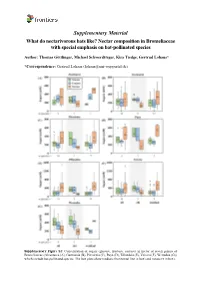
Supplementary Material What do nectarivorous bats like? Nectar composition in Bromeliaceae with special emphasis on bat-pollinated species Author: Thomas Göttlinger, Michael Schwerdtfeger, Kira Tiedge, Gertrud Lohaus* *Correspondence: Gertrud Lohaus (lohaus@uni-wuppertal.de) Supplementary Figure S1: Concentration of sugars (glucose, fructose, sucrose) in nectar of seven genera of Bromeliaceae (Alcantarea (A), Guzmania (B), Pitcairnia (C), Puya (D), Tillandsia (E), Vriesea (F), Werauhia (G)) which include bat-pollinated species. The box plots show medians (horizontal line in box) and means (x in box). Supplementary Material What do nectarivorous bats like? Nectar composition in Bromeliaceae with special emphasis on bat-pollinated species Author: Thomas Göttlinger, Michael Schwerdtfeger, Kira Tiedge, Gertrud Lohaus* *Correspondence: Gertrud Lohaus (lohaus@uni-wuppertal.de) Supplementary Figure S2: Concentration of amino acids (ala, arg, asn, asp, gaba, gln, glu, gly, his, iso, leu, lys, met, phe, pro, ser, thr, trp, tyr, val) in nectar of seven genera of Bromeliaceae (Alcantarea (A), Guzmania (B), Pitcairnia (C), Puya (D), Tillandsia (E), Vriesea (F), Werauhia (G)), which include bat-pollinated species. The box plots show medians (horizontal line in box) and means (x in box). Supplementary Material What do nectarivorous bats like? Nectar composition in Bromeliaceae with special emphasis on bat-pollinated species Author: Thomas Göttlinger, Michael Schwerdtfeger, Kira Tiedge, Gertrud Lohaus* *Correspondence: Gertrud Lohaus (lohaus@uni-wuppertal.de) Supplementary Figure S3: Cation concentrations (Ca2+, K+, Na+, Mg2+) in nectar of seven genera of Bromeliaceae (Alcantarea (A), Guzmania (B), Pitcairnia (C), Puya (D), Tillandsia (E), Vriesea (F), Werauhia (G)), which include bat-pollinated species. The box plots show medians (horizontal line in box) and means (x in box). -

Departamento De Botánica Facultad De Ciencias Naturales Y Oceanográficas Universidad De Concepción VALOR ADAPTATIVO DE LA VÍ
Departamento de Botánica Facultad de Ciencias Naturales y Oceanográficas Universidad de Concepción VALOR ADAPTATIVO DE LA VÍA FOTOSINTÉTICA CAM PARA ESPECIES CHILENAS DEL GÉNERO PUYA (BROMELIACEAE) Tesis para optar al grado de Doctor en Ciencias Biológicas, Área de especialización Botánica IVÁN MARCELO QUEZADA ARRIAGADA Profesor guía: Dr. Ernesto Gianoli M. Profesor co-tutor: Dr. Alfredo Saldaña M. Comisión evaluadora de tesis, para optar al grado de Doctor en Ciencias Biológicas Área Botánica “Valor adaptativo de la vía fotosintética CAM para especies chilenas del género Puya (Bromeliaceae)” Dr. Ernesto Gianoli ___________________________________ Profesor Guía Dr. Alfredo Saldaña ___________________________________ Co-tutor Dr. Carlos M. Baeza ___________________________________ Dra. María Fernanda Pérez ___________________________________ Evaluadora externa Dra. Fabiola Cruces ___________________________________ Directora (S) Programa Doctorado en Botánica Septiembre 2013 1 A Paula, Leonor y Julieta 2 AGRADECIMIENTOS El completar exitosamente una tarea de esta magnitud se debe, en gran medida, a todos quienes me brindaron su apoyo, consejo o ayuda en algún punto de este largo camino. En primer lugar debo agradecer a Paula, mi esposa, amiga y compañera, por soportar conmigo estos 4 años y medio de esfuerzo, sacrificios y más de alguna recompensa. No solo ha sido soporte para mi espíritu durante todo este tiempo, sino que además fue la mejor compañera de terreno que pude haber encontrado. Agradezco también a mi hija mayor, Leonor, inspirada dibujante, talentosa fotógrafa y la mejor asistente de muestreo que existe, cuya mirada de felicidad y asombro durante los largos viajes en los que me acompañó fue el mejor recordatorio de que la vida hay que disfrutarla, siempre. También, y aunque llegó al final de este largo camino, agradezco a Julieta, quien ha sido el impulso que necesitaba para darme a la tarea de concluír este trabajo. -
Loranthaceae) on the Cactus Echinopsis Chilensis
Revista Chilena de Historia Natural 73: 525-531, 2000 Factors affecting the circular distribution of the leafless mistletoe Tristerix aphyllus (Loranthaceae) on the cactus Echinopsis chilensis Factores que afectan la distribuci6n circular del muerdago sin hojas Tristerix aphyllus (Loranthaceae) sobre el cacto Echinopsis chilensis CAREZZA BOTTO-MAHAN', RODRIGO MEDEL', ROSANNA GINOCCHI02 & GLORIA MONTENEGR03 'Departamento de Ciencias Ecologicas, Facultad de Ciencias, Universidad de Chile, Casilla 653, Santiago, Chile, e-mai I: rmedel@ abello.dic. uchile.cl 2Departamento de Ecologfa, Facultad de Ciencias Biologicas, Pontificia Universidad Catolica de Chile, Casilla 114-D, Santiago, Chile. 3Departamento de Ciencias Vegetales, Facultad de Agronomfa y de Ingenierfa Forestal, Pontificia Universidad Catolica de Chile, Casilla 306, Santiago, Chile ABSTRACT We describe the pattern of emergence of the holoparasitic mistletoe Tristerix aphyllus from its cactus host Echinopsis chilensis in a semiarid Chilean ecosystem. The observed circular distribution of the parasite inflorescence differed significantly from a uniform distribution based on a random process. We quantified the circular distribution of the seeds defecated on the cactus surface by Mimus thenca, the only bird responsible of seed dispersal. Our data did not support the idea of a directional seed deposition by the bird. To test the hypothesis that the observed circular distribution can be attributable to a differential seed survival due to microsite temperature variation, we infected cacti with seeds ofT. aphyllus every 30°and quantified the temperature associated to each angle. Our results revealed that even though seeds located in angles with higher sun exposure had the lowest haustoria! disk formation, this variation in mortality is not sufficient to explain the angular polarity observed in this species. -
Phylogenetic Relationships and Ecological Speciation in the Mistletoe Tristerix (Loranthaceae): the Influence of Pollinators, Dispersers, and Hosts Amico C
Southern Illinois University Carbondale OpenSIUC Publications Department of Plant Biology 2007 Phylogenetic relationships and ecological speciation in the mistletoe Tristerix (Loranthaceae): the influence of pollinators, dispersers, and hosts Amico C. Guillermo Romina Vidal-Russel Daniel L. Nickrent Southern Illinois University Carbondale, nickrent@plant.siu.edu Follow this and additional works at: http://opensiuc.lib.siu.edu/pb_pubs Published in American Journal of Botany 94: 558-567. http://www.amjbot.org/cgi/content/ abstract/94/4/558 Recommended Citation Guillermo, Amico C., Vidal-Russel, Romina and Nickrent, Daniel L. "Phylogenetic relationships and ecological speciation in the mistletoe Tristerix (Loranthaceae): the influence of pollinators, dispersers, and hosts." (Jan 2007). This Article is brought to you for free and open access by the Department of Plant Biology at OpenSIUC. It has been accepted for inclusion in Publications by an authorized administrator of OpenSIUC. For more information, please contact opensiuc@lib.siu.edu. American Journal of Botany 94(4): 558–567. 2007. PHYLOGENETIC RELATIONSHIPS AND ECOLOGICAL SPECIATION IN THE MISTLETOE TRISTERIX (LORANTHACEAE): THE INFLUENCE OF POLLINATORS, DISPERSERS, AND HOSTS1 GUILLERMO C. AMICO,2,3,4 ROMINA VIDAL-RUSSELL,3 AND DANIEL L. NICKRENT3 2Laboratorio Ecotono, Universidad Nacional del Comahue, CRUB, Quintral 1250 Bariloche, RN 8400 Argentina; and 3Department of Plant Biology, Southern Illinois University, Carbondale, Illinois 62901-6509 USA Phylogenies can provide valuable information on biotic and abiotic factors associated with speciation. We examined species relationships in Tristerix (Loranthaceae), a genus of 11 species with an Andean distribution from Colombia to Chile. A previous classification divided Tristerix into subgenera Tristerix (two species) and Metastachys (nine species). -

Literaturverzeichnis
Literaturverzeichnis Abaimov, A.P., 2010: Geographical Distribution and Ackerly, D.D., 2009: Evolution, origin and age of Genetics of Siberian Larch Species. In Osawa, A., line ages in the Californian and Mediterranean flo- Zyryanova, O.A., Matsuura, Y., Kajimoto, T. & ras. Journal of Biogeography 36, 1221–1233. Wein, R.W. (eds.), Permafrost Ecosystems. Sibe- Acocks, J.P.H., 1988: Veld Types of South Africa. 3rd rian Larch Forests. Ecological Studies 209, 41–58. Edition. Botanical Research Institute, Pretoria, Abbadie, L., Gignoux, J., Le Roux, X. & Lepage, M. 146 pp. (eds.), 2006: Lamto. Structure, Functioning, and Adam, P., 1990: Saltmarsh Ecology. Cambridge Uni- Dynamics of a Savanna Ecosystem. Ecological Stu- versity Press. Cambridge, 461 pp. dies 179, 415 pp. Adam, P., 1994: Australian Rainforests. Oxford Bio- Abbott, R.J. & Brochmann, C., 2003: History and geography Series No. 6 (Oxford University Press), evolution of the arctic flora: in the footsteps of Eric 308 pp. Hultén. Molecular Ecology 12, 299–313. Adam, P., 1994: Saltmarsh and mangrove. In Groves, Abbott, R.J. & Comes, H.P., 2004: Evolution in the R.H. (ed.), Australian Vegetation. 2nd Edition. Arctic: a phylogeographic analysis of the circu- Cambridge University Press, Melbourne, pp. marctic plant Saxifraga oppositifolia (Purple Saxi- 395–435. frage). New Phytologist 161, 211–224. Adame, M.F., Neil, D., Wright, S.F. & Lovelock, C.E., Abbott, R.J., Chapman, H.M., Crawford, R.M.M. & 2010: Sedimentation within and among mangrove Forbes, D.G., 1995: Molecular diversity and deri- forests along a gradient of geomorphological set- vations of populations of Silene acaulis and Saxi- tings. -

Cactaceae) with Special Emphasis on the Genus Mammillaria Charles A
Iowa State University Capstones, Theses and Retrospective Theses and Dissertations Dissertations 2003 Phylogenetic studies of Tribe Cacteae (Cactaceae) with special emphasis on the genus Mammillaria Charles A. Butterworth Iowa State University Follow this and additional works at: https://lib.dr.iastate.edu/rtd Part of the Botany Commons, and the Genetics Commons Recommended Citation Butterworth, Charles A., "Phylogenetic studies of Tribe Cacteae (Cactaceae) with special emphasis on the genus Mammillaria " (2003). Retrospective Theses and Dissertations. 565. https://lib.dr.iastate.edu/rtd/565 This Dissertation is brought to you for free and open access by the Iowa State University Capstones, Theses and Dissertations at Iowa State University Digital Repository. It has been accepted for inclusion in Retrospective Theses and Dissertations by an authorized administrator of Iowa State University Digital Repository. For more information, please contact digirep@iastate.edu. INFORMATION TO USERS This manuscript has been reproduced from the microfilm master. UMI films the text directly from the original or copy submitted. Thus, some thesis and dissertation copies are in typewriter face, while others may be from any type of computer printer. The quality of this reproduction is dependent upon the quality of the copy submitted. Broken or indistinct print, colored or poor quality illustrations and photographs, print bleedthrough, substandard margins, and improper alignment can adversely affect reproduction. In the unlikely event that the author did not send UMI a complete manuscript and there are missing pages, these will be noted. Also, if unauthorized copyright material had to be removed, a note will indicate the deletion. Oversize materials (e.g., maps, drawings, charts) are reproduced by sectioning the original, beginning at the upper left-hand comer and continuing from left to right in equal sections with small overlaps. -

Anatomia Floral De Aechmea Distichantha Lem. E Canistropsis Billbergioides (Schult
Hoehnea 43(2): 183-193, 4 fig., 2016 http://dx.doi.org/10.1590/2236-8906-78/2015 Anatomia floral de Aechmea distichantha Lem. e Canistropsis billbergioides (Schult. & Schult.f) Leme (Bromeliaceae)1 Fernanda Maria Cordeiro de Oliveira2,3, André Melo de Souza2, Brenda Bogatzky Ribeiro Corrêa2, Tatiana Midori Maeda2 e Gladys Flavia Melo-de-Pinna2 Recebido: 13.10.2015; aceito: 26.02.2016 ABSTRACT - (Floral anatomy of Aechmea distichantha Lem. and Canistropsis billbergioides (Schult. & Schult.f) Leme (Bromeliaceae)). Aechmea Ruiz & Pav. and Canistropsis (Mez) Leme belong to the subfamily Bromelioideae, which has the largest morphological diversity in Bromeliaceae. The flower buds of Aechmea distichantha Lem. and Canistropsis billbergioides (Schult. & Schult. f.) Leme were collected, fixed, and processed according to usual techniques in plant anatomy. The species share characteristics such as the presence of spherical crystals of silica in the epidermal cells of perianth; idioblasts with raphids; endothecium with annular thickening; and inferior ovary with axillary placentation. Non- vascular petal appendages were observed only in A. distichantha, arranged in pairs on each petal. Both species present a septal nectary, which nectar is rich in of proteins and carbohydrates. A placental obturator occurs in both species and histochemical tests revealed that the secretion produced by the obturator contains carbohydrates and proteins, probably related to the pollen tube guidance. Keywords: obturator, petal appendages, septal nectary RESUMO - (Anatomia floral de Aechmea distichantha Lem. e Canistropsis billbergioides (Schult. & Schult.f) Leme (Bromeliaceae)). Aechmea Ruiz & Pav. e Canistropsis (Mez) Leme pertencem à subfamília Bromelioideae, detentora da maior diversidade morfológica em Bromeliaceae. Botões florais deAechmea distichantha Lem.