Olive Shootworm, Palpita Persimilis Munroe (Insecta: Lepidoptera: Crambidae)1 James E
Total Page:16
File Type:pdf, Size:1020Kb
Load more
Recommended publications
-

1 1 DNA Barcodes Reveal Deeply Neglected Diversity and Numerous
Page 1 of 57 1 DNA barcodes reveal deeply neglected diversity and numerous invasions of micromoths in 2 Madagascar 3 4 5 Carlos Lopez-Vaamonde1,2, Lucas Sire2, Bruno Rasmussen2, Rodolphe Rougerie3, 6 Christian Wieser4, Allaoui Ahamadi Allaoui 5, Joël Minet3, Jeremy R. deWaard6, Thibaud 7 Decaëns7, David C. Lees8 8 9 1 INRA, UR633, Zoologie Forestière, F- 45075 Orléans, France. 10 2 Institut de Recherche sur la Biologie de l’Insecte, UMR 7261 CNRS Université de Tours, UFR 11 Sciences et Techniques, Tours, France. 12 3Institut de Systématique Evolution Biodiversité (ISYEB), Muséum national d'Histoire naturelle, 13 CNRS, Sorbonne Université, EPHE, 57 rue Cuvier, CP 50, 75005 Paris, France. 14 4 Landesmuseum für Kärnten, Abteilung Zoologie, Museumgasse 2, 9020 Klagenfurt, Austria 15 5 Department of Entomology, University of Antananarivo, Antananarivo 101, Madagascar 16 6 Centre for Biodiversity Genomics, University of Guelph, 50 Stone Road E., Guelph, ON 17 N1G2W1, Canada 18 7Centre d'Ecologie Fonctionnelle et Evolutive (CEFE UMR 5175, CNRS–Université de Genome Downloaded from www.nrcresearchpress.com by UNIV GUELPH on 10/03/18 19 Montpellier–Université Paul-Valéry Montpellier–EPHE), 1919 Route de Mende, F-34293 20 Montpellier, France. 21 8Department of Life Sciences, Natural History Museum, Cromwell Road, SW7 5BD, UK. 22 23 24 Email for correspondence: carlos.lopezvaamonde@inra.fr For personal use only. This Just-IN manuscript is the accepted prior to copy editing and page composition. It may differ from final official version of record. 1 Page 2 of 57 25 26 Abstract 27 Madagascar is a prime evolutionary hotspot globally, but its unique biodiversity is under threat, 28 essentially from anthropogenic disturbance. -

DNA Barcodes Reveal Deeply Neglected Diversity and Numerous Invasions of Micromoths in Madagascar
Genome DNA barcodes reveal deeply neglected diversity and numerous invasions of micromoths in Madagascar Journal: Genome Manuscript ID gen-2018-0065.R2 Manuscript Type: Article Date Submitted by the 17-Jul-2018 Author: Complete List of Authors: Lopez-Vaamonde, Carlos; Institut National de la Recherche Agronomique (INRA), ; Institut de Recherche sur la Biologie de l’Insecte (IRBI), Sire, Lucas; Institut de Recherche sur la Biologie de l’Insecte Rasmussen,Draft Bruno; Institut de Recherche sur la Biologie de l’Insecte Rougerie, Rodolphe; Institut Systématique, Evolution, Biodiversité (ISYEB), Wieser, Christian; Landesmuseum für Kärnten Ahamadi, Allaoui; University of Antananarivo, Department Entomology Minet, Joël; Institut de Systematique Evolution Biodiversite deWaard, Jeremy; Biodiversity Institute of Ontario, University of Guelph, Decaëns, Thibaud; Centre d'Ecologie Fonctionnelle et Evolutive (CEFE UMR 5175, CNRS–Université de Montpellier–Université Paul-Valéry Montpellier–EPHE), , CEFE UMR 5175 CNRS Lees, David; Natural History Museum London Keyword: Africa, invasive alien species, Lepidoptera, Malaise trap, plant pests Is the invited manuscript for consideration in a Special 7th International Barcode of Life Issue? : https://mc06.manuscriptcentral.com/genome-pubs Page 1 of 57 Genome 1 DNA barcodes reveal deeply neglected diversity and numerous invasions of micromoths in 2 Madagascar 3 4 5 Carlos Lopez-Vaamonde1,2, Lucas Sire2, Bruno Rasmussen2, Rodolphe Rougerie3, 6 Christian Wieser4, Allaoui Ahamadi Allaoui 5, Joël Minet3, Jeremy R. deWaard6, Thibaud 7 Decaëns7, David C. Lees8 8 9 1 INRA, UR633, Zoologie Forestière, F- 45075 Orléans, France. 10 2 Institut de Recherche sur la Biologie de l’Insecte, UMR 7261 CNRS Université de Tours, UFR 11 Sciences et Techniques, Tours, France. -

Informação Base De Biodiversidade Da Ilha Do Corvo E Do Ilhéu De Vila Franca Do Campo
LIFE+ Safe Islands for Seabirds Relatório Acção A1 - Informação Base de Biodiversidade da Ilha do Corvo e do Ilhéu de Vila Franca do Campo LIFE07 NAT/P/000649 Corvo, Dezembro 2009 O P r o j e c O O projecto LIFE+ Safe Islands for Seabirds é uma parceria da SPEA com a Secretaria Regional do Ambiente e do Mar (SRAM), a Câmara Municipal do Corvo e a Royal Society for Protection of Birds, contando ainda com o apoio das seguintes entidades enquanto observadoras na sua Comissão Executiva: Direcção Regional dos Recursos Florestais (DRRF) e Câmara Municipal de Vila Franca do Campo. Trabalhar para o estudo e conservação das aves e seus habitats, promovendo um desenvolvimento que garanta a viabilidade do património natural para usufruto das gerações futuras. A SPEA – Sociedade Portuguesa para o Estudo das Aves é uma organização não governamental de ambiente que trabalha para a conservação das aves e dos seus habitats em Portugal. Como associação sem fins lucrativos, depende do apoio dos sócios e de diversas entidades para concretizar as suas acções. Faz parte de uma rede mundial de organizações de ambiente, a BirdLife International, que actua em mais de 100 países e tem como objectivo a preservação da diversidade biológica através da conservação das aves, dos seus habitats e da promoção do uso sustentável dos recursos naturais. LIFE+ Safe Islands for Seabirds. Relatório Inicial Sociedade Portuguesa para o Estudo das Aves, 2009 Direcção Nacional: Ricardo Azul Tomé, Maria Ana Peixe, Pedro Guerreiro, Ana Leal Martins, João Jara, Paulo Travassos, Pedro Coelho, Miguel Capelo, Paulo Simões Coelho, Teresa Catry Direcção Executiva: Luís Costa Coordenação do projecto: Pedro Luís Geraldes Equipa técnica: Ana Catarina Henriques, Carlos Silva, Joana Domingues, Nuno Oliveira, Sandra Hervías, Nuno Domingos, Susana Costa e Vanessa Oliveira. -
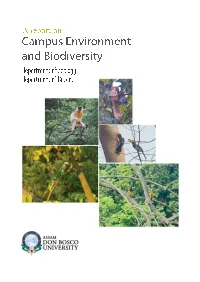
Campus Environment and Biodiversity Department of Zoology Department of Botany
A report on Campus Environment and Biodiversity Department of Zoology Department of Botany Content Pg No. 1. Introduction 1 2. Methodology 2 3. Result 3.1 Water Analysis of campus Lake 3 3.2 Soil Analysis 4 3.3 Faunal Diversity 5 i. Spider diversity 5 ii. Orthopteran diversity 7 iii. Avian diversity 8 iv. Odonate diversity 10 v. Ant diversity 13 vi. Terrestrial Beetle diversity 14 vii. Butterfly diversity 15 viii. Soil arthropod diversity 17 ix. Plankton diversity 18 x. Aquatic insect diversity 20 xi. Cockroach diversity 21 xii. Amphibia diversity 21 xiii. Moth diversity 23 xiv. Reptile diversity 24 xv. Mammal diversity 26 3.4 Floral Diversity 28 1. Introduction In its effort towards creating an eco-friendly campus, the University encourages its Faculty and Students to engage in conserving the Campus environment, its flora and fauna, through activities that include individual and collaborative research, conservation practices, activities and initiatives of the EcoClub and the University as a whole. Since 2017, the School of Life Sciences has been on a constant endeavour to create a repository of information on the biodiversity of the Campus through documentation of indigenous flora and fauna in its three Campuses, particularly the Tapesia Campus, which harbours unique species of flora and fauna. The Tapesia Campus is home to 296 species of fauna and 38 species of flora. Among the animal species, of mention is the incredible arachnid Lyrognathus saltator, the common Tarantula, which is found nesting among our vast expanse of greens. These numbers reveal the rich biodiversity of the Campus which summon for both admiration as well as protection and conservation. -
Oviposition Preference and Olfactory Response of Diaphania Indica (Lepidoptera: Pyralidae) to Volatiles of Uninfested and Infested Cucurbitaceous Host Plants
EUROPEAN JOURNAL OF ENTOMOLOGYENTOMOLOGY ISSN (online): 1802-8829 Eur. J. Entomol. 116: 392–401, 2019 http://www.eje.cz doi: 10.14411/eje.2019.040 ORIGINAL ARTICLE Oviposition preference and olfactory response of Diaphania indica (Lepidoptera: Pyralidae) to volatiles of uninfested and infested cucurbitaceous host plants AMIN MOGHBELI GHARAEI 1, MAHDI ZIAADDINI 1, *, MOHAMMAD AMIN JALALI 1 and BRIGITTE FREROT 2 1 Department of Plant Protection, College of Agriculture, Vali-e-Asr University of Rafsanjan, Rafsanjan, Iran; e-mails: ziaaddini@vru.ac.ir, a.moghbeli.g@gmail.com, ma.jalali@vru.ac.ir 2 INRA, UMR 1392, iEES Paris, Route de St Cyr, 78000 Versailles, France; e-mail: brigitte.frerot@inra.fr Key words. Lepidoptera, Pyralidae, Diaphania indica, cucumber moth, host volatiles, olfactory response, wind tunnel, oviposition, Cucurbitaceae, Citrullus lanatus, Cucumis melo, Cucumis sativus, Cucurbita pepo Abstract. The cucumber moth, Diaphania indica (Saunders) (Lepidoptera: Pyralidae), is a major pest of cucurbitaceous plants. The oviposition preference and olfactory response of larvae, mated and unmated male and female adults to volatiles emanating from uninfested and infested plants of four species of cucurbitaceous host plants and odours of conspecifi cs were recorded. Also the role of experience in the host fi nding behaviour of D. indica was evaluated. The experiments were done using a wind tunnel, olfactometer attraction assays and oviposition bioassays. The results reveal that fewer eggs were laid on infested plants than on uninfested plants. Females signifi cantly preferred cucumber over squash, melon and watermelon. Cucurbitaceous plants elicited adults of D. indica to fl y upwind followed by landing on the plants. -

Developing Biodiverse Green Roofs for Japan: Arthropod and Colonizer Plant Diversity on Harappa and Biotope Roofs
20182018 Green RoofsUrban and Naturalist Urban Biodiversity SpecialSpecial Issue No. Issue 1:16–38 No. 1 A. Nagase, Y. Yamada, T. Aoki, and M. Nomura URBAN NATURALIST Developing Biodiverse Green Roofs for Japan: Arthropod and Colonizer Plant Diversity on Harappa and Biotope Roofs Ayako Nagase1,*, Yoriyuki Yamada2, Tadataka Aoki2, and Masashi Nomura3 Abstract - Urban biodiversity is an important ecological goal that drives green-roof in- stallation. We studied 2 kinds of green roofs designed to optimize biodiversity benefits: the Harappa (extensive) roof and the Biotope (intensive) roof. The Harappa roof mimics vacant-lot vegetation. It is relatively inexpensive, is made from recycled materials, and features community participation in the processes of design, construction, and mainte- nance. The Biotope roof includes mainly native and host plant species for arthropods, as well as water features and stones to create a wide range of habitats. This study is the first to showcase the Harappa roof and to compare biodiversity on Harappa and Biotope roofs. Arthropod species richness was significantly greater on the Biotope roof. The Harappa roof had dynamic seasonal changes in vegetation and mainly provided habitats for grassland fauna. In contrast, the Biotope roof provided stable habitats for various arthropods. Herein, we outline a set of testable hypotheses for future comparison of these different types of green roofs aimed at supporting urban biodiversity. Introduction Rapid urban growth and associated anthropogenic environmental change have been identified as major threats to biodiversity at a global scale (Grimm et al. 2008, Güneralp and Seto 2013). Green roofs can partially compensate for the loss of green areas by replacing impervious rooftop surfaces and thus, contribute to urban biodiversity (Brenneisen 2006). -

And Lepidoptera Associated with Fraxinus Pennsylvanica Marshall (Oleaceae) in the Red River Valley of Eastern North Dakota
A FAUNAL SURVEY OF COLEOPTERA, HEMIPTERA (HETEROPTERA), AND LEPIDOPTERA ASSOCIATED WITH FRAXINUS PENNSYLVANICA MARSHALL (OLEACEAE) IN THE RED RIVER VALLEY OF EASTERN NORTH DAKOTA A Thesis Submitted to the Graduate Faculty of the North Dakota State University of Agriculture and Applied Science By James Samuel Walker In Partial Fulfillment of the Requirements for the Degree of MASTER OF SCIENCE Major Department: Entomology March 2014 Fargo, North Dakota North Dakota State University Graduate School North DakotaTitle State University North DaGkroadtaua Stet Sacteho Uolniversity A FAUNAL SURVEYG rOFad COLEOPTERA,uate School HEMIPTERA (HETEROPTERA), AND LEPIDOPTERA ASSOCIATED WITH Title A FFRAXINUSAUNAL S UPENNSYLVANICARVEY OF COLEO MARSHALLPTERTAitl,e HEM (OLEACEAE)IPTERA (HET INER THEOPTE REDRA), AND LAE FPAIDUONPATLE RSUAR AVSESYO COIFA CTOEDLE WOIPTTHE RFRAA, XHIENMUISP PTENRNAS (YHLEVTAENRICOAP TMEARRAS),H AANLDL RIVER VALLEY OF EASTERN NORTH DAKOTA L(EOPLIDEAOCPTEEAREA) I ANS TSHOEC RIAETDE RDI VWEITRH V FARLALXEIYN UOSF P EEANSNTSEYRLNV ANNOICRAT HM DAARKSHOATALL (OLEACEAE) IN THE RED RIVER VAL LEY OF EASTERN NORTH DAKOTA ByB y By JAMESJAME SSAMUEL SAMUE LWALKER WALKER JAMES SAMUEL WALKER TheThe Su pSupervisoryervisory C oCommitteemmittee c ecertifiesrtifies t hthatat t hthisis ddisquisition isquisition complies complie swith wit hNorth Nor tDakotah Dako ta State State University’s regulations and meets the accepted standards for the degree of The Supervisory Committee certifies that this disquisition complies with North Dakota State University’s regulations and meets the accepted standards for the degree of University’s regulations and meetMASTERs the acce pOFted SCIENCE standards for the degree of MASTER OF SCIENCE MASTER OF SCIENCE SUPERVISORY COMMITTEE: SUPERVISORY COMMITTEE: SUPERVISORY COMMITTEE: David A. Rider DCoa-CCo-Chairvhiadi rA. -

Diversity of the Moth Fauna (Lepidoptera: Heterocera) of a Wetland Forest: a Case Study from Motovun Forest, Istria, Croatia
PERIODICUM BIOLOGORUM UDC 57:61 VOL. 117, No 3, 399–414, 2015 CODEN PDBIAD DOI: 10.18054/pb.2015.117.3.2945 ISSN 0031-5362 original research article Diversity of the moth fauna (Lepidoptera: Heterocera) of a wetland forest: A case study from Motovun forest, Istria, Croatia Abstract TONI KOREN1 KAJA VUKOTIĆ2 Background and Purpose: The Motovun forest located in the Mirna MITJA ČRNE3 river valley, central Istria, Croatia is one of the last lowland floodplain 1 Croatian Herpetological Society – Hyla, forests remaining in the Mediterranean area. Lipovac I. n. 7, 10000 Zagreb Materials and Methods: Between 2011 and 2014 lepidopterological 2 Biodiva – Conservation Biologist Society, research was carried out on 14 sampling sites in the area of Motovun forest. Kettejeva 1, 6000 Koper, Slovenia The moth fauna was surveyed using standard light traps tents. 3 Biodiva – Conservation Biologist Society, Results and Conclusions: Altogether 403 moth species were recorded Kettejeva 1, 6000 Koper, Slovenia in the area, of which 65 can be considered at least partially hygrophilous. These results list the Motovun forest as one of the best surveyed regions in Correspondence: Toni Koren Croatia in respect of the moth fauna. The current study is the first of its kind koren.toni1@gmail.com for the area and an important contribution to the knowledge of moth fauna of the Istria region, and also for Croatia in general. Key words: floodplain forest, wetland moth species INTRODUCTION uring the past 150 years, over 300 papers concerning the moths Dand butterflies of Croatia have been published (e.g. 1, 2, 3, 4, 5, 6, 7, 8). -

Keystone Ancient Forest Preserve Resource Management Plan 2011
Keystone Ancient Forest Preserve Resource Management Plan 2011 Osage County & Tulsa County, Oklahoma Lowell Caneday, Ph.D. With Kaowen (Grace) Chang, Ph.D., Debra Jordan, Re.D., Michael J. Bradley, and Diane S. Hassell This page intentionally left blank. 2 Acknowledgements The authors acknowledge the assistance of numerous individuals in the preparation of this Resource Management Plan. On behalf of the Oklahoma Tourism and Recreation Department’s Division of State Parks, staff members were extremely helpful in providing access to information and in sharing of their time. In particular, this assistance was provided by Deby Snodgrass, Kris Marek, and Doug Hawthorne – all from the Oklahoma City office of the Oklahoma Tourism and Recreation Department. However, it was particularly the assistance provided by Grant Gerondale, Director of Parks and Recreation for the City of Sand Springs, Oklahoma, that initiated the work associated with this RMP. Grant provided a number of documents, hosted an on-site tour of the Ancient Forest, and shared his passion for this property. It is the purpose of the Resource Management Plan to be a living document to assist with decisions related to the resources within the park and the management of those resources. The authors’ desire is to assist decision-makers in providing high quality outdoor recreation experiences and resources for current visitors, while protecting the experiences and the resources for future generations. Lowell Caneday, Ph.D., Professor Leisure Studies Oklahoma State University Stillwater, -
The Insect Database in Dokdo, Korea: an Updated Version in 2020
Biodiversity Data Journal 9: e62011 doi: 10.3897/BDJ.9.e62011 Data Paper The Insect database in Dokdo, Korea: An updated version in 2020 Jihun Ryu‡,§, Young-Kun Kim |, Sang Jae Suh|, Kwang Shik Choi‡,§,¶ ‡ School of Life Science, BK21 FOUR KNU Creative BioResearch Group, Kyungpook National University, Daegu, South Korea § Research Institute for Dok-do and Ulleung-do Island, Kyungpook National University, Daegu, South Korea | School of Applied Biosciences, Kyungpook National University, Daegu, South Korea ¶ Research Institute for Phylogenomics and Evolution, Kyungpook National University, Daegu, South Korea Corresponding author: Kwang Shik Choi (ksc@knu.ac.kr) Academic editor: Paulo Borges Received: 14 Dec 2020 | Accepted: 20 Jan 2021 | Published: 26 Jan 2021 Citation: Ryu J, Kim Y-K, Suh SJ, Choi KS (2021) The Insect database in Dokdo, Korea: An updated version in 2020. Biodiversity Data Journal 9: e62011. https://doi.org/10.3897/BDJ.9.e62011 Abstract Background Dokdo, a group of islands near the East Coast of South Korea, comprises 89 small islands. These volcanic islands were created by an eruption that also led to the formation of the Ulleungdo Islands (located in the East Sea), which are approximately 87.525 km away from Dokdo. Dokdo is important for geopolitical reasons; however, because of certain barriers to investigation, such as weather and time constraints, knowledge of its insect fauna is limited compared to that of Ulleungdo. Until 2017, insect fauna on Dokdo included 10 orders, 74 families, 165 species and 23 undetermined species; subsequently, from 2018 to 2019, we discovered 23 previously unrecorded species and three undetermined species via an insect survey. -

Forest & Shade Tree Insect & Disease Conditions for Maine a Summary Of
Forest & Shade Tree Insect & Disease Conditions for Maine A Summary of the 2006 Situation , Forest Health & Monitoring Division Maine Forest Service Summary Report No. 18 MAINE DEPARTMENT CONSERVATION March 2007 Augusta, Maine Forest Health & Monitoring Division Insect & Disease Management Unit p~'t'i~n."'~ihiStratiot1 ~Ce·.. '~.·'·"lM.·· QU\IIRl'. DM,'StrubI$, ....n":"" ....... ~~"lI .. I r I I -. ForestlShadeTnaeQ~$~lMgt '·Erlt.UI . Fb~8.d8Treernsect~ QuarantirtEtlRegUt8tory . Entll Emil s~~. Bill OstrotskY ChafteneDonahufJ . AIIiSOnKanOti V8ctlnf --' l _I , r rEnt Tech. ( . Senior Erit. Tech (project) Senior Em. Tech Clerk TypistUl Conservation Aide (Project) Mike Skinner --- Crystal . GrayJn Smith Jean Mtbux Bli Urquhart .GreenVIlle . == ...' -"-.--. ~-~ Maine Department of Conservation • Maine Forest Service • Insect and Disease Laboratory Advice and Technical Assistance htt.p:llwww.maine.gov/doc/mfs/idmhome.htm The Maine Forest ServicelForest Health and Monitoring (FH&M) Division maintains a diagnostic laboratory staffed with forest entomologists and a plant pathologist. This expertise is available to " ~"<" provide practical information on a wide variety of forest and shade tree problems. Our technical reference librarY and insect collection enables the staff to accurately identifY most causal agents. A stock of information sheets arid brochures is available on many of the more common insect and disease . " problems. '..: . Please contact the Insect and Disease Laboratory in Augusta for information or assistance. Should it be' '1I •. .1 necessary to send or bring in material for diagnosis, this should be accompanied by 'as much" .. information as possible including: host plant, type of damage (i.e., canker, defoliation, wilting~ wood 'r: borer, etc.), date, location, site description, and information desired, along with your name, mailing address and day-time telephone nUmber. -

2015-2025 Pennsylvania Wildlife Action Plan
2 0 1 5 – 2 0 2 5 Species Assessments Appendix 1.1A – Birds A Comprehensive Status Assessment of Pennsylvania’s Avifauna for Application to the State Wildlife Action Plan Update 2015 (Jason Hill, PhD) Assessment of eBird data for the importance of Pennsylvania as a bird migratory corridor (Andy Wilson, PhD) Appendix 1.1B – Mammals A Comprehensive Status Assessment of Pennsylvania’s Mammals, Utilizing NatureServe Ranking Methodology and Rank Calculator Version 3.1 for Application to the State Wildlife Action Plan Update 2015 (Charlie Eichelberger and Joe Wisgo) Appendix 1.1C – Reptiles and Amphibians A Revision of the State Conservation Ranks of Pennsylvania’s Herpetofauna Appendix 1.1D – Fishes A Revision of the State Conservation Ranks of Pennsylvania’s Fishes Appendix 1.1E – Invertebrates Invertebrate Assessment for the 2015 Pennsylvania Wildlife Action Plan Revision 2015-2025 Pennsylvania Wildlife Action Plan Appendix 1.1A - Birds A Comprehensive Status Assessment of Pennsylvania’s Avifauna for Application to the State Wildlife Action Plan Update 2015 Jason M. Hill, PhD. Table of Contents Assessment ............................................................................................................................................. 3 Data Sources ....................................................................................................................................... 3 Species Selection ................................................................................................................................