The Old Church Tower at Jamestown VIRGINIA
Total Page:16
File Type:pdf, Size:1020Kb
Load more
Recommended publications
-
Jamestown Timeline
A Jamestown Timeline Christopher Columbus never reached the shores of the North American Continent, but European explorers learned three things from him: there was someplace to go, there was a way to get there, and most importantly, there was a way to get back. Thus began the European exploration of what they referred to as the “New World”. The following timeline details important events in the establishment of the first permanent English settlement in America – Jamestown, Virginia. Preliminary Events 1570s Spanish Jesuits set up an Indian mission on the York River in Virginia. They were killed by the Indians, and the mission was abandoned. Wahunsonacock (Chief Powhatan) inherited a chiefdom of six tribes on the upper James and middle York Rivers. By 1607, he had conquered about 25 other tribes. 1585-1590 Three separate voyages sent English settlers to Roanoke, Virginia (now North Carolina). On the last voyage, John White could not locate the “lost” settlers. 1602 Captain Bartholomew Gosnold explored New England, naming some areas near and including Martha’s Vineyard. 1603 Queen Elizabeth I died; James VI of Scotland became James I of England. Early Settlement Years 1606, April James I of England granted a charter to the Virginia Company to establish colonies in Virginia. The charter named two branches of the Company, the Virginia Company of London and the Virginia Company of Plymouth. 1606, December 20 Three ships – Susan Constant, Godspeed, and Discovery - left London with 105 men and boys to establish a colony in Virginia between 34 and 41 degrees latitude. 1607, April 26 The three ships sighted the land of Virginia, landed at Cape Henry (present day Virginia Beach) and were attacked by Indians. -
Jamestown Long Range Interpretive Plan (LRIP)
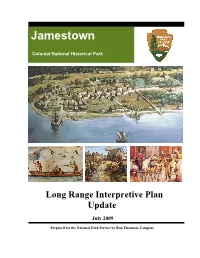
Jamestown Colonial National Historical Park Long Range Interpretive Plan Update July 2009 Prepared for the National Park Service by Ron Thomson, Compass Table of Contents Part 1: Foundation Introduction 4 Background 6 Park in 2009 12 Purpose & Significance 19 Interpretive Themes 22 Audiences 29 Audience Experiences 32 Issues & Initiatives 35 Part 2: Taking Action Introduction 38 Projects from 2000 Plan 38 Current Area of Focus 40 Enhance Existing Resources 40 Anniversaries/Events 43 Linking Research, Interpretation & Sales 44 Education Programs 45 Technology for Interpretation 46 Evaluation & Professional Standards 47 Staffing & Training 47 Library, Collection & Research Needs 48 Implementation Charts 52 Participants 59 Appendices 1. Other Planning Documents 60 2. Partner Mission Statements 64 3. Second Century Goals 66 4. Interpretation & Education Renaissance Action Plan 69 5. Children in Nature 71 2 Part 1 The Foundation 3 Introduction The Long Range Interpretive Plan A Long Range Interpretive Plan (LRIP) provides a 5+ year vision for a park’s interpretive program. A facilitator skilled in interpretive planning works with park staff, partners, and outside consultants to prepare a plan that is consistent with other current planning documents. Part 1 of the LRIP establishes criteria against which existing and proposed personal services and media can be measured. It identifies themes, audiences, audience experiences, and issues. Part 2 describes the mix of services and facilities that are necessary to achieve management goals and interpretive mission. It includes implementation charts that plot a course of action, assign responsibilities, and offer a schedule of activity. When appropriate, Appendices provide more detailed discussions of specific topics. The completed LRIP forms a critical part of the more inclusive Comprehensive Interpretive Plan (CIP). -
The History of the Jamestown Colony: Seventeenth-Century and Modern Interpretations
The History of the Jamestown Colony: Seventeenth-Century and Modern Interpretations A Senior Honors Thesis Presented in Partial Fulfillment of the Requirements for graduation with research distinction in History in the undergraduate colleges of the Ohio State University By Sarah McBee The Ohio State University at Mansfield June 2009 Project Advisor: Professor Heather Tanner, Department of History Introduction Reevaluating Jamestown On an unexceptional day in December about four hundred years ago, three small ships embarked from an English dock and began the long and treacherous voyage across the Atlantic. The passengers on board envisioned their goals – wealth and discovery, glory and destiny. The promise of a new life hung tantalizingly ahead of them. When they arrived in their new world in May of the next year, they did not know that they were to begin the journey of a nation that would eventually become the United States of America. This summary sounds almost ridiculously idealistic – dream-driven achievers setting out to start over and build for themselves a better world. To the average American citizen, this story appears to be the classic description of the Pilgrims coming to the new world in 1620 seeking religious freedom. But what would the same average American citizen say to the fact that this deceptively idealistic story actually took place almost fourteen years earlier at Jamestown, Virginia? The unfortunate truth is that most people do not know the story of the Jamestown colony, established in 1607.1 Even when people have heard of Jamestown, often it is with a negative connotation. Common knowledge marginally recognizes Jamestown as the colony that predates the Separatists in New England by more than a dozen years, and as the first permanent English settlement in America. -

Powhatan Creek Blueway Brochure
The Blueway, open 24 hours a day, is located off Jamestown Road. The recommended roundtrip is about Public Access Points Emergencies eight miles from Powhatan Creek Park to the Causeway and back. Only well-prepared and highly skilled paddlers should attempt the additional eight-mile trip Much land along this creek is privately owned; please do Dial 911 for all emergencies. around Jamestown Island. not use private land. Public access points are located at: Cell phones are the best means of communication. Please keep in mind that Powhatan Creek and the Powhatan Creek Park and Blueway The dispatcher can contact the appropriate agency • Powhatan Creek Park and Blueway, a Chesapeake Discovering the Past; James River can change from peaceful and calm to 1831 Jamestown Road for aid. Although cell phones have become a widely harsh and extremely rough in a matter of minutes. used tool, do not rely on them entirely; you may be Bay Gateway, is one of your entry points to enjoy and Williamsburg, VA 23185 learn about the places and stories of the Chesapeake and Protecting the Future Therefore, plan your trip carefully and keep an eye For park information, call 757-259-5360. out of transmission range, cell phone batteries have on the weather! a short life, and some equipment is affected by the its watershed. The 64,000 square mile Bay watershed A visit to the Powhatan Creek Park and Blueway marine environment. For these reasons, VHF FM radios is a complex ecosystem. Home to over 15 million offers an opportunity to connect with the rich history • James City County Marina are an alternative. -

Living with the Indians.Rtf
Living With the Indians Introduction Archaeologists believe the American Indians were the first people to arrive in North America, perhaps having migrated from Asia more than 16,000 years ago. During this Paleo time period, these Indians rapidly spread throughout America and were the first people to live in Virginia. During the Woodland period, which began around 1200 B.C., Indian culture reached its highest level of complexity. By the late 16th century, Indian people in Coastal Plain Virginia, united under the leadership of Wahunsonacock, had organized themselves into approximately 32 tribes. Wahunsonacock was the paramount or supreme chief, having held the title “Powhatan.” Not a personal name, the Powhatan title was used by English settlers to identify both the leader of the tribes and the people of the paramount chiefdom he ruled. Although the Powhatan people lived in separate towns and tribes, each led by its own chief, their language, social structure, religious beliefs and cultural traditions were shared. By the time the first English settlers set foot in “Tsenacommacah, or “densely inhabited land,” the Powhatan Indians had developed a complex culture with a centralized political system. Living With the Indians is a story of the Powhatan people who lived in early 17th-century Virginia—their social, political, economic structures and everyday life ways. It is the story of individuals, cultural interactions, events and consequences that frequently challenged the survival of the Powhatan people. It is the story of how a unique culture, through strong kinship networks and tradition, has endured and maintained tribal identities in Virginia right up to the present day. -

Colonial Parkway a Triple Memorial of History Is Here Made Accessible by a Scenic and Historically Rich Parkway
COLONIAL PAR KWAY IAMSB uko. 't14,4 Jamestown 0 94%cb 44, c°' 1L viRGirrit, Williamsburg Colonial National Historical Park VIRGINIA Colonial Parkway A triple memorial of history is here made accessible by a scenic and historically rich parkway N THE Virginia Peninsula three fa- Williamsburg Information Center. These mous places—Jamestown, Williams- are the best points of departure for seeing 0 burg, and Yorktown—form a triangle the areas. only 14 miles at the base. Here, between The parkway route is outward from James- the James and York Rivers, is compressed a town Island over a sandbar to Glasshouse great deal of American history. The found- Point An isthmus existed there in colonial ing of the first permanent English settlement times. For the colonists, it was the way to in 1607 at Jamestown, Va.; the establish- unoccupied lands awaiting beyond. In the ment there of the first representative form vicinity of the Glasshouse and Virginia's Fes- of government in the New World; the flower- tival Park, Colonial Parkway bends sharply ing of colonial culture and growth of revolu- to cross Powhatan Creek and then courses tionary sentiment at Williamsburg; and the eastward along Back River and the Thor- winning of American independence at York- oughfare, which separate Jamestown Island town are historical milestones. from the mainland. After following the Each place has a thrilling story of its own. James River for 3 miles, the parkway at Yet, they are connected stories, for things College Creek turns inland through the woods that happened at Jamestown led directly to toward Williamsburg. -

The Political Career of Sir John Harvey : Governor of Virginia from 1629 to 1639 Merrill R
University of Richmond UR Scholarship Repository Honors Theses Student Research 1939 The political career of Sir John Harvey : Governor of Virginia from 1629 to 1639 Merrill R. Stewart Follow this and additional works at: http://scholarship.richmond.edu/honors-theses Recommended Citation Stewart, Merrill R., "The political career of Sir John Harvey : Governor of Virginia from 1629 to 1639" (1939). Honors Theses. Paper 774. This Thesis is brought to you for free and open access by the Student Research at UR Scholarship Repository. It has been accepted for inclusion in Honors Theses by an authorized administrator of UR Scholarship Repository. For more information, please contact scholarshiprepository@richmond.edu. THE POLITICAL CAREER OF SIR JOHN HARVEY: GOVERNOR OF VIRGINIA FRai 1629 TO 1639 by MERRILL ROBERT STEWART UNIVERSITY OF RICHMOND VIRGINIA 1939 TABLE OF CONTENTS. Chapter ! ••• Commissioner Harvey •••••••• Page l Chapter !! •• Governor Harvey •••••••••• Page 9 Chapter III.Governor Harvey; His Secord Term •• Page 34 Bibliography • • • • • • • • • • • • • • • • • Page 1 -------------- BIBLIOORAPHY General histories: Andrews, C. M., The Colonial Period of American History, Yale Univ. Press, New Haven, 1934. Andrews, M. P., Virginia, the Old Dominion, Doubleday, Doran & Co. Inc., Garden City, New York, 1937• Blanton , Wyndham B. , Medicine in Vir~inia in ~ Seventeenth Century, The William Byrd Press, Inc., Richmond, 1930. Campbell, Chas., The History of ~ Colony and Ancient Dominion of Virginia, J. B. Lippincott and Co., Philadelphia, Pa., lSbO. Craven, W. F. , 1h§. Dissolution of the Virf2.nia Company, Oxford Univ. Press, New York, 1932· Dodd, W. E., The Old South; Struggles for Democracy, The Mac Millan Co., New York, 1937• Fiske, John, Old Virginia and Her Neighbors, two volumes, Hough ton, Mifflin and Co., New York, 1898. -
"Every American Should Stand Here Once": Jamestown's 400Th Anniversary Commemoration and the Creation of an American Origin Narrative
W&M ScholarWorks Dissertations, Theses, and Masters Projects Theses, Dissertations, & Master Projects 2013 "Every American Should Stand Here Once": Jamestown's 400th Anniversary Commemoration and the Creation of an American Origin Narrative Elizabeth Howard College of William & Mary - Arts & Sciences Follow this and additional works at: https://scholarworks.wm.edu/etd Part of the American Studies Commons Recommended Citation Howard, Elizabeth, ""Every American Should Stand Here Once": Jamestown's 400th Anniversary Commemoration and the Creation of an American Origin Narrative" (2013). Dissertations, Theses, and Masters Projects. Paper 1539626708. https://dx.doi.org/doi:10.21220/s2-xh3y-g425 This Thesis is brought to you for free and open access by the Theses, Dissertations, & Master Projects at W&M ScholarWorks. It has been accepted for inclusion in Dissertations, Theses, and Masters Projects by an authorized administrator of W&M ScholarWorks. For more information, please contact scholarworks@wm.edu. “Every American Should Stand Here Once”: Jamestown’s 400th Anniversary Commemoration and the Creation of an American Origin Narrative Elizabeth Howard McLean, Virginia B.A., Yale University, 2008 A Thesis presented to the Graduate Faculty of the College of William and Mary in Candidacy for the Degree of Master of Arts Department of American Studies The College of William and Mary August 2013 APPROVAL PAGE This Thesis is submitted in partial fulfillment of the requirements for the degree of Master of Arts Elizabeth Ann Howard Approved by tyie Committee, April 2012 : ,■ Committee Chair Associate Professor'Charles MbGovern, History and American Studies College of William and Mary Associate Professor M. Lynn Weiss, English and American Studies College of William and Mary f Associate Professor Karin Wulf, History and American Sttraies College of William and Mary ABSTRACT This thesis examines the way that narratives of American origin are created, sustained, and altered, utilizing the 400th anniversary of the English settlement of Jamestown, Virginia as a lens. -

National Park Service Cultural Landscapes Inventory 1999
National Park Service Cultural Landscapes Inventory 1999 Revised 2008 Jamestown Island Area Colonial National Historical Park Table of Contents Inventory Unit Summary & Site Plan Concurrence Status Geographic Information and Location Map Management Information National Register Information Chronology & Physical History Analysis & Evaluation of Integrity Condition Treatment Bibliography & Supplemental Information Jamestown Island Area Colonial National Historical Park Inventory Unit Summary & Site Plan Inventory Summary The Cultural Landscapes Inventory Overview: CLI General Information: Cultural Landscapes Inventory – General Information The Cultural Landscapes Inventory (CLI) is a database containing information on the historically significant landscapes within the National Park System. This evaluated inventory identifies and documents each landscape’s location, size, physical development, condition, landscape characteristics, character-defining features, as well as other valuable information useful to park management. Cultural landscapes become approved inventory records when all required data fields are entered, the park superintendent concurs with the information, and the landscape is determined eligible for the National Register of Historic Places through a consultation process or is otherwise managed as a cultural resource through a public planning process. The CLI, like the List of Classified Structures (LCS), assists the National Park Service (NPS) in its efforts to fulfill the identification and management requirements associated -

Colonial National Historical Park Jamestown Island Visitor Study
Colonial National Historical Park Jamestown Island Visitor Study The Visitor Services Project 2 Colonial National Historical Park—Jamestown Island Visitor Study OMB Approval 1024-0224 (NPS 01-011) Expiration Date: 12/31/01 United States Department The Association for the of the Interior Preservation of Virginia NATIONAL PARK SERVICE Antiquities Colonial National Historical Park 204 W. Franklin Street P.O. Box 210 Richmond, Virginia 23220 IN REPLY REFER TO: Yorktown, Virginia 23690 June 2001 Dear Visitor: Thank you for participating in this important study. Our goal is to learn about the expectations, opinions, and interests of visitors to the Jamestown Island Unit of Colonial National Historical Park, jointly preserved by the National Park Service and The Association for the Preservation of Virginia Antiquities. This will assist us in our efforts to better develop, manage and protect the park in order to serve you, the visitor. This questionnaire is only being given to a select number of visitors, so your participation is very important! Completing it should only take a few minutes of your time after your visit. When your visit is over, please fill out the questionnaire, seal it with the sticker provided on the last page and drop it in any U.S. mailbox. If you have any questions about the survey, please contact Margaret Littlejohn, VSP Coordinator, Cooperative Park Studies Unit, College of Natural Resources, University of Idaho, Moscow, Idaho 83844-1133, phone: 208- 885-7863, email: littlej@uidaho.edu. We very much appreciate your help. Sincerely, Alec Gould Elizabeth Kostelny Superintendent Executive Director Colonial NHP APVA Colonial National Historical Park—Jamestown Island Visitor Study 3 DIRECTIONS One adult in your group should complete the questionnaire. -

Dendrochronology at Jamestown Grade: 3Rd-5Th Subjects
Reading the Trees: Dendrochronology at Jamestown Grade: 3rd-5th Subjects: History, Virginia Studies, Science, Math Time: 1 hour Class Size: Adaptable Skills: Measuring, analyzing, interpretation Strategies: Have students read and interpret primary sources to gain understanding of historical events. Compare and contrast primary sources with archaeological evidence. Student will: SOLs VS.1 Students will demonstrate skills for historical thinking and VS.1, VS.2, VS.3, VS.4 geographic analysis by: a) analyzing and interpreting artifacts and primary and secondary sources to understand events in Virginia history VS.2 Demonstrate an understanding of the relationship between physical geography and the lives of native peoples of Virginia by: c) locating and identifying water features important to the early history of Virginia e) describing how American Indians related to the climate and their environment to secure food, clothing, and shelter f) describing how archaeologists have recovered new material evidence at sites including Jamestown VS.3 Demonstrate an understanding of the first permanent English settlement in America by: f) describing the hardships faced by settlers at Jamestown and the changes that took place to ensure survival g) describing the interactions between the English settlers and native peoples, including the role of the Powhatan in the survival of the settlers VS.4 Demonstrate an understanding of life in the Virginia colony by describing everyday life in colonial Virginia 3.1, 4.1, 5.1 Students will plan and conduct investigations in Science 3.1, 3.6, 3.10, 4.1, 4.5, which: data are collected, recorded, and reported using the 4.9, 5.1 appropriate graphical representation (graphs, charts, diagrams); predictions are made using patterns, and simple graphical data are extrapolated; manipulated and responding variables are identified; and an understanding of the nature of science is developed and reinforced. -

History and Facts on Virginia
History and Facts on Virginia Capitol Building, Richmond 3 HISTORY AND FACTS ON VIRGINIA In 1607, the first permanent English settlement in America was established at Jamestown. The Jamestown colonists also established the first representative legislature in America in 1619. Virginia became a colony in 1624 and entered the union on June 25, 1788, the tenth state to do so. Virginia was named for Queen Elizabeth I of England, the “Virgin Queen” and is also known as the “Old Dominion.” King Charles II of England gave it this name in appreciation of Virginia’s loyalty to the crown during the English Civil War of the mid-1600s. Virginia is designated as a Commonwealth, along with Kentucky, Massachusetts, and Pennsylvania. In 1779, the capital was relocated from Williamsburg to Richmond. The cornerstone for the Virginia Capitol Building was laid on August 18, 1785, and the building was completed in 1792. Modeled after the Maison Carrée at Nîmes, France, the Capitol was the first public building in the United States to be built using the Classical Revival style of architecture. Thomas Jefferson designed the central section of the Capitol, including its most outstanding feature: the interior dome, which is undetectable from the exterior. The wings were added in 1906 to house the Senate and House of Delegates. In 2007, in time to receive the Queen of England during the celebration of the 400th anniversary of the Jamestown Settlement, the Capitol underwent an extensive restoration, renovation and expansion, including the addition of a state of the art Visitor’s Center that will ensure that it remains a working capitol well into the 21st Century.