Renewed Potential for Violence: Bayelsa Gubernatorial Elections
Total Page:16
File Type:pdf, Size:1020Kb
Load more
Recommended publications
-
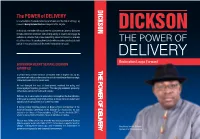
The POWER of DELIVERY Is a Compilation of Selected Extempore Remarks, and the first of a Trilogy, by Governor Henry Seriake Dickson of Bayelsa State, Nigeria
DICKS The POWER of DELIVERY is a compilation of selected extempore remarks, and the first of a trilogy, by Governor Henry Seriake Dickson of Bayelsa State, Nigeria. ON In this book, the reader will encounter the robustness of Governor Dickson's DICKSON remarks delivered extempore with striking ability to inspire and engage its audience in a manner that is most compelling. Governor Dickson is an orator of a different hue. He speaks authoritatively with penetrating intellectual depth THE POWER OF typical of most great leaders in the world, both past and present. DELIVERY Restoration Leaps Forward GOVERNOR HENRY SERIAKE DICKSON A PROFILE THE POWER OF DELIVERY Governor Henry Seriake Dickson of Bayelsa State in Nigeria has, by his performance in office, underscored the critical role of leadership in strategic restructuring and effective governance. He has changed the face of development, sanitized the polity, and encouraged participatory governance. The emerging economic prosperity in Bayelsa is a product of vision and courage. Dickson, 48, is an exceptional leader whose foresight on the diversification of the state’s economy beyond oil and gas to focus more on tourism and agriculture holds great promise of economic boom. A lawyer, former Attorney-General of Bayelsa State and member of the National Executive Committee of the Nigerian Bar Association, he was elected to the House of Representatives in 2007 and re-elected in 2011, where he served as the Chairman, House Committee on Justice. His star was further on the rise when he was elected governor of Bayelsa State by popular acclamation later in 2012. He has been an agent of positive change, challenged the status quo and re-invented the architecture of Hon. -
States and Local Government Areas Creation As a Strategy of National Integration Or Disintegration in Nigeria
ISSN 2239-978X Journal of Educational and Social Research Vol. 3 (1) January 2013 States and Local Government Areas Creation as a Strategy of National Integration or Disintegration in Nigeria Bassey, Antigha Okon #!230#0Q#.02+#,2-$-!'-*-%7 !3*27-$-!'*!'#,, 4#01'27-$* 0 TTTWWV[* 0$TT– Nigeria E-mail: &X)Z&--T!-+, &,#SV^VYY[Z_YY\ Omono, Cletus Ekok #!230#0Q#.02+#,2-$-!'-*-%7 !3*27-$-!'*!'#,, 4#01'27-$* 0 Bisong, Patrick Owan #!230#0Q#.02+#,2-$-!'-*-%7 Facult$-!'*!'#,, 4#01'27-$* 0 Bassey, Umo Antigha !3*27-$1"3!2'-, ,'4#01'27-$* 0 Doi: 10.5901/jesr.2013.v3n1p237 Abstract 3&'1..#0#6+',#1122#1,"*-!*%-4#0,+#,20#1!0#2'-,',5'%#0'1-,#-$2&+(-01202#%'#1of #,130',%52'-,*',2#%02'-,T3&#,*71'15 1#"-,1#""2- 2',#"$0-+2#6 )1,"-2� 0#20'#4#" +2#0'*1T 3&# 1!-.# -$ 2&# ..#0 -� 2&, 2&# "!2'-,Q !-4#01R !-,!#.23* ,*71'1 -$ 40' *#1R 0#4'#5 -$ *-!* %-4#0,+#,2 0#as and states creation in Nigeria, rationale for States and Local 90,+#,21!0#R2&#-0#2'!*$"R!-,1#/#,!#1R!-,!*31'-,"0#!-++#,"-,T<2#0!0'2'!* #6+',2'-, -$ 2&# !-,1#/#,!#1 -$ !0#2'-, -$ 122#1 "*-!*%-4#0,+#,2 0#15hich include structural imbalance in Nigeria socio-1203!230#R.#0.#232'-,-$+',-0'27"-+',2'-,Q!-,2',3-311203%%*#$-0 national resources in terms of sharing national revenue and creation of consciousness among ethnic nationalities. State and Local government creation rather promotes National disintegration. The conclusion of &'1 ..#0 2�#$-0# "#4'2#1 1'%,'$'!,2*7 $0-+ 2&# ',2#,"" $3,!2'-, -$ 122# !0#2'-, 1 #6!2#" 7 2&# %'22-01T3&'1..#0381$3,!2'-,*&',,*8g state and local government creation in Nigeria "'2'10#!-++#""2&2&##"0*9-4#0,+#,21&-3*"',20-"3!#"-+'!'*'07.-*'!72-1-*4#2&#.0- *#+ of non-indigenes and minorities. -

Nigeria's Constitution of 1999
PDF generated: 26 Aug 2021, 16:42 constituteproject.org Nigeria's Constitution of 1999 This complete constitution has been generated from excerpts of texts from the repository of the Comparative Constitutions Project, and distributed on constituteproject.org. constituteproject.org PDF generated: 26 Aug 2021, 16:42 Table of contents Preamble . 5 Chapter I: General Provisions . 5 Part I: Federal Republic of Nigeria . 5 Part II: Powers of the Federal Republic of Nigeria . 6 Chapter II: Fundamental Objectives and Directive Principles of State Policy . 13 Chapter III: Citizenship . 17 Chapter IV: Fundamental Rights . 20 Chapter V: The Legislature . 28 Part I: National Assembly . 28 A. Composition and Staff of National Assembly . 28 B. Procedure for Summoning and Dissolution of National Assembly . 29 C. Qualifications for Membership of National Assembly and Right of Attendance . 32 D. Elections to National Assembly . 35 E. Powers and Control over Public Funds . 36 Part II: House of Assembly of a State . 40 A. Composition and Staff of House of Assembly . 40 B. Procedure for Summoning and Dissolution of House of Assembly . 41 C. Qualification for Membership of House of Assembly and Right of Attendance . 43 D. Elections to a House of Assembly . 45 E. Powers and Control over Public Funds . 47 Chapter VI: The Executive . 50 Part I: Federal Executive . 50 A. The President of the Federation . 50 B. Establishment of Certain Federal Executive Bodies . 58 C. Public Revenue . 61 D. The Public Service of the Federation . 63 Part II: State Executive . 65 A. Governor of a State . 65 B. Establishment of Certain State Executive Bodies . -

An Analysis of What Works and What Doesn't
Radicalisation and Deradicalisation in Nigeria: An Analysis of What Works and What Doesn’t Nasir Abubakar Daniya i Radicalisation and Deradicalisation in Nigeria: An Analysis of What Works and What Doesn’t. Nasir Abubakar Daniya Student Number: 13052246 A Thesis Submitted in Fulfilment of Requirements for award of: Professional Doctorate Degree in Policing Security and Community Safety London Metropolitan University Faculty of Social Science and Humanities March 2021 Thesis word count: 104, 482 ii Abstract Since Nigeria’s independence from Britain in 1960, the country has made some progress while also facing some significant socio-economic challenges. Despite being one of the largest producers of oil in the world, in 2018 and 2019, the Brooking Institution and World Poverty Clock respectively ranked Nigeria amongst top three countries with extreme poverty in the World. Muslims from the north and Christians from the south dominate the country; each part has its peculiar problem. There have been series of agitations by the militants from the south to break the country due to unfair treatments by the Nigerian government. They produced multiple violent groups that killed people and destroyed properties and oil facilities. In the North, an insurgent group called Boko Haram emerges in 2009; they advocated for the establishment of an Islamic state that started with warning that, western education is prohibited. Reports say the group caused death of around 100,000 and displaced over 2 million people. As such, Niger Delta Militancy and Boko Haram Insurgency have been major challenges being faced by Nigeria for about a decade. To address such challenges, the Nigerian government introduced separate counterinsurgency interventions called Presidential Amnesty Program (PAP) and Operation Safe Corridor (OSC) in 2009 and 2016 respectively, which are both aimed at curtailing Militancy and Insurgency respectively. -
Towards a New Type of Regime in Sub-Saharan Africa?
Towards a New Type of Regime in Sub-Saharan Africa? DEMOCRATIC TRANSITIONS BUT NO DEMOCRACY Marc-Antoine Pérouse de Montclos cahiers & conférences travaux & recherches les études The Institut français des relations internationales (Ifri) is a research center and a forum for debate on major international political and economic issues. Headed by Thierry de Montbrial since its founding in 1979, Ifri is a non-governmental and a non- profit organization. As an independent think tank, Ifri sets its own research agenda, publishing its findings regularly for a global audience. Using an interdisciplinary approach, Ifri brings together political and economic decision-makers, researchers and internationally renowned experts to animate its debate and research activities. With offices in Paris and Brussels, Ifri stands out as one of the rare French think tanks to have positioned itself at the very heart of European debate. The opinions expressed in this text are the responsibility of the author alone. The Sub-Saharian Africa Program is supported by: Translated by: Henry Kenrick, in collaboration with the author © Droits exclusivement réservés – Ifri – Paris, 2010 ISBN: 978-2-86592-709-8 Ifri Ifri-Bruxelles 27 rue de la Procession Rue Marie-Thérèse, 21 75740 Paris Cedex 15 – France 1000 Bruxelles – Belgique Tél. : +33 (0)1 40 61 60 00 Tél. : +32 (0)2 238 51 10 Email: ifri@ifri.org Email: info.bruxelles@ifri.org Internet Website : Ifri.org Summary Sub-Saharan African hopes of democratization raised by the end of the Cold War and the decline in the number of single party states are giving way to disillusionment. -

Socio-Economic and Political Activities of Southern Ijaw Local Government Area of Bayelsa State
International Journal of Science and Research (IJSR) ISSN (Online): 2319-7064 Index Copernicus Value (2016): 79.57 | Impact Factor (2017): 7.296 Socio-Economic and Political Activities of Southern Ijaw Local Government Area of Bayelsa State Sigah .F. 1, Otoro P.2, Omovwohwovie E. E.3 1 , 2Department of Public Administration, Federal Polytechnic Ekowe,Bayelsa State 3Department of Fisheries Technology, Federal Polytechnic Ekowe, Bayelsa State Abstract: Southern Ijaw Local Government Area is the largest local government area in Bayelsa State, and it is in the Niger Delta region of the country. This Study highlighted the social, economic and political activities in the local government area as to have a clear understanding about the wellbeing and politics of the people of Southern Ijaw Local Government Area of Bayelsa State Nigeria. 1. Introduction term........local government can only be characterized in such a way that it can be recognized as such different times 3 Local Government is widely recognized, as a veritable and places’’ instrument for the transformation and the delivery of social services to the people. It is also recognized as being strategic Let us at this point cite a few definitions of local government in facilitating the extension of democracy to the local level by some scholars and authors. “Local government has been by increasing the opportunities for political participation by defined as the lowest unit of administration to whose laws the grassroots population. It is as well widely regarded as and regulation, the communities who live in a defined being well situated to perform the above functions due to the geographical area and with common social and political ties 4 various advantages which it has over the other tiers of are subject’’ government and their field agencies. -

Geo-Electric Evaluation of Aquifer Protective Capacity and Groundwater Flow Pattern in Ogbia Local Government of Bayelsa State, Nigeria
Journal of Multidisciplinary Engineering Science and Technology (JMEST) ISSN: 2458-9403 Vol. 4 Issue 5, May - 2017 Geo-Electric Evaluation Of Aquifer Protective Capacity And Groundwater Flow Pattern In Ogbia Local Government Of Bayelsa State, Nigeria Oborie, E and Oki, O. A Department of Geology, Niger Delta University, Wilberforce Island, Bayelsa State, Nigeria. Corresponding Author: ebixl@yahoo.com, +2348061363420 Abstract—The groundwater flow pattern and water levels to areas where water levels are low; that aquifer protective capacity of overburden layers in is from below high ground, which are recharge areas, some communities of Ogbia in Bayelsa State was to groundwater discharge points in valleys or the sea. investigated to determine the vulnerability of The direction of flow is indicated by the slope of the groundwater resources due to infiltration and/or water table which is called the hydraulic gradient migration of potential contaminants. These [5].When groundwater is pumped from a borehole, the communities plays host to crude oil exploitation water level is lowered in the surrounding area. A activities, as such, environmental degradation hydraulic gradient is created in the aquifer which associated with these activities are commonplace. allows water to flow towards the borehole. The Spills, leachate plumes from dumpsite and waste difference between the original water level and the from septic tanks may contaminate the aquifers pumping level is the drawdown, which is equivalent to indiscriminately. Dar Zarrouk parameters obtained the head of water necessary to produce a flow from the geoelectric sounding was used to through the aquifer to the borehole. The surface of the evaluate the protective capacity of the soil, while pumping level is in the form of an inverted cone and is the groundwater flow pattern was determined by referred to as a cone of depression. -

First Election Security Threat Assessment
SECURITY THREAT ASSESSMENT: TOWARDS 2015 ELECTIONS January – June 2013 edition With Support from the MacArthur Foundation Table of Contents I. Executive Summary II. Security Threat Assessment for North Central III. Security Threat Assessment for North East IV. Security Threat Assessment for North West V. Security Threat Assessment for South East VI. Security Threat Assessment for South South VII. Security Threat Assessment for South West Executive Summary Political Context The merger between the Action Congress of Nigeria (ACN), Congress for Progressive Change (CPC), All Nigerian Peoples Party (ANPP) and other smaller parties, has provided an opportunity for opposition parties to align and challenge the dominance of the Peoples Democratic Party (PDP). This however will also provide the backdrop for a keenly contested election in 2015. The zoning arrangement for the presidency is also a key issue that will define the face of the 2015 elections and possible security consequences. Across the six geopolitical zones, other factors will define the elections. These include the persisting state of insecurity from the insurgency and activities of militants and vigilante groups, the high stakes of election as a result of the availability of derivation revenues, the ethnic heterogeneity that makes elite consensus more difficult to attain, as well as the difficult environmental terrain that makes policing of elections a herculean task. Preparations for the Elections The political temperature across the country is heating up in preparation for the 2015 elections. While some state governors are up for re-election, most others are serving out their second terms. The implication is that most of the states are open for grab by either of the major parties and will therefore make the electoral contest fiercer in 2015 both within the political parties and in the general election. -

The Jonathan Presidency, by Abati, the Guardian, Dec. 17
The Jonathan Presidency By Reuben Abati Published by The Jonathan Presidency The Jonathan Presidency By Reuben Abati A review of the Goodluck Jonathan Presidency in Nigeria should provide significant insight into both his story and the larger Nigerian narrative. We consider this to be a necessary exercise as the country prepares for the next general elections and the Jonathan Presidency faces the certain fate of becoming lame-duck earlier than anticipated. The general impression about President Jonathan among Nigerians is that he is as his name suggests, a product of sheer luck. They say this because here is a President whose story as a politician began in 1998, and who within the space of ten years appears to have made the fastest stride from zero to “stardom” in Nigerian political history. Jonathan himself has had cause to declare that he is from a relatively unknown village called Otuoke in Bayelsa state; he claims he did not have shoes to wear to school, one of those children who ate rice only at Xmas. When his father died in February 2008, it was probably the first time that Otuoke would play host to the kind of quality crowd that showed up in the community. The beauty of the Jonathan story is to be found in its inspirational value, namely that the Nigerian dream could still take on the shape of phenomenal and transformational social mobility in spite of all the inequities in the land. With Jonathan’s emergence as the occupier of the highest office in the land, many Nigerians who had ordinarily given up on the country and the future felt imbued with renewed energy and hope. -

The Judiciary and Nigeria's 2011 Elections
THE JUDICIARY AND NIGERIA’S 2011 ELECTIONS CSJ CENTRE FOR SOCIAL JUSTICE (CSJ) (Mainstreaming Social Justice In Public Life) THE JUDICIARY AND NIGERIA’S 2011 ELECTIONS Written by Eze Onyekpere Esq With Research Assistance from Kingsley Nnajiaka THE JUDICIARY AND NIGERIA’S 2011 ELECTIONS PAGE iiiiii First Published in December 2012 By Centre for Social Justice Ltd by Guarantee (Mainstreaming Social Justice In Public Life) No 17, Flat 2, Yaounde Street, Wuse Zone 6, P.O. Box 11418 Garki, Abuja Tel - 08127235995; 08055070909 Website: www.csj-ng.org ; Blog: http://csj-blog.org Email: censoj@gmail.com ISBN: 978-978-931-860-5 Centre for Social Justice THE JUDICIARY AND NIGERIA’S 2011 ELECTIONS PAGE iiiiiiiii Table Of Contents List Of Acronyms vi Acknowledgement viii Forewords ix Chapter One: Introduction 1 1.0. Monitoring Election Petition Adjudication 1 1.1. Monitoring And Project Activities 2 1.2. The Report 3 Chapter Two: Legal And Political Background To The 2011 Elections 5 2.0. Background 5 2.1. Amendment Of The Constitution 7 2.2. A New Electoral Act 10 2.3. Registration Of Voters 15 a. Inadequate Capacity Building For The National Youth Service Corps Ad-Hoc Staff 16 b. Slowness Of The Direct Data Capture Machines 16 c. Theft Of Direct Digital Capture (DDC) Machines 16 d. Inadequate Electric Power Supply 16 e. The Use Of Former Polling Booths For The Voter Registration Exercise 16 f. Inadequate DDC Machine In Registration Centres 17 g. Double Registration 17 2.4. Political Party Primaries And Selection Of Candidates 17 a. Presidential Primaries 18 b. -

Interim Report the Bayelsa State Oil & Environmental Commission | Nov 2019 Interim Report
November 2019 Interim Report The Bayelsa State Oil & Environmental Commission | Nov 2019 Interim Report Date of publication: 1 November 2019 Written by: The Bayelsa State Oil and Environmental Commission 2 The Bayelsa State Oil & Environmental Commission | Nov 2019 Interim Report Contents: Introduction 4 Environmental degradation 5 A silent health crisis 6 Economic devastation 7 Communities destabilised 9 Access to Justice 10 Conclusion 11 3 The Bayelsa State Oil & Environmental Commission | Nov 2019 Interim Report Introduction Few countries on the face of the planet have suffered more from oil pollution than Nigeria. Over the last half century, as many as ten million barrels of oil have been spilled across the country. That’s equivalent to a spill similar in size to the Exxon Valdez catastrophe – which devastated the coast of Alaska – every single year for the last fifty years. And few parts of Nigeria have suffered worse pollution Communities have been de-stabilised and their cohesion than Bayelsa State. Bayelsa is one of Nigeria’s main oil undermined by disputes and competition for resources producing states, accounting for almost a quarter of its arising from oil extraction which have been sharpened by onshore crude oil production, and approximately a third spills and their impacts. of its oil wealth. It is home to one of Africa’s most diverse The list goes on and on. The cost-in terms of ecosystems, a rich but fragile tapestry of wetlands and environmental degradation and human suffering has been mangrove swamps. vast. And it is rising every day. Despite its immense oil reserves, Bayelsa’s people are What’s more, the individuals and communities affected poor, with the state scoring lower on the United Nations’ have found it almost impossible to win redress for their Human Development Index than any other Nigerian state. -
Analysis of Immigrants' Residential Preference and Ethnic Segregation
View metadata, citation and similar papers at core.ac.uk brought to you by CORE provided by International Institute for Science, Technology and Education (IISTE): E-Journals Research on Humanities and Social Sciences www.iiste.org ISSN (Paper)2224-5766 ISSN (Online)2225-0484 (Online) Vol.4, No.19, 2014 Analysis of Immigrants’ Residential Preference and Ethnic Segregation in Yenagoa Metropolis Obafemi, Andrew Adesola (Ph.D) Department of Geography & Environmental Management University of Port Harcourt, Rivers State, Nigeria E-mail: aandyfemi@yahoo.com Omiunu, Philomena Department of Geography & Environmental Management University of Port Harcourt, Rivers State, Nigeria E-mail: philomiunu@yahoo.com Corresponding Author: aandyfemi@yahoo.com Abstract Migrants from diverse ethnic background now live in Yenagoa city. But instead of being a city with culturally mixed neighborhoods, the various ethnic groups lives in residential areas that are segregated by ethnicity. This paper thus seeks to investigate how the migrant’s preference in the choice of initial residence determine the dimension of ethnic residential segregation in Yenagoa Metropolis and its neighborhood impacts. Using the chi- square statistical techniques, result shows that there is a statistical significant relationship between migrant’s residential preferences and ethnic neighborhood composition. On the other hand, the multiple regressions revealed that there are differences in the socio-economic characteristics that explain segregation within each ethnic group. Such that for instance, segregated Urhobo/Isoko and Hausa neighborhoods were found to have lower socio-economic characteristics, such as lower education and income, than segregated Ijaw places. INTRODUCTION AND BACKGROUND TO STUDY Ethnicity and residential segregation rank very high among the oldest and most persistently studied topics in the Social sciences in Africa.