Storylines America
Total Page:16
File Type:pdf, Size:1020Kb
Load more
Recommended publications
-

Women by County
WOMEN BY COUNTY Albany County Maria Van Rensselaer, 1645-1688 (Colonial and Revolutionary Eras) “Mother” Ann Lee, 1736-1784 (Faith Leaders) Harriet Myers, 1807-1865 (Abolition and Suffrage) Columbia County Margaret Beekman Livingston, 1724-1800 (Entrepreneurs) “Mother” Ann Lee, 1736-1784 (Faith Leaders) Elizabeth Freeman, “Mumbet,” 1742-1829 (Abolition and Suffrage) Janet Livingston Montgomery, 1743-1828 (Colonial & Revolutionary War Eras) Flavia Marinda Bristol, 1824-1918 (Entrepreneurs) Ida Helen Ogilvie, 1874-1963 (STEM) Edna St. Vincent Millay, 1892-1950 (The Arts) Ella Fitzgerald, 1917-1996 (The Arts) Lillian “Pete” Campbell, 1929-2017 (Reformers, Activists, and Trailblazers) Dutchess County Cathryna Rombout Brett, 1687-1763 (Entrepreneurs) Janet Livingston Montgomery, 1743-1828 (Colonial & Revolutionary War Eras) Sybil Ludington, 1761-1839 (Colonial & Revolutionary War Eras) Lucretia Mott, 1793-1880 (Abolition and Suffrage) Maria Mitchell, 1818-1889 (STEM) Antonia Maury, 1866-1952 (STEM) Beatrix Farrand, 1872-1959 (STEM) Eleanor Roosevelt, 1884-1962 (Reformers, Activists, and Trailblazers) Inez Milholland, 1886-1916 (Abolition and Suffrage) Edna St. Vincent Millay, 1892-1950 (The Arts) Dorothy Day, 1897-1980 (Faith Leaders) Elizabeth “Lee” Miller, 1907-1977 (Reformers, Activists, and Trailblazers) Jane Bolin, 1908-2007 (Reformers, Activists, and Trailblazers) Katharine Graham, 1917-2001(Entrepreneurs) Frances “Franny” Reese, 1917-2003 (Reformers, Activists, and Trailblazers) Raquel Rabinovich, b. 1929 (The Arts) Greene County Sybil Ludington, 1761-1839 (Colonial and Revolutionary War Eras) Candace Wheeler, 1827-1923 (The Arts) Margaret Newton Van Cott, 1830-1914 (Faith Leaders) Elizabeth Cochrane Seaman “Nellie Bly,” 1864-1922 (Reformers, Activists…) Ruth Franckling Reynolds, 1918-2007 (Reformers, Activists, and Trailblazers) Orange County Jane Colden, 1724-1760 (STEM) Margaret “Capt. -

" to Be Young, Gifted, and Black." Cue Sheet for Students
DOCUMENT RESUME ED 442 171 CS 510 360 AUTHOR Jennings, Caleen Sinnette TITLE "To Be Young, Gifted, and Black." Cue Sheet for Students. INSTITUTION John F. Kennedy Center for the Performing Arts, Washington, DC SPONS AGENCY Department of Education, Washington, DC. PUB DATE 1996-00-00 NOTE 10p.; Additional funding provided by The Kennedy Center Corporate Fund and The Morris and Gwendolyn Cafritz Foundation. AVAILABLE FROM http://artsedge.kennedy-center.org/cuesheet/theater.html. PUB TYPE Guides - Classroom - Learner (051) EDRS PRICE MF01/PC01 Plus Postage. DESCRIPTORS Audiences; Black Culture; Black History; Black Leadership; Class Activities; Cultural Activities; Elementary Secondary Education; Playwriting; Production Techniques; *Theater Arts; United States History IDENTIFIERS *Drama in Education; *Hansberry (Lorraine) ABSTRACT This performance guide is designed for teachers to use with students before and after a performance of "To Be Young, Gifted, and Black." The guide, called a "Cuesheet," contains seven activity sheets for use in class, addressing:(1) To Be Young, Gifted, and Black (a theatrical collage based upon the life and work of the African-American playwright Lorraine Hansberry, featuring scenes from her most famous plays, as well as excerpts from her speeches and letters);(2) Lorraine Hansberry: Her Life and Legacy (offering biographical material about Hansberry's life and work);(3) The World of Lorraine Hansberry (looking at important people who influenced Hansberry, and at historical, economic, and social changes that took place during her lifetime and that she was part of); and (4) Before and After the Play (presenting ideas for discussion topics and class activities before and after attending the play). -

Women in the Modern Civil Rights Movement
Women in the Modern Civil Rights Movement Introduction Research Questions Who comes to mind when considering the Modern Civil Rights Movement (MCRM) during 1954 - 1965? Is it one of the big three personalities: Martin Luther to Consider King Jr., Malcolm X, or Rosa Parks? Or perhaps it is John Lewis, Stokely Who were some of the women Carmichael, James Baldwin, Thurgood Marshall, Ralph Abernathy, or Medgar leaders of the Modern Civil Evers. What about the names of Septima Poinsette Clark, Ella Baker, Diane Rights Movement in your local town, city or state? Nash, Daisy Bates, Fannie Lou Hamer, Ruby Bridges, or Claudette Colvin? What makes the two groups different? Why might the first group be more familiar than What were the expected gender the latter? A brief look at one of the most visible events during the MCRM, the roles in 1950s - 1960s America? March on Washington, can help shed light on this question. Did these roles vary in different racial and ethnic communities? How would these gender roles On August 28, 1963, over 250,000 men, women, and children of various classes, effect the MCRM? ethnicities, backgrounds, and religions beliefs journeyed to Washington D.C. to march for civil rights. The goals of the March included a push for a Who were the "Big Six" of the comprehensive civil rights bill, ending segregation in public schools, protecting MCRM? What were their voting rights, and protecting employment discrimination. The March produced one individual views toward women of the most iconic speeches of the MCRM, Martin Luther King Jr.’s “I Have a in the movement? Dream" speech, and helped paved the way for the Civil Rights Act of 1964 and How were the ideas of gender the Voting Rights Act of 1965. -

A Mediagraphy Relating to the Black Man
racumEN7 RESUME ED 033 943 IE 001 593 AUTHOR Parker, James E., CcmF. TITLE A Eediagraphy Relating to the Flack Man. INSTITUTION North Carclina Coll., Durham. Pub Date May 69 Note 82F. EDRS Price EDRS Price MF-$0.50 BC Not Available from EDRS. Descriptors African Culture, African Histcry, *Instructional Materials, *Mass Media, *Negro Culture, *Negro Histcry, Negro leadership, *Negro Literature, Negro Ycuth, Racial Eiscriminaticn, Slavery Abstract Media dealing with the Black man--his history, art, problems, and aspirations--are listed under 10 headings:(1) disc reccrdings,(2) filmstrips and multimedia kits, (3) microfilms, (4) motion pictures, (5) pictures, Fcsters and charts,(6) reprints,(7) slides, (8) tape reccrdings, (9) telecourses (kinesccFes and videotapes), and (10) transparencies. Rentalcr purchase costs of the materials are usually included, andsources and addresses where materials may be obtainedare appended. [Not available in hard cecy due tc marginal legibility of original dccument.] (JM) MEDIA Relatingto THE BLACKMAN by James E. Parker U.). IMPARIMUll OF !ULM,tOUGAI1011 &WINE OfFKE OF EDUCATION PeN THIS DOCUMENT HAS BEEN REPRODUCED EXACTLY AS RECEIVED FROM THE PERSON 02 ORGANIZATION ORIGINATING IT. POINTS OF VIEW OR OPINIONS Ci STATED DO NOT NECESSARILY REPRESENT OFFICIAL OFFICE OF EDUCATION re% POSITION OR POLICY. O1 14.1 A MEDIAGRAPHY RELATING TO THE BLACK MAN Compiled by James E. Parker, Director Audiovisual-Television Center North Carolina College at Durham May, 1969 North Carolina College at Durham Durham, North Carolina 27707 .4 TABLE OF CONTENTS Page ACKNOWLEDGEMENTS ii FOREWORD iii DISC RECORDINGS 1-6 FILMSTRIPS AND MULTIMEDIA KITS 7- 18 MICROFILMS 19- 25 NOTION PICTURES 26- 48 PICTURES, POSTERS, CHARTS. -

Dorothy West: the Last Writer of the Harlem Renaissance
Dorothy West: The Last Writer of the Harlem Renaissance Dorothy West's first long book was published when she was more than forty years old. Her second book was published when she was in her late eighties. Yet African-American poet Langston Hughes called her "The Kid." This means a child. Dorothy West had been one of the youngest members of the group of writers and artists of the Harlem Renaissance. This was a creative period for African-Americans during the 1920s and 1930s. During and after World War I, thousands of southern blacks moved to northern cities in the United States. They were seeking jobs and better lives. Many settled in an area of New York City known as Harlem. Many were musicians, writers, artists and performers. Harlem became the largest Dorothy West African-American community in the United States. The mass movement from South to North led African-Americans to examine their lives: Who were they? What were their rights as Americans? The artistic expression of this collective examination became known as the Harlem Renaissance. Renaissance means rebirth. The Harlem Renaissance represented a rebirth of black people as an effective part of American life. Dorothy West helped influence the direction and form of African-American writing during this time. Dorothy West was born in 1907 in the city of Boston, Massachusetts. Both her parents were born in the southern United States, and moved north. Her father was a former slave. He became the first African-American to own a food-selling company in Boston. The family became part of the black upper middle class social group of Boston. -

Lorraine Hansberry
STUDY GUIDE A NOISE WITHIN PRESENTS A Raisin in the Sun BY LORRAINE HANSBERRY “Hold Fast to Dreams” STUDY GUIDES FROM A NOISE WITHIN A rich resource for teachers of English, reading arts, and drama education. Dear Reader, We’re delighted you’re interested in our study guides, designed to provide a full range of information on our plays to teachers of all grade levels. A Noise Within’s study guides include: • General information about the play (characters, synopsis, timeline, and more) • Playwright biography and literary analysis • Historical content of the play • Scholarly articles • Production information (costumes, lights, direction, etc.) • Suggested classroom activities • Related resources (videos, books, etc.) • Discussion themes • Background on verse and prose (for Shakespeare’s plays) Our study guides allow you to review and share information with students to enhance both lesson plans and pupils’ theatrical experience and appreciation. They are designed to let you extrapolate articles and other information that best align with your own curricula and pedagogic goals. More information? It would be our pleasure. We’re here to make your students’ learning experience as rewarding and memorable as it can be! All the best, Alicia Green DIRECTOR OF EDUCATION Pictured: Donnla Hughes, Romeo and Juliet, 2016. PHOTO BY CRAIG SCHWARTZ. TABLE OF CONTENTS Characters ..........................................4 Special thanks to our 25th Anniversary Gala donors who kept the arts thriving this year by Synopsis ...........................................5 -

The Magician's Serpent: Race and the Tragedy of American Democracy
FEATURE ESSAY The Magician’s Serpent: Race and the Tragedy of American Democracy Eddie S. Glaude, Jr. Princeton University Abstract In this essay, Eddie S. Glaude, Jr. addresses the historical and contemporary fail- ures of American democracy. Using the metaphor of “the magician’s serpent,” Glaude brings Walt Whitman’s views on democracy into the full light of America’s failure to resolve the problem of race. Glaude places Whitman’s Democratic Vistas (1871) in conversation with James Baldwin’s No Name in the Street (1972) in order to construct a different sort of reading practice that can both engage with Whitman’s views on democracy and reckon with what George Hutchinson calls Whitman’s “white imperialist self and ideology” as an indication of the limits of a certain radical democratic imagining. Keywords: James Baldwin, Walt Whitman, democracy, racism, reading, Trump I find myself these days, more so than usual, reaching for books. Any book really. Fiction. Nonfiction. Poetry. Anything to distract from the ongoing spectacle that is this country’s politics, or anything to help me understand more fully this mess, in the Samuel Beckett sense of the word. Of course, there is the work. Teaching. Tarrying with the words and life of James Baldwin. When I am not doing that I am navigating the currents of Trumpism. Talking incessantly, and coping with, because I can’t seem to do anything else, the sourness that sits at the bottom of my stomach and that, every now and again, creeps up to the back of my throat. Bitter. Sour. With all of this, I want to hear a voice other than my own. -

Maya Angelou, a Writer's Legacy
2017-2018 Resource Guide MAYA ANGELOU, A WRITER’S LEGACY Written by Mary Tensing Produced by TCT On Tour, a Division of The Children’s Theatre of Cincinnati Friday, February 2, 2018 VICTORIA THEATRE ASSOCIATION VICTORIA • SCHUSTER • MAC/LOFT • ARTS ANNEX • ARTS GARAGE 9:30 a.m. & 11:30 a.m. Curriculum Connections You will find these icons listed in the resource guide next to the activities that indicate curricular connections. Teachers and parents are encouraged to adapt all of the activities included in an appropriate way for your students’ age and abilities. MAYA ANGELOU, A WRITER’S LEGACY fulfills the following Ohio and National Education Standards and Benchmarks for Grades 3-12: elcome to the 2017-2018 Discovery Series at Victoria Ohio’s New Learning Standards for English Language Arts: WTheatre Association. We are very Grade 3- RI.3.4, W.3.3, W.3.4, W.3.5, SL.3.1, L.3.1, L.3.2, L.3.3, L.3.5 excited to be your education partner in Grade 4- RI.4.4, W.4.3, W.4.4, W.4.5, SL.4.1, L.4.1, L.4.2, L.4.3, L.4.5 providing professional arts experiences to Grade 5- RI.5.4, W.5.3, W.5.4, W.5.5, SL.5.1, L.5.1, L.5.2, L.5.3, L.5.5 you and your students! Grade 6- RI.6.4, W.6.3, W.6.4, W.6.5, SL.6.1, L.6.1, L.6.2, L.6.3, L.6.5 Grade 7- RI.7.4, W.7.3, W.7.4, W.7.5, SL.7.1, L.7.1, L.7.2, L.7.3, L.7.5 Maya Angelou is one of the most inspiring Grade 8- RI.8.4, W.8.3, W.8.4, W.8.5, SL.8.1, L.8.1, L.8.2, L.8.3, L.8.5 and influential poets our country has Grades 9-10- RI.9-10.4, W.9-10.3, W.9-10.4, W.9-10.5, SL.9-10.1, L.9-10.1, L.9-10.2, L.9- ever seen. -

African-American Psychology and the Works of Gayl Jones
AFRICAN-AMERICAN PSYCHOLOGY AND THE WORKS OF GAYL JONES ABDUL QUADIR Research Scholar Department of English Jai Prakash University, Chapra (BH) INDIA Jones’ work has frequently been challenged on account of her questionable subjects just as news inclusion of her own life, her work keeps on awing peruses with its unpredictable style and profundity of feeling. She attracts a significant number of the subjects her accounts from her African-American legacy just as her very own life and battles. Maybe generally significant all through the mental advancements in the characters are their voices which yell from the pages of her work their story, their melody, and their fact. Her peruses can't hold back to hear what will come next from this calm lady who works so anyone can hear. Keywords: Gayl Jones, Slavery, Brutality, Racism, Classic Blues, Diaspora, Black INTRODUCTION A profoundly respected and inventive voice of African-American women author, Gayl Jones is a Black American Poet, Novelist, Play Wright, Short Story Writer, Professor and scholarly critic and was destined to Franklin and Lucille Jones on November 23, 1949 in Lexington, Kentucky, Jones early associations with the south are reflected unequivocally in her own life just as in her composition, which frequently rejuvenates Kentucky culture and characters for the peruses. As a striking novelistic voice apparently at progress with her tranquil, baffling persona, Gayl Jones shocked the abstract world during the 1970s with various books of African Americans battling to adapt to the tradition of Race, Violence, Slavery and Female Subjectivity. Both the structure and topic of her work are drawn from the dark oral custom. -
Here May Is Not Rap Be Music D in Almost Every Major Language,Excerpted Including Pages Mandarin
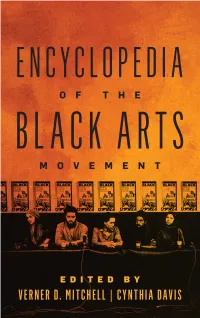
ENCYCLOPEDIA OF THE BLACK ARTS MOVEMENT ed or printed. Edited by istribut Verner D. Mitchell Cynthia Davis an uncorrected page proof and may not be d Excerpted pages for advance review purposes only. All rights reserved. This is ROWMAN & LITTLEFIELD Lanham • Boulder • New York • London 18_985_Mitchell.indb 3 2/25/19 2:34 PM ed or printed. Published by Rowman & Littlefield An imprint of The Rowman & Littlefield Publishing Group, Inc. 4501 Forbes Boulevard, Suite 200, Lanham, Maryland 20706 istribut www.rowman.com 6 Tinworth Street, London, SE11 5AL, United Kingdom Copyright © 2019 by The Rowman & Littlefield Publishing Group Inc. All rights reserved. No part of this book may be reproduced in any form or by any electronic or mechanical means, including information storage and retrieval systems, without written permission from the publisher, except by a reviewer who may quote passages in a review. British Library Cataloguing in Publication Information Available Library of Congress Cataloging-in-Publication Data Names: Mitchell, Verner D., 1957– author. | Davis, Cynthia, 1946– author. Title: Encyclopedia of the Black Arts Movement / Verner D. Mitchell, Cynthia Davis. Description: Lanhaman : uncorrectedRowman & Littlefield, page proof [2019] and | Includes may not bibliographical be d references and index. Identifiers:Excerpted LCCN 2018053986pages for advance(print) | LCCN review 2018058007 purposes (ebook) only. | AllISBN rights reserved. 9781538101469This is (electronic) | ISBN 9781538101452 | ISBN 9781538101452 (cloth : alk. paper) Subjects: LCSH: Black Arts movement—Encyclopedias. Classification: LCC NX512.3.A35 (ebook) | LCC NX512.3.A35 M58 2019 (print) | DDC 700.89/96073—dc23 LC record available at https://lccn.loc.gov/2018053986 The paper used in this publication meets the minimum requirements of American National Standard for Information Sciences—Permanence of Paper for Printed Library Materials, ANSI/NISO Z39.48-1992. -
47 Free Films Dealing with Racism That Are Just a Click Away (With Links)
47 Free Films Dealing with Racism that Are Just a Click Away (with links) Ida B. Wells : a Passion For Justice [1989] [San Francisco, California, USA] : Kanopy Streaming, 2015. Video — 1 online resource (1 video file, approximately 53 min.) : digital, .flv file, sound Sound: digital. Digital: video file; MPEG-4; Flash. Summary Documents the dramatic life and turbulent times of the pioneering African American journalist, activist, suffragist and anti-lynching crusader of the post-Reconstruction period. Though virtually forgotten today, Ida B. Wells-Barnett was a household name in Black America during much of her lifetime (1863-1931) and was considered the equal of her well-known African American contemporaries such as Booker T. Washington and W.E.B. Du Bois. Ida B. Wells: A Passion for Justice documents the dramatic life and turbulent times of the pioneering African American journalist, activist, suffragist and anti-lynching crusader of the post-Reconstruction period. Nobel Prize-winning author Toni Morrison reads selections from Wells' memoirs and other writings in this winner of more than 20 film festival awards. "One had better die fighting against injustice than die like a dog or a rat in a trap." - Ida B. Wells "Tells of the brave life and works of the 19th century journalist, known among Black reporters as 'the princess of the press, ' who led the nation's first anti-lynching campaign." - New York Times "A powerful account of the life of one of the earliest heroes in the Civil Rights Movement...The historical record of her achievements remains relatively modest. This documentary goes a long way towards rectifying that egregious oversight." - Chicago Sun-Times "A keenly realized profile of Ida B. -

Chicago Black Renaissance Literary Movement
CHICAGO BLACK RENAISSANCE LITERARY MOVEMENT LORRAINE HANSBERRY HOUSE 6140 S. RHODES AVENUE BUILT: 1909 ARCHITECT: ALBERT G. FERREE PERIOD OF SIGNIFICANCE: 1937-1940 For its associations with the “Chicago Black Renaissance” literary movement and iconic 20th century African-American playwright Lorraine Hansberry (1930-1965), the Lorraine Hansberry House at 6140 S. Rhodes Avenue possesses exceptional historic and cultural significance. Lorraine Hansberry’s groundbreaking play, A Raisin in the Sun, was the first drama by an African American woman to be produced on Broadway. It grappled with themes of the Chicago Black Renaissance literary movement and drew directly from Hansberry’s own childhood experiences in Chicago. A Raisin in the Sun closely echoes the trauma that Hansberry’s own family endured after her father, Carl Hansberry, purchased a brick apartment building at 6140 S. Rhodes Avenue that was subject to a racially- discriminatory housing covenant. A three-year-long-legal battle over the property, challenging the enforceability of restrictive covenants that effectively sanctioned discrimination in Chicago’s segregated neighborhoods, culminated in 1940 with a United States Supreme Court decision and was a locally important victory in the effort to outlaw racially-discriminatory covenants in housing. Hansberry’s pioneering dramas forced the American stage to a new level of excellence and honesty. Her strident commitment to gaining justice for people of African descent, shaped by her family’s direct efforts to combat institutional racism and segregation, marked the final phase of the vibrant literary movement known as the Chicago Black Renaissance. Born of diverse creative and intellectual forces in Chicago’s African- American community from the 1930s through the 1950s, the Chicago Black Renaissance also yielded such acclaimed writers as Richard Wright (1908-1960) and Gwendolyn Brooks (1917-2000), as well as pioneering cultural institutions like the George Cleveland Hall Branch Library.