Colorful Sea Whip Leptogorgia Virgulata
Total Page:16
File Type:pdf, Size:1020Kb
Load more
Recommended publications
-
Coelenterata: Anthozoa), with Diagnoses of New Taxa
PROC. BIOL. SOC. WASH. 94(3), 1981, pp. 902-947 KEY TO THE GENERA OF OCTOCORALLIA EXCLUSIVE OF PENNATULACEA (COELENTERATA: ANTHOZOA), WITH DIAGNOSES OF NEW TAXA Frederick M. Bayer Abstract.—A serial key to the genera of Octocorallia exclusive of the Pennatulacea is presented. New taxa introduced are Olindagorgia, new genus for Pseudopterogorgia marcgravii Bayer; Nicaule, new genus for N. crucifera, new species; and Lytreia, new genus for Thesea plana Deich- mann. Ideogorgia is proposed as a replacement ñame for Dendrogorgia Simpson, 1910, not Duchassaing, 1870, and Helicogorgia for Hicksonella Simpson, December 1910, not Nutting, May 1910. A revised classification is provided. Introduction The key presented here was an essential outgrowth of work on a general revisión of the octocoral fauna of the western part of the Atlantic Ocean. The far-reaching zoogeographical affinities of this fauna made it impossible in the course of this study to ignore genera from any part of the world, and it soon became clear that many of them require redefinition according to modern taxonomic standards. Therefore, the type-species of as many genera as possible have been examined, often on the basis of original type material, and a fully illustrated generic revisión is in course of preparation as an essential first stage in the redescription of western Atlantic species. The key prepared to accompany this generic review has now reached a stage that would benefit from a broader and more objective testing under practical conditions than is possible in one laboratory. For this reason, and in order to make the results of this long-term study available, even in provisional form, not only to specialists but also to the growing number of ecologists, biochemists, and physiologists interested in octocorals, the key is now pre- sented in condensed form with minimal illustration. -

Diversity of Norwegian Sea Slugs (Nudibranchia): New Species to Norwegian Coastal Waters and New Data on Distribution of Rare Species
Fauna norvegica 2013 Vol. 32: 45-52. ISSN: 1502-4873 Diversity of Norwegian sea slugs (Nudibranchia): new species to Norwegian coastal waters and new data on distribution of rare species Jussi Evertsen1 and Torkild Bakken1 Evertsen J, Bakken T. 2013. Diversity of Norwegian sea slugs (Nudibranchia): new species to Norwegian coastal waters and new data on distribution of rare species. Fauna norvegica 32: 45-52. A total of 5 nudibranch species are reported from the Norwegian coast for the first time (Doridoxa ingolfiana, Goniodoris castanea, Onchidoris sparsa, Eubranchus rupium and Proctonotus mucro- niferus). In addition 10 species that can be considered rare in Norwegian waters are presented with new information (Lophodoris danielsseni, Onchidoris depressa, Palio nothus, Tritonia griegi, Tritonia lineata, Hero formosa, Janolus cristatus, Cumanotus beaumonti, Berghia norvegica and Calma glau- coides), in some cases with considerable changes to their distribution. These new results present an update to our previous extensive investigation of the nudibranch fauna of the Norwegian coast from 2005, which now totals 87 species. An increase in several new species to the Norwegian fauna and new records of rare species, some with considerable updates, in relatively few years results mainly from sampling effort and contributions by specialists on samples from poorly sampled areas. doi: 10.5324/fn.v31i0.1576. Received: 2012-12-02. Accepted: 2012-12-20. Published on paper and online: 2013-02-13. Keywords: Nudibranchia, Gastropoda, taxonomy, biogeography 1. Museum of Natural History and Archaeology, Norwegian University of Science and Technology, NO-7491 Trondheim, Norway Corresponding author: Jussi Evertsen E-mail: jussi.evertsen@ntnu.no IntRODUCTION the main aims. -

Larval Development of Shallow Water Barnacles of the Carolinas (Cirripedia
421 NOAA Technical Report Circular 421 OF <•*>" *o, Larval Development of / Shallow Water Barnacles of the Carolinas (Cirripedia: Sr V/ *TES O* Thoracica) With Keys to Naupliar Stages William H. Lang February 1979 U.S. DEPARTMENT OF COMMERCE National Oceanic and Atmospheric Administration National Marine Fisheries Service NOAA TECHNICAL REPORTS National Marine Fisheries Service, Circulars The major responsibilities of the National Marine Fisheries Service (NMFS) are to monitor and assess the abundance and geographic distribution of fishery resources, to understand and predict fluctuations in the quantity and distribution of these resources, and to establish levels for optimum use of the resources. NMFS is also charged with the development and implementation of policies for managing national fishing grounds, development and enforcement of domestic fisheries regulations, surveillance of foreign fishing off United States coastal waters, and the development and enforcement of international fishery agreements and policies. NMFS also assists the fishing industry through marketing service and economic analysis programs, and mortgage insurance and vessel construction subsidies. It collects, analyzes, and publishes statistics on various phases of the industry. The NOAA Technical Report NMFS Circular series continues a series that has been in existence since 1941. The Circulars are technical publications of general interest intended to aid conservation and management. Publications that review in considerable detail and at a high technical level certain broad areas of research appear in this series. Technical papers originating in economics studies and from management in- vestigations appear in the Circular series. NOAA Technical Report NMFS Circulars are available free in limited numbers to governmental agencies, both Federal and State. -
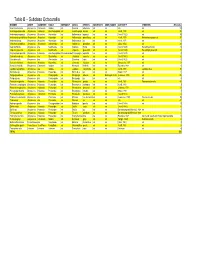
Table B – Subclass Octocorallia
Table B – Subclass Octocorallia BINOMEN ORDER SUBORDER FAMILY SUBFAMILY GENUS SPECIES SUBSPECIES COMN_NAMES AUTHORITY SYNONYMS #Records Acanella arbuscula Alcyonacea Calcaxonia Isididae n/a Acanella arbuscula n/a n/a n/a n/a 59 Acanthogorgia armata Alcyonacea Holaxonia Acanthogorgiidae n/a Acanthogorgia armata n/a n/a Verrill, 1878 n/a 95 Anthomastus agassizii Alcyonacea Alcyoniina Alcyoniidae n/a Anthomastus agassizii n/a n/a (Verrill, 1922) n/a 35 Anthomastus grandiflorus Alcyonacea Alcyoniina Alcyoniidae n/a Anthomastus grandiflorus n/a n/a Verrill, 1878 Anthomastus purpureus 37 Anthomastus sp. Alcyonacea Alcyoniina Alcyoniidae n/a Anthomastus sp. n/a n/a Verrill, 1878 n/a 1 Anthothela grandiflora Alcyonacea Scleraxonia Anthothelidae n/a Anthothela grandiflora n/a n/a (Sars, 1856) n/a 24 Capnella florida Alcyonacea n/a Nephtheidae n/a Capnella florida n/a n/a (Verrill, 1869) Eunephthya florida 44 Capnella glomerata Alcyonacea n/a Nephtheidae n/a Capnella glomerata n/a n/a (Verrill, 1869) Eunephthya glomerata 4 Chrysogorgia agassizii Alcyonacea Holaxonia Acanthogorgiidae Chrysogorgiidae Chrysogorgia agassizii n/a n/a (Verrill, 1883) n/a 2 Clavularia modesta Alcyonacea n/a Clavulariidae n/a Clavularia modesta n/a n/a (Verrill, 1987) n/a 6 Clavularia rudis Alcyonacea n/a Clavulariidae n/a Clavularia rudis n/a n/a (Verrill, 1922) n/a 1 Gersemia fruticosa Alcyonacea Alcyoniina Alcyoniidae n/a Gersemia fruticosa n/a n/a Marenzeller, 1877 n/a 3 Keratoisis flexibilis Alcyonacea Calcaxonia Isididae n/a Keratoisis flexibilis n/a n/a Pourtales, 1868 n/a 1 Lepidisis caryophyllia Alcyonacea n/a Isididae n/a Lepidisis caryophyllia n/a n/a Verrill, 1883 Lepidisis vitrea 13 Muriceides sp. -
Comprehensive Phylogenomic Analyses Resolve Cnidarian Relationships and the Origins of Key Organismal Traits
Comprehensive phylogenomic analyses resolve cnidarian relationships and the origins of key organismal traits Ehsan Kayal1,2, Bastian Bentlage1,3, M. Sabrina Pankey5, Aki H. Ohdera4, Monica Medina4, David C. Plachetzki5*, Allen G. Collins1,6, Joseph F. Ryan7,8* Authors Institutions: 1. Department of Invertebrate Zoology, National Museum of Natural History, Smithsonian Institution 2. UPMC, CNRS, FR2424, ABiMS, Station Biologique, 29680 Roscoff, France 3. Marine Laboratory, university of Guam, UOG Station, Mangilao, GU 96923, USA 4. Department of Biology, Pennsylvania State University, University Park, PA, USA 5. Department of Molecular, Cellular and Biomedical Sciences, University of New Hampshire, Durham, NH, USA 6. National Systematics Laboratory, NOAA Fisheries, National Museum of Natural History, Smithsonian Institution 7. Whitney Laboratory for Marine Bioscience, University of Florida, St Augustine, FL, USA 8. Department of Biology, University of Florida, Gainesville, FL, USA PeerJ Preprints | https://doi.org/10.7287/peerj.preprints.3172v1 | CC BY 4.0 Open Access | rec: 21 Aug 2017, publ: 21 Aug 20171 Abstract Background: The phylogeny of Cnidaria has been a source of debate for decades, during which nearly all-possible relationships among the major lineages have been proposed. The ecological success of Cnidaria is predicated on several fascinating organismal innovations including symbiosis, colonial body plans and elaborate life histories, however, understanding the origins and subsequent diversification of these traits remains difficult due to persistent uncertainty surrounding the evolutionary relationships within Cnidaria. While recent phylogenomic studies have advanced our knowledge of the cnidarian tree of life, no analysis to date has included genome scale data for each major cnidarian lineage. Results: Here we describe a well-supported hypothesis for cnidarian phylogeny based on phylogenomic analyses of new and existing genome scale data that includes representatives of all cnidarian classes. -

<I>Tritonia</I> (Opisthobranchia: Gastropoda)
BULLETIN OF MARINE SCIENCE, 40(3): 428-436, 1987 A NEW SPECIES OF TRITONIA (OPISTHOBRANCHIA: GASTROPODA) FROM THE CARIBBEAN SEA Terrence M. Gosliner and Michael T. Ghiselin ABSTRACT The tritoniid opisthobranchs of the western Atlantic have recently been reviewed (Marcus, 1983). Seven species in three or four genera are known from tropical and subtropical waters of the region. Investigations by one of us (M.T.G.) in the Bahamas yielded specimens of what appeared to be an undescribed species of Tritonia. Subsequently, our joint investigations in Quintana Roo, Mexico have provided additional specimens of this species. This paper de- scribes the anatomy of this new species and compares it to closely allied species. DESCRIPTION Tritonia ham nerorum new species Type Material. - Holotype: Department ofInvertebrate Zoology, California Academy of Sciences, San Francisco, CASIZ 061278, near La Ceiba Hotel, Puerto Morelos, Quintana Roo, Mexico, on Gorgonia flabellum Linnaeus, 2 m depth, 27 March 1985, collected by T. M. Gosliner. Paratypes.-CASIZ 061279, 87 specimens, near La Ceiba Hotel, Puerto Morelos, Quintana Roo, Mexico, on Gorgoniaflabellum, 2 m depth, 27 March 1985, collected by T. M. Gosliner. Paratypes.-CASIZ 061280, 14 specimens, Sandy Cay, Great Abaco Island, Bahamas, on Gorgonia flabellum, 4 m depth, 16 July 1983, collected by M. T. Ghiselin. Etymology. - This species is named for William and Peggy Hamner, who accom- panied one of us (M.T.G.) while collecting the specimens in the Bahamas. External Morphology. - The living animals (Figure I) reach IS mm in length. The notum is smooth, devoid of tubercles. The ground color of living specimens is light pinkish purple, the same color as their gorgonian prey. -

Journal of Experimental Marine Biology and Ecology Subtropical Epibenthos Varies with Location, Reef Type, and Grazing Intensity
Journal of Experimental Marine Biology and Ecology 509 (2018) 54–65 Contents lists available at ScienceDirect Journal of Experimental Marine Biology and Ecology journal homepage: www.elsevier.com/locate/jembe Subtropical epibenthos varies with location, reef type, and grazing intensity T ⁎ Kara R. Wall , Christopher D. Stallings College of Marine Science, University of South Florida, 140 7th Ave, St Petersburg, FL 33705, USA ARTICLE INFO ABSTRACT Keywords: Composition of marine epibenthic communities are influenced by both physical and biotic processes. For in- West Florida Shelf stance, the larval supply and cues that influence colonization (physical), as well as the growth and mortality of Coral individuals (biotoic), may differ across location and reef type. Determining the relative influence of these pro- Warm temperate cesses is important to understanding how epibenthic communities can develop in a region. Using both a partial Fouling caging experiment that controlled grazing by urchins and in situ photographic surveys of epibenthic commu- Habitat heterogeneity Settlement nities, this study examined the relationship between urchin grazing and the composition of epibenthos on natural limestone and artificial reefs in the eastern Gulf of Mexico (eGOM). In the experiment, tiles that were open to urchin grazing had lower percent cover of algae (−12%) and higher cover of crustose coralline algae (CCA) (13%) than those that excluded urchins. Patterns in tile cover were likely the result of CCA either resisting grazing mortality or recolonizing exposed areas after algae were removed. Variation in colonization was ob- served between inshore and offshore reef groups. Urchin density was positively correlated with the structural complexity of the habitats, which was higher on artificial reefs than natural ones, a factor that potentially had important effects on several observed patterns. -

A New Species of <I>Tritonia</I> (Opisthobranchia: Gastropoda)
BULLETIN OF MARINE SCIENCE, 40(3): 428-436, 1987 A NEW SPECIES OF TRITONIA (OPISTHOBRANCHIA: GASTROPODA) FROM THE CARIBBEAN SEA Terrence M. Gosliner and Michael T. Ghiselin ABSTRACT The tritoniid opisthobranchs of the western Atlantic have recently been reviewed (Marcus, 1983). Seven species in three or four genera are known from tropical and subtropical waters of the region. Investigations by one of us (M.T.G.) in the Bahamas yielded specimens of what appeared to be an undescribed species of Tritonia. Subsequently, our joint investigations in Quintana Roo, Mexico have provided additional specimens of this species. This paper de- scribes the anatomy of this new species and compares it to closely allied species. DESCRIPTION Tritonia ham nerorum new species Type Material. - Holotype: Department ofInvertebrate Zoology, California Academy of Sciences, San Francisco, CASIZ 061278, near La Ceiba Hotel, Puerto Morelos, Quintana Roo, Mexico, on Gorgonia flabellum Linnaeus, 2 m depth, 27 March 1985, collected by T. M. Gosliner. Paratypes.-CASIZ 061279, 87 specimens, near La Ceiba Hotel, Puerto Morelos, Quintana Roo, Mexico, on Gorgoniaflabellum, 2 m depth, 27 March 1985, collected by T. M. Gosliner. Paratypes.-CASIZ 061280, 14 specimens, Sandy Cay, Great Abaco Island, Bahamas, on Gorgonia flabellum, 4 m depth, 16 July 1983, collected by M. T. Ghiselin. Etymology. - This species is named for William and Peggy Hamner, who accom- panied one of us (M.T.G.) while collecting the specimens in the Bahamas. External Morphology. - The living animals (Figure I) reach IS mm in length. The notum is smooth, devoid of tubercles. The ground color of living specimens is light pinkish purple, the same color as their gorgonian prey. -

South Carolina Department of Natural Resources
FOREWORD Abundant fish and wildlife, unbroken coastal vistas, miles of scenic rivers, swamps and mountains open to exploration, and well-tended forests and fields…these resources enhance the quality of life that makes South Carolina a place people want to call home. We know our state’s natural resources are a primary reason that individuals and businesses choose to locate here. They are drawn to the high quality natural resources that South Carolinians love and appreciate. The quality of our state’s natural resources is no accident. It is the result of hard work and sound stewardship on the part of many citizens and agencies. The 20th century brought many changes to South Carolina; some of these changes had devastating results to the land. However, people rose to the challenge of restoring our resources. Over the past several decades, deer, wood duck and wild turkey populations have been restored, striped bass populations have recovered, the bald eagle has returned and more than half a million acres of wildlife habitat has been conserved. We in South Carolina are particularly proud of our accomplishments as we prepare to celebrate, in 2006, the 100th anniversary of game and fish law enforcement and management by the state of South Carolina. Since its inception, the South Carolina Department of Natural Resources (SCDNR) has undergone several reorganizations and name changes; however, more has changed in this state than the department’s name. According to the US Census Bureau, the South Carolina’s population has almost doubled since 1950 and the majority of our citizens now live in urban areas. -

Genetic Divergence and Polyphyly in the Octocoral Genus Swiftia [Cnidaria: Octocorallia], Including a Species Impacted by the DWH Oil Spill
diversity Article Genetic Divergence and Polyphyly in the Octocoral Genus Swiftia [Cnidaria: Octocorallia], Including a Species Impacted by the DWH Oil Spill Janessy Frometa 1,2,* , Peter J. Etnoyer 2, Andrea M. Quattrini 3, Santiago Herrera 4 and Thomas W. Greig 2 1 CSS Dynamac, Inc., 10301 Democracy Lane, Suite 300, Fairfax, VA 22030, USA 2 Hollings Marine Laboratory, NOAA National Centers for Coastal Ocean Sciences, National Ocean Service, National Oceanic and Atmospheric Administration, 331 Fort Johnson Rd, Charleston, SC 29412, USA; peter.etnoyer@noaa.gov (P.J.E.); thomas.greig@noaa.gov (T.W.G.) 3 Department of Invertebrate Zoology, National Museum of Natural History, Smithsonian Institution, 10th and Constitution Ave NW, Washington, DC 20560, USA; QuattriniA@si.edu 4 Department of Biological Sciences, Lehigh University, 111 Research Dr, Bethlehem, PA 18015, USA; santiago.herrera@lehigh.edu * Correspondence: janessy.frometa@noaa.gov Abstract: Mesophotic coral ecosystems (MCEs) are recognized around the world as diverse and ecologically important habitats. In the northern Gulf of Mexico (GoMx), MCEs are rocky reefs with abundant black corals and octocorals, including the species Swiftia exserta. Surveys following the Deepwater Horizon (DWH) oil spill in 2010 revealed significant injury to these and other species, the restoration of which requires an in-depth understanding of the biology, ecology, and genetic diversity of each species. To support a larger population connectivity study of impacted octocorals in the Citation: Frometa, J.; Etnoyer, P.J.; GoMx, this study combined sequences of mtMutS and nuclear 28S rDNA to confirm the identity Quattrini, A.M.; Herrera, S.; Greig, Swiftia T.W. -

Benthic Habitat Mapping and Assessment in the Wilmington-East Wind Energy Call Area
OCS Study BOEM 2016-003 NOAA Technical Memorandum NOS NCCOS 196 Benthic Habitat Mapping and Assessment in the Wilmington-East Wind Energy Call Area Final Report US Department of the Interior US Department of Commerce Bureau of Ocean Energy Management National Oceanic and Atmospheric Administration Office of Renewable Energy Programs National Centers for Coastal Ocean Science OCS Study BOEM 2016-003 NOAA Technical Memorandum NOS NCCOS 196 Benthic Habitat Mapping and Assessment in the Wilmington-East Wind Energy Call Area Authors J. Christopher Taylor1 T. Shay Viehman1 Avery B. Paxton2 Stephen R. Fegley2 Christine M. Voss2 Emily A. Pickering2 Benjamin W. Sumners3 Alyssa M. Adler2 Christine A. Buckel1 Christopher Freeman3 Jenny L. Vander Pluym1 Charles H. Peterson2 Erik E. Ebert1 Prepared under Cooperative and Interagency Agreements by 1National Ocean Service National Centers for Coastal Ocean Science 101 Pivers Island Road Beaufort, NC 28516 Interagency Agreement M13PG00019 In cooperation with 2The University of North Carolina 3Geodynamics Group Institute of Marine Sciences 310-A Greenfield Drive 3431 Arendell Street Newport, North Carolina 28570 Morehead City, NC 28557 Under contract to UNC Cooperative Agreement M13AC00006 Published by US Department of the Interior US Department of Commerce Bureau of Ocean Energy National Oceanic and Atmospheric Management Administration Office of Renewable Energy National Centers for Coastal Ocean Science Programs January 13, 2016 OCS Study BOEM 2016-003 NOAA Technical Memorandum NOS NCCOS 196 DISCLAIMER Research collaboration and funding were provided by the US Department of the Interior, Bureau of Ocean Energy Management, Office of Renewable Energy Programs, Sterling, VA under Agreement Number M13AC00006 and by the National Oceanic and Atmospheric Administration’s National Centers for Coastal Ocean Science under Interagency Agreement Number M13PG00019. -

An Invitation to Monitor Georgia's Coastal Wetlands
An Invitation to Monitor Georgia’s Coastal Wetlands www.shellfish.uga.edu By Mary Sweeney-Reeves, Dr. Alan Power, & Ellie Covington First Printing 2003, Second Printing 2006, Copyright University of Georgia “This book was prepared by Mary Sweeney-Reeves, Dr. Alan Power, and Ellie Covington under an award from the Office of Ocean and Coastal Resource Management, National Oceanic and Atmospheric Administration. The statements, findings, conclusions, and recommendations are those of the authors and do not necessarily reflect the views of OCRM and NOAA.” 2 Acknowledgements Funding for the development of the Coastal Georgia Adopt-A-Wetland Program was provided by a NOAA Coastal Incentive Grant, awarded under the Georgia Department of Natural Resources Coastal Zone Management Program (UGA Grant # 27 31 RE 337130). The Coastal Georgia Adopt-A-Wetland Program owes much of its success to the support, experience, and contributions of the following individuals: Dr. Randal Walker, Marie Scoggins, Dodie Thompson, Edith Schmidt, John Crawford, Dr. Mare Timmons, Marcy Mitchell, Pete Schlein, Sue Finkle, Jenny Makosky, Natasha Wampler, Molly Russell, Rebecca Green, and Jeanette Henderson (University of Georgia Marine Extension Service); Courtney Power (Chatham County Savannah Metropolitan Planning Commission); Dr. Joe Richardson (Savannah State University); Dr. Chandra Franklin (Savannah State University); Dr. Dionne Hoskins (NOAA); Dr. Charles Belin (Armstrong Atlantic University); Dr. Merryl Alber (University of Georgia); (Dr. Mac Rawson (Georgia Sea Grant College Program); Harold Harbert, Kim Morris-Zarneke, and Michele Droszcz (Georgia Adopt-A-Stream); Dorset Hurley and Aimee Gaddis (Sapelo Island National Estuarine Research Reserve); Dr. Charra Sweeney-Reeves (All About Pets); Captain Judy Helmey (Miss Judy Charters); Jan Mackinnon and Jill Huntington (Georgia Department of Natural Resources).