And Micro-Level Processes in John Adams's Phrygian Gates" (2013)
Total Page:16
File Type:pdf, Size:1020Kb
Load more
Recommended publications
-

Doctor Atomic
What to Expect from doctor atomic Opera has alwayS dealt with larger-than-life Emotions and scenarios. But in recent decades, composers have used the power of THE WORK DOCTOR ATOMIC opera to investigate society and ethical responsibility on a grander scale. Music by John Adams With one of the first American operas of the 21st century, composer John Adams took up just such an investigation. His Doctor Atomic explores a Libretto by Peter Sellars, adapted from original sources momentous episode in modern history: the invention and detonation of First performed on October 1, 2005, the first atomic bomb. The opera centers on Dr. J. Robert Oppenheimer, in San Francisco the brilliant physicist who oversaw the Manhattan Project, the govern- ment project to develop atomic weaponry. Scientists and soldiers were New PRODUCTION secretly stationed in Los Alamos, New Mexico, for the duration of World Alan Gilbert, Conductor War II; Doctor Atomic focuses on the days and hours leading up to the first Penny Woolcock, Production test of the bomb on July 16, 1945. In his memoir Hallelujah Junction, the American composer writes, “The Julian Crouch, Set Designer manipulation of the atom, the unleashing of that formerly inaccessible Catherine Zuber, Costume Designer source of densely concentrated energy, was the great mythological tale Brian MacDevitt, Lighting Designer of our time.” As with all mythological tales, this one has a complex and Andrew Dawson, Choreographer fascinating hero at its center. Not just a scientist, Oppenheimer was a Leo Warner and Mark Grimmer for Fifty supremely cultured man of literature, music, and art. He was conflicted Nine Productions, Video Designers about his creation and exquisitely aware of the potential for devastation Mark Grey, Sound Designer he had a hand in designing. -

Mahler 5 & Music You Know
CONCERT PROGRAM Friday, January 22, 2016, 10:30am Saturday, January 23, 2016, 8:00pm David Robertson, conductor Timothy McAllister, saxophone JOHN ADAMS Saxophone Concerto (2013) (b. 1947) Animato; Moderato; Tranquillo, suave Molto vivo (a hard driving pulse) Timothy McAllister, saxophone INTERMISSION MAHLER Symphony No. 5 in C-sharp minor (1901-02) (1860-1911) PART I Trauermarsch. In gemessenem Schritt. Streng. Wie ein Kondukt Stürmisch bewegt, mit größter Vehemenz PART II Scherzo. Kräftig, nicht zu schnell PART III Adagietto. Sehr langsam— Rondo-Finale. Allegro 23 ACKNOWLEDGMENTS These concerts are part of the Wells Fargo Advisors Orchestral series. These concerts are presented by St. Louis College of Pharmacy. David Robertson is the Beofor Music Director and Conductor. Timothy McAllister is the Ann and Paul Lux Guest Artist. The concert of Saturday, January 23, is underwritten in part by a generous gift from Rex and Jeanne Sinquefield. The concert of Friday, January 22, 10:30am, features coffee and doughnuts provided through the generosity of Community Coffee and Krispy Kreme, respectively. Pre-Concert Conversations are sponsored by Washington University Physicians. Large print program notes are available through the generosity of Bellefontaine Cemetery and Arboretum and are located at the Customer Service table in the foyer. 24 ON EDGE BY EDDIE SILVA Their music is made of the worlds around them, Gustav Mahler and John Adams. Mahler of that thrilling age, the shift from the 19th to the 20th century, the speed of the modern beginning to TIMELINKS change how people think and act. Also a time of anxiety, especially for a Jewish artist in an anti- Semitic Vienna. -

Download Booklet
Acknowledgments This recording was made at the I would also like to thank the Teresa This disc is dedicated to all the Academy of Arts and Letters in Sterne Foundation, Gilbert Kalish, members of my family — especially Manhattan, New York on May and Norma Hurlburt for their gener- my mom, dad, Eve, Henry, and 26-28, 2007. Thank you to osity, which helped to make this my nephews — who have been a Ardith Holmgrain for her help disc a reality. And, a thank you to constant source of love and support in arranging our use of this Lehman College and its Shuster in my life; to my primary teachers magnificent recording space. Grant through the Research Jesslyn Kitts, Michael Zenge, Foundation of the City of New Leonard Hokanson, and Gilbert I would like to thank Max Wilcox, York for their help in the Kalish; to a cherished circle of who very graciously helped to completion of this disc. friends, which grows wider all the prepare and record this disc. time; and, to God who orchestrated Without his help it never could I would also like to thank Jeremy all of these parts. have happened. I also thank Mary Geffen, Ara Guzelemian, Kathy Schwendeman for the use of her Schumann, John Adams, Peter glorious Steinway. Thank you to Sellars, David Robertson, Dawn David Merrill who continuously Upshaw and the Carnegie Hall Publishers: t h r e a d s offered a bright smile and encour- family for giving me so many Andriessen: Boosey & Hawkes aging words during the engineering wonderfully rich treasures in my Music Publishers Limited and recording of this disc and musical experiences thus far. -

THE CLEVELAN ORCHESTRA California Masterwor S
����������������������� �������������� ��������������������������������������������� ������������������������ �������������������������������������� �������� ������������������������������� ��������������������������� ��������������������������������������������������� �������������������� ������������������������������������������������������� �������������������������� ��������������������������������������������� ������������������������ ������������������������������������������������� ���������������������������� ����������������������������� ����� ������������������������������������������������ ���������������� ���������������������������������������� ��������������������������� ���������������������������������������� ��������� ������������������������������������� ���������� ��������������� ������������� ������ ������������� ��������� ������������� ������������������ ��������������� ����������� �������������������������������� ����������������� ����� �������� �������������� ��������� ���������������������� Welcome to the Cleveland Museum of Art The Cleveland Orchestra’s performances in the museum California Masterworks – Program 1 in May 2011 were a milestone event and, according to the Gartner Auditorium, The Cleveland Museum of Art Plain Dealer, among the year’s “high notes” in classical Wednesday evening, May 1, 2013, at 7:30 p.m. music. We are delighted to once again welcome The James Feddeck, conductor Cleveland Orchestra to the Cleveland Museum of Art as this groundbreaking collaboration between two of HENRY COWELL Sinfonietta -
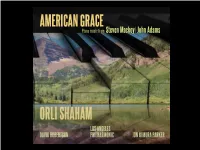
ORLI SHAHAM LOS ANGELES DAVID ROBERTSON PHILHARMONIC JON KIMURA PARKER 1 Merican Composers Have Always Pushed Boundaries, As Americans Themselves Have a Pushed West
AMERICAN GRACE Piano music from Steven Mackey | John Adams ORLI SHAHAM LOS ANGELES DAVID ROBERTSON PHILHARMONIC JON KIMURA PARKER 1 merican composers have always pushed boundaries, as Americans themselves have A pushed West. I feel strongly that John Adams and Steven Mackey are at the forefront of defining what it means to be an American pianist today. On a stunning summer’s day in 2007 in the inspiring Rocky Mountain valley of Aspen, I found myself as usual underground, in a windowless practice room. One of the magical things about Aspen is that the otherwise oppressive quality of such a room is transformed by the people who inhabit it. I was taking a practice break from Gershwin and Stravinsky, preparing for rehearsal with the orchestra, when Steve Mackey came off the stage from rehearsing his guitar concerto Tuck and Roll. I was seven months pregnant with my twin sons, and Steve and I immediately started to talk about both music and child-bearing, which his wife was soon to do as well. I relished our talk and was further enthralled by Steve’s sizzling guitar playing and magnetic compositional style. For the next months, I ravenously listened to his oeuvre, convincing me that he was the first composer I wanted to ask to write me a concerto. The process was amazing. Steve showed me bits now and again, listened to my recordings and live performances, asked about my hand size, even allowed me a say in the final dramatic turn of the piece. Every time a part of the score came my way, I was more excited to learn it and understand it. -
Form in the Music of John Adams
Graduate Theses, Dissertations, and Problem Reports 2018 Form in the Music of John Adams Michael Ridderbusch Follow this and additional works at: https://researchrepository.wvu.edu/etd Recommended Citation Ridderbusch, Michael, "Form in the Music of John Adams" (2018). Graduate Theses, Dissertations, and Problem Reports. 6503. https://researchrepository.wvu.edu/etd/6503 This Dissertation is protected by copyright and/or related rights. It has been brought to you by the The Research Repository @ WVU with permission from the rights-holder(s). You are free to use this Dissertation in any way that is permitted by the copyright and related rights legislation that applies to your use. For other uses you must obtain permission from the rights-holder(s) directly, unless additional rights are indicated by a Creative Commons license in the record and/ or on the work itself. This Dissertation has been accepted for inclusion in WVU Graduate Theses, Dissertations, and Problem Reports collection by an authorized administrator of The Research Repository @ WVU. For more information, please contact researchrepository@mail.wvu.edu. Form in the Music of John Adams Michael Ridderbusch DMA Research Paper submitted to the College of Creative Arts at West Virginia University in partial fulfillment of the requirements for the degree of Doctor of Musical Arts in Music Theory and Composition Andrew Kohn, Ph.D., Chair Travis D. Stimeling, Ph.D. Melissa Bingmann, Ph.D. Cynthia Anderson, MM Matthew Heap, Ph.D. School of Music Morgantown, West Virginia 2017 Keywords: John Adams, Minimalism, Phrygian Gates, Century Rolls, Son of Chamber Symphony, Formalism, Disunity, Moment Form, Block Form Copyright ©2017 by Michael Ridderbusch ABSTRACT Form in the Music of John Adams Michael Ridderbusch The American composer John Adams, born in 1947, has composed a large body of work that has attracted the attention of many performers and legions of listeners. -

Harmonic Progression and Pitch-Centricity in John Adams Phrygian Gates
HARMONIC PROGRESSION AND PITCH-CENTRICITY IN JOHN ADAMS PHRYGIAN GATES Connor D’Netto A thesis submitted in partial fulfillment of the requirements for the degree of Bachelor of Music with Honours in Musicology/Composition School of Music, The University of Queensland, November 2015. ii Statement of Originality I understand the University’s rules and policies on referencing and avoiding plagiarism. This thesis is my own work and contains nothing submitted for assessment elsewhere or for another course, at The University of Queensland or any other institution. I have appropriately and fairly accredited the work of others that I have drawn on in the writing of this thesis. I have undertaken the online Academic Integrity Tutorial: (https://www.uq.edu.au/integrity/Login.aspx?ReturnUrl=%25252fintegrity). Signature of student: Date: 09/11/15 Disciplinary action will be taken for students found signing a false statement regarding the above, or who are in breach of the UQ Policy and Procedure Library 3.60.04 Student Integrity and Misconduct 6 Guidelines for Students http://ppl.app.uq.edu.au/content/3.60.04-student- integrity-and-misconduct#Policy iii Abstract John Adams is one of the most frequently performed living composers in the realm of Western Art Music. As one of the foremost composers of minimalism, his solo piano work Phrygian Gates, to him, represents his initiation into this musical style, and as such, his “Opus one” (Hallelujah Junction 89). This work, representing a significant point in the development of Adams’ musical style, also represents a significant occurrence in the development in the Western-classical music: the emergence of tonality. -
Minimalism Post-Modernism Is a Term That Refers to Events After the So
Post-Modernism - Minimalism Post-Modernism is a term that refers to events after the so-called Modern period. The term suggests that we are now using what we learned in the “modern” period, but mixing it with ideas from the more distant past. A major movement within Post-Modernism is Minimalism Minimalism mixes some Eastern philosophical principles involving chant and meditation with simple tonal materials. Basic definition of Minimalism: sustained or repetitive use of simple (often tonal) materials. The movement began with LaMonte Young (b.1935); he used simple textures and consonant materials; often called trance music. Terry Riley (b.1935) is credited with first minimalist work In C (1964). The piece has repeated high C’s on piano maintaining simple pulse. Score has 53 short motives to be played by a group any size; players play all 53 figures, repeating as many times and as frequently as desired. Performance ends when all players are done with all 53 figures. Because figures change in content, there is subtle but constantly shifting texture all the time. Steve Reich (b. 1936) prefers to call his music “Structural” not minimal. His music is influenced by his study of African drumming. Some of his early works use phasing, where a tape loop is set up: the tape records first sounds made by performer; then plays them back while performer continues to play. More layers are added, and gradually live sounds get ahead of play-back. Effect can be hypnotic: trance-like. Violin Phase (1967) is example. In Mid-70’s Reich expanded his viewpoint and his ensemble: Music for 18 Musicians is a little like In C, but there is much more variation in patterns. -

Atheneum Nantucket Dance Festival
NANTUCKET ATHENEUM DANCE FESTIVAL 2011 Featuring stars of New York City Ballet & Paris Opera Ballet Benjamin Millepied Artistic Director Dorothée Gilbert Teresa Reichlen Amar Ramasar Sterling Hyltin Tyler Angle Daniel Ulbricht Maria Kowroski Alessio Carbone Ana Sofia Scheller Sean Suozzi Chase Finlay Georgina Pazcoguin Ashley Laracey Justin Peck Troy Schumacher Musicians Cenovia Cummins Katy Luo Gillian Gallagher Naho Tsutsui Parrini Maria Bella Jeffers Brooke Quiggins Saulnier Cover: Photo of Benjamin Millepied by Paul Kolnik 1 Welcometo the Nantucket Atheneum Dance Festival! For 177 years the Nantucket Atheneum has enriched our island community through top quality library services and programs. This year the library served more than 200,000 adults, teens and children year round with free access to over 1.4 million books, CDs, and DVDs, reference and information services and a wide range of cultural and educational programs. In keeping with its long-standing tradition of educational and cultural programming, the Nantucket Atheneum is very excited to present a multifaceted dance experience on Nantucket for the fourth straight summer. This year’s performances feature the world’s best dancers from New York City Ballet and Paris Opera Ballet under the brilliant artistic direction of Benjamin Millepied. In addition to live music for two of the pieces in the program, this year’s program includes an exciting world premier by Justin Peck of the New York City Ballet. The festival this week has offered a sparkling array of free community events including two dance-related book author/illustrator talks, Frederick Wiseman’s film La Danse, Children’s Workshop, Lecture Demonstration and two youth master dance classes. -
Harmonic Vocabulary in the Music of John Adams: a Hierarchical Approach Author(S): Timothy A
Yale University Department of Music Harmonic Vocabulary in the Music of John Adams: A Hierarchical Approach Author(s): Timothy A. Johnson Source: Journal of Music Theory, Vol. 37, No. 1 (Spring, 1993), pp. 117-156 Published by: Duke University Press on behalf of the Yale University Department of Music Stable URL: http://www.jstor.org/stable/843946 Accessed: 06-07-2017 19:50 UTC JSTOR is a not-for-profit service that helps scholars, researchers, and students discover, use, and build upon a wide range of content in a trusted digital archive. We use information technology and tools to increase productivity and facilitate new forms of scholarship. For more information about JSTOR, please contact support@jstor.org. Your use of the JSTOR archive indicates your acceptance of the Terms & Conditions of Use, available at http://about.jstor.org/terms Yale University Department of Music, Duke University Press are collaborating with JSTOR to digitize, preserve and extend access to Journal of Music Theory This content downloaded from 198.199.32.254 on Thu, 06 Jul 2017 19:50:30 UTC All use subject to http://about.jstor.org/terms HARMONIC VOCABULARY IN THE MUSIC OF JOHN ADAMS: A HIERARCHICAL APPROACH Timothy A. Johnson Overview Following the minimalist tradition, much of John Adams's' music consists of long passages employing a single set of pitch classes (pcs) usually encompassed by one diatonic set.2 In many of these passages the pcs form a single diatonic triad or seventh chord with no additional pcs. In other passages textural and registral formations imply a single triad or seventh chord, but additional pcs obscure this chord to some degree. -

An HD Odyssey
The Earth - An HD Odysse y Grades 9-12 Young Peopl e's Concert Listening Guide PERFORMERS Nashville Sympho ny Giancarlo Guerrero, condu ctor PROGRAM John Adams – Short Ride in a Fast Machine R. Strauss – Also sprach Zarathustra The program will be accompanied by high-definition images taken from NASA missions to Earth’s orbit JOHN ADAMS Born on February 15, 1947, in Worcester, Massachusetts; currently lives in Berkeley, California John Adams, whose new opera Girls of the Golden West received its world premiere at the end of last year at San Francisco Opera, is equally at home on the stage and in the concert hall. In fact, Short Ride in a Fast Machine is a concert-opening fanfare that Adams wrote during the period, in the mid-1980s, when he was busy composing his first opera, Nixon in China. It also shows a kinship with the exultant passages of Harmonielehre, Adams’s breakthrough orchestral work that preceded Nixon. Adams had an opportunity around this time to experiment twice with the format of the stand-alone concert fanfare. Preceding Short Ride in a Fast Machine was Tromba Lontana (“Distant Trumpet”). The composer characterizes both pieces as “in extremis versions of the traditional fanfare.” As a pair, they form a kind of fanfarish yin-and-yang: Tromba being a reserved, ruminative “anti-fanfare,” while Short Ride is a boisterously in-your-face, virtuoso roller coaster ride of orchestral sonorities. Although both are sometimes presented as companion pieces, Adams points out that he never actually intended them to be played together. WHAT TO LISTEN FOR: Short Ride in a Fast Machine Composed: 1986 First performance: June 13, 1986, with Michael Tilson Thomas conducting the Pittsburgh Symphony Short Ride might almost be heard as a concise primer on how Adams forged a freshly powerful musical language all his own from the building blocks of Minimalism as well as from the vernacular idioms of his upbringing—all transmogrified by his buoyant imagination. -
Aaron Jay Kernis.” – Forbes
“In the 20th century there were giants in the land. Charles Ives, Duke Ellington, George Gershwin, Aaron Copland, and Leonard Bernstein. But who is filling those shoes now? Heading many lists is Aaron Jay Kernis.” – Forbes Winner of the coveted 2002 Grawemeyer Award for Music Composition and one of the youngest composers ever to be awarded the Pulitzer Prize, AARON JAY KERNIS is among the most esteemed musical figures of his generation. With "fearless originality [and] powerful voice" (The New York Times), each new Kernis work is eagerly awaited by audiences and musicians alike, and he is one of today's most frequently performed composers. His music, full of variety and dynamic energy, is rich in lyric beauty, poetic imagery, and brilliant instrumental color. His works figure prominently on orchestral, chamber, and recital programs world-wide and have been commissioned by many of America‘s foremost performers, including sopranos Renee Fleming and Dawn Upshaw, violinists Joshua Bell, Pamela Frank, Nadja Salerno-Sonnenberg and James Ehnes (for the BBC Proms), pianist Christopher O'Riley and guitarist Sharon Isbin, and such musical institutions as the New York Philharmonic, Philadelphia Orchestra (for the inauguration of its new home at the Kimmel Center), Walt Disney Company, Rose Center for Earth and Space at New York’s American Museum of Natural History, Ravinia Festival (for James Conlon’s inaugural season), San Francisco and Singapore Symphonies, Minnesota Orchestra, Lincoln Center Great Performers Series, American Public Radio; Los Angeles and Saint Paul Chamber Orchestras, and Aspen Music Festival and programs from Philadelphia to Amsterdam (Concertgebouw, Amsterdam Sinfonietta), Santa Barbara to France (Orchestra National De France) throughout Europe and beyond.