(Pezizales, Ascomycetes) Saprotrophic Fungi
Total Page:16
File Type:pdf, Size:1020Kb
Load more
Recommended publications
-

Chorioactidaceae: a New Family in the Pezizales (Ascomycota) with Four Genera
mycological research 112 (2008) 513–527 journal homepage: www.elsevier.com/locate/mycres Chorioactidaceae: a new family in the Pezizales (Ascomycota) with four genera Donald H. PFISTER*, Caroline SLATER, Karen HANSENy Harvard University Herbaria – Farlow Herbarium of Cryptogamic Botany, Department of Organismic and Evolutionary Biology, Harvard University, 22 Divinity Avenue, Cambridge, MA 02138, USA article info abstract Article history: Molecular phylogenetic and comparative morphological studies provide evidence for the Received 15 June 2007 recognition of a new family, Chorioactidaceae, in the Pezizales. Four genera are placed in Received in revised form the family: Chorioactis, Desmazierella, Neournula, and Wolfina. Based on parsimony, like- 1 November 2007 lihood, and Bayesian analyses of LSU, SSU, and RPB2 sequence data, Chorioactidaceae repre- Accepted 29 November 2007 sents a sister clade to the Sarcosomataceae, to which some of these taxa were previously Corresponding Editor: referred. Morphologically these genera are similar in pigmentation, excipular construction, H. Thorsten Lumbsch and asci, which mostly have terminal opercula and rounded, sometimes forked, bases without croziers. Ascospores have cyanophilic walls or cyanophilic surface ornamentation Keywords: in the form of ridges or warts. So far as is known the ascospores and the cells of the LSU paraphyses of all species are multinucleate. The six species recognized in these four genera RPB2 all have limited geographical distributions in the northern hemisphere. Sarcoscyphaceae ª 2007 The British Mycological Society. Published by Elsevier Ltd. All rights reserved. Sarcosomataceae SSU Introduction indicated a relationship of these taxa to the Sarcosomataceae and discussed the group as the Chorioactis clade. Only six spe- The Pezizales, operculate cup-fungi, have been put on rela- cies are assigned to these genera, most of which are infre- tively stable phylogenetic footing as summarized by Hansen quently collected. -

The Ascomycota
Papers and Proceedings of the Royal Society of Tasmania, Volume 139, 2005 49 A PRELIMINARY CENSUS OF THE MACROFUNGI OF MT WELLINGTON, TASMANIA – THE ASCOMYCOTA by Genevieve M. Gates and David A. Ratkowsky (with one appendix) Gates, G. M. & Ratkowsky, D. A. 2005 (16:xii): A preliminary census of the macrofungi of Mt Wellington, Tasmania – the Ascomycota. Papers and Proceedings of the Royal Society of Tasmania 139: 49–52. ISSN 0080-4703. School of Plant Science, University of Tasmania, Private Bag 55, Hobart, Tasmania 7001, Australia (GMG*); School of Agricultural Science, University of Tasmania, Private Bag 54, Hobart, Tasmania 7001, Australia (DAR). *Author for correspondence. This work continues the process of documenting the macrofungi of Mt Wellington. Two earlier publications were concerned with the gilled and non-gilled Basidiomycota, respectively, excluding the sequestrate species. The present work deals with the non-sequestrate Ascomycota, of which 42 species were found on Mt Wellington. Key Words: Macrofungi, Mt Wellington (Tasmania), Ascomycota, cup fungi, disc fungi. INTRODUCTION For the purposes of this survey, all Ascomycota having a conspicuous fruiting body were considered, excluding Two earlier papers in the preliminary documentation of the endophytes. Material collected during forays was described macrofungi of Mt Wellington, Tasmania, were confined macroscopically shortly after collection, and examined to the ‘agarics’ (gilled fungi) and the non-gilled species, microscopically to obtain details such as the size of the -

Contribution to the Study of Neotropical Discomycetes: a New Species of the Genus Geodina (Geodina Salmonicolor Sp
Mycosphere 9(2): 169–177 (2018) www.mycosphere.org ISSN 2077 7019 Article Doi 10.5943/mycosphere/9/2/1 Copyright © Guizhou Academy of Agricultural Sciences Contribution to the study of neotropical discomycetes: a new species of the genus Geodina (Geodina salmonicolor sp. nov.) from the Dominican Republic Angelini C1,2, Medardi G3, Alvarado P4 1 Jardín Botánico Nacional Dr. Rafael Ma. Moscoso, Santo Domingo, República Dominicana 2 Via Cappuccini 78/8, 33170 (Pordenone) 3 Via Giuseppe Mazzini 21, I-25086 Rezzato (Brescia) 4 ALVALAB, La Rochela 47, E-39012 Santander, Spain Angelini C, Medardi G, Alvarado P 2018 - Contribution to the study of neotropical discomycetes: a new species of the genus Geodina (Geodina salmonicolor sp. nov.) from the Dominican Republic. Mycosphere 9(2), 169–177, Doi 10.5943/mycosphere/9/2/1 Abstract Geodina salmonicolor sp. nov., a new neotropical / equatorial discomycetes of the genus Geodina, is here described and illustrated. The discovery of this new entity allowed us to propose another species of Geodina, until now a monospecific genus, and produce the first 28S rDNA genetic data, which supports this species is related to genus Wynnea in the Sarcoscyphaceae. Key-words – 1 new species – Ascomycota – Sarcoscyphaceae – Sub-tropical zone Caribbeans – Taxonomy Introduction A study started more than 10 years ago in the area of Santo Domingo (Dominican Republic) by one of the authors allowed us to identify several interesting fungal species, both Basidiomycota and Ascomycota. Angelini & Medardi (2012) published a first report of ascomycetes in which 12 lignicolous species including discomycetes and pyrenomycetes were described and illustrated in detail, also delineating the physical and botanical characteristics of the research area. -
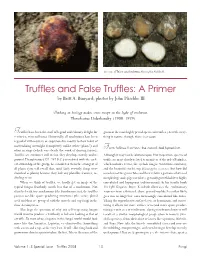
Truffles and False Truffles: a Primer by Britt A
Two views of Tuber canaliculatum. Photos: John Plschke III. Truffles and False Truffles: A Primer by Britt A. Bunyard; photos by John Plischke III Nothing in biology makes sense except in the light of evolution. —Theodosius Dobzhansky (1900–1979) Truffles have been the stuff of legend and culinary delight for genus of the most highly prized species of truffles.) As with every- centuries, even millennia. Historically, all mushrooms have been thing in nature, though, there is a reason. regarded with mystery or suspicion due mostly to their habit of materializing overnight (completely unlike other “plants”) and Form follows function: the convoluted hymenium often in rings (which was clearly the work of dancing fairies). Truffles are curiouser still in that they develop entirely under- Although it may not be obvious upon first inspection, species of ground. Theophrastus (372–287 B.C.) is credited with the earli- truffle are most closely related to members of the order Pezizales, est authorship of the group; he considered them the strangest of which includes Peziza, the eyelash fungus (Scutellinia scutellata), all plants (you will recall that, until fairly recently, fungi were and the beautiful scarlet cup (Sarcoscypha coccinea). But how did classified as plants) because they lack any plantlike features, in- members of the genus Tuber and their relatives go from a flattened cluding roots. morphology and epigeous (above ground) growth habit to highly When we think of truffles, we hardly get an image of the convoluted and hypogeous (subterranean)? In his terrific book typical fungus fruitbody, much less that of a mushroom. Not The Fifth Kingdom, Bryce Kendrick illustrates the evolutionary classified with true mushrooms (the Basidiomycetes), the truffles sequence from a flattened, above-ground cup like Peziza that likely possess sac-like spore producing structures (the ascus; plural gave rise to fungi that were increasingly convoluted like Genea. -

Species of Peziza S. Str. on Water-Soaked Wood with Special Reference to a New Species, P
DOI 10.12905/0380.sydowia68-2016-0173 Species of Peziza s. str. on water-soaked wood with special reference to a new species, P. nordica, from central Norway Donald H. Pfister1, *, Katherine F. LoBuglio1 & Roy Kristiansen2 1 Department of Organismic and Evolutionary Biology, Harvard University Herbaria, 22 Divinity Ave., Cambridge, MA 02138, USA 2 PO Box 32, N-1650 Sellebakk, Norway * e-mail: dpfister@oeb.harvard.edu Pfister D.H., LoBuglio K.F. & Kristiansen R. (2016) Species ofPeziza s. str. on water-soaked wood with special reference to a new species, P. nordica, from central Norway. – Sydowia 68: 173–185. Peziza oliviae, P. lohjaoensis, P. montirivicola and a new species from Norway form a well-supported clade within the Peziza s. str. group based on study of the internal transcribed spacer + 5.8S rRNA gene, large subunit rRNA gene and the 6–7 region of the DNA-dependent RNA polymerase II gene. Like P. oliviae and P. montirivicola, the new species, P. nordica, is distinctly stipi- tate and occurs on wood that has been inundated by fresh water. These species also have paraphyses with yellow vacuolar inclu- sions. They fruit early in the season or at high elevations and are presumed to be saprobic. A discussion of application of the name Peziza is given. Keywords: Ascomycota, molecular phylogeny, Pezizales, taxonomy. The present work was begun to determine the Schwein.) Fr., Cudoniella clavus (Alb. & Schwein.) identity of a collection made by one of us (RK) in Dennis and frequently Scutellinia scutellata (L.) August 2014. This large, orange brown to brown, Lambotte. -

Pezizales De Rhône-Alpes
Contribution à la connaissance des Pézizales (Ascomycota) de Rhône‐Alpes. 2e partie Liste des espèces présentées Pachyella aquatilis Rhodoscypha ovilla Pachyella violaceonigra Saccobolus depauperatus Pachyphlodes citrinus Saccobolus versicolor Parascutellinia carneosanguinea Sarcoscypha austriaca Paratrichophaea boudieri Sarcoscypha coccinea Peziza acroornata Sarcoscypha jurana Peziza alaskana Sarcosphaera coronaria Peziza queletii (= ampelina) Scutellinia cejpii Peziza arvernensis Scutellinia citrina Peziza badia Scutellinia crinita Peziza badioides Scutellinia decipiens Peziza coquandii Scutellinia hyperborea Peziza depressa Scutellinia legaliae Peziza echinospora Scutellinia macrospora Peziza gerardii Scutellinia minor Peziza granularis~fimeti Scutellinia minutella Peziza limnaea Scutellinia mirabilis Peziza lobulata Scutellinia nigrohirtula Peziza pauli (= martinii) Scutellinia olivascens Peziza michelii Scutellinia patagonica Peziza ninguis Scutellinia pseudotrechispora Peziza nivis Scutellinia scutellata Peziza obtusapiculata Scutellinia setosa Peziza petersii Scutellinia subhirtella Peziza phyllogena Scutellinia trechispora Peziza pudicella Scutellinia umbrorum Peziza saccardiana Sepultaria arenosa Peziza saniosa Sepultaria cervina Peziza subisabellina Sepultaria sumneriana Peziza sublaricina Sepultaria tenuis Peziza succosa Smardaea ovalispora Peziza succosella Smardaea planchonis Peziza tenacella Sowerbyella fagicola Peziza varia Sowerbyella imperialis Peziza vesiculosa Sowerbyella radiculata Pithya vulgaris Sowerbyella rhenana -

Ascomycete Fungi Species List
Ascomycete Fungi Species List Higher Classification1 Kingdom: Fungi, Phylum: Ascomycota Class (C:), Order (O:) and Family (F:) Scientific Name1 English Name(s)2 C: Geoglossomycetes (Earth Tongues) O: Geoglossales F: Geoglossaceae Trichoglossum hirsutum Black Earth Tongue C: Leotiomycetes O: Helotiales F: Bulgariaceae Bulgaria inquinans Black Bulgar F: Helotiaceae Chlorociboria aeruginascens Green Elfcup, Green Wood Cup, Green Stain Fungus F: Leotiaceae Leotia lubrica Jellybaby F: Vibrisseaceae Vibrissea truncorum O: Pezizales F: Helvellaceae Gyromitra infula Hooded False Morel, Elfin Saddle Helvella macropus Felt Saddle Fungus Helvella spp. Elfin Saddles F: Pyronemataceae Cheilymenia theleboloides Scutellinia scutellata Eyelash Cup F: Sarcoscyphaceae Cookeina speciosa Cookeina venezuelae C: Sordariomycetes O: Hypocreales F: Clavicipitaceae Ophiocordyceps melolonthae O: Xylariales F: Xylariaceae Daldinia sp. Xylaria globosa Xylaria hypoxylon Candlestick Fungus, Candlesnuff Fungus, Stag's Horn Fungus Xylaria polymorpha Dead Man's Fingers Xylaria spp. Xylocoremium sp. Page 1 of 2 Cloudbridge Nature Reserve, Costa Rica Last Updated: February 3, 2017 Ascomycete Fungi Species List NOTES: Short-forms: sp. = one species of the given genus identified; spp. = more than one of species of the given genus identified 1, Classification and scientific names based on current classifications as found on MycoBank (www.mycobank.org) 2, English names are not standardized for fungi and the English names provided are not considered the definitive names for the given species. English names were gathered from a variety of sources including mushroom identification books and various fungi related websites. Contributors: Major Contributor – Baptiste Saunier. Other Contributors – Ranzeth Gómez Navarro. Page 2 of 2 Cloudbridge Nature Reserve, Costa Rica Last Updated: February 3, 2017 . -

The Genus Scutellinia (Pezizales, Ascomycotina) in Croatia, Ii.: Scutellinia Barlae and S. Minor
NAT. CROAT. VOL. 7 No 2 91¿105 ZAGREB June 30, 1998 ISSN 1330-0520 UDK 582.282(497.5) THE GENUS SCUTELLINIA (PEZIZALES, ASCOMYCOTINA) IN CROATIA, II.: SCUTELLINIA BARLAE AND S. MINOR NEVEN MATO^EC Ru|er Bo{kovi} Institute, Bijeni~ka c. 54, Zagreb, Croatia Mato~ec, N.: The genus Scutellinia (Pezizales, Ascomycotina) in Croatia, II.: Scutellinia bar- lae and S. minor, Nat. Croat., Vol. 7, No 2., 91¿105, 1998, Zagreb The present research on Discomycetes in the Kvarner region has produced the first Croatian record of S. barlae, the first record of the genus Scutellinia in the Croatian North Adriatic. This European species is relatively poorly known as it has been so far recorded in only ten localities situated mostly in the Mediterranean area. Collections of the species were examined in detail through a proposed standardised procedure and compared with other collections outside Croatia as well as with the similar species S. minor. Although S. barlae and S. minor inhabit quite different bioclimatic areas, their closest localities in Croatia, are only 45 km distant. The January mean air temperature isotherm of 0 °C clearly separates all so far known localities of these two species. Key words: Ascomycotina, Pezizales, Scutellinia, S. barlae, S. minor. ¿ Chorology, morphology, mycofloristics, standardised microscopical research. Croatia. Mato~ec, N.: Rod Scutellinia (Pezizales, Ascomycotina) u Hrvatskoj, II.: Scutellinia barlae i S. minor, Nat. Croat., Vol. 7, No 2., 91¿105, 1998, Zagreb Novo istra`ivanje diskomiceta, provedeno na Kvarneru, rezultiralo je pronalaskom nove vrste iz roda Scutellinia za Hrvatsku mikofloru: S. barlae. To je ujedno i prvi nalaz toga roda na sjever- nom Jadranu u Hrvatskoj. -

Fungi from the Owyhee Region
FUNGI FROM THE OWYHEE REGION OF SOUTHERN IDAHO AND EASTERN OREGON bY Marcia C. Wicklow-Howard and Julie Kaltenecker Boise State University Boise, Idaho Prepared for: Eastside Ecosystem Management Project October 1994 THE OWYHEE REGION The Owyhee Region is south of the Snake River and covers Owyhee County, Idaho, Malheur County, Oregon, and a part of northern Nevada. It extends approximately from 115” to 118” West longitude and is bounded by parallels 41” to 44”. Owyhee County includes 7,662 square miles, Malheur County has 9,861 square miles, and the part of northern Nevada which is in the Owyhee River watershed is about 2,900 square miles. The elevations in the region range from about 660 m in the Snake River Plains and adjoining Owyhee Uplands to 2522 m at Hayden Peak in the Owyhee Mountains. Where the Snake River Plain area is mostly sediment-covered basalt, the area south of the Snake River known as the Owyhee Uplands, includes rolling hills, sharply dissected by basaltic plateaus. The Owyhee Mountains have a complex geology, with steep slopes of both basalt and granite. In the northern areas of the Owyhee Mountains, the steep hills, mountains, and escarpments consist of basalt. In other areas of the mountains the steep slopes are of granitic or rhyolitic origin. The mountains are surrounded by broad expanses of sagebrush covered plateaus. The soils of the Snake River Plains are generally non-calcareous and alkaline. Most are well-drained, with common soil textures of silt loam, loam and fine sand loam. In the Uplands and Mountains, the soils are often coarse textured on the surface, while the subsoils are loamy and non-calcareous. -

Contribution to the Study of the Genus Scutellinia (Pezizales) II: Type Study of Scutellinia Uliginosa and S
CZECH MYCOL. 63(2): 163–175, 2011 Contribution to the study of the genus Scutellinia (Pezizales) II: Type study of Scutellinia uliginosa and S. phymatodea BEÑAT JEANNEROT Lycée Agricole Technologique Privé, Route de Lys, 64800 Nay, France; benateuskadi@laposte.net Jeannerot B. (2011): Contribution to the study of the genus Scutellinia (Pezizales) II: Type study of Scutellinia uliginosa and S. phymatodea. – Czech Mycol. 63(2): 163–175. The author revises and illustrates the types of Scutellinia uliginosa L.R. Batra and S. phymatodea S.C. Kaushal & R. Kaushal, two rare species, based on Indian material. The two names are concluded to be synonyms and S. uliginosa is the correct name of the species. New criteria for identification of this species are proposed, and the history and taxonomic status are discussed. Key words: Ascomycota, taxonomy, nomenclature, Pyronemataceae, Scutellinia sect. Minutae. Jeannerot B. (2011): Příspěvek ke studiu rodu Scutellinia (Pezizales) II: revize typů Scutellinia uliginosa and S. phymatodea. – Czech Mycol. 63(2): 163–175. Autor reviduje typy vzácných druhů Scutellinia uliginosa L.R. Batra and S. phymatodea S.C. Kaushal & R. Kaushal. Tato jména se ukázala být synonymní a S. uliginosa je správným jménem druhu. Jsou navrženy nové znaky pro jeho určování a je diskutována jeho historie a taxonomie. INTRODUCTION In the ongoing studies of Scutellinia (Cooke) Lambotte on a worldwide scale the types and other material of the putative species S. phymatodea S.C. Kaushal & R. Kaushal and S. uliginosa L.R. Batra have been studied. Several overlooked characters came to light and it is concluded that these names represent one spe- cies, S. -

Seznam Knih a Separátů Knihovny ČVSM
Seznam knih a separátů knihovny České vědecké společnosti pro mykologii Autor Rok Název Vydavatel Počet vydání stran Aarnæs, Jon-Otto 2002 Catalogue over macro- and micromycetes Oslo: Fungiflora 412 s. recorded for Norway and Svalbard. Synopsis fungorum 16 Alessio, C.L. 1991 Fungi Europaei. 2A. Boletus Dill. Ex L. (senzu Saronno: Libreria 126 s. lato) Edt. B. Giovanna Amadei, L. - 1993 Funghi tra artificio e realta Pisa: Museo 46 s. Ansaldi, M. - botanico Bedini, G. - Garbari, F. - Guazzi, E. - Maccioni, S. - Monti, G. - Pistolesi, G. Amadei, L. - 1993 Funghi tra artificio e realta. Mostra sulla Pisa: Museo Bot. E 46 s. Ansaldi, M. - didattica micologica, 5-6-7 Nov. 1993 Orto Botanico Bedini, G. - Garbari, F. - Guazzi, E. - Maccioni, S. - Monti, G. - Pistolesi, G. Amadei, L. - Bedini, 1995 Flora Pisana: piante alimentari selvatiche e Pisa: Museo 79 s. G. - Garbari, F. - domesticate Mostra didattica botanico Pistolesi, G. Andersson A. R. 1961 Morten lange svampe livet Kobenhavn: Rhodos 244 s. Anonymus Leitfaden für Pilzaufklärung 43 s. Anonymus 1962 Conference and study tour on Fomes annosus. Firenze: Internat. 151 s. Scotland, June 1960 Union Forest Res. Organ. Anonymus 1968 Členové Československé akademie věd a 178 s. členové českých národních vědeckých institucí na něž ČSAV navazuje ve své čínnosti Anonymus 1969 Flora of british fungi - colour identification Edinburgh: Majesty´s nestr. chart stat. Off. Anonymus 1970 6. sjezd Čs. pěstitelů žampiónů. Řeka, 23.-25. Praha: Čs. 61 s. října 1970. Referáty mykologická společnost/sekce pěstitelů žampiónů Anonymus 1972 Věda pomáhá rozvoji výroby hub. Souhrn Praha: 85 s. referátů z konference pořádané k příležitosti Mikrobiologický 7. -

DNA Barcoding Facilitates a Rapid Biotic Survey of a Temperate Nature
Biodiversity inventories in high gear: DNA barcoding facilitates a rapid biotic survey of a temperate nature reserve Angela Telfer, Monica Young, Jenna Quinn, Kate Perez, Crystal Sobel, Jayme Sones, Valerie Levesque-Beaudin, Rachael Derbyshire, Jose Fernandez-Triana, Rodolphe Rougerie, et al. To cite this version: Angela Telfer, Monica Young, Jenna Quinn, Kate Perez, Crystal Sobel, et al.. Biodiversity inven- tories in high gear: DNA barcoding facilitates a rapid biotic survey of a temperate nature reserve. Biodiversity Data Journal, Pensoft, 2015, 3, pp.e6313. 10.3897/BDJ.3.e6313. hal-01206879 HAL Id: hal-01206879 https://hal-univ-rennes1.archives-ouvertes.fr/hal-01206879 Submitted on 12 Oct 2015 HAL is a multi-disciplinary open access L’archive ouverte pluridisciplinaire HAL, est archive for the deposit and dissemination of sci- destinée au dépôt et à la diffusion de documents entific research documents, whether they are pub- scientifiques de niveau recherche, publiés ou non, lished or not. The documents may come from émanant des établissements d’enseignement et de teaching and research institutions in France or recherche français ou étrangers, des laboratoires abroad, or from public or private research centers. publics ou privés. Biodiversity Data Journal 3: e6313 doi: 10.3897/BDJ.3.e6313 Taxonomic Paper Biodiversity inventories in high gear: DNA barcoding facilitates a rapid biotic survey of a temperate nature reserve Angela C Telfer‡, Monica R Young‡§, Jenna Quinn , Kate Perez‡, Crystal N Sobel‡, Jayme E Sones‡, Valerie Levesque-Beaudin‡,