French Fashion During the First World War Florence Brachet Champsaur
Total Page:16
File Type:pdf, Size:1020Kb
Load more
Recommended publications
-

Dress and Cultural Difference in Early Modern Europe European History Yearbook Jahrbuch Für Europäische Geschichte
Dress and Cultural Difference in Early Modern Europe European History Yearbook Jahrbuch für Europäische Geschichte Edited by Johannes Paulmann in cooperation with Markus Friedrich and Nick Stargardt Volume 20 Dress and Cultural Difference in Early Modern Europe Edited by Cornelia Aust, Denise Klein, and Thomas Weller Edited at Leibniz-Institut für Europäische Geschichte by Johannes Paulmann in cooperation with Markus Friedrich and Nick Stargardt Founding Editor: Heinz Duchhardt ISBN 978-3-11-063204-0 e-ISBN (PDF) 978-3-11-063594-2 e-ISBN (EPUB) 978-3-11-063238-5 ISSN 1616-6485 This work is licensed under a Creative Commons Attribution-NonCommercial-NoDerivatives 04. International License. For details go to http://creativecommons.org/licenses/by-nc-nd/4.0/. Library of Congress Control Number:2019944682 Bibliographic information published by the Deutsche Nationalbibliothek The Deutsche Nationalbibliothek lists this publication in the Deutsche Nationalbibliografie; detailed bibliographic data are available on the Internet at http://dnb.dnb.de. © 2019 Walter de Gruyter GmbH, Berlin/Boston The book is published in open access at www.degruyter.com. Typesetting: Integra Software Services Pvt. Ltd. Printing and Binding: CPI books GmbH, Leck Cover image: Eustaţie Altini: Portrait of a woman, 1813–1815 © National Museum of Art, Bucharest www.degruyter.com Contents Cornelia Aust, Denise Klein, and Thomas Weller Introduction 1 Gabriel Guarino “The Antipathy between French and Spaniards”: Dress, Gender, and Identity in the Court Society of Early Modern -
Percy Savage Interviewed by Linda Sandino: Full Transcript of the Interview
IN PARTNERSHIP WITH AN ORAL HISTORY OF BRITISH FASHION Percy Savage Interviewed by Linda Sandino C1046/09 IMPORTANT Please refer to the Oral History curators at the British Library prior to any publication or broadcast from this document. Oral History The British Library 96 Euston Road London NW1 2DB United Kingdom +44 [0]20 7412 7404 oralhistory@bl.uk Every effort is made to ensure the accuracy of this transcript, however no transcript is an exact translation of the spoken word, and this document is intended to be a guide to the original recording, not replace it. Should you find any errors please inform the Oral History curators. THE NATIONAL LIFE STORY COLLECTION INTERVIEW SUMMARY SHEET Ref. No.: C1046/09 Playback No.: F15198-99; F15388-90; F15531-35; F15591-92 Collection title: An Oral History of British Fashion Interviewee’s surname: Savage Title: Mr Interviewee’s forenames: Percy Sex: Occupation: Date of birth: 12.10.1926 Mother’s occupation: Father’s occupation: Date(s) of recording: 04.06.2004; 11.06.2004; 02.07.2004; 09.07.2004; 16.07.2004 Location of interview: Name of interviewer: Linda Sandino Type of recorder: Marantz Total no. of tapes: 12 Type of tape: C60 Mono or stereo: stereo Speed: Noise reduction: Original or copy: original Additional material: Copyright/Clearance: Interview is open. Copyright of BL Interviewer’s comments: Percy Savage Page 1 C1046/09 Tape 1 Side A (part 1) Tape 1 Side A [part 1] .....to plug it in? No we don’t. Not unless something goes wrong. [inaudible] see well enough, because I can put the [inaudible] light on, if you like? Yes, no, lovely, lovely, thank you. -
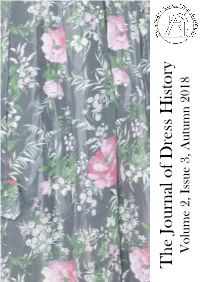
Volume 2, Issue 3, Autumn 2018
The Journal of Dress History Volume 2, Issue 3, Autumn 2018 Front Cover Image: Textile Detail of an Evening Dress, circa 1950s, Maker Unknown, Middlesex University Fashion Collection, London, England, F2021AB. The Middlesex University Fashion Collection comprises approximately 450 garments for women and men, textiles, accessories including hats, shoes, gloves, and more, plus hundreds of haberdashery items including buttons and trimmings, from the nineteenth century to the present day. Browse the Middlesex University Fashion Collection at https://tinyurl.com/middlesex-fashion. The Journal of Dress History Volume 2, Issue 3, Autumn 2018 Editor–in–Chief Jennifer Daley Editor Scott Hughes Myerly Proofreader Georgina Chappell Published by The Association of Dress Historians journal@dresshistorians.org www.dresshistorians.org The Journal of Dress History Volume 2, Issue 3, Autumn 2018 journal@dresshistorians.org www.dresshistorians.org Copyright © 2018 The Association of Dress Historians ISSN 2515–0995 Online Computer Library Centre (OCLC) accession #988749854 The Journal of Dress History is the academic publication of The Association of Dress Historians through which scholars can articulate original research in a constructive, interdisciplinary, and peer reviewed environment. The Association of Dress Historians supports and promotes the advancement of public knowledge and education in the history of dress and textiles. The Association of Dress Historians (ADH) is Registered Charity #1014876 of The Charity Commission for England and Wales. The Journal of Dress History is copyrighted by the publisher, The Association of Dress Historians, while each published author within the journal holds the copyright to their individual article. The Journal of Dress History is circulated solely for educational purposes, completely free of charge, and not for sale or profit. -

Paul Iribe (1883–1935) Was Born in Angoulême, France
4/11/2019 Bloomsbury Fashion Central - BLOOMSBURY~ Sign In: University of North Texas Personal FASHION CENTRAL ~ No Account? Sign Up About Browse Timelines Store Search Databases Advanced search --------The Berg Companion to Fashion eBook Valerie Steele (ed) Berg Fashion Library IRIBE, PAUL Michelle Tolini Finamore Pages: 429–430 Paul Iribe (1883–1935) was born in Angoulême, France. He started his career in illustration and design as a newspaper typographer and magazine illustrator at numerous Parisian journals and daily papers, including Le temps and Le rire. In 1906 Iribe collaborated with a number of avantgarde artists to create the satirical journal Le témoin, and his illustrations in this journal attracted the attention of the fashion designer Paul Poiret. Poiret commissioned Iribe to illustrate his first major dress collection in a 1908 portfolio entitled Les robes de Paul Poiret racontées par Paul Iribe . This limited edition publication (250 copies) was innovative in its use of vivid fauvist colors and the simplified lines and flattened planes of Japanese prints. To create the plates, Iribe utilized a hand coloring process called pochoir, in which bronze or zinc stencils are used to build up layers of color gradually. This publication, and others that followed, anticipated a revival of the fashion plate in a modernist style to reflect a newer, more streamlined fashionable silhouette. In 1911 the couturier Jeanne Paquin also hired Iribe , along with the illustrators Georges Lepape and Georges Barbier, to create a similar portfolio of her designs, entitled L’Eventail et la fourrure chez Paquin. Throughout the 1910s Iribe became further involved in fashion and added design for theater, interiors, and jewelry to his repertoire. -

Issue: Fashion Industry Fashion Industry
Issue: Fashion Industry Fashion Industry By: Vickie Elmer Pub. Date: January 16, 2017 Access Date: October 1, 2021 DOI: 10.1177/237455680302.n1 Source URL: http://businessresearcher.sagepub.com/sbr-1863-101702-2766972/20170116/fashion-industry ©2021 SAGE Publishing, Inc. All Rights Reserved. ©2021 SAGE Publishing, Inc. All Rights Reserved. Can it adapt to changing times? Executive Summary The global fashion business is going through a period of intense change and competition, with disruption coming in many colors: global online marketplaces, slower growth, more startups and consumers who now seem bored by what once excited them. Many U.S. shoppers have grown tired of buying Prada and Chanel suits and prefer to spend their money on experiences rather than clothes. Questions about fashion companies’ labor and environmental practices are leading to new policies, although some critics remain unconvinced. Fashion still relies on creativity, innovation and consumer attention, some of which comes from technology and some from celebrities. Here are some key takeaways: High-fashion brands must now compete with “fast fashion,” apparel sold on eBay and vintage sites. Risk factors for fashion companies include China’s growth slowdown, reduced global trade, Brexit, terrorist attacks and erratic commodity prices. Plus-size women are a growing segment of the market, yet critics say designers are ignoring them. Overview José Neves launched Farfetch during the global economic crisis of 2008, drawing more on his background in IT and software than a love of fashion. His idea: Allow small designers and fashion shops to sell their wares worldwide on a single online marketplace. The site will “fetch” fashion from far-off places. -

Retail Product Merchandising: Retail Buying-Selling Cycle
Retail Product Merchandising: Retail Buying-Selling Cycle SECTION 2: Establishing the Retail Merchandise Mix Part 1: The Basics of the Retail Merchandise Mix Part 1: 1-2 Industry Zones in the Apparel Industry Fashion products, especially in the women’s wear industry, are categorized by the industry zone in which they are produced and marketed. Industry has designated these zones as a) Haute Couture or couture, b) designer, c) bridge, d) contemporary, e) better, f) moderate, g) popular price/budget/mass, and g) discount/off price. Often the industry emphasizes the wholesale costs or price points of the merchandise in order to define the zone. However, price alone is not the major factor impacting the placement of the merchandise in the zone. Major factors impacting the zone classifications include the following criteria: . fashion level of the design (i.e., degree of design innovation inherent or intrinsic to the merchandise) . type and name of designer creating and developing the design concept . wholesale cost and retail price of product . types and quality of fibers and fineness of fabrications, trims, and findings . standards of construction quality or workmanship quality. In summary, the classification of a zone is based on the type of designer creating the product, design level of the product, type and quality of fabrications, standards of the workmanship, and the price range of the merchandise. Therefore, depending upon the lifestyle of the target consumer, the fashion taste level of that consumer (i.e., position of product on the fashion curve), and the current fashion trend direction in the market, the retailer, when procuring the merchandise mix, selects the industry zone(s) which offer(s) the product characteristics most desired by the target consumer. -

Model Commodities: Gender and Value in Contemporary Couture
Model Commodities: Gender and Value in Contemporary Couture By Xiaoyu Elena Wang A dissertation submitted in partial satisfaction of the requirements for the degree of Doctor of Philosophy in Political Science in the Graduate Division of the University of California, Berkeley Committee in charge: Professor Wendy L. Brown, Chair Professor Shannon C. Stimson Professor Ramona Naddaff Professor Julia Q. Bryan-Wilson Spring 2015 Abstract Model Commodities: Gender and Value in Contemporary Couture by Xiaoyu Elena Wang Doctor of Philosophy in Political Science University of California, Berkeley Professor Wendy L. Brown, Chair Every January and June, the most exclusive and influential sector of the global apparel industry stages a series of runway shows in the high fashion, or, couture capitals of New York, Milan, London and Paris. This dissertation explores the production of material goods and cultural ideals in contemporary couture, drawing on scholarly and anecdotal accounts of the business of couture clothes as well as the business of couture models to understand the disquieting success of marketing luxury goods through bodies that appear to signify both extreme wealth and extreme privation. This dissertation argues that the contemporary couture industry idealizes a mode of violence that is unique in couture’s history. The industry’s shift of emphasis toward the mass market in the late 20th-century entailed divestments in the integrity of garment production and modeling employment. Contemporary couture clothes and models are promoted as high-value objects, belying however a material impoverishment that can be read from the models’ physiques and miens. 1 Table of Contents I. The enigma of couture…………………………………………………………………………..1 1. -

© 2018 Weronika Gaudyn ALL RIGHTS RESERVED
© 2018 Weronika Gaudyn ALL RIGHTS RESERVED STUDY OF HAUTE COUTURE FASHION SHOWS AS PERFORMANCE ART A Thesis Presented to The Graduate Faculty of The University of Akron In Partial Fulfillment of the Requirements for the Degree Master of Arts Weronika Gaudyn December 2018 STUDY OF HAUTE COUTURE FASHION SHOWS AS PERFORMANCE ART Weronika Gaudyn Thesis Approved: Accepted: _________________________________ _________________________________ Advisor School Director Mr. James Slowiak Mr. Neil Sapienza _________________________________ _________________________________ Committee Member Dean of the College Ms. Lisa Lazar Linda Subich, Ph.D. _________________________________ _________________________________ Committee Member Dean of the Graduate School Sandra Stansbery-Buckland, Ph.D. Chand Midha, Ph.D. _________________________________ Date ii ABSTRACT Due to a change in purpose and structure of haute couture shows in the 1970s, the vision of couture shows as performance art was born. Through investigation of the elements of performance art, as well as its functions and characteristics, this study intends to determine how modern haute couture fashion shows relate to performance art and can operate under the definition of performance art. iii ACKNOWLEDGEMENTS I would like to thank my committee––James Slowiak, Sandra Stansbery Buckland and Lisa Lazar for their time during the completion of this thesis. It is something that could not have been accomplished without your help. A special thank you to my loving family and friends for their constant support -

The Mini Skirt Danielle Hueston New York City College of Technology Textiles
The Mini Skirt Danielle Hueston New York City College of Technology Textiles When I was six my mother and I took one of our weekly day shopping trips to the mall. On our way back we stopped at this local thrift store. This being one of the first times I had ever experienced one, everything seemed so different and weird, in a good way. I wasn’t used to there only being one of everything, or one store that sold clothes, books, toys, home decor and shoes.Walking down the ‘bottoms aisle’ is where I first came across it. It was black and flowy, probably a cotton material, with a black elastic band around the waist. I wanted it, I needed it. It was the perfect mini skirt. It reminded me of the one I saw Regina George wear in the Hallway Scene in the movie ‘Mean Girls’ a few months prior and had to get it, even though it was a “little” big. There was only one, I was going to make it work. When Monday came I wasted no time showing off my new skirt at school. It made me feel like a whole new person. At some point of the day however my teacher had stepped out of the room to talk to another teacher, in conjunction one of my classmates playfully grabbed my pencil out of my hand, to which I decided to chase him around the room to retrieve it back. I tripped and my skirt fell right to my ankles, in front of the entire class. -
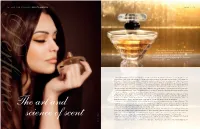
The Creation of a Perfume Is Both a Science and an Art, and Choosing a Scent Is Deeply Personal
Perfume 80 I south africa deLuxe I bEAUTY & hEALTH perfume I 81 The creation of a perfume is both a science and an art, and choosing a scent is deeply personal. Aroma is evocative. In French, the word for “to smell” is sentir. It’s hardly surprising that the same word also means “to feel”. I always knew my mother was in the room by the scent of Elizabeth Arden’s Red Door or, later, Estée Lauder’s Beautiful. I spent many childhood afternoons playing dress-up in my grandmother’s scarves and gloves, which smelled faintly of 4711 Original Eau de Cologne by Maurer & Wirtz. I would fill her empty bottles with water and line them up proudly on my windowsill, feeling very sophisticated. Yet I never really used to think about perfume until I read Molly Birnbaum’s biography, ‘Season to Taste: How I lost my sense of smell and found my way’. Suddenly, a door was opened and I began to appreciate the history, art and allure of perfume. Birnbaum was about to begin studying towards becoming a chef when she was involved in a horrific accident and lost her sense of smell due to head injury. Her book chronicles her journey towards recovery as she begins to understand the critical role that smell – a generally underrated sense – plays. She embarked on a visit to Grasse, France, considered the historical centre of the modern fragrance industry and the setting for Patrick Süskind’s novel, ‘Perfume’. Grasse originally produced leather goods during the Middle Ages. The smell of its numerous tanneries permeated the air. -

Jeanne Lanvin
JEANNE LANVIN A 01long history of success: the If one glances behind the imposing façade of Rue du Faubourg Saint-Honoré, 22, in Paris, Lanvin fashion house is the oldest one will see a world full of history. For this is the Lanvin headquarters, the oldest couture in the world. The first creations house in the world. Founded by Jeanne Lanvin, who at the outset of her career could not by the later haute couture salon even afford to buy fabric for her creations. were simple clothes for children. Lanvin’s first contact with fashion came early in life—admittedly less out of creative passion than economic hardship. In order to help support her six younger siblings, Lanvin, then only fifteen, took a job with a tailor in the suburbs of Paris. In 1890, at twenty-seven, Lanvin took the daring leap into independence, though on a modest scale. Not far from the splendid head office of today, she rented two rooms in which, for lack of fabric, she at first made only hats. Since the severe children’s fashions of the turn of the century did not appeal to her, she tailored the clothing for her young daughter Marguerite herself: tunic dresses designed for easy movement (without tight corsets or starched collars) in colorful patterned cotton fabrics, generally adorned with elaborate smocking. The gentle Marguerite, later known as Marie-Blanche, was to become the Salon Lanvin’s first model. When walking JEANNE LANVIN on the street, other mothers asked Lanvin and her daughter from where the colorful loose dresses came. -

Costume Crafts an Exploration Through Production Experience Michelle L
Louisiana State University LSU Digital Commons LSU Master's Theses Graduate School 2010 Costume crafts an exploration through production experience Michelle L. Hathaway Louisiana State University and Agricultural and Mechanical College, mlch1@msn.com Follow this and additional works at: https://digitalcommons.lsu.edu/gradschool_theses Part of the Theatre and Performance Studies Commons Recommended Citation Hathaway, Michelle L., "Costume crafts na exploration through production experience" (2010). LSU Master's Theses. 2152. https://digitalcommons.lsu.edu/gradschool_theses/2152 This Thesis is brought to you for free and open access by the Graduate School at LSU Digital Commons. It has been accepted for inclusion in LSU Master's Theses by an authorized graduate school editor of LSU Digital Commons. For more information, please contact gradetd@lsu.edu. COSTUME CRAFTS AN EXPLORATION THROUGH PRODUCTION EXPERIENCE A Thesis Submitted to the Graduate Faculty of the Louisiana State University and Agricultural and Mechanical College in partial fulfillment of the requirements for the degree of Master of Fine Arts in The Department of Theatre by Michelle L. Hathaway B.A., University of Colorado at Denver, 1993 May 2010 Acknowledgments First, I would like to thank my family for their constant unfailing support. In particular Brinna and Audrey, girls you inspire me to greatness everyday. Great thanks to my sister Audrey Hathaway-Czapp for her personal sacrifice in both time and energy to not only help me get through the MFA program but also for her fabulous photographic skills, which are included in this thesis. I offer a huge thank you to my Mom for her support and love.