A New Tube-Nosed Fruit Bat from New Guinea, Nyctimene Wrightae Sp
Total Page:16
File Type:pdf, Size:1020Kb
Load more
Recommended publications
-

Volume 41, 2000
BAT RESEARCH NEWS Volume 41 : No. 1 Spring 2000 I I BAT RESEARCH NEWS Volume 41: Numbers 1–4 2000 Original Issues Compiled by Dr. G. Roy Horst, Publisher and Managing Editor of Bat Research News, 2000. Copyright 2011 Bat Research News. All rights reserved. This material is protected by copyright and may not be reproduced, transmitted, posted on a Web site or a listserve, or disseminated in any form or by any means without prior written permission from the Publisher, Dr. Margaret A. Griffiths. The material is for individual use only. Bat Research News is ISSN # 0005-6227. BAT RESEARCH NEWS Volume41 Spring 2000 Numberl Contents Resolution on Rabies Exposure Merlin Tuttle and Thomas Griffiths o o o o eo o o o • o o o o o o o o o o o o o o o o 0 o o o o o o o o o o o 0 o o o 1 E - Mail Directory - 2000 Compiled by Roy Horst •••• 0 ...................... 0 ••••••••••••••••••••••• 2 ,t:.'. Recent Literature Compiled by :Margaret Griffiths . : ....••... •"r''• ..., .... >.•••••• , ••••• • ••< ...... 19 ,.!,..j,..,' ""o: ,II ,' f 'lf.,·,,- .,'b'l: ,~··.,., lfl!t • 0'( Titles Presented at the 7th Bat Researc:b Confei'ebee~;Moscow :i'\prill4-16~ '1999,., ..,, ~ .• , ' ' • I"',.., .. ' ""!' ,. Compiled by Roy Horst .. : .......... ~ ... ~· ....... : :· ,"'·~ .• ~:• .... ; •. ,·~ •.•, .. , ........ 22 ·.t.'t, J .,•• ~~ Letters to the Editor 26 I ••• 0 ••••• 0 •••••••••••• 0 ••••••• 0. 0. 0 0 ••••••• 0 •• 0. 0 •••••••• 0 ••••••••• 30 News . " Future Meetings, Conferences and Symposium ..................... ~ ..,•'.: .. ,. ·..; .... 31 Front Cover The illustration of Rhinolophus ferrumequinum on the front cover of this issue is by Philippe Penicaud . from his very handsome series of drawings representing the bats of France. -
A Global Overview of Protected Areas on the World Heritage List of Particular Importance for Biodiversity
A GLOBAL OVERVIEW OF PROTECTED AREAS ON THE WORLD HERITAGE LIST OF PARTICULAR IMPORTANCE FOR BIODIVERSITY A contribution to the Global Theme Study of World Heritage Natural Sites Text and Tables compiled by Gemma Smith and Janina Jakubowska Maps compiled by Ian May UNEP World Conservation Monitoring Centre Cambridge, UK November 2000 Disclaimer: The contents of this report and associated maps do not necessarily reflect the views or policies of UNEP-WCMC or contributory organisations. The designations employed and the presentations do not imply the expressions of any opinion whatsoever on the part of UNEP-WCMC or contributory organisations concerning the legal status of any country, territory, city or area or its authority, or concerning the delimitation of its frontiers or boundaries. TABLE OF CONTENTS EXECUTIVE SUMMARY INTRODUCTION 1.0 OVERVIEW......................................................................................................................................................1 2.0 ISSUES TO CONSIDER....................................................................................................................................1 3.0 WHAT IS BIODIVERSITY?..............................................................................................................................2 4.0 ASSESSMENT METHODOLOGY......................................................................................................................3 5.0 CURRENT WORLD HERITAGE SITES............................................................................................................4 -

Chiroptera: Pteropodidae)
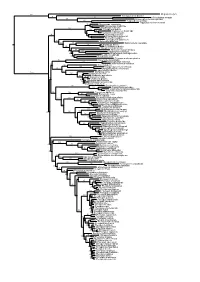
Chapter 6 Phylogenetic Relationships of Harpyionycterine Megabats (Chiroptera: Pteropodidae) NORBERTO P. GIANNINI1,2, FRANCISCA CUNHA ALMEIDA1,3, AND NANCY B. SIMMONS1 ABSTRACT After almost 70 years of stability following publication of Andersen’s (1912) monograph on the group, the systematics of megachiropteran bats (Chiroptera: Pteropodidae) was thrown into flux with the advent of molecular phylogenetics in the 1980s—a state where it has remained ever since. One particularly problematic group has been the Austromalayan Harpyionycterinae, currently thought to include Dobsonia and Harpyionycteris, and probably also Aproteles.Inthis contribution we revisit the systematics of harpyionycterines. We examine historical hypotheses of relationships including the suggestion by O. Thomas (1896) that the rousettine Boneia bidens may be related to Harpyionycteris, and report the results of a series of phylogenetic analyses based on new as well as previously published sequence data from the genes RAG1, RAG2, vWF, c-mos, cytb, 12S, tVal, 16S,andND2. Despite a striking lack of morphological synapomorphies, results of our combined analyses indicate that Boneia groups with Aproteles, Dobsonia, and Harpyionycteris in a well-supported, expanded Harpyionycterinae. While monophyly of this group is well supported, topological changes within this clade across analyses of different data partitions indicate conflicting phylogenetic signals in the mitochondrial partition. The position of the harpyionycterine clade within the megachiropteran tree remains somewhat uncertain. Nevertheless, biogeographic patterns (vicariance-dispersal events) within Harpyionycterinae appear clear and can be directly linked to major biogeographic boundaries of the Austromalayan region. The new phylogeny of Harpionycterinae also provides a new framework for interpreting aspects of dental evolution in pteropodids (e.g., reduction in the incisor dentition) and allows prediction of roosting habits for Harpyionycteris, whose habits are unknown. -
Figs1 ML Tree.Pdf
100 Megaderma lyra Rhinopoma hardwickei 71 100 Rhinolophus creaghi 100 Rhinolophus ferrumequinum 100 Hipposideros armiger Hipposideros commersoni 99 Megaerops ecaudatus 85 Megaerops niphanae 100 Megaerops kusnotoi 100 Cynopterus sphinx 98 Cynopterus horsfieldii 69 Cynopterus brachyotis 94 50 Ptenochirus minor 86 Ptenochirus wetmorei Ptenochirus jagori Dyacopterus spadiceus 99 Sphaerias blanfordi 99 97 Balionycteris maculata 100 Aethalops alecto 99 Aethalops aequalis Thoopterus nigrescens 97 Alionycteris paucidentata 33 99 Haplonycteris fischeri 29 Otopteropus cartilagonodus Latidens salimalii 43 88 Penthetor lucasi Chironax melanocephalus 90 Syconycteris australis 100 Macroglossus minimus 34 Macroglossus sobrinus 92 Boneia bidens 100 Harpyionycteris whiteheadi 69 Harpyionycteris celebensis Aproteles bulmerae 51 Dobsonia minor 100 100 80 Dobsonia inermis Dobsonia praedatrix 99 96 14 Dobsonia viridis Dobsonia peronii 47 Dobsonia pannietensis 56 Dobsonia moluccensis 29 Dobsonia anderseni 100 Scotonycteris zenkeri 100 Casinycteris ophiodon 87 Casinycteris campomaanensis Casinycteris argynnis 99 100 Eonycteris spelaea 100 Eonycteris major Eonycteris robusta 100 100 Rousettus amplexicaudatus 94 Rousettus spinalatus 99 Rousettus leschenaultii 100 Rousettus aegyptiacus 77 Rousettus madagascariensis 87 Rousettus obliviosus Stenonycteris lanosus 100 Megaloglossus woermanni 100 91 Megaloglossus azagnyi 22 Myonycteris angolensis 100 87 Myonycteris torquata 61 Myonycteris brachycephala 33 41 Myonycteris leptodon Myonycteris relicta 68 Plerotes anchietae -
Bat Count 2003
BAT COUNT 2003 Working to promote the long term, sustainable conservation of globally threatened flying foxes in the Philippines, by developing baseline population information, increasing public awareness, and training students and protected area managers in field monitoring techniques. 1 A Terminal Report Submitted by Tammy Mildenstein1, Apolinario B. Cariño2, and Samuel Stier1 1Fish and Wildlife Biology, University of Montana, USA 2Silliman University and Mt. Talinis – Twin Lakes Federation of People’s Organizations, Diputado Extension, Sibulan, Negros Oriental, Philippines Photo by: Juan Pablo Moreiras 2 EXECUTIVE SUMMARY Large flying foxes in insular Southeast Asia are the most threatened of the Old World fruit bats due to deforestation, unregulated hunting, and little conservation commitment from local governments. Despite the fact they are globally endangered and play essential ecological roles in forest regeneration as seed dispersers and pollinators, there have been only a few studies on these bats that provide information useful to their conservation management. Our project aims to promote the conservation of large flying foxes in the Philippines by providing protected area managers with the training and the baseline information necessary to design and implement a long-term management plan for flying foxes. We focused our efforts on the globally endangered Philippine endemics, Acerodon jubatus and Acerodon leucotis, and the bats that commonly roost with them, Pteropus hypomelanus, P. vampyrus lanensis, and P. pumilus which are thought to be declining in the Philippines. Local participation is an integral part of our project. We conducted the first national training workshop on flying fox population counts and conservation at the Subic Bay area. -

Governing New Guinea New
Governing New Guinea New Guinea Governing An oral history of Papuan administrators, 1950-1990 Governing For the first time, indigenous Papuan administrators share their experiences in governing their country with an inter- national public. They were the brokers of development. After graduating from the School for Indigenous Administrators New Guinea (OSIBA) they served in the Dutch administration until 1962. The period 1962-1969 stands out as turbulent and dangerous, Leontine Visser (Ed) and has in many cases curbed professional careers. The politi- cal and administrative transformations under the Indonesian governance of Irian Jaya/Papua are then recounted, as they remained in active service until retirement in the early 1990s. The book brings together 17 oral histories of the everyday life of Papuan civil servants, including their relationship with superiors and colleagues, the murder of a Dutch administrator, how they translated ‘development’ to the Papuan people, the organisation of the first democratic institutions, and the actual political and economic conditions leading up to the so-called Act of Free Choice. Finally, they share their experiences in the UNTEA and Indonesian government organisation. Leontine Visser is Professor of Development Anthropology at Wageningen University. Her research focuses on governance and natural resources management in eastern Indonesia. Leontine Visser (Ed.) ISBN 978-90-6718-393-2 9 789067 183932 GOVERNING NEW GUINEA KONINKLIJK INSTITUUT VOOR TAAL-, LAND- EN VOLKENKUNDE GOVERNING NEW GUINEA An oral history of Papuan administrators, 1950-1990 EDITED BY LEONTINE VISSER KITLV Press Leiden 2012 Published by: KITLV Press Koninklijk Instituut voor Taal-, Land- en Volkenkunde (Royal Netherlands Institute of Southeast Asian and Caribbean Studies) P.O. -

West Papua – Birds-Of-Paradise and Endemics of the Arfaks and Waigeo
INDONESIA: WEST PAPUA – BIRDS-OF-PARADISE AND ENDEMICS OF THE ARFAKS AND WAIGEO 03 – 14 AUGUST 2021 03 – 14 AUGUST 2022 03 – 14 AUGUST 2023 Wilson’s Bird-of-paradise is often considered one of the best-looking birds in the world! www.birdingecotours.com info@birdingecotours.com 2 | ITINERARY Indonesia: West Papua – Arfak and Waigeo New Guinea is a geographic rather than political term that refers to the main island in the region. The western half of the island of New Guinea comprises the Indonesian provinces of West Papua (Papua Barat) and Papua, collectively once called West Irian or Irian Jaya; the eastern half of the main island of New Guinea comprises the country of Papua New Guinea. We will be based in West Papua for this exhilarating, small-group birding adventure. Aside from the large landmass of New Guinea, the New Guinea region includes numerous small islands (some part of Indonesia and others part of Papua New Guinea), and we will visit one of these areas: Waigeo, part of the Raja Ampat Archipelago in West Papua (also known as the Northwestern Islands). Approximately 680 bird species have been recorded from West Papua, from slightly more than 700 for the whole New Guinea region. Some 550 species are considered breeding residents, with 279 New Guinea endemics (found in Indonesia and/or Papua New Guinea) and at least an additional 42 endemics found only in West Papua. There are also over 115 Palearctic and Australian migrant species and a range of seabirds which spend some of their time in West Papua. -
Index of Handbook of the Mammals of the World. Vol. 9. Bats
Index of Handbook of the Mammals of the World. Vol. 9. Bats A agnella, Kerivoula 901 Anchieta’s Bat 814 aquilus, Glischropus 763 Aba Leaf-nosed Bat 247 aladdin, Pipistrellus pipistrellus 771 Anchieta’s Broad-faced Fruit Bat 94 aquilus, Platyrrhinus 567 Aba Roundleaf Bat 247 alascensis, Myotis lucifugus 927 Anchieta’s Pipistrelle 814 Arabian Barbastelle 861 abae, Hipposideros 247 alaschanicus, Hypsugo 810 anchietae, Plerotes 94 Arabian Horseshoe Bat 296 abae, Rhinolophus fumigatus 290 Alashanian Pipistrelle 810 ancricola, Myotis 957 Arabian Mouse-tailed Bat 164, 170, 176 abbotti, Myotis hasseltii 970 alba, Ectophylla 466, 480, 569 Andaman Horseshoe Bat 314 Arabian Pipistrelle 810 abditum, Megaderma spasma 191 albatus, Myopterus daubentonii 663 Andaman Intermediate Horseshoe Arabian Trident Bat 229 Abo Bat 725, 832 Alberico’s Broad-nosed Bat 565 Bat 321 Arabian Trident Leaf-nosed Bat 229 Abo Butterfly Bat 725, 832 albericoi, Platyrrhinus 565 andamanensis, Rhinolophus 321 arabica, Asellia 229 abramus, Pipistrellus 777 albescens, Myotis 940 Andean Fruit Bat 547 arabicus, Hypsugo 810 abrasus, Cynomops 604, 640 albicollis, Megaerops 64 Andersen’s Bare-backed Fruit Bat 109 arabicus, Rousettus aegyptiacus 87 Abruzzi’s Wrinkle-lipped Bat 645 albipinnis, Taphozous longimanus 353 Andersen’s Flying Fox 158 arabium, Rhinopoma cystops 176 Abyssinian Horseshoe Bat 290 albiventer, Nyctimene 36, 118 Andersen’s Fruit-eating Bat 578 Arafura Large-footed Bat 969 Acerodon albiventris, Noctilio 405, 411 Andersen’s Leaf-nosed Bat 254 Arata Yellow-shouldered Bat 543 Sulawesi 134 albofuscus, Scotoecus 762 Andersen’s Little Fruit-eating Bat 578 Arata-Thomas Yellow-shouldered Talaud 134 alboguttata, Glauconycteris 833 Andersen’s Naked-backed Fruit Bat 109 Bat 543 Acerodon 134 albus, Diclidurus 339, 367 Andersen’s Roundleaf Bat 254 aratathomasi, Sturnira 543 Acerodon mackloti (see A. -

West Papua: Arfak and Waigeo Birding Expedition
WEST PAPUA: ARFAK AND WAIGEO BIRDING EXPEDITION 16 – 27 NOVEMBER 2018 Lesser Bird-of-paradise (photo Matt Prophet) is one of our targets on this trip. www.birdingecotours.com info@birdingecotours.com 2 | ITINERARY West Papua: Arfak and Waigeo Birding Expedition 2017 West Papua has 322 of the endemics of the island of New Guinea (94 %), compared to Papua New Guinea's 294 (86 %). West Papua is also considered the safer alternative to PNG for seeing birds-of-paradise. Our Birding Tour West Papua will begin in the town of Manokwari, situated on the north- eastern tip of New Guinea's Bird's Head, or “Vogelkop”, Peninsula. From here we will travel straight through for five nights in the nearby Arfak Mountains, where we will search for a fabulous series of birds, renowned in birders’ circles as the “Vogelkop endemics”. The second leg of our birding adventure takes us to Sorong, on the opposite side of the Bird's Head Peninsula, for a relaxed afternoon's birding outside the town. Then we will spend three days in the spectacular Raja Ampat Islands off Sarong on Waigeo, one of this archipelago’s four major islands. On our return journey to Sorong we will stop for a few hours on a tiny atoll in Dampier Strait for birding, searching for regional island specialties. This tour can be combined with our Birding Tour Indonesia: Sulawesi and Halmahera 2018 to explore Indonesia’s avian fauna in both the Indomalayan and Australasian ecozones. Please note that the detailed itinerary below cannot be guaranteed as it is only a rough guide and can be changed (usually slightly) due to factors such as availability of accommodation, updated information on the state of accommodation, roads or birding sites, and the discretion of the guides and other factors. -

Investigating the Role of Bats in Emerging Zoonoses
12 ISSN 1810-1119 FAO ANIMAL PRODUCTION AND HEALTH manual INVESTIGATING THE ROLE OF BATS IN EMERGING ZOONOSES Balancing ecology, conservation and public health interest Cover photographs: Left: © Jon Epstein. EcoHealth Alliance Center: © Jon Epstein. EcoHealth Alliance Right: © Samuel Castro. Bureau of Animal Industry Philippines 12 FAO ANIMAL PRODUCTION AND HEALTH manual INVESTIGATING THE ROLE OF BATS IN EMERGING ZOONOSES Balancing ecology, conservation and public health interest Edited by Scott H. Newman, Hume Field, Jon Epstein and Carol de Jong FOOD AND AGRICULTURE ORGANIZATION OF THE UNITED NATIONS Rome, 2011 Recommended Citation Food and Agriculture Organisation of the United Nations. 2011. Investigating the role of bats in emerging zoonoses: Balancing ecology, conservation and public health interests. Edited by S.H. Newman, H.E. Field, C.E. de Jong and J.H. Epstein. FAO Animal Production and Health Manual No. 12. Rome. The designations employed and the presentation of material in this information product do not imply the expression of any opinion whatsoever on the part of the Food and Agriculture Organization of the United Nations (FAO) concerning the legal or development status of any country, territory, city or area or of its authorities, or concerning the delimitation of its frontiers or boundaries. The mention of specific companies or products of manufacturers, whether or not these have been patented, does not imply that these have been endorsed or recommended by FAO in preference to others of a similar nature that are not mentioned. The views expressed in this information product are those of the author(s) and do not necessarily reflect the views of FAO. -

Flying Foxes): Preliminary Chemical Comparisons Among Species Jamie Wagner SIT Study Abroad
View metadata, citation and similar papers at core.ac.uk brought to you by CORE provided by World Learning SIT Graduate Institute/SIT Study Abroad SIT Digital Collections Independent Study Project (ISP) Collection SIT Study Abroad Fall 2008 Glandular Secretions of Male Pteropus (Flying Foxes): Preliminary Chemical Comparisons Among Species Jamie Wagner SIT Study Abroad Follow this and additional works at: https://digitalcollections.sit.edu/isp_collection Part of the Animal Sciences Commons, and the Biology Commons Recommended Citation Wagner, Jamie, "Glandular Secretions of Male Pteropus (Flying Foxes): Preliminary Chemical Comparisons Among Species" (2008). Independent Study Project (ISP) Collection. 559. https://digitalcollections.sit.edu/isp_collection/559 This Unpublished Paper is brought to you for free and open access by the SIT Study Abroad at SIT Digital Collections. It has been accepted for inclusion in Independent Study Project (ISP) Collection by an authorized administrator of SIT Digital Collections. For more information, please contact digitalcollections@sit.edu. Glandular secretions of male Pteropus (flying foxes): Preliminary chemical comparisons among species By Jamie Wagner Academic Director: Tony Cummings Project Advisor: Dr. Hugh Spencer Oberlin College Biology and Neuroscience Cape Tribulation, Australia Submitted in partial fulfillment of the requirements for Australia: Natural and Cultural Ecology, SIT Study Abroad, Fall 2008 1 1. Abstract Chemosignaling – passing information by means of chemical compounds that can be detected by members of the same species – is a very important form of communication for most mammals. Flying fox males have odiferous marking secretions on their neck-ruffs that include a combination of secretion from the neck gland and from the urogenital tract; males use this substance to establish territory, especially during the mating season. -

TR Westpapuasd August 2019
West Papua: The Best Birds on Earth A Tropical Birding Set Departure Main Tour: August 3-21, 2019 Biak Extension: August 21-24, 2019 Guides: Ken Behrens & Charley Hesse Photos by Ken Behrens unless labelled otherwise TOUR SUMMARY A quick look through a field guide should suffice to convince any travelling birder that New Guinea does indeed have “the best birds on Earth”. There are dozens of spectacular birds-of- paradise, most of which have an absurdly cool display, and fabulous arrays of pigeons, doves, parrots, and kingfishers. The gaudy marquee birds are supported by several great island-endemic and regional endemic families like owlet-nightjars, bowerbirds, Australasian warblers and robins, berrypeckers, jewel-babblers, bellbirds, Ifrita, and Ploughbill. There are dozens and dozens of birds on our list from this tour that could EASILY be picked as the top bird of a tour anywhere else in the world. The quality of birds on this island is that high. The “top ten” sightings below give a taste of the wonders of Papuan birding, but neglect dozens of other world-class spectacular birds that we saw on this tour. West Papua: The Best Birds on Earth August 3-24, 2019 The island of New Guinea has long been a tricky place to travel. Although Papua New Guinea enjoyed a brief heyday as a birding destination, its lack of infrastructure and security issues have seen it dive in popularity. At the same time, West Papua, which is part of Indonesia, has opened up to visitors, and become the clear choice for most people who want to visit the island.