Report to October 2009 Freshwater Sawfish (Pristis Microdon)
Total Page:16
File Type:pdf, Size:1020Kb
Load more
Recommended publications
-
Life History of the Critically Endangered Largetooth Sawfish: a Compilation of Data for Population Assessment and Demographic Modelling
Vol. 44: 79–88, 2021 ENDANGERED SPECIES RESEARCH Published January 28 https://doi.org/10.3354/esr01090 Endang Species Res OPEN ACCESS Life history of the Critically Endangered largetooth sawfish: a compilation of data for population assessment and demographic modelling P. M. Kyne1,*, M. Oetinger2, M. I. Grant3, P. Feutry4 1Research Institute for the Environment and Livelihoods, Charles Darwin University, Darwin, Northern Territory 0909, Australia 2Argus-Mariner Consulting Scientists, Owensboro, Kentucky 42301, USA 3Centre for Sustainable Tropical Fisheries and Aquaculture and College of Science and Engineering, James Cook University, Townsville, Queensland 4811, Australia 4CSIRO Oceans and Atmosphere, Hobart, Tasmania 7000, Australia ABSTRACT: The largetooth sawfish Pristis pristis is a Critically Endangered, once widespread shark-like ray. The species is now extinct or severely depleted in many former parts of its range and is protected in some other range states where populations persist. The likelihood of collecting substantial new biological information is now low. Here, we review all available life history infor- mation on size, age and growth, reproductive biology, and demography as a resource for popula- tion assessment and demographic modelling. We also revisit a subset of historical data from the 1970s to examine the maternal size−litter size relationship. All available information on life history is derived from the Indo-West Pacific (i.e. northern Australia) and the Western Atlantic (i.e. Lake Nicaragua-Río San Juan system in Central America) subpopulations. P. pristis reaches a maxi- mum size of at least 705 cm total length (TL), size-at-birth is 72−90 cm TL, female size-at-maturity is reached by 300 cm TL, male size-at-maturity is 280−300 cm TL, age-at-maturity is 8−10 yr, longevity is 30−36 yr, litter size range is 1−20 (mean of 7.3 in Lake Nicaragua), and reproductive periodicity is suspected to be biennial in Lake Nicaragua (Western Atlantic) but annual in Aus- tralia (Indo-West Pacific). -
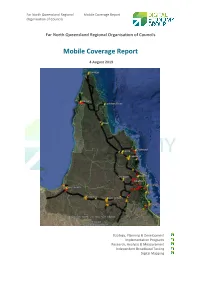
Mobile Coverage Report Organisation of Councils
Far North Queensland Regional Mobile Coverage Report Organisation of Councils Far North Queensland Regional Organisation of Councils Mobile Coverage Report 4 August 2019 Strategy, Planning & Development Implementation Programs Research, Analysis & Measurement Independent Broadband Testing Digital Mapping Far North Queensland Regional Mobile Coverage Report Organisation of Councils Document History Version Description Author Date V1.0 Mobile Coverage Report Michael Whereat 29 July 2019 V2.0 Mobile Coverage Report – Michael Whereat 4 August 2019 updated to include text results and recommendations V.2.1 Amendments to remove Palm Michael Whereat 15 August 2019 Island reference Distribution List Person Title Darlene Irvine Executive Officer, FNQROC Disclaimer: Information in this document is based on available data at the time of writing this document. Digital Economy Group Consulting Pty Ltd or its officers accept no responsibility for any loss occasioned to any person acting or refraining from acting in reliance upon any material contained in this document. Copyright © Digital Economy Group 2011-19. This document is copyright and must be used except as permitted below or under the Copyright Act 1968. You may reproduce and publish this document in whole or in part for you and your organisation’s own personal and internal compliance, educational or non-commercial purposes. You must not reproduce or publish this document for commercial gain without the prior written consent of the Digital Economy Group Consulting Pty. Ltd. Far North Queensland Regional Mobile Coverage Report Organisation of Councils Executive Summary For Far North QLD Regional Organisation of Councils (FNQROC) the challenge of growing the economy through traditional infrastructure is now being exacerbated by the need to also facilitate the delivery of digital infrastructure to meet the expectations of industry, residents, community and visitors or risk being left on the wrong side of the digital divide. -

Cape York Peninsula Parks and Reserves Visitor Guide
Parks and reserves Visitor guide Featuring Annan River (Yuku Baja-Muliku) National Park and Resources Reserve Black Mountain National Park Cape Melville National Park Endeavour River National Park Kutini-Payamu (Iron Range) National Park (CYPAL) Heathlands Resources Reserve Jardine River National Park Keatings Lagoon Conservation Park Mount Cook National Park Oyala Thumotang National Park (CYPAL) Rinyirru (Lakefield) National Park (CYPAL) Great state. Great opportunity. Cape York Peninsula parks and reserves Thursday Possession Island National Park Island Pajinka Bamaga Jardine River Resources Reserve Denham Group National Park Jardine River Eliot Creek Jardine River National Park Eliot Falls Heathlands Resources Reserve Captain Billy Landing Raine Island National Park (Scientific) Saunders Islands Legend National Park National park Sir Charles Hardy Group National Park Mapoon Resources reserve Piper Islands National Park (CYPAL) Wen Olive River loc Conservation park k River Wuthara Island National Park (CYPAL) Kutini-Payamu Mitirinchi Island National Park (CYPAL) Water Moreton (Iron Range) Telegraph Station National Park Chilli Beach Waterway Mission River Weipa (CYPAL) Ma’alpiku Island National Park (CYPAL) Napranum Sealed road Lockhart Lockhart River Unsealed road Scale 0 50 100 km Aurukun Archer River Oyala Thumotang Sandbanks National Park Roadhouse National Park (CYPAL) A r ch KULLA (McIlwraith Range) National Park (CYPAL) er River C o e KULLA (McIlwraith Range) Resources Reserve n River Claremont Isles National Park Coen Marpa -

A Life History Overview of the Largetooth Sawfish Pristis Pristis
LIFE HISTORY OVERVIEW No. 1 A Life History Overview of the Largetooth Sawfish Pristis pristis 2013 Prepared by Peter M. Kyne & Pierre Feutry NERP Marine Biodiversity Hub Project 2.4 (Supporting Management of Listed and Rare Species) Research Institute for the Environment and Livelihoods Charles Darwin University Darwin NT 0909, Australia Email: peter.kyne@cdu.edu.au Introduction The Largetooth Sawfish Pristis pristis is wide-ranging in tropical waters with distinct geographically-separated populations in the Western Atlantic, Eastern Atlantic, Eastern Pacific and Indo-West Pacific. It was until recently referred to as P. microdon (Freshwater Sawfish) in the Indo-West Pacific and P. perotteti in the Atlantic before research showed these to be synonymous with P. pristis (Faria et al. 2013). Northern Australia represents one of the last strongholds of a species not only once widespread in the Indo-West Pacific, but widespread in many tropical waters. Here, the available life history information on the Largetooth Sawfish is compiled and summarised. Much of this was published under the previous names P. microdon and P. perotteti. The species’ life history is characterised by parameters such as late age at maturity, long lifespan and low fecundity, which results in a low intrinsic rate of population increase (Simpfendorfer 2000; Moreno Iturria 2012). This life history is generally consistent with that of many large elasmobranchs (sharks and rays). For such a wide-ranging and conspicuous species, life history is poorly understood and available information is patchy. For example, the only dedicated reproductive studies were undertaken in the Lake Nicaragua-Río San Juan system in Central America (hereafter referred to as ‘Lake Nicaragua’) (Thorson 1976, 1982), and the vast majority of life history information originates from either Lake Nicaragua or northern Australia (northwest Western Australia and the Queensland Gulf of Carpentaria) (e.g. -

Surface Water Resources of Cape York Peninsula
CAPE YORK PENINSULA LAND USE STRATEGY LAND USE PROGRAM SURFACE WATER RESOURCES OF CAPE YORK PENINSULA A.M. Horn Queensland Department of Primary Industries 1995 r .am1, a DEPARTMENT OF, PRIMARY 1NDUSTRIES CYPLUS is a joint initiative of the Queensland and Commonwealth Governments CAPE YORK PENINSULA LAND USE STRATEGY (CYPLUS) Land Use Program SURFACE WATER RESOURCES OF CAPE YORK PENINSULA A.M.Horn Queensland Department of Primary Industries CYPLUS is a joint initiative of the Queensland and Commonwealth Governments Recommended citation: Horn. A. M (1995). 'Surface Water Resources of Cape York Peninsula'. (Cape York Peninsula Land Use Strategy, Office of the Co-ordinator General of Queensland, Brisbane, Department of the Environment, Sport and Territories, Canberra and Queensland Department of Primary Industries.) Note: Due to the timing of publication, reports on other CYPLUS projects may not be fully cited in the BIBLIOGRAPHY section. However, they should be able to be located by author, agency or subject. ISBN 0 7242 623 1 8 @ The State of Queensland and Commonwealth of Australia 1995. Copyright protects this publication. Except for purposes permitted by the Copyright Act 1968, - no part may be reproduced by any means without the prior written permission of the Office of the Co-ordinator General of Queensland and the Australian Government Publishing Service. Requests and inquiries concerning reproduction and rights should be addressed to: Office of the Co-ordinator General, Government of Queensland PO Box 185 BRISBANE ALBERT STREET Q 4002 The Manager, Commonwealth Information Services GPO Box 84 CANBERRA ACT 2601 CAPE YORK PENINSULA LAND USE STRATEGY STAGE I PREFACE TO PROJECT REPORTS Cape York Peninsula Land Use Strategy (CYPLUS) is an initiative to provide a basis for public participation in planning for the ecologically sustainable development of Cape York Peninsula. -

An Annotated Checklist of the Chondrichthyan Fishes Inhabiting the Northern Gulf of Mexico Part 1: Batoidea
Zootaxa 4803 (2): 281–315 ISSN 1175-5326 (print edition) https://www.mapress.com/j/zt/ Article ZOOTAXA Copyright © 2020 Magnolia Press ISSN 1175-5334 (online edition) https://doi.org/10.11646/zootaxa.4803.2.3 http://zoobank.org/urn:lsid:zoobank.org:pub:325DB7EF-94F7-4726-BC18-7B074D3CB886 An annotated checklist of the chondrichthyan fishes inhabiting the northern Gulf of Mexico Part 1: Batoidea CHRISTIAN M. JONES1,*, WILLIAM B. DRIGGERS III1,4, KRISTIN M. HANNAN2, ERIC R. HOFFMAYER1,5, LISA M. JONES1,6 & SANDRA J. RAREDON3 1National Marine Fisheries Service, Southeast Fisheries Science Center, Mississippi Laboratories, 3209 Frederic Street, Pascagoula, Mississippi, U.S.A. 2Riverside Technologies Inc., Southeast Fisheries Science Center, Mississippi Laboratories, 3209 Frederic Street, Pascagoula, Missis- sippi, U.S.A. kristin.hannan@noaa.gov; https://orcid.org/0000-0002-2687-3331 3Smithsonian Institution, Division of Fishes, Museum Support Center, 4210 Silver Hill Road, Suitland, Maryland, U.S.A. raredons@si.edu; https://orcid.org/0000-0002-8295-6000 4 william.driggers@noaa.gov; https://orcid.org/0000-0001-8577-968X 5 eric.hoffmayer@noaa.gov; https://orcid.org/0000-0001-5297-9546 6 lisa.m.jones@noaa.gov; https://orcid.org/0000-0003-2228-7156 *Corresponding author. christian.jones@noaa.gov; https://orcid.org/0000-0001-5093-1127 Abstract Herein we consolidate the information available concerning the biodiversity of batoid fishes in the northern Gulf of Mexico, including nearly 70 years of survey data collected by the National Marine Fisheries Service, Mississippi Laboratories and their predecessors. We document 41 species proposed to occur in the northern Gulf of Mexico. -
IR 519 Preliminary Analysis of Streamflow Characteristics of The
internal report 519 Preliminary analysis of streamflow characteristics of the tropical rivers region DR Moliere February 2007 (Release status - unrestricted) Preliminary analysis of streamflow characteristics of the tropical rivers region DR Moliere Hydrological and Geomorphic Processes Program Environmental Research Institute of the Supervising Scientist Supervising Scientist Division GPO Box 461, Darwin NT 0801 February 2007 Registry File SG2006/0061 (Release status – unrestricted) How to cite this report: Moliere DR 2007. Preliminary analysis of streamflow characteristics of the tropical rivers region. Internal Report 519, February, Supervising Scientist, Darwin. Unpublished paper. Location of final PDF file in SSD Explorer \Publications Work\Publications and other productions\Internal Reports (IRs)\Nos 500 to 599\IR519_TRR Hydrology (Moliere)\IR519_TRR hydrology (Moliere).pdf Contents Executive summary v Acknowledgements v Glossary vi 1 Introduction 1 1.1 Climate 2 2 Hydrology 5 2.1 Annual flow 5 2.2 Monthly flow 7 2.3 Focus catchments 11 2.3.1 Data 11 2.3.2 Data quality 18 3 Streamflow classification 19 3.1 Derivation of variables 19 3.2 Multivariate analysis 24 3.2.1 Effect of flow data quality on hydrology variables 31 3.3 Validation 33 4 Conclusions and recommendations 35 5 References 35 Appendix A – Rainfall and flow gauging stations within the focus catchments 38 Appendix B – Long-term flow stations throughout the tropical rivers region 43 Appendix C – Extension of flow record at G8140040 48 Appendix D – Annual runoff volume and annual peak discharge 52 Appendix E – Derivation of Colwell parameter values 81 iii iv Executive summary The Tropical Rivers Inventory and Assessment Project is aiming to categorise the ecological character of rivers throughout Australia’s wet-dry tropical rivers region. -

The Largetooth Sawfish, Pristis Pristis (Linnaeus, 1758), Is Not Extirpated from Peru: New Records from Tumbes
13 4 261 Mendoza et al NOTES ON GEOGRAPHIC DISTRIBUTION Check List 13 (4): 261–265 https://doi.org/10.15560/13.4.261 The Largetooth Sawfish, Pristis pristis (Linnaeus, 1758), is not extirpated from Peru: new records from Tumbes Alejandra Mendoza,1 Shaleyla Kelez,1 Wilmer Gonzales Cherres,2 Rossana Maguiño1 1 ecOceánica, Copernico 179, San Borja, Lima 41, Peru. 2 Asociacion de Pescadores Artesanales para Consumo Humano Directo de La Cruz, Caleta La Cruz, Tumbes, Peru. Corresponding author: Alejandra Mendoza, alejandra.mendoza@ecoceanica.org Abstract The Largetooth Sawfish,Pristis pristis, was for a long time considered extirpated from Peru. However, here we report the capture of 2 individuals from the north coast of Peru, indicating that this species is still extant in Peruvian waters. Both individuals were adult-sized and their encounters occurred during the austral summer, which could indicate a seasonal presence in those waters. Gillnets are still a major threat for the species as both specimens were incidentally captured with this gear. Our finding highlights the need for continuous research, awareness, and legal protection of this species. Key words Tropical Eastern Pacific; bycatch; Pristidae; northern Peru; critically endangered species. Academic editor: Arturo Angulo Sibaja | Received 15 March 2017 | Accepted 24 May 2017 | Published 4 August 2017 Citation: Mendoza A, Kelez S, Cherres WG, Maguiño R (2017) The Largetooth Sawfish, Pristis pristis (Linnaeus, 1758), is not extirpated from Peru: new records from Tumbes. Check List 13 (4): 261–265. https://doi.org/10.15560/13.4.261 Introduction For example, they can swim far up into large rivers and have been found in lakes in South America, Africa, and All extant sawfishes belong to the family Pristidae, Southeast Asia (Harrison and Dulvy 2014). -

Cape York Claims and Determinations
142°E 143°E 144°E 145°E Keirri Island Maururra Island ROUND ISLAND THURSDAY ISLAND CONSERVATION PARK ! ! Kaurareg MURALUG Aboriginal Muri Aboriginal Kaiwalagal AC Horn Land Trust Cape Land Trust Hammond Island York Mori CAPE YORK CLAIMS AND DETERMINATIONS Island POSSESSION Island CAPE YORK PENINSULA LAND TENURE EDITION 35 ISLAND Prepared by the Department of Natural Resources and Mines Townsville, Queensland, 6 June 2017 NATIONAL Ulrica Point PARK " Major Road Cape Cornwall Chandogoo Point Legend Homesteads/Roadhouse Minor Road Cliffy Point !( Population Centres SEISIA! River Boundary of CYP Region as referred !NEW MAPOON to in the CYP Heritage Act 2007 UMAGICO! ! Reef ! BAMAGA INJINOO Turtle Head Island DUNBAR Pastoral Holding Name Nature Refuge & Conservation Areas Slade Point Sharp Point Cape York Claims Cape York Determinations y Ck ck Sadd Point 11°S Ja 11°S y Classes of Land Tenure Apudthama k c Furze Point a Land Trust J JARDINE LandN ATIONALreserved- PARK Under ConservationNathe ture FREEHOLDINGincludingLEASE PURCHASELEASE SPECIAL RIVER Naaas tionaNaAct Park, Conserva l tionaor Park(Scientific) l tion theirforTena pay pricepurchaFREEHOLD these to - elects nt Jardine River RESOURCES Park. leawhichfreeho se, toconverts ldoncom pletionofpayments. RESERVE DENHAM GROUP Ussher NATIONAL PARK creaover tedAbo - N rigina ATIONAL(CYPAL) PARKland. l Land admLANDS- LEASE inisteredexcludingunderLand the Act JARDINE RIVER Point Traditionaformaareowners l (represented llybylanda trust) MiningHom esteaTenem d Lea ent ses. Vrilya Point NATIONAL PARK recognisedownersas ofland,thearea the being ma na gedaas NunderConservaNathe ain perpetuity tiona ture (CYPAL) Park tion l PERPETUincludingLEASES AL GRAZINGHOMESTEAD Act. PERPETUNON-COMPETITIVE LEASE, AL LEASE, Orford Ness N ON-COMPETITIVECONVLEASE Ongo ERTED - inglea seho ld CONSERVATIONRESOU PARK, Land RCESRESERVE Reserved- oragricultural e.g. -

Establishing Priorities for Wetland Conservation and Management in the Kimberley
ESTABLISHING PRIORITIES FOR WETLAND CONSERVATION AND MANAGEMENT IN THE KIMBERLEY Final Report WWF-Australia March 2007 © WWF-Australia. All Rights Reserved. Author: Tanya Vernes WWF-Australia Head Office GPO Box 528 Sydney, NSW, Australia 2001 Tel: +612 9281 5515 Fax: +612 9281 1060 wwf.org.au Published March 2007 by WWF-Australia. Any reproduction in full or in part of this publication must mention the title and credit the above-mentioned publisher as the copyright owner. The opinions expressed in this publication are those of the author and do not necessarily reflect the views of WWF. Cover image: Wetland in the Paruku IPA, Kimberley © Tanya Vernes World Wide Fund for Nature ABN: 57 001 594 074 Executive Summary "Establishing priorities for wetland conservation and management in the Kimberley" was funded by WWF-Australia and the Natural Heritage Trust through the Rangelands NRM Coordinating Group. The project was developed to collate existing knowledge of wetlands across the Kimberley region and generate a baseline of information on current threats, uses, cultural and biological values in conjunction with land owners and managers. This project also aimed to provide recommendations on a way forward for planning and management of wetlands in the Kimberley. This is the final project report, and includes: • A summary of the major activities completed under the contract milestones; • A summary of the major findings of the project; • Future recommendations for wetland planning and management in the Kimberley. Information regarding values and threats associated with wetlands in the Kimberley are collated and discussed for each of the 12 catchments. Engaging local people, including Aboriginal custodians, in two way information sharing and problem solving, assisted to build regional and specific information on wetlands. -

A Practical Key for the Identification of Large Fish Rostra 145-160 ©Zoologische Staatssammlung München/Verlag Friedrich Pfeil; Download
ZOBODAT - www.zobodat.at Zoologisch-Botanische Datenbank/Zoological-Botanical Database Digitale Literatur/Digital Literature Zeitschrift/Journal: Spixiana, Zeitschrift für Zoologie Jahr/Year: 2015 Band/Volume: 038 Autor(en)/Author(s): Lange Tabea, Brehm Julian, Moritz Timo Artikel/Article: A practical key for the identification of large fish rostra 145-160 ©Zoologische Staatssammlung München/Verlag Friedrich Pfeil; download www.pfeil-verlag.de SPIXIANA 38 1 145-160 München, August 2015 ISSN 0341-8391 A practical key for the identification of large fish rostra (Pisces) Tabea Lange, Julian Brehm & Timo Moritz Lange, T., Brehm, J. & Moritz, T. 2015. A practical key for the identification of large fish rostra (Pisces). Spixiana 38 (1): 145-160. Large fish rostra without data of origin or determination are present in many museum collections or may appear in customs inspections. In recent years the inclu- sion of fish species on national and international lists for the protection of wildlife resulted in increased trading regulations. Therefore, useful identification tools are of growing importance. Here, we present a practical key for large fish rostra for the families Pristidae, Pristiophoridae, Xiphiidae and Istiophoridae. This key allows determination on species level for three of four families. Descriptions of the rostrum characteristics of the respective taxa are given. Tabea Lange, Lindenallee 38, 18437 Stralsund Julian Brehm, Königsallee 5, 95448 Bayreuth Timo Moritz, Deutsches Meeresmuseum, Katharinenberg 14-20, 18439 Stralsund; e-mail: timo.moritz@meeresmuseum.de Introduction Polyodon spathula is equipped with a spoon-like rostrum which is used as an electrosensory organ Rostra are found in many fish species and can for locating plankton in water columns (Wilkens & be used for hunting (Wueringer et al. -

WA Marine Oil Pollution Risk Assessment: Kimberley
Western Australia Marine Oil Pollution Risk Assessment Kimberley Zone Report Prepared for Department of Transport by Navigatus Consulting March 2019 This page is intentionally blank. Navigatus Consulting March 2019 Prepared for: Department of Transport Western Australia Prepared by: Navigatus Consulting Limited 347 Parnell Road PO Box 137249 Parnell, Auckland 1052 +64 9 377 4132 www.navigatusconsulting.com Quality Control Prepared by: Celia Cunningham, Jessica Spinetto Reviewed by: Kevin Oldham, Geraint Bermingham Revision Date Authorised By Draft 13 Feb 19 Kevin Oldham Rev 0 27 March 19 Kevin Oldham WAMOPRA Kimberley Zone Report Rev0 i of 68 Navigatus Consulting March 2019 This page is intentionally blank. WAMOPRA Kimberley Zone Report Rev0 ii of 68 Navigatus Consulting March 2019 Contents Outputs in this Series ...................................................................................................................... iv 1. Introduction ............................................................................................................................... 5 1.1. Overview ........................................................................................................................... 5 1.2. Programme Background ................................................................................................... 5 2. Scope ........................................................................................................................................ 6 2.1. Kimberley Zone ................................................................................................................