Itinerary: Papua New Guinea
Total Page:16
File Type:pdf, Size:1020Kb
Load more
Recommended publications
-

Papua New Guinea Huon Peninsula Extension 26Th June to 1St July 2018 (6 Days) Trip Report
Papua New Guinea Huon Peninsula Extension 26th June to 1st July 2018 (6 days) Trip Report Pesquet’s Parrots by Sue Wright Tour Leader: Adam Walleyn Rockjumper Birding Tours View more tours to Papua New Guinea Trip Report – RBL Papua New Guinea - Huon Peninsula Extension I 2018 2 Tour Summary This was our inaugural Huon Peninsula Extension. Most of the group started out with a quick flight from Moresby into Nadzab Airport. Upon arrival, we drove to our comfortable hotel on the outskirts of Lae City. After getting settled in, we set off on a short but very productive bird walk around the hotel’s expansive grounds. The best thing about the walk was how confiding the birds were –they are clearly not hunted much around here! Red-cheeked Parrot, Coconut Lorikeet, Orange-bellied Fruit Dove, Torresian Imperial Pigeon, White-bellied Cuckooshrike, Yellow-faced Myna, and Singing Starling all vied for our attention right in the parking lot. As we took a short wander, we added Hooded Butcherbird, New Guinea Friarbird and look-alike Brown Oriole, and Black and Olive-backed Sunbirds to our growing tally. A Buff-faced Pygmy Parrot zipped overhead providing just a quick view, but the highlight of the walk was clearly the Palm Cockatoo that sat out feeding contentedly on fruits – admittedly a bit of a surprise to find this species so close to a major urban centre! We were relieved when Sue had arrived and Pinon’s Imperial Pigeon by Markus Lilje joined us for dinner to complete the group! The real adventure began early the next morning, with a drive back to the airport where we were to board our flight into the Huon. -
TAG Operational Structure
PARROT TAXON ADVISORY GROUP (TAG) Regional Collection Plan 5th Edition 2020-2025 Sustainability of Parrot Populations in AZA Facilities ...................................................................... 1 Mission/Objectives/Strategies......................................................................................................... 2 TAG Operational Structure .............................................................................................................. 3 Steering Committee .................................................................................................................... 3 TAG Advisors ............................................................................................................................... 4 SSP Coordinators ......................................................................................................................... 5 Hot Topics: TAG Recommendations ................................................................................................ 8 Parrots as Ambassador Animals .................................................................................................. 9 Interactive Aviaries Housing Psittaciformes .............................................................................. 10 Private Aviculture ...................................................................................................................... 13 Communication ........................................................................................................................ -

Papua New Guinea: Birding Attenborough’S Paradise
PAPUA NEW GUINEA: BIRDING ATTENBOROUGH’S PARADISE 17 AUGUST – 03 SEPTEMBER 2021 17 AUGUST – 03 SEPTEMBER 2022 17 AUGUST – 03 SEPTEMBER 2023 Raggiana Bird-of-paradise is one of our major targets on this trip (photo Matt Prophet). www.birdingecotours.com info@birdingecotours.com 2 | ITINERARY Papua New Guinea: Birding Attenborough’s Paradise Papua New Guinea (PNG) is undoubtedly a birder’s paradise. Thirty-four birds-of-paradise (BoPs) live on the island of New Guinea, of which 31 can be found in PNG, and a large number of these are possible on this tour – get ready for sensory overload! The island is home to approximately 400 endemic bird species. Together with awe-inspiring scenery, endless rainforests, and fascinating highland societies that only made contact with the outside world in the 1930s, this makes PNG a definite must-see destination for any avid birder and nature enthusiast. We start our adventure in the tropical savanna near Port Moresby. This area holds species restricted to northern Australia and PNG, such as the remarkable and huge Papuan Frogmouth, the localized Fawn-breasted Bowerbird, and several gorgeous kingfishers such as Blue-winged Kookaburra, Yellow-billed Kingfisher, and Brown-headed Paradise Kingfisher. We will fly to the Mount Hagen Highlands, where we base ourselves at Kumul Lodge, the holy grail of PNG highland birding. At Kumul's legendary feeding table some of PNG’s most spectacular birds await us in the form of Ribbon-tailed Astrapia (surely one of the best-looking of the island's birds-of-paradise?), Brehm's Tiger Parrot, Archbold's Bowerbird, Crested Satinbird, and more. -
Disaggregation of Bird Families Listed on Cms Appendix Ii
Convention on the Conservation of Migratory Species of Wild Animals 2nd Meeting of the Sessional Committee of the CMS Scientific Council (ScC-SC2) Bonn, Germany, 10 – 14 July 2017 UNEP/CMS/ScC-SC2/Inf.3 DISAGGREGATION OF BIRD FAMILIES LISTED ON CMS APPENDIX II (Prepared by the Appointed Councillors for Birds) Summary: The first meeting of the Sessional Committee of the Scientific Council identified the adoption of a new standard reference for avian taxonomy as an opportunity to disaggregate the higher-level taxa listed on Appendix II and to identify those that are considered to be migratory species and that have an unfavourable conservation status. The current paper presents an initial analysis of the higher-level disaggregation using the Handbook of the Birds of the World/BirdLife International Illustrated Checklist of the Birds of the World Volumes 1 and 2 taxonomy, and identifies the challenges in completing the analysis to identify all of the migratory species and the corresponding Range States. The document has been prepared by the COP Appointed Scientific Councilors for Birds. This is a supplementary paper to COP document UNEP/CMS/COP12/Doc.25.3 on Taxonomy and Nomenclature UNEP/CMS/ScC-Sc2/Inf.3 DISAGGREGATION OF BIRD FAMILIES LISTED ON CMS APPENDIX II 1. Through Resolution 11.19, the Conference of Parties adopted as the standard reference for bird taxonomy and nomenclature for Non-Passerine species the Handbook of the Birds of the World/BirdLife International Illustrated Checklist of the Birds of the World, Volume 1: Non-Passerines, by Josep del Hoyo and Nigel J. Collar (2014); 2. -

PAPUA NEW GUINEA Paradise Untamed
Tropical Birding: Papua New Guinea July-August 2010 A Tropical Birding Set Departure Tour PAPUA NEW GUINEA (with the NEW BRITAIN EXTENSION): Paradise Untamed RIBBON-TAILED ASTRAPIA Kumul Lodge Voted bird of the trip 15 July – 5 August, 2010 Tour Leader: Sam Woods www.tropicalbirding.com info@tropicalbirding.com 1-409-515-0514 1 Tropical Birding: Papua New Guinea July-August 2010 Papua New Guinea is known as the “land of unexpected”, and their national saying is “expect the unexpected”. For good, and bad, we experienced some examples of this during this successful tour on this resource-rich island, and ammased a great trip list of 407 species . Some of what we saw was very much expected: a slew of species from arguably the most spectacular bird family on the planet, the outrageous birds-of-paradise. We picked up 24 species of birds-of-paradise on the tour, with the majority being males, some of which were seen in full, jaw-dropping display mode! The flurry of displaying male Greater Birds-of-paradise during a late afternoon show in the steamy lowland jungle near Kiunga standing out, as did the wonderful performance put on by PNG’s national bird, the Raggiana Bird-of- paradise near the nation’s capital, at Varirata NP. Getting a bunch of BOPs was expected, even in the land of the unexpected. However, on only our third day in the country watching a tree full of BOPs, of NINE different species (and 3 sicklebill species at one time in the same tree ) was very much unexpected even in New Guinea. -

The Avifauna of Mt. Karimui, Chimbu Province, Papua New Guinea, Including Evidence for Long-Term Population Dynamics in Undisturbed Tropical Forest
Ben Freeman & Alexandra M. Class Freeman 30 Bull. B.O.C. 2014 134(1) The avifauna of Mt. Karimui, Chimbu Province, Papua New Guinea, including evidence for long-term population dynamics in undisturbed tropical forest Ben Freeman & Alexandra M. Class Freeman Received 27 July 2013 Summary.—We conducted ornithological feld work on Mt. Karimui and in the surrounding lowlands in 2011–12, a site frst surveyed for birds by J. Diamond in 1965. We report range extensions, elevational records and notes on poorly known species observed during our work. We also present a list with elevational distributions for the 271 species recorded in the Karimui region. Finally, we detail possible changes in species abundance and distribution that have occurred between Diamond’s feld work and our own. Most prominently, we suggest that Bicolored Mouse-warbler Crateroscelis nigrorufa might recently have colonised Mt. Karimui’s north-western ridge, a rare example of distributional change in an avian population inhabiting intact tropical forests. The island of New Guinea harbours a diverse, largely endemic avifauna (Beehler et al. 1986). However, ornithological studies are hampered by difculties of access, safety and cost. Consequently, many of its endemic birds remain poorly known, and feld workers continue to describe new taxa (Prat 2000, Beehler et al. 2007), report large range extensions (Freeman et al. 2013) and elucidate natural history (Dumbacher et al. 1992). Of necessity, avifaunal studies are usually based on short-term feld work. As a result, population dynamics are poorly known and limited to comparisons of diferent surveys or diferences noticeable over short timescales (Diamond 1971, Mack & Wright 1996). -
Toxic Birds Not of a Feather
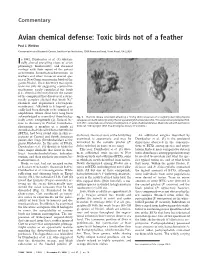
Commentary Avian chemical defense: Toxic birds not of a feather Paul J. Weldon Conservation and Research Center, Smithsonian Institution, 1500 Remount Road, Front Royal, VA 22630 n 1992, Dumbacher et al. (1) substan- Itially altered prevailing views of avian physiology, biochemistry, and chemical ecology with their report of the potent neurotoxin homobatrachotoxinin in feathers and other tissues of several spe- cies of New Guinean passerine birds of the genus Pitohui. Their discovery was signif- icant not only for suggesting a protective mechanism rarely considered for birds (i.e., chemical defense) but for the nature of the compound they discovered, a struc- turally complex alkaloid that binds Naϩ channels and depolarizes electrogenic membranes. Alkaloids in tetrapods gen- erally had been thought to be confined to amphibians, whose skins have long been acknowledged as arsenals of these biolog- Fig. 1. Hornets (Vespa orientalis) attacking a freshly skinned carcass of a laughing dove (Steptopelia ically active compounds (2). Indeed, be- senegalensis)(Left) while ignoring that of a pied kingfisher (Ceryle rudis). This observation prompted H. B. fore its discovery in Pitohui, homobatra- Cott (4) to undertake an extensive investigation of avian chemical defense. [Reproduced with permission chotoxinin, a member of a family of from ref. 4 (Copyright 1947, The Zoological Society of London).] steroidal alkaloids called batrachotoxinins (BTXs), had been found only in skin se- cretions of Central and South American dichrous), the most toxic of the birds they An additional enigma described by poison-dart frogs (Dendrobatidae) of the examined, is aposematic and may be Dumbacher et al. (3) is the profound genus Phyllobates. -
Notes on Occurrence and Feeding of Birds at Crater Mountain Biological Research Station, Papua New Guinea
EMU Vol. 96,89-101,1996 0 Royal Australasian Ornithologists Union 1996 0158-4197/96/0289 + 12 Received 10-4-1995, accepted 14-7-1995 Notes on Occurrence and Feeding of Birds at Crater Mountain Biological Research Station, Papua New Guinea Andrew L. MacklJ and Debra D. Wright132 University of Miami, Department of Biology, Coral Gables, Florida 33124, USA Department of Ornithology, Academy of Natural Sciences, 19th and Parkway, Philadelphia, Pennsylvania 19103, USA Summary: During 1989-93, 170 species of birds were ob- net capture rates. Comparisons among four other sites in served and 1787 individuals captured in mist nets at the southern Papua New Guinea reveal striking similarities Crater Mountain Biological Research Station, Chimbu among sites in number of species and trophic organisation. Province, Papua New Guinea. Populations of many species Range extensions, weights and natural history observations fluctuated on annual or supra-annual schedules; 46 species are reported for many species. Feeding observations of nec- were considered transients. Areas of the forest where many tarivorous and frugivorous birds at over 50 species of plant understorey trees had been removed exhibited reduced mist are reported. In a review of the ecology of New Guinea's avifauna, Management Area, a conservation project based on Beehler (1982) reported that no long-term field studies land-use management by the traditional Pawaiian and had been carried out in diverse avian communities of Gimi landowners. The station is 10 km east of Haia in New Guinea. Since then there has been some progress, Chimbu Province, Papua New Guinea (6"43.4'S, mostly in lowland sites (Bell 1982a, 1982b, 1982c, 145'5.6'E) at c. -

Nest, Egg, Incubation Behaviour and Vocalisations of the New Guinea Endemic Black Pitohui Melanorectes Nigrescens
Australian Field Ornithology 2019, 36, 116–120 http://dx.doi.org/10.20938/afo36116120 Nest, egg, incubation behaviour and vocalisations of the New Guinea endemic Black Pitohui Melanorectes nigrescens Richard H. Donaghey1, 2*, Donna J. Belder3 and Tony Baylis4 1Environmental Futures Research Institute, Griffith University, Nathan QLD 4111, Australia 280 Sawards Road, Myalla TAS 7325, Australia 3Fenner School of Environment and Society, The Australian National University, Canberra ACT 2601, Australia 4628 Utopia Road, Brooweena QLD 4621, Australia *Corresponding author. Email: ricardo@southernphone.com.au Abstract. The Black Pitohui Melanorectes nigrescens (Pachycephalidae) is endemic to mid-mountain forests in mainland New Guinea. Spectrograms of three different songs recorded in the Yopno Urawa Som Conservation Area (YUS CA), Huon Peninsula, Papua New Guinea, are presented. We describe the elevation and nest-site, height above the ground, structure and materials of a nest with an egg, discovered in the YUS CA. The colour and dimensions of the egg are documented. We present photographs of the nest-site, nest, and egg, and compare these with previously described eggs and a nest. We observed only the female Black Pitohui incubating the single-egg clutch. We compare the meagre information on pitohui breeding biology with that of Australian whistlers and shrike-thrushes. Introduction (Bell 1983). In lowland rainforest sites, flock composition was more influenced by the presence of Papuan Babblers Garritornis isidori (Pomatostomidae) than by that of The genus Melanorectes was resurrected by Dumbacher pitohuis, indicating that pitohui toxicity does not drive flock (2014) for the Black Pitohui, previously named Pitohui organisation (Goodale et al. 2012). -
Bird Abundances in Primary and Secondary Growths in Papua New Guinea: a Preliminary Assessment
Mongabay.com Open Access Journal - Tropical Conservation Science Vol.3 (4):373-388, 2010 Research Article Bird abundances in primary and secondary growths in Papua New Guinea: a preliminary assessment Kateřina Tvardíková1 1 Department of Zoology, Faculty of Biological Science, University of South Bohemia, Branišovská 31, CZ- 370 05 České Budějovice. Email: <katerinatvardikova@seznam.cz Abstract Papua New Guinea is the third largest remaining area of tropical forest after the Amazon and Congo basins. However, the growing intensity of large-scale slash-and-burn agriculture and logging call for conservation research to assess how local people´s traditional land-use practices result in conservation of local biodiversity, of which a species-rich and diverse component is the avian community. With this in mind, I conducted a preliminary survey of birds in small-scale secondary plots and in adjacent primary forest in Wanang Conservation Area in Papua New Guinea. I used mist-netting, point counts, and transect walks to compare the bird communities of 7-year-old secondary growth, and neighboring primary forest. The preliminary survey lasted 10 days and was conducted during the dry season (July) of 2008. I found no significant differences in summed bird abundances between forest types. However, species richness was higher in primary forest (98 species) than in secondary (78 species). The response of individual feeding guilds was also variable. Two habitats differed mainly in presence of canopy frugivores, which were more abundant (more than 80%) in primary than in secondary forests. A large difference (70%) was found also in understory and mid-story insectivores. Species occurring mainly in secondary forest were Hooded Butcherbird (Cracticus cassicus), Brown Oriole (Oriolus szalayi), and Helmeted Friarbird (Philemon buceroides). -
Australia ‐ Part Two 2016 (With Tasmania Extension to Nov 7)
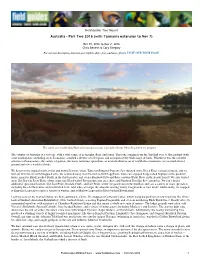
Field Guides Tour Report Australia ‐ Part Two 2016 (with Tasmania extension to Nov 7) Oct 18, 2016 to Nov 2, 2016 Chris Benesh & Cory Gregory For our tour description, itinerary, past triplists, dates, fees, and more, please VISIT OUR TOUR PAGE. The sunset over Cumberland Dam near Georgetown was especially vibrant. Photo by guide Cory Gregory. The country of Australia is a vast one, with a wide range of geography, flora, and fauna. This tour, ranging from the Top End over to Queensland (with some participants continuing on to Tasmania), sampled a diverse set of regions and an impressively wide range of birds. Whether it was the colorful selection of honeyeaters, the variety of parrots, the many rainforest specialties, or even the diverse set of world-class mammals, we covered a lot of ground and saw a wealth of birds. We began in the tropical north, in hot and humid Darwin, where Torresian Imperial-Pigeons flew through town, Black Kites soared overhead, and we had our first run-ins with Magpie-Larks. We ventured away from Darwin to bird Fogg Dam, where we enjoyed Large-tailed Nightjar in the predawn hours, majestic Black-necked Storks in the fields nearby, and even a Rainbow Pitta and Rose-crowned Fruit-Dove in the nearby forest! We also visited areas like Darwin River Dam, where some rare Black-tailed Treecreepers put on a show and Northern Rosellas flew around us. We can’t forget additional spots near Darwin, like East Point, Buffalo Creek, and Lee Point, where we gazed out on the mudflats and saw a variety of coast specialists, including Beach Thick-knee and Gull-billed Tern. -

Muruk July 2007 Vol 8-3-1
Editorial There has been a 7-year gap between the last issue of the Papua New Guinea Birdwatching Society’s journal Muruk in 2000 (Vol. 8: 2) and this issue, which completes that volume. It serves a valuable purpose documenting significant records of New Guinea birds, and publishing notes and papers relevant to New Guinea ornithology. Thanks are due to Conservation International’s Melanesia Centre for Biodiversity Conservation (funded by the Gordon and Betty Moore Foundation) for coming up with funds for the printing of the journal, with particular thanks to Roger James. The idea is to clear a large backlog of records, and publish articles relating to New Guinea ornithology, with the help of an editorial team: Editor - Phil Gregory Editorial consultants: K. David Bishop, Ian Burrows, Brian Coates, Guy Dutson, Chris Eastwood. We would like feedback about the direction the journal should take; it has been a useful reference resource over the years and is cited in many publications. Current thinking is to publish two issues per annum, with thoughts about expanding coverage to include other nearby areas such as Halmahera and the Solomon Islands, which have a large New Guinea component to the avifauna. The Pacific region as a whole is poorly served and there may be scope to include other parts of Melanesia and Polynesia. We now complete the old pre-2000 subscriptions with this issue, which is sent free to former subscribers, and invite new subscriptions. Editorial address: PO Box 387, Kuranda, Queensland 4881, Australia. Email - sicklebill@optusnet.com.au Significant Sightings from Tour Reports Compiled and edited by Phil Gregory More and more companies are offering tours to PNG, mostly doing the same circuit but still coming up with interesting records or little known or rare species, breeding data or distributional information.