Maisie Macknight Ford Fellowship Recommendation from J Maerz
Total Page:16
File Type:pdf, Size:1020Kb
Load more
Recommended publications
-

Summary of Amphibian Community Monitoring at Canaveral National Seashore, 2009
National Park Service U.S. Department of the Interior Natural Resource Program Center Summary of Amphibian Community Monitoring at Canaveral National Seashore, 2009 Natural Resource Data Series NPS/SECN/NRDS—2010/098 ON THE COVER Clockwise from top left, Hyla chrysoscelis (Cope’s grey treefrog), Hyla gratiosa (barking treefrog), Scaphiopus holbrookii (Eastern spadefoot), and Hyla cinerea (Green treefrog). Photographs by J.D. Willson. Summary of Amphibian Community Monitoring at Canaveral National Seashore, 2009 Natural Resource Data Series NPS/SECN/NRDS—2010/098 Michael W. Byrne, Laura M. Elston, Briana D. Smrekar, Brent A. Blankley, and Piper A. Bazemore USDI National Park Service Southeast Coast Inventory and Monitoring Network Cumberland Island National Seashore 101 Wheeler Street Saint Marys, Georgia, 31558 October 2010 U.S. Department of the Interior National Park Service Natural Resource Program Center Fort Collins, Colorado The National Park Service, Natural Resource Program Center publishes a range of reports that address natural resource topics of interest and applicability to a broad audience in the National Park Service and others in natural resource management, including scientists, conservation and environmental constituencies, and the public. The Natural Resource Data Series is intended for timely release of basic data sets and data summaries. Care has been taken to assure accuracy of raw data values, but a thorough analysis and interpretation of the data has not been completed. Consequently, the initial analyses of data in this report are provisional and subject to change. All manuscripts in the series receive the appropriate level of peer review to ensure that the information is scientifically credible, technically accurate, appropriately written for the intended audience, and designed and published in a professional manner. -
TERRITORY SIZE - What Is the Territory Size for the Species?
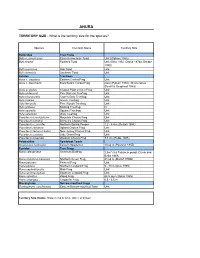
ANURA TERRITORY SIZE - What is the territory size for the species? Species Common Name Territory Size Bufonidae True Frogs Bufo a. americanus Eastern American Toad Unk (Oldham 1966) Bufo fowleri Fowler's Toad Unk (Stille 1952, Clarke 1974a, Breden 1988) Bufo quercicus Oak Toad Unk Bufo terrestris Southern Toad Unk Hylidae Treefrogs Acris c. crepitans Eastern Cricket Frog Unk Acris c. blanchardi Blanchard's Cricket Frog none (Pyburn 1958); 30 cm radius (Perrill & Shepherd 1989) Acris g. gryllus Coastal Plain Cricket Frog Unk Hyla andersonii Pine Barrens Treefrog Unk Hyla chrysoscelis Cope’s Gray Treefrog Unk Hyla cinerea Green Treefrog Unk Hyla femoralis Pine Woods Treefrog Unk Hyla gratiosa Barking Treefrog N Hyla squirella Squirrel Treefrog Unk Hyla versicolor Gray Treefrog Unk Pseudacris brachyphona Mountain Chorus Frog Unk Pseudacris brimleyi Brimley’s Chorus Frog Unk Pseudacris c. crucifer Northern Spring Peeper 1.2 - 5.4 m (Delzell 1958) Pseudacris feriarum Upland Chorus Frog Unk Pseudacris feriarum kalmi New Jersey Chorus Frog Unk Pseudacris ocularis Little Grass Frog Unk Pseudacris triseriata Western Chorus Frog 7.5 cm (Roble 1985) Pelobatidae Spadefoot Toads Scaphiopus holbrookii Eastern Spadefoot 10 sq m (Pearson 1955) Ranidae True Frogs Rana catesbeiana American Bullfrog 2.5m2 (8.6 ft diam.in pond) (Currie and Bellis 1969) Rana clamitans melanota Northern Green Frog 61 sq m (Martof 1956b) Rana palustris Pickerel Frog Unk Rana pipiens Northern Leopard Frog 5 - 10 m (Dole 1965) Rana septentrionalis Mink Frog Unk Rana sphenocephala Southern Leopard Frog Unk Rana sylvatica Wood Frog 64.5 sq m (Bellis 1965) Rana virgatipes Carpenter Frog 0.5 - 6.5 m Microhylidae Narrow-mouthed Frogs Gastrophryne carolinensis Eastern Narrow-mouthed Toad Unk Territory Size Codes: State in m2 or km2, Unk = unknown. -
Population Status of the Illinois Chorus Frog
ILLINOI S UNIVERSITY OF ILLINOIS AT URBANA-CHAMPAIGN PRODUCTION NOTE University of Illinois at Urbana-Champaign Library Large-scale Digitization Project, 2007. Population status of the Illinois chorus frog (Pseudacris streckeri illinoensis) in Madison County, Illinois: Results of 1994 surveys IDOT CONTRACT 1-5-90179 FINAL REPORT ON 1994 RESULTS John K. Tucker Center for Aquatic Ecology Illinois Natural History Survey 4134 Alby Street Alton, Illinois 62002 and David P. Philipp Center for Aquatic Ecology Illinois Natural History Survey 607 E. Peabody Champaign, Illinois 61781 December 1995 J. K. Tucker Dr. David P. Philipp Co-Principal Investigator Co-Principal Investigator Center for Aquatic Ecology Center for Aquatic Ecology Illinois Natural History Survey Illinois Natural History Survey DISCLAIMER The findings, conclusions, and views expressed herein are those of the researchers and should not be considered as the official position of the Illinois Department of Transportation. ACKNOWLEDGMENT OF SUPPORT This research (contract number 1-5-90179) was funded by the Illinois Department of Transportation. ii EXECUTIVE SUMMARY A study of the biology of the Illinois chorus frog, Pseudacris streckeri illinoensis, is reported. Surveys of Madison County for choruses of the frogs located seven choruses. Choruses previously reported at Granite City and South Roxana were not relocated and are thought to be extirpated. We estimated population size to be 420 frogs in April 1994 with a juvenile survivorship of 4.5%. Mean distance for 20 recaptured frogs from point of initial capture was 0.52 km with a range of 0 to 0.9 km. Habitat preference for 48 frogs found on roads appeared to be for old field habitats in preference to areas of agriculture or lawns. -
Checklist of Reptiles and Amphibians Revoct2017
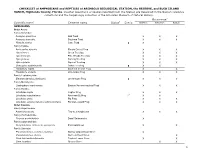
CHECKLIST of AMPHIBIANS and REPTILES of ARCHBOLD BIOLOGICAL STATION, the RESERVE, and BUCK ISLAND RANCH, Highlands County, Florida. Voucher specimens of species recorded from the Station are deposited in the Station reference collections and the herpetology collection of the American Museum of Natural History. Occurrence3 Scientific name1 Common name Status2 Exotic Station Reserve Ranch AMPHIBIANS Order Anura Family Bufonidae Anaxyrus quercicus Oak Toad X X X Anaxyrus terrestris Southern Toad X X X Rhinella marina Cane Toad ■ X Family Hylidae Acris gryllus dorsalis Florida Cricket Frog X X X Hyla cinerea Green Treefrog X X X Hyla femoralis Pine Woods Treefrog X X X Hyla gratiosa Barking Treefrog X X X Hyla squirella Squirrel Treefrog X X X Osteopilus septentrionalis Cuban Treefrog ■ X X Pseudacris nigrita Southern Chorus Frog X X Pseudacris ocularis Little Grass Frog X X X Family Leptodactylidae Eleutherodactylus planirostris Greenhouse Frog ■ X X X Family Microhylidae Gastrophryne carolinensis Eastern Narrow-mouthed Toad X X X Family Ranidae Lithobates capito Gopher Frog X X X Lithobates catesbeianus American Bullfrog ? 4 X X Lithobates grylio Pig Frog X X X Lithobates sphenocephalus sphenocephalus Florida Leopard Frog X X X Order Caudata Family Amphiumidae Amphiuma means Two-toed Amphiuma X X X Family Plethodontidae Eurycea quadridigitata Dwarf Salamander X Family Salamandridae Notophthalmus viridescens piaropicola Peninsula Newt X X Family Sirenidae Pseudobranchus axanthus axanthus Narrow-striped Dwarf Siren X Pseudobranchus striatus -

Okefenokee National Wildlife Refuge Amphibians, Fish, Mammals and Reptiles List
U.S. Fish & Wildlife Service Okefenokee National Wildlife Refuge Amphibians, Fish, Mammals and Reptiles List The Okefenokee swamp is covered with Mammals ___Seminole Bat cypress, blackgum, and bay forests (Lasiurus seminolus). A common bat of scattered throughout a flooded prairie ___Virginia Opossum the Okefenokee which is found hanging in made of grasses, sedges, and various (Didelphis virginiana pigna). Common on Spanish Moss during the day. the swamp edge and the islands within aquatic plants. The peripheral upland and ___Hoary Bat the almost 70 islands within the swamp the Swamp. A night prowler. “Pogo” is often seen by campers. (Lasiurus cinereus cinereus). This are forested with pine interspersed with yellowish-brown bat flies high in the air hardwood hammocks. Lakes of varying ___Southern Short-Tailed Shrew late at night and will hang in trees when sizes and depths, and floating sections (Barina carolinensis). A specimen was resting. It is the largest bat in the East of the peat bed, are also part of the found on Floyds Island June 12, 1921. It and eats mostly moths. Okefenokee terrain. kills its prey with poisonous saliva. ___Northern Yellow Bat People have left their mark on the swamp. ___Least Shrew (Lasiurus intermedius floridanus). A 12-mile long canal was dug into the (Cryptotus parva parva). Rarely seen but Apparently a rare species in the area. It eastern prairies in the 1890’s in a failed probably fairly common. Specimens have likes to feed in groups. attempt to drain the swamp. During the been found on several of the islands, on early 1900’s large amounts of timber were the swamp edge, and in the pine woods ___Evening Bat removed, so that very few areas of virgin around the swamp. -

AG-472-02 Snakes
Snakes Contents Intro ........................................................................................................................................................................................................................1 What are Snakes? ...............................................................1 Biology of Snakes ...............................................................1 Why are Snakes Important? ............................................1 People and Snakes ............................................................3 Where are Snakes? ............................................................1 Managing Snakes ...............................................................3 Family Colubridae ...............................................................................................................................................................................................5 Eastern Worm Snake—Harmless .................................5 Red-Bellied Water Snake—Harmless ....................... 11 Scarlet Snake—Harmless ................................................5 Banded Water Snake—Harmless ............................... 11 Black Racer—Harmless ....................................................5 Northern Water Snake—Harmless ............................12 Ring-Necked Snake—Harmless ....................................6 Brown Water Snake—Harmless .................................12 Mud Snake—Harmless ....................................................6 Rough Green Snake—Harmless .................................12 -

Biodiversity and Coarse Woody Debris in Southern Forests Proceedings of the Workshop on Coarse Woody Debris in Southern Forests: Effects on Biodiversity
Biodiversity and Coarse woody Debris in Southern Forests Proceedings of the Workshop on Coarse Woody Debris in Southern Forests: Effects on Biodiversity Athens, GA - October 18-20,1993 Biodiversity and Coarse Woody Debris in Southern Forests Proceedings of the Workhop on Coarse Woody Debris in Southern Forests: Effects on Biodiversity Athens, GA October 18-20,1993 Editors: James W. McMinn, USDA Forest Service, Southern Research Station, Forestry Sciences Laboratory, Athens, GA, and D.A. Crossley, Jr., University of Georgia, Athens, GA Sponsored by: U.S. Department of Energy, Savannah River Site, and the USDA Forest Service, Savannah River Forest Station, Biodiversity Program, Aiken, SC Conducted by: USDA Forest Service, Southem Research Station, Asheville, NC, and University of Georgia, Institute of Ecology, Athens, GA Preface James W. McMinn and D. A. Crossley, Jr. Conservation of biodiversity is emerging as a major goal in The effects of CWD on biodiversity depend upon the management of forest ecosystems. The implied harvesting variables, distribution, and dynamics. This objective is the conservation of a full complement of native proceedings addresses the current state of knowledge about species and communities within the forest ecosystem. the influences of CWD on the biodiversity of various Effective implementation of conservation measures will groups of biota. Research priorities are identified for future require a broader knowledge of the dimensions of studies that should provide a basis for the conservation of biodiversity, the contributions of various ecosystem biodiversity when interacting with appropriate management components to those dimensions, and the impact of techniques. management practices. We thank John Blake, USDA Forest Service, Savannah In a workshop held in Athens, GA, October 18-20, 1993, River Forest Station, for encouragement and support we focused on an ecosystem component, coarse woody throughout the workshop process. -

Standard Common and Current Scientific Names for North American Amphibians, Turtles, Reptiles & Crocodilians
STANDARD COMMON AND CURRENT SCIENTIFIC NAMES FOR NORTH AMERICAN AMPHIBIANS, TURTLES, REPTILES & CROCODILIANS Sixth Edition Joseph T. Collins TraVis W. TAGGart The Center for North American Herpetology THE CEN T ER FOR NOR T H AMERI ca N HERPE T OLOGY www.cnah.org Joseph T. Collins, Director The Center for North American Herpetology 1502 Medinah Circle Lawrence, Kansas 66047 (785) 393-4757 Single copies of this publication are available gratis from The Center for North American Herpetology, 1502 Medinah Circle, Lawrence, Kansas 66047 USA; within the United States and Canada, please send a self-addressed 7x10-inch manila envelope with sufficient U.S. first class postage affixed for four ounces. Individuals outside the United States and Canada should contact CNAH via email before requesting a copy. A list of previous editions of this title is printed on the inside back cover. THE CEN T ER FOR NOR T H AMERI ca N HERPE T OLOGY BO A RD OF DIRE ct ORS Joseph T. Collins Suzanne L. Collins Kansas Biological Survey The Center for The University of Kansas North American Herpetology 2021 Constant Avenue 1502 Medinah Circle Lawrence, Kansas 66047 Lawrence, Kansas 66047 Kelly J. Irwin James L. Knight Arkansas Game & Fish South Carolina Commission State Museum 915 East Sevier Street P. O. Box 100107 Benton, Arkansas 72015 Columbia, South Carolina 29202 Walter E. Meshaka, Jr. Robert Powell Section of Zoology Department of Biology State Museum of Pennsylvania Avila University 300 North Street 11901 Wornall Road Harrisburg, Pennsylvania 17120 Kansas City, Missouri 64145 Travis W. Taggart Sternberg Museum of Natural History Fort Hays State University 3000 Sternberg Drive Hays, Kansas 67601 Front cover images of an Eastern Collared Lizard (Crotaphytus collaris) and Cajun Chorus Frog (Pseudacris fouquettei) by Suzanne L. -

Venomous Nonvenomous Snakes of Florida
Venomous and nonvenomous Snakes of Florida PHOTOGRAPHS BY KEVIN ENGE Top to bottom: Black swamp snake; Eastern garter snake; Eastern mud snake; Eastern kingsnake Florida is home to more snakes than any other state in the Southeast – 44 native species and three nonnative species. Since only six species are venomous, and two of those reside only in the northern part of the state, any snake you encounter will most likely be nonvenomous. Florida Fish and Wildlife Conservation Commission MyFWC.com Florida has an abundance of wildlife, Snakes flick their forked tongues to “taste” their surroundings. The tongue of this yellow rat snake including a wide variety of reptiles. takes particles from the air into the Jacobson’s This state has more snakes than organs in the roof of its mouth for identification. any other state in the Southeast – 44 native species and three nonnative species. They are found in every Fhabitat from coastal mangroves and salt marshes to freshwater wetlands and dry uplands. Some species even thrive in residential areas. Anyone in Florida might see a snake wherever they live or travel. Many people are frightened of or repulsed by snakes because of super- stition or folklore. In reality, snakes play an interesting and vital role K in Florida’s complex ecology. Many ENNETH L. species help reduce the populations of rodents and other pests. K Since only six of Florida’s resident RYSKO snake species are venomous and two of them reside only in the northern and reflective and are frequently iri- part of the state, any snake you en- descent. -
Identifying Priority Ecoregions for Amphibian Conservation in the U.S. and Canada
Acknowledgements This assessment was conducted as part of a priority setting effort for Operation Frog Pond, a project of Tree Walkers International. Operation Frog Pond is designed to encourage private individuals and community groups to become involved in amphibian conservation around their homes and communities. Funding for this assessment was provided by The Lawrence Foundation, Northwest Frog Fest, and members of Tree Walkers International. This assessment would not be possible without data provided by The Global Amphibian Assessment, NatureServe, and the International Conservation Union. We are indebted to their foresight in compiling basic scientific information about species’ distributions, ecology, and conservation status; and making these data available to the public, so that we can provide informed stewardship for our natural resources. I would also like to extend a special thank you to Aaron Bloch for compiling conservation status data for amphibians in the United States and to Joe Milmoe and the U.S. Fish and Wildlife Service, Partners for Fish and Wildlife Program for supporting Operation Frog Pond. Photo Credits Photographs are credited to each photographer on the pages where they appear. All rights are reserved by individual photographers. All photos on the front and back cover are copyright Tim Paine. Suggested Citation Brock, B.L. 2007. Identifying priority ecoregions for amphibian conservation in the U.S. and Canada. Tree Walkers International Special Report. Tree Walkers International, USA. Text © 2007 by Brent L. Brock and Tree Walkers International Tree Walkers International, 3025 Woodchuck Road, Bozeman, MT 59715-1702 Layout and design: Elizabeth K. Brock Photographs: as noted, all rights reserved by individual photographers. -

Natural Heritage Program List of Rare Animal Species of North Carolina 2020
Natural Heritage Program List of Rare Animal Species of North Carolina 2020 Hickory Nut Gorge Green Salamander (Aneides caryaensis) Photo by Austin Patton 2014 Compiled by Judith Ratcliffe, Zoologist North Carolina Natural Heritage Program N.C. Department of Natural and Cultural Resources www.ncnhp.org C ur Alleghany rit Ashe Northampton Gates C uc Surry am k Stokes P d Rockingham Caswell Person Vance Warren a e P s n Hertford e qu Chowan r Granville q ot ui a Mountains Watauga Halifax m nk an Wilkes Yadkin s Mitchell Avery Forsyth Orange Guilford Franklin Bertie Alamance Durham Nash Yancey Alexander Madison Caldwell Davie Edgecombe Washington Tyrrell Iredell Martin Dare Burke Davidson Wake McDowell Randolph Chatham Wilson Buncombe Catawba Rowan Beaufort Haywood Pitt Swain Hyde Lee Lincoln Greene Rutherford Johnston Graham Henderson Jackson Cabarrus Montgomery Harnett Cleveland Wayne Polk Gaston Stanly Cherokee Macon Transylvania Lenoir Mecklenburg Moore Clay Pamlico Hoke Union d Cumberland Jones Anson on Sampson hm Duplin ic Craven Piedmont R nd tla Onslow Carteret co S Robeson Bladen Pender Sandhills Columbus New Hanover Tidewater Coastal Plain Brunswick THE COUNTIES AND PHYSIOGRAPHIC PROVINCES OF NORTH CAROLINA Natural Heritage Program List of Rare Animal Species of North Carolina 2020 Compiled by Judith Ratcliffe, Zoologist North Carolina Natural Heritage Program N.C. Department of Natural and Cultural Resources Raleigh, NC 27699-1651 www.ncnhp.org This list is dynamic and is revised frequently as new data become available. New species are added to the list, and others are dropped from the list as appropriate. The list is published periodically, generally every two years. -

Summary of Amphibian Community Monitoring at Timucuan Ecological and Historic Preserve and Fort Caroline National Memorial, 2009
National Park Service U.S. Department of the Interior Natural Resource Program Center Summary of Amphibian Community Monitoring at Timucuan Ecological and Historic Preserve and Fort Caroline National Memorial, 2009 Natural Resource Data Series NPS/SECN/NRDS—2010/095 ON THE COVER Clockwise from top left, Hyla chrysoscelis (Cope’s grey treefrog), Hyla gratiosa (barking treefrog), Scaphiopus holbrookii (Eastern spadefoot), and Hyla cinerea (Green treefrog). Photographs by J.D. Willson. Summary of Amphibian Community Monitoring at Timucuan Ecological and Historic Preserve and Fort Caroline National Memorial, 2009 Natural Resource Data Series NPS/SECN/NRDS—2010/095 Michael W. Byrne, Laura M. Elston, Briana D. Smrekar, Marylou N. Moore, and Piper A. Bazemore USDI National Park Service Southeast Coast Inventory and Monitoring Network Cumberland Island National Seashore 101 Wheeler Street Saint Marys, Georgia, 31558 October 2010 U.S. Department of the Interior National Park Service Natural Resource Program Center Fort Collins, Colorado The National Park Service, Natural Resource Program Center publishes a range of reports that address natural resource topics of interest and applicability to a broad audience in the National Park Service and others in natural resource management, including scientists, conservation and environmental constituencies, and the public. The Natural Resource Data Series is intended for timely release of basic data sets and data summaries. Care has been taken to assure accuracy of raw data values, but a thorough analysis and interpretation of the data has not been completed. Consequently, the initial analyses of data in this report are provisional and subject to change. All manuscripts in the series receive the appropriate level of peer review to ensure that the information is scientifically credible, technically accurate, appropriately written for the intended audience, and designed and published in a professional manner.