Hugo Banzer Suárez
Total Page:16
File Type:pdf, Size:1020Kb
Load more
Recommended publications
-

Former Dictator and President Banzer Dies LADB Staff
University of New Mexico UNM Digital Repository NotiSur Latin America Digital Beat (LADB) 5-10-2002 Former Dictator and President Banzer Dies LADB Staff Follow this and additional works at: https://digitalrepository.unm.edu/notisur Recommended Citation LADB Staff. "Former Dictator and President Banzer Dies." (2002). https://digitalrepository.unm.edu/notisur/13023 This Article is brought to you for free and open access by the Latin America Digital Beat (LADB) at UNM Digital Repository. It has been accepted for inclusion in NotiSur by an authorized administrator of UNM Digital Repository. For more information, please contact amywinter@unm.edu. LADB Article Id: 53105 ISSN: 1089-1560 Former Dictator and President Banzer Dies by LADB Staff Category/Department: Bolivia Published: 2002-05-10 Bolivia's former President Hugo Banzer, who resigned in August 2001 after being diagnosed with lung cancer, died May 5. He was 75 years old. To his supporters, his greatest achievement was his political journey from Latin American dictator in the 1970s to elected civilian leader in the late 1990s. To his critics, the repression carried out during his years as a dictator, for which he was never held accountable, made him a symbol of impunity. When Banzer resigned, then Vice President Jorge Quiroga assumed the presidency for the rest of Banzer's term, which ends in August 2002 (see NotiSur, 2001-08-03). Under Bolivian law, Quiroga cannot run for president in the June 30 elections. Banzer, a cigarette smoker, was diagnosed in July 2001 by doctors at Walter Reed Army Medical Center in Washington, DC, with lung cancer that had spread to his liver. -

Bolivian Katarism: the Emergence of an Indian Challenge to the Social Order
BOLIVIAN KATARISM: THE EMERGENCE OF AN INDIAN CHALLENGE TO THE SOCIAL ORDER By Cécile Casen “Como indios nos explotaron, como indios nos liberaremos.”1 The name of Túpac Katari is mentioned in all of Evo Morales’ major speeches. Often presented as Bolivia’s “first indigenous president”, Morales likes to think he embodies the prophesy of this Aymara chief, who was drawn and quartered at the end of the 18th- century: “I will return and there will be millions of us.” Túpac Katari is known for having laid siege to La Paz during the Great Rebellion of 1780.2 His name is also associated with more recent political history, in particular the eponymous movement that, in the 1970s, made him a symbol of Indian resistance to Creole elite oppression and the 1 “Exploited as Indians, it is as Indians that we will free ourselves.” All Spanish-language citations in the present article are our translation. 2 The siege lasted from March to October 1781. The Great Rebellion concerned the entire region of Upper Peru between 1780 and 1783. In this revolt against excessive taxes and the abuses of the corregidores – representatives of Spanish royal power – Túpac Amaru and Túpac Katari were leaders of the regions of Cuzco and La Paz, respectively. Scarlett O’Phelan Godoy, Un siglo de rebeliones anticoloniales: Perú y Bolivia 1700-1783, Cuzco, Centro de Estudios Regionales Andinos Bartolomé de Las Casas, 1988; Jean Piel, “¿Cómo interpretar la rebelión pan-andina de 1780-1783?”, in Jean Meyer (ed.), Tres levantamientos populares: Pugachov, Túpac Amaru, Hidalgo, Mexico, Centro de Estudios mexicanos y centroamericanos (CEMCA/CNCAM), 1992, pp. -

Historia Del Pacto Militar Campesino Titulo Soto
Historia del pacto militar campesino Titulo Soto, Cesar - Autor/a; Autor(es) Cochabamba Lugar CERES, Centro de Estudios de la Realidad Económica y Social Editorial/Editor 1994 Fecha Colección Fuerzas Armadas; Historia; Campesinado; Pacto militar campesino; Bolivia; Temas Libro Tipo de documento http://bibliotecavirtual.clacso.org.ar/Bolivia/ceres/20120830025841/soto.pdf URL Reconocimiento-No comercial-Sin obras derivadas 2.0 Genérica Licencia http://creativecommons.org/licenses/by-nc-nd/2.0/deed.es Segui buscando en la Red de Bibliotecas Virtuales de CLACSO http://biblioteca.clacso.edu.ar Consejo Latinoamericano de Ciencias Sociales (CLACSO) Conselho Latino-americano de Ciências Sociais (CLACSO) Latin American Council of Social Sciences (CLACSO) www.clacso.edu.ar HISTORIA DEL PACTO MILITAR CAMPESINO Cesar Soto Ediciones CERES 1994 CERES agradece la cooperación de SAREC a su programa de publicaciones y a sus actividades de investigación en ciencias sociales. Depósito Legal N§ 1-1-96-91 Edición 500 ejemplares CERES Casilla 949 Fax (42) 32310 Cochabamba - Bolivia Composición, diagramación e Impresión Ed. Arol <197> ODEC Teléfono 40572 Casilla 3419 - Cochabamba Enero, 1994 Impreso en Bolivia 1 PRESENTACION Hace treinta años se formalizó e institucionalizó el Pacto Militar Campesino, prolongando y concentrando una alianza que dominó el espacio político boliviano desde los años de la Reforma Agraria. La alianza entre el campesinado parcelario y la burocracia estatal, concentrada desde 1964 en los estamentos militares. En 1983 se abrió en CERES un Programa de investigaciones sobre Movimientos Sociales, que contó con el apoyo del IDRC de Canadá y de la Fundación Interamericana de los Estados Unidos. A ese Programa se incorporó César Soto, y como parte de las actividades de formación del mismo desarrolló la investigación que hoy publicamos. -

Performance of Banks and Microfinance in Bolivia
POOLING VERSUS SEPARATING REGULATION: THE PERFORMANCE OF BANKS AND MICROFINANCE IN BOLIVIA UNDER SYSTEMIC SHOCKS DISSERTATION Presented in Partial Fulfillment of the Requirements for the Degree Doctor of Philosophy in the Graduate School of The Ohio State University By Marcelo Villafani‐Ibarnegaray ***** The Ohio State University 2008 Dissertation Committee: Approved by Professor Claudio Gonzalez‐Vega, Adviser Professor Mario Miranda Adviser Graduate Program in Professor Joseph Kaboski Agricultural, Environmental and Development Economics i ABSTRACT Bank superintendents implement prudential regulation that simultaneously seeks protection of the stability and solvency of financial intermediaries and several dimensions of financial deepening. If they use only one instrument, a given level of safety is achieved at the expense of some intermediation. The question addressed by this dissertation are the excessive losses of intermediation efficiency from a single, uniform (pooling) regulation, which treated loan portfolios built with a traditional banking technology or with a microfinance technology as if they carried the same risk profile. Given significant differences between the two lending technologies, in their ability to match their clienteles and to recognize different risks, a differentiated (separating) set of prudential norms would contribute more to the dual goals of stability as well as financial deepening and breadth of outreach. This task is specially challenging in developing countries exposed to frequent systemic shocks. The dissertation develops a simple theoretical framework to guide regulators about the welfare shortcomings of pooling regulation, compared to separating regulation. If the risk profiles of the portfolios are different, different prudential norms should be applied. The problem for the regulator, however, is incomplete information ii about these risk profiles and the high costs of overcoming the information imperfections about their characteristics. -

Bolivia En La Vida De Un Chileno
ENCUENTROS CON BOLIVIA Leonardo Jeffs Castro ENCUENTROS CON BOLIVIA ©Leonardo Jeffs Castro Inscripción Registro de Propiedad Intelectual N° 183.800 I.S.B.N. XXX Diseño y diagramación: José Jeffs Munizaga Ediciones Peña Andina: leo_jeffs@yahoo.com Esta edición de 200 ejemplares se imprimió en Impresos Libra, Juana Ross 35, Valparaíso, Chile. Se autoriza la reproducción total o parcial de este libro en Chile y en el exterior siempre que se indique la fuente. 1 DEDICATORIA A Roberto Espíndola quien me invitó a Bolivia en 1969, y a Fernando Aguirre Bastos y Carlos Gerke Mendieta, quienes organizaron el Encuentro de La Paz ese año y me dieron la oportunidad de empezar a conocer a su país y su gente y me brindaron su amistad. 2 A MODO DE PRESENTACIÓN Cuando conocí Bolivia en 1969 no pensé que iba a gravitar tanto en mi vida. Han transcurrido más de cuarenta años de esa primera visita. Invitado a participar en un Congreso de Profesionales cristianos del Cono Sur americano que se realizó en La Paz en agosto de 1969, concurrí gustoso, pero con muchos prejuicios. Dichos prejuicios, que creo que son los que predominan en muchos de los habitantes de las ciudades del centro de mi país, se me cayeron como por encanto. A modo de breve referencia, considero que muchos chilenos hemos estimado, en algún momento de nuestras vidas, que Bolivia es un país pobre y hemos considerado a sus habitantes como ignorantes, cobardes y flojos. De Bolivia sabía muy poco. Sabía que una prima hermana de mi abuelo Guillermo Jeffs Lynam, Adriana Lynam Mandujano se había -

Boliviahoy.Pdf
BOLIVIA HOY: ¿Una Democracia Poscolonial o Anticolonial? Seis estudios y una bibliografía seleccionada 1990-2016 EDITOR Juan Carlos Gómez Leyton EDICIONES ESCAPARATE BOLIVIA HOY: ¿Una Democracia Poscolonial o Anticolonial? Seis estudios y una bibliografía seleccionada 1990-2016 JUAN CARLOS GÓMEZ LEYTON EDITOR Registro Propiedad Intelectual Nº 278.299 ISBN: 978-956-9065-90-3 Producción General: Equipo Editoeial Diseño de Portada: Yaneth Piedrahita Posada © JUAN CARLOS GÓMEZ LEYTON © ESCAPARATE EDICIONES SPA E-mail: jcgomezleyton@gmail.com E-mail: edicionesescaparate1@gmail.com Junio 2017 IMPRESO EN CHILE Ninguna parte de esta publicación puede ser reproducida, almacenada y transmitida por cualquier medio, ya sea eléctrico, químico, mecánico, óptico, de grabación o de fotocopia, sin autorización previa del editor. BOLIVIA HOY: ¿Una Democracia Poscolonial o Anticolonial? Seis estudios y una bibliografía seleccionada 1990-2016 JUAN CARLOS GÓMEZ LEYTON ELIZABETH JIMÉNEZ CORTÉS DORIS JOHNSON BARELLA FABIOLA ESCARZAGA NICTÉ ANDRÉS LEIVA GUZMÁN MARÍA TERESA ZEGADA CLAURE JORGE GIBERT GALASSI COLECCIÓN PENSAR NUESTRA AMERICA COLECCIÓN PENSAR NUESTRA AMÉRICA EDICIONES ESCAPARATE JUAN CARLOS GÓMEZ LEYTON DIRECTOR DE LA COLEccIÓN COMITÉ EDITORIAL Dra. Valeria Coronel FLACSO- ECUADOR Dra. Fabiola Escarzaga Nicté UNIVERSIDAD AUTÓNOMA METROPOLITANA, UAM, MÉXICO Dr. Franck Gaudichuad UNIVERSIDAD DE GRENOBLE, FRANCIA Dr. Juan Carlos Gómez Leyton FLACSO-CHILE Dra. Elizabeth Jiménez Cortés COLECTIVO EL KINTRAL, CHILE Dra. Doris Johnson Barella UNIVERSIDAD DE PLAYA ANCHA, CHILE Dra. Inés Nercesian UNIVERSIDAD BUENOS AIRES, ARGENTINA Dr. José Francisco Puello-Socarrás UNIVERSIDAD NACIONAL DE COLOMBIA Dra. Claudia Zapata Silva UNIVERSIDAD DE CHILE Dra. María Teresa Zegada Claure UNIVERSIDAD MAYOR SAN SIMÓN, COCHABAMBA, BOLIVIA A Cinthia, por su solidaridad a toda prueba. -

Las Relaciones Entre El Perú Y Bolivia (1826-2013)
Fabián Novak Sandra Namihas SERIE: POLÍTICA EXTERIOR PERUANA LAS RELACIONES ENTRE EL PERÚ Y BOLIVIA ( 1826-2013 ) SERIE: POLÍTICA EXTERIOR PERUANA LAS RELACIONES ENTRE EL PERÚ Y BOLIVIA (1826-2013) Serie: Política Exterior Peruana LAS RELACIONES ENTRE EL PERÚ Y BOLIVIA (1826-2013) Fabián Novak Sandra Namihas 2013 Serie: Política Exterior Peruana Las relaciones entre el Perú y Bolivia (1826-2013) Primera edición, octubre de 2013 © Konrad Adenauer Stiftung General Iglesias 630, Lima 18 – Perú Email: kasperu@kas.de URL: <www.kas.de/peru> Telf: (51-1) 208-9300 Fax: (51-1) 242-1371 © Instituto de Estudios Internacionales (IDEI) Pontificia Universidad Católica del Perú Plaza Francia 1164, Lima 1 – Perú Email: idei@pucp.edu.pe URL: <www.pucp.edu.pe/idei> Telf: (51-1) 626-6170 Fax: (51-1) 626-6176 Diseño de cubierta: Eduardo Aguirre / Sandra Namihas Derechos reservados, prohibida la reproducción de este libro por cualquier medio, total o parcialmente, sin permiso expreso de los editores. Hecho el depósito legal en la Biblioteca Nacional del Perú Registro: Nº 2013-14683 ISBN Nº 978-9972-671-18-0 Impreso en: EQUIS EQUIS S.A. RUC: 20117355251 Jr. Inca 130, Lima 34 – Perú Impreso en el Perú – Printed in Peru A la memoria de mi padre y hermano, F.N. A mis padres, Jorge y María Luisa S.N. Índice Introducción …………………………….……...…………….…… 17 CAPÍTULO 1: El inicio de ambas repúblicas y los grandes temas bilaterales en el siglo XIX ……………………….………..……… 19 1 El inicio de las relaciones diplomáticas y el primer intento de federación peruano-boliviana ……………............. 22 2 El comienzo del largo camino para la definición de los límites ……………………………………………...…. -
Dates and Events
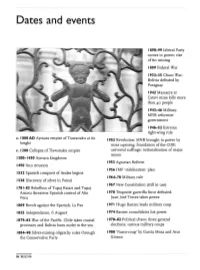
Dates and events 1898-99 Liberal Party comes to power; rise of tin mining 1899 Federal War 1932-35 Chaco War; Bolivia defeated by Paraguay 1942 Massacre at Catavi mine kills more than 40 people 1943-46 Military- MNR reformist government 1946-52 Extreme right-wing rule c. 1000 AD Aymara empire of Tiawanaku at its 1952 Revolution: MNR brought to power by height mass uprising; foundation of the COB; c. 1200 Collapse of Tiawanaku empire universal suffrage; nationalisation of major mines 1200-1450 Aymara kingdoms 1953 Agrarian Reform 1450 Inca invasion 1956 IMF 'stabilisation' plan 1532 Spanish conquest of Andes begins 1964-78 Military rule 1538 Discovery of silver in Potosi 1967 New Constitution (still in use) 1781-83 Rebellion of Tupaj Katari and Tupaj Amaru threatens Spanish control of Alto 1970 Teoponte guerrilla force defeated. Peru Juan Jose Torres takes power. 1809 Revolt against the Spanish, La Paz 1971 Hugo Banzer leads military coup 1825 Independence, 6 August 1974 Banzer consolidates his power 1879-83 War of the Pacific. Chile takes coastal 1978-82 Political chaos; three general provinces and Bolivia loses outlet to the sea elections; various military coups 1884-98 Silver-mining oligarchy rules through 1980 'Narco-coup' by Garcia Meza and Arce the Conservative Party Gomez 86 BOLIVIA 1982-85 Siles Zuazo (Union Democrdtica y 1990 First March for Territory, Dignity, and life Popular) President by lowland indigenous people 1985 World-record hyperinflation (22,000 per 1992 Free-trade zone at Ilo (Pacific Coast) cent per annum) instituted -

Movimientos Sociales En Torno a La Producción De Coca En Bolivia
Movimientos sociales en torno a la producción de coca en Bolivia : políticas de Titulo asentamiento, producción - erradicación de coca y desarrollo alternativo en el trópico de Cochabamba Bolivia, 1920 - 2006 Salazar Ortuño, Fernando - Autor/a; Autor(es) Cochabamba Lugar IESE-UMSS Editorial/Editor 2009 Fecha Colección Producción; Cultivos de coca; Movimientos sociales; Narcotráfico; Políticas públicas; Temas Cochabamba; Bolivia; Libro Tipo de documento "http://biblioteca.clacso.edu.ar/Bolivia/iese-umss/20171024055444/pdf_555.pdf" URL Reconocimiento-No Comercial-Sin Derivadas CC BY-NC-ND Licencia http://creativecommons.org/licenses/by-nc-nd/2.0/deed.es Segui buscando en la Red de Bibliotecas Virtuales de CLACSO http://biblioteca.clacso.edu.ar Consejo Latinoamericano de Ciencias Sociales (CLACSO) Conselho Latino-americano de Ciências Sociais (CLACSO) Latin American Council of Social Sciences (CLACSO) www.clacso.edu.ar MOVIMIENTOS SOCIALES EN TORNO A LA PRODUCCIÓN DE COCA EN BOLIVIA Políticas de asentamiento, producción - erradicación de coca y desarrollo alternativo en el trópico de Cochabamba Bolivia, 1920 – 2006. Fernando Benito Salazar ortuño Cochabamba - Bolivia Queda rigurosamente prohibida sin autorización escrita del titular del Copyright, bajo las sanciones previstas por las leyes, la reproducción total o parcial de esta obra por cualquier medio o procedimiento, comprendidos la fotocopia y el tratamiento informático. “MoviMientos sociales en torno a la producción de coca en Bolivia” Primera edición, diciembre 2009 autor: Fernando -

Bolivia 1980-1981: the Political System in Crisis
UNIVERSITY OF LONDON INSTITUTE OF LATIN AMERICAN STUDIES WORKING PAPERS Bolivia 1980-1981: the Political System in Crisis James Dunkerley Bolivia 1980-1981: the Political System in Crisis by James Dunkerley University of London Institute of Latin American Studies 31 Tavistock Square, London WC1H 9HA Editorial Committee Dr. George Philip Dr. Leslie Bethell Miss Daphne Rodger ISBN 0 901145 49 1 ISSN 0142-1875 Bolivia 1980-1981: the Political System in Crisis There can be little doubt that the Bolivian political system is in deep crisis. Over the last four years the country has witnessed no less than three elections, ten presidents and eight coups (both failed and successful). What is noteworthy, indeed remarkable, about this chaos is that it has continued through two periods of highly distinct and polarised forms of government: the 'democratic experiment1 of 1978 to July 1980 and the military regimes born of the harsh coup of 17 July 1980. For some months after the coup commentators sought explanations of the failure to establish a stable civil regime in the extreme weakness of the country's parliamentary tradition, the inepti- tude of the civilian political elite and the historical tendency of the armed forces to take direct control in periods when they possess the institutional capacity so to do. The radicalism of the coup, the clear intention of its leaders to emulate the examples of Chile (1973), Uruguay (1973) and Argentina (1976), and the manifest failure of the large political formations to win an unambiguous popular mandate for their parliamentary project were all construed as constituting a de- cisive end of an era. -

La Distorsión Nacionalista Construida Entre Bolivia Y Chile Ante El Tribunal De La Haya
La distorsión nacionalista construida entre Bolivia y Chile ante el Tribunal de La Haya Sergio Molina Monasterios1 “Los estamos esperando chilenos…” Video en el sitio oficial del Ejército de Bolivia (2009) "Bolivianos fusilaré…". Cántico de marinos chilenos entrenando en una calle de Viña del Mar (2009). I. Resumen En este trabajo se trata de describir el impacto de la Guerra del Pacífico (1879-1883) en el imaginario de los países involucrados y se hacen apreciaciones sobre las principales negociaciones que tuvieron Chile y Bolivia hasta la demanda interpuesta ante el Tribunal Internacional de Justicia de La Haya. Es difícil sostener que Bolivia haya sido un “país marítimo” antes de la Guerra del Pacífico. A pesar de ello, no se debe olvidar que los países sin acceso al mar enfrentan una seria desventaja. Chile argumenta que los datos sobre la mediterraneidad corren para Bolivia, porque tendría salida al mar asegurada sin soberanía. Sin embargo, al argumentar eso, elude la construcción identitaria boliviana. Finalmente, se rescatan algunas posiciones que han privilegiado el acercamiento antes que la confrontación entre ambos países y se expone la necesidad de separar la historia de la contingencia política. Palabras clave: Guerra del Pacífico, Tribunal de La Haya, nacionalismo, imaginario 1 Sergio Molina Monasterios es candidato a Doctor en Estudios Americanos por la Universidad de Santiago de Chile. Su Tesis de Doctorado se titula “La guerra imaginada: La construcción del conflicto entre Chile y Bolivia después de la Guerra del Pacífico”. Este trabajo se desarrolló en el marco del Proyecto CONICYT ANILLOS SOC-1109 "Relaciones transfronterizas entre Bolivia y Chile: Paradiplomacia y prácticas sociales 1904-2004" ejecutado por el Instituto de Estudios Internacionales (INTE), de la UNAP y el Instituto de Estudios Avanzados (IDEA) de la USACH. -

Former Dictator Hugo Banzer Assumes Presidency in Bolivia LADB Staff
University of New Mexico UNM Digital Repository NotiSur Latin America Digital Beat (LADB) 8-8-1997 Former Dictator Hugo Banzer Assumes Presidency in Bolivia LADB Staff Follow this and additional works at: https://digitalrepository.unm.edu/notisur Recommended Citation LADB Staff. "Former Dictator Hugo Banzer Assumes Presidency in Bolivia." (1997). https://digitalrepository.unm.edu/notisur/ 12391 This Article is brought to you for free and open access by the Latin America Digital Beat (LADB) at UNM Digital Repository. It has been accepted for inclusion in NotiSur by an authorized administrator of UNM Digital Repository. For more information, please contact amywinter@unm.edu. LADB Article Id: 55114 ISSN: 1060-4189 Former Dictator Hugo Banzer Assumes Presidency in Bolivia by LADB Staff Category/Department: Bolivia Published: 1997-08-08 On Aug. 6, Hugo Banzer Suarez was inaugurated as Bolivia's new president, completing his transition from military dictator to democratically elected head of state. Among the challenges the 71-year-old president will face are lifting Bolivia from its place as one of the continent's poorest countries and meeting US demands in eradicating coca production. Meanwhile, former president Gonzalo Sanchez de Lozada leaves office "satisfied with his accomplishments, but concerned about the future." Banzer headed the military junta that ruled Bolivia from 1971-1978, when he was overthrown in another coup. During his regime, human rights violations were widespread, and Bolivia became a major player in satisfying the growing international appetite for cocaine. Banzer said he was not a dictator but led an authoritarian regime. "If I were a dictator, I would not be where I am now.