The Wife of Robert the Strong
Total Page:16
File Type:pdf, Size:1020Kb
Load more
Recommended publications
-
Class Struggles in France 1848-1850
Karl Marx The Class Struggles in France, 1848-1850 Written: December January-October 1850; Published: as a booklet by Engels in 1895; Source: Selected Works, Volume 1, Progress Publishers, Moscow 1969; Proofed: and corrected by Matthew Carmody, 2009, Mark Harris 2010; Transcribed: by Louis Proyect. Table of Contents Introduction (Engels, 1895) ......................................................................................................... 1 Part I: The Defeat of June 1848 ................................................................................................. 15 Part II: From June 1848 to June 13, 1849 .................................................................................. 31 Part III: Consequences of June 13, 1849 ................................................................................... 50 Part IV: The Abolition of Universal Suffrage in 1850 .............................................................. 70 Introduction (Engels, 1895)1 The work republished here was Marx’s first attempt to explain a piece of contemporary history by means of his materialist conception, on the basis of the prevailing economic situation. In the Communist Manifesto, the theory was applied in broad outline to the whole of modern history; in the articles by Marx and myself in the Neue Rheinische Zeitung, it was constantly used to interpret political events of the day. Here, on the other hand, the question was to demonstrate the inner causal connection in the course of a development which extended over some years, a development -
LECTURE 5 the Origins of Feudalism
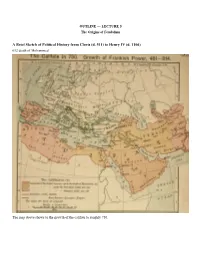
OUTLINE — LECTURE 5 The Origins of Feudalism A Brief Sketch of Political History from Clovis (d. 511) to Henry IV (d. 1106) 632 death of Mohammed The map above shows to the growth of the califate to roughly 750. The map above shows Europe and the East Roman Empire from 533 to roughly 600. – 2 – The map above shows the growth of Frankish power from 481 to 814. 486 – 511 Clovis, son of Merovich, king of the Franks 629 – 639 Dagobert, last effective Merovingian king of the Franks 680 – 714 Pepin of Heristal, mayor of the palace 714 – 741 Charles Martel, mayor (732(3), battle of Tours/Poitiers) 714 – 751 - 768 Pepin the Short, mayor then king 768 – 814 Charlemagne, king (emperor, 800 – 814) 814 – 840 Louis the Pious (emperor) – 3 – The map shows the Carolingian empire, the Byzantine empire, and the Califate in 814. – 4 – The map shows the breakup of the Carolingian empire from 843–888. West Middle East 840–77 Charles the Bald 840–55 Lothair, emp. 840–76 Louis the German 855–69 Lothair II – 5 – The map shows the routes of various Germanic invaders from 150 to 1066. Our focus here is on those in dark orange, whom Shepherd calls ‘Northmen: Danes and Normans’, popularly ‘Vikings’. – 6 – The map shows Europe and the Byzantine empire about the year 1000. France Germany 898–922 Charles the Simple 919–36 Henry the Fowler 936–62–73 Otto the Great, kg. emp. 973–83 Otto II 987–96 Hugh Capet 983–1002 Otto III 1002–1024 Henry II 996–1031 Robert II the Pious 1024–39 Conrad II 1031–1060 Henry I 1039–56 Henry III 1060–1108 Philip I 1056–1106 Henry IV – 7 – The map shows Europe and the Mediterranean lands in roughly the year 1097. -

Paris History Early History Julius Caesar Conquered Paris in 52 BC It
Paris History Early History Julius Caesar conquered Paris in 52 B.C. It was then a fishing village, called Lutetia Parisiorum (the Parisii were a Gallic tribe), on the Île de la Cité. Under the Romans the town spread to the left bank and acquired considerable importance under the later emperors. The vast catacombs under Montparnasse and the baths (now in the Cluny Mus.) remain from the Roman period. Legend says that St. Denis, first bishop of Paris, was martyred on Montmartre (hence the name) and that in the 5th cent. St. Geneviève, the patron saint of Paris, preserved the city from destruction by the Huns. On several occasions in its early history Paris was threatened by barbarian and Norman invasions, which at times drove the inhabitants back to the Île de la Cité. Clovis I and several other Merovingian kings made Paris their capital; under Charlemagne it became a center of learning. In 987, Hugh Capet, count of Paris, became king of France. The Capetians firmly established Paris as the French capital. The city grew as the power of the French kings increased. In the 11th cent. the city spread to the right bank. During the next two centuries—the reign of Philip Augustus (1180–1223) is especially notable for the growth of Paris—streets were paved and the city walls enlarged; the first Louvre (a fortress) and several churches, including Notre-Dame, were constructed or begun; and the schools on the left bank were organized into the Univ. of Paris. One of them, the Sorbonne, became a fountainhead of theological learning with Albertus Magnus and St. -

Abshier - Music Genealogy Page 1
Abshier - Music Genealogy Page 1 No. 1 on this chart is the same as no. 1 on chart no. 1 Chart no. 1 8 Joseph Bentley Abshier b. 25 Jan 1891 cont. 2 p. m. 24 Dec 1911 4 Ernie Clifton Abshier Sr p. b. 31 Aug 1914 d. 17 May 1976 p. p. m. 18 Jun 1942 p. 9 Ethel Euraine Reavis d. Apr 2006 b. 8 Feb 1891 cont. 3 p. p. d. 26 Jun 1975 2 Joseph (Jay) Bentley Abshier II p. b. p. m. p. 10 Charles Cleveland White d. b. 30 Jul 1885 cont. 4 p. p. m. 5 Jan 1922 5 Mary Etta White p. b. d. 30 Nov 1966 p. p. d. p. 11 Ruth Lyon b. 4 Sep 1900 cont. 5 p. d. 28 Dec 1965 1 Claire Elizabeth Abshier p. b. p. m. p. 12 John Henry Music d. b. 1902 cont. 6 p. p. sp. m. 1924 6 Robert Boyd Music p. b. 1927 d. 1986 p. p. m. p. 13 Avis Ruth Cutright d. 1996 b. 26 Sep 1904 cont. 7 p. Oklahoma City, Canadian, Oklahoma, USA p. Palace Valley, West Virginia d. 1 Nov 1975 3 Sherri Renea Music p. Cordell, Oklahoma b. p. d. p. 14 Ira Wilbur Franklin b. 1898 cont. 8 p. m. 3 Jan 1926 7 Annetta Mae Franklin p. Gotebo, Kiowa, Oklahoma, USA b. d. 1972 p. p. d. p. 15 Christine Dunn b. 1905 cont. 9 p. d. 1987 p. Produced by Legacy on 3 Oct 2010 Abshier - Music Genealogy Page 2 No. -

Veronica Ortenberg “The King from Overseas”: Why Did Aethelstan Matter in Tenth-Century Continental Affairs?
Veronica Ortenberg “The King from Overseas”: Why Did Aethelstan Matter in Tenth-Century Continental Affairs? [A stampa in England and the Continent in the Tenth Century, a cura di D. Rollason e C. Leyser, Turnhout, Brepols, 2011, pp. 211-236 © dell’autrice - Distribuito in formato digitale da “Reti Medievali”, www.retimedievali.it]. Part II Kingship, Royal Models, and Dynastic Strategies ‘THE KING FROM OVERSEAS’: WHY DID ÆTHELSTAN MATTER IN TENTH-CENTURY CONTINENTAL AFFAIRS? Veronica Ortenberg ccording to the tenth-century chronicler Flodoard, Æthelstan, king of Wessex (924–39), was ‘the king from overseas’.1 In the early twelfth Acentury William of Malmesbury wrote of him: This explains why the whole of Europe sang his praises and extolled his merits to the sky; kings of other nations, not without reason, thought themselves fortunate if they could buy his friendship either by family alliances or by gifts.2 Was this a case of William of Malmesbury’s hyperbole? How far did it correspond with the reality of Æthelstan’s reign, the perception of him by his contemporaries, and his own perception of his role in Continental politics? Æthelstan’s Carolingian heritage had its origins in the mid-ninth century. The story of Æthelwulf’s marriage in 856 to Judith, Charles the Bald’s daughter, and its implications, notably in terms of Judith’s anointing and coronation in West Francia prior to her arrival in England, with an English coronation ordo adapted by Hincmar, are familiar.3 A great deal has been made, justifiably, of the impact of 1 ‘Alstanus rex […] a transmarinis regionibus’: Flodoard (Lauer), p. -

Capetian France (987–1328)
FORUM Capetian France (987–1328) Introduction Damien Kempf If “France is a creation of its medieval history,”1 the rule of the Cape- tian dynasty (987–1328) in particular is traditionally regarded as the beginning of France as a nation.2 Following the narrative established by Joseph Strayer’s influential bookOn the Medieval Origins of the Mod- ern State, historians situate the construction of the French nation- state in the thirteenth century, under the reigns of Philip Augustus (1180– 1223) and Louis IX (1226–70). Territorial expansion, the development of bureaucracy, and the centralization of the royal government all con- tributed to the formation of the state in France.3 Thus it is only at the end of a long process of territorial expansion and royal affirmation that the Capetian kings managed to turn what was initially a disparate and fragmented territory into a unified kingdom, which prefigured the modern state. In this teleological framework, there is little room or interest for the first Capetian kings. The eleventh and twelfth centuries are still described as the “âge des souverains,” a period of relative anarchy and disorder during which the aristocracy dominated the political land- scape and lordship was the “normative expression of human power.”4 Compared to these powerful lords, the early Capetians pale into insignifi- cance. They controlled a royal domain centered on Paris and Orléans and struggled to keep at bay the lords dominating the powerful sur- rounding counties and duchies. The famous anecdote reported by the Damien Kempf is senior lecturer in medieval history at the University of Liverpool. -

This Site (Generic PDF)
Kathleen Kirkwood Sampler #2 This Sampler contains: The Prologue and the first three chapters of The Valiant Heart, The Prologue and first five chapters of The Defiant Heart, The Prologue and first three chapters of The Captive Heart. Table of Contents Kathleen Kirkwood Sampler #2 The Valiant Heart Dedication Author's Notes Prologue Chapter 1 Chapter 2 Chapter 3 The Story Continues! The Defiant Heart Dedication Author’s Appreciation Prologue Chapter 1 Chapter 2 Chapter 3 Chapter 4 Chapter 5 The Story Continues! The Captive Heart Dedication Author’s Appreciation Author’s Note Prologue Chapter 1 Chapter 2 Chapter 3 The Story Continues! Author Biography Also Available Coming in Late 2013 ©Copyright 1991, 2013 by Anita Gordon Revised Edition, 2013 All rights reserved. This eBook sample may not be incorporated, in part or whole into any other work without express written permission of the author or publisher. License Notes: This eBook sample is intended for your personal enjoyment. This eBook sample may not be sold, but it may be given away to other people, as long as it is not changed in any manner. This novel is a work of fiction. Names, characters, places, and incidents, other than those in attributed quotations or references, are either products of the author’s imagination or are used fictitiously. All characters are fictional and any similarity to people living or dead is purely coincidental. Cover art: edhgraphics Model images licensed from Jimmy Thomas at www.romancenovelcovers.com. THE VALIANT HEART Winner of the Golden Heart Award “Wonderful historical fantasy; I read it with avid enjoyment!” — Roberta Gellis, bestselling author of Fires of Winter “Exciting and heartrending, touched with warmth and humor. -

1 Making a Difference in Tenth-Century Politics: King
View metadata, citation and similar papers at core.ac.uk brought to you by CORE provided by St Andrews Research Repository 1 Making a Difference in Tenth-Century Politics: King Athelstan’s Sisters and Frankish Queenship Simon MacLean (University of St Andrews) ‘The holy laws of kinship have purposed to take root among monarchs for this reason: that their tranquil spirit may bring the peace which peoples long for.’ Thus in the year 507 wrote Theoderic, king of the Ostrogoths, to Clovis, king of the Franks.1 His appeal to the ideals of peace between kin was designed to avert hostilities between the Franks and the Visigoths, and drew meaning from the web of marital ties which bound together the royal dynasties of the early-sixth-century west. Theoderic himself sat at the centre of this web: he was married to Clovis’s sister, and his daughter was married to Alaric, king of the Visigoths.2 The present article is concerned with a much later period of European history, but the Ostrogothic ruler’s words nevertheless serve to introduce us to one of its central themes, namely the significance of marital alliances between dynasties. Unfortunately the tenth-century west, our present concern, had no Cassiodorus (the recorder of the king’s letter) to methodically enlighten the intricacies of its politics, but Theoderic’s sentiments were doubtless not unlike those that crossed the minds of the Anglo-Saxon and Frankish elite families who engineered an equally striking series of marital relationships among themselves just over 400 years later. In the early years of the tenth century several Anglo-Saxon royal women, all daughters of King Edward the Elder of Wessex (899-924) and sisters (or half-sisters) of his son King Athelstan (924-39), were despatched across the Channel as brides for Frankish and Saxon rulers and aristocrats. -
Shadow Kingdom: Lotharingia and the Frankish World, C.850-C.1050 1. Introduction Like Any Family, the Carolingian Dynasty Which
1 Shadow Kingdom: Lotharingia and the Frankish World, c.850-c.1050 1. Introduction Like any family, the Carolingian dynasty which ruled continental Western Europe from the mid-eighth century until the end of the ninth had its black sheep. Lothar II (855-69) was perhaps the most tragic example. A great-grandson of the famous emperor Charlemagne, he belonged to a populous generation of the family which ruled the Frankish empire after it was divided into three kingdoms – east, west and middle – by the Treaty of Verdun in 843. In 855 Lothar inherited the northern third of the Middle Kingdom, roughly comprising territories between the Meuse and the Rhine, and seemed well placed to establish himself as a father to the next generation of Carolingians. But his line was not to prosper. Early in his reign he had married a noblewoman called Theutberga in order to make an alliance with her family, but a few childless years later attempted to divorce her in order to marry a former lover called Waldrada by whom he already had a son. This was to be Lothar’s downfall, as his uncles Charles the Bald and Louis the German, kings respectively of west and east Francia, enlisted the help of Pope Nicholas I in order to keep him married and childless, and thus render his kingdom vulnerable to their ambitions. In this they were ultimately successful – by the time he died in 869, aged only 34, Lothar’s divorce had become a full-blown imperial drama played out through an exhausting cycle of litigation and posturing which dominated Frankish politics throughout the 860s.1 In the absence of a legitimate heir to take it over, his kingdom was divided between those of his uncles – and with the exception of a short period in the 890s, it never truly existed again as an independent kingdom. -

Political Culture and Ducal Authority in Aquitaine, C. 900–1040
DOI: 10.1111/hic3.12622 ARTICLE Political culture and ducal authority in Aquitaine, c. 900–1040 Fraser McNair University of Leeds Abstract Correspondence The development of ducal authority in tenth-century Aqui- Fraser McNair, School of History, University taine was a major change in the region's political culture. of Leeds, Woodhouse, Leeds LS2 9JT, UK. Email: f.a.mcnair@leeds.ac.uk The emergence of a regional, aristocratic polity was a shift from the Carolingian past, and historians have proffered Funding information Leverhulme Trust, Grant/Award Number: several explanations for it. This article examines several ECF-2017-693 models for the development of principalities: as the expres- sions, however compromised, of ethnic separatism; as the evolved forms of ninth-century administrative structures; and as aristocratic power constellations no different from any other. It traces the history of Aquitaine from the first duke, William the Pious, in the early tenth century, to the Poitevin dukes of the mid-eleventh century. The post- Carolingian duchy of Aquitaine, it is argued, is best under- stood not as an ethnic or an institutional formative, but as the distinctive expression of a changing regional political culture. 1 | INTRODUCTION The emergence of discrete, regional, non-royal political units (known, by an historian's term of art, as ‘principalities’) in what is now France over the course of the late ninth through early eleventh centuries is an historical puzzle. Prob- ably the most profound is how we are to characterise these polities: a break, an evolution or just the nobility's power essentially unchanged but dressed up in flashy new titles? Historians have up to the present struggled to characterise the emergence, out of a Carolingian world where aristocratic polities were conspicuous by their absence of regional political units such as Normandy, Burgundy and, of course, Aquitaine. -

Histoires De Famine. La Patente Au Moyen Age
Histoires de famine. La patente au Moyen Age Collection dirigee par Martin Aurell 4 Plantageriets et Capetiens: confrontations et heritages EDITE PAR MARTIN AURELL ET NOEL-YVES TONNERRE BREPOLS '\ I " )_:_ Lj Patronage, Politics and Piety in the Charters of Eleanor of Aquitaine Nicholas VINCENT In 1959, H.G. Richardson wrote that Eleanor of Aquitaine 'has been less than happy in her biographers", Even in Richardson's day, this was something of an understatement, since Eleanor has in fact inspired some of the very worst historical writing devoted to the European Middle Ages. Adopted as a figurehead by literary romantics and more recently by feminist historians, the Eleanor of history has been overshadowed by an Eleanor of wishful-thinking and make-believe. The tone here is set by Amy Kelly's biography, first published in 1950. Attempting to enter the mind-set of her heroine after the manner of Sir Walter Scott, Kelly conjures up a fantasy world of courtly love, fair damsels and daring deeds. 'The highhearted Plan- tagenets are marble still. The dusty sunlight falls softly where they sleep', Kelly concludes, in fine pre-Raphaelite mode but with about as much understanding of optical physics as of the reality of twelfth-century kingship". Even the most sober and distinguished of scholars, some of them far too distinguished to cite here by name, have been tempted to tread in Kelly's footsteps. On the one hand they admit that very little is or can be known of Eleanor's personality or daily life. On the other hand, and in direct contradiction of the admitted facts, they then pile conjecture upon conjecture in pursuit of an Eleanor whom even the novelists amongst us might find unduly fantasmagorical. -

De Carpentier Allied Ancestry
DE CARPENTIER ALLIED ANCESTRY ANCESTRY OF MARIA DE CARPENTIER WIFE OF JEAN PAUL JAQUET VICE-DIRECTOR AND CHIEF MAGISTRATE ON THE SOUTH RIVER OF NEW NETHERLAND 1655-1657 BY EDWIN JAQUETT SELLERS PHILADELPHIA 1928 EDITION LIMITED TO ONE HUNDRED COPIES WORKS OF THE AUTHOR AN ACCOUNT OF THE JAUDON FAMILY. PHILADELPHIA, 1890. GENEALOGY OF THE J AQUETT FAMILY. PHILADELPHIA, I 896. GENEALOGY OF THE KoLI,.OCK FAMILY OF SUSSEX COUNTY, DELAWARE, 1657-1897. PHILADELPHIA, 1897. CAPTAIN JOHN AVERY, PRESIDENT JUDGE AT THE WHOREKILL IN DELAWARE BAY, AND HIS DESCENDANTS. PHILADELPHIA, 1898. GENEALOGY OF DR. FRANCIS JOSEPH PFEIFFER AND HIS DESCEND ANTS, 1734-1899. PHILADELPHIA, 1899. ALLIED FAMILIES OF DELA WARE, Stretcher, Fenwick, Davis, Draper, Kipshaven, Stidham.. PHILADELPHIA, 1901 . PARTIAL GENEALOGY OF THE SELLERS AND WAMPOLE FAMILIES OF PENNSYLVANIA. PHILADELPHIA, 1903. GENEALOGY OF THE JAQUETT FAMILY. REVISED EDITION. PHILADEL PHIA, 1907. GENEALOGY OF THE DE CARPENTIER FAMILY OF HOLLAND. PHILADEL PHIA, 1909. ALLIED ANCESTRY OF THE VAN CULEMBORG FAMILY OF CULEMBORG, HOLLAND. Being the ancestry of Sophia van Culemborg, wife of Johan de Carpentier, parents of Maria de Carpentier, wife of Jean Paul Jaquet, Vice-Director and--Chief Magistrate of the Colonies on the South River of New Netherland, 1655-1657. PHILADELPHIA, 1915. FENWICK ALLIED ANCESTRY. Ancestry of Thomas Fenwick of Sussex County, Delaware, Provincial Councillor, Member of the Assembly, Justice of the Peace, Register of Wills, High Sheriff. PHILADELPHIA, 1916. SUPPLEMENT TO GENEALOGIES. PHILADELPHIA, 1922. JAUDON FAMILY OF PENNSYLVANIA. PHILADELPHIA, 1924. SELLERS FAMILY OF PENNSYLVANIA AND ALLIED FAMILIES. PHILA DELPHIA, 1925. ENGLISH ANCESTRY OF THE WAYNE FAMILY OF PENNSYLVANIA. PHILA DELPHIA, 1927.