Fauna Species List Recorded at Sydney Olympic Park
Total Page:16
File Type:pdf, Size:1020Kb
Load more
Recommended publications
-
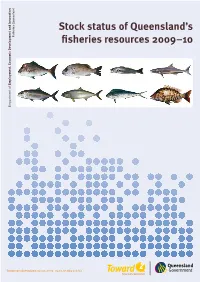
Stock Status of Queensland's Fisheries Resources 2009–10
Stock status of Queensland’s Fisheries Queensland fisheries resources 2009–10 Employment, Development Economic Innovation and Department of Tomorrow’s Queensland: strong, green, smart, healthy and fair Stock status of Queensland’s fisheries resources 2009–10 PR10–5184 © The State of Queensland, Department of Employment, Economic Development and Innovation, 2010. Except as permitted by the Copyright Act 1968, no part of the work may in any form or by any electronic, mechanical, photocopying, recording, or any other means be reproduced, stored in a retrieval system or be broadcast or transmitted without the prior written permission of the Department of Employment, Economic Development and Innovation. The information contained herein is subject to change without notice. The copyright owner shall not be liable for technical or other errors or omissions contained herein. The reader/user accepts all risks and responsibility for losses, damages, costs and other consequences resulting directly or indirectly from using this information. Enquiries about reproduction, including downloading or printing the web version, should be directed to ipcu@deedi.qld.gov.au or telephone +61 7 3225 1398. Contents Acronyms 6 Fishery acronyms 6 Introduction 7 Stock status process 7 Stock status assessment 2009–10 8 Stocks with no assessment made 16 Stock background and status determination 17 Barramundi (Lates calcarifer) EC 18 Barramundi (Lates calcarifer) GOC 19 Bream–yellowfin (Acanthopagrus australis) EC 20 Bugs–Balmain (Ibacus chacei and I. brucei) EC 21 Bugs–Moreton Bay (Thenus australiensis & T. parindicus) EC 22 Cobia (Rachycentron canadum) EC 23 Coral trout (Plectropomus spp. and Variola spp.) EC 24 Crab–blue swimmer (Portunus pelagius) EC 25 Crab–mud (Scylla spp.) EC 26 Crab–mud (Scylla spp.) GOC 27 Crab–spanner (Ranina ranina) EC 28 Eel (Anguilla australis and A. -
Condition Monitoring of Threatened Fish Populations in Lake Alexandrina and Lake Albert
Condition Monitoring of Threatened Fish Populations in Lake Alexandrina and Lake Albert Report to the Murray–Darling Basin Authority and the South Australian Department for Environment and Water Scotte Wedderburn and Thomas Barnes June 2018 © The University of Adelaide and the Department for Environment and Water With the exception of the Commonwealth Coat of Arms, the Murray–Darling Basin Authority logo, photographs and presented data, all material presented in this document is provided under a Creative Commons Attribution 4.0 International licence (https://creativecommons.org/licences/by/4.0/). For the avoidance of any doubt, this licence only applies to the material set out in this document. The details of the licence are available on the Creative Commons website (accessible using the links provided) as is the full legal code for the CC BY 4.0 licence (https://creativecommons.org/licences/by/4.0/legalcode). MDBA’s preference is that this publication be attributed (and any material sourced from it) using the following: Publication title: Condition Monitoring of Threatened Fish Populations in Lake Alexandrina and Lake Albert Source: Licensed from the Department for Environment and Water under a Creative Commons Attribution 4.0 International Licence The contents of this publication do not purport to represent the position of the Commonwealth of Australia or the MDBA in any way and are presented for the purpose of informing and stimulating discussion for improved management of Basin's natural resources. To the extent permitted by law, the copyright holders (including its employees and consultants) exclude all liability to any person for any consequences, including but not limited to all losses, damages, costs, expenses and any other compensation, arising directly or indirectly from using this report (in part or in whole) and any information or material contained in it. -

Native Fish Strategy
MURRAY-DARLING BASIN AUTHORITY Native Fish Strategy Mesoscale movements of small- and medium-sized fish in the Murray-Darling Basin MURRAY-DARLING BASIN AUTHORITY Native Fish Strategy Mesoscale movements of small- and medium-sized fish in the Murray-Darling Basin M. Hutchison, A. Butcher, J. Kirkwood, D. Mayer, K. Chilcott and S. Backhouse Queensland Department of Primary Industries and Fisheries Published by Murray-Darling Basin Commission Postal Address GPO Box 409, Canberra ACT 2601 Office location Level 4, 51 Allara Street, Canberra City Australian Capital Territory Telephone (02) 6279 0100 international + 61 2 6279 0100 Facsimile (02) 6248 8053 international + 61 2 6248 8053 Email info@mdbc.gov.au Internet http://www.mdbc.gov.au For further information contact the Murray-Darling Basin Commission office on (02) 6279 0100 This report may be cited as: Hutchison, M, Butcher, A, Kirkwood, J, Mayer, D, Chikott, K and Backhouse, S. Mesoscale movements of small and medium-sized fish in the Murray-Darling Basin MDBC Publication No. 41/08 ISBN 978 1 921257 81 0 © Copyright Murray-Darling Basin Commission 2008 This work is copyright. Graphical and textual information in the work (with the exception of photographs and the MDBC logo) may be stored, retrieved and reproduced in whole or in part, provided the information is not sold or used for commercial benefit and is acknowledged. Such reproduction includes fair dealing for the purpose of private study, research, criticism or review as permitted under the Copyright Act 1968. Reproduction for other purposes is prohibited without prior permission of the Murray-Darling Basin Commission or the individual photographers and artists with whom copyright applies. -

Resistance and Resilience of Murray-Darling Basin Fishes to Drought Disturbance
Resistance and Resilience of Murray- Darling Basin Fishes to Drought Disturbance Dale McNeil1, Susan Gehrig1 and Clayton Sharpe2 SARDI Publication No. F2009/000406-1 SARDI Research Report Series No. 602 SARDI Aquatic Sciences PO Box 120 Henley Beach SA 5022 April 2013 Final Report to the Murray-Darling Basin Authority - Native Fish Strategy Project MD/1086 “Ecosystem Resilience and the Role of Refugia for Native Fish Communities & Populations” McNeil et. al. 2013 Drought and Native Fish Resilience Resistance and Resilience of Murray- Darling Basin Fishes to Drought Disturbance Final Report to the Murray-Darling Basin Authority - Native Fish Strategy Project MD/1086 “Ecosystem Resilience and the Role of Refugia for Native Fish Communities & Populations” Dale McNeil1, Susan Gehrig1 and Clayton Sharpe2 SARDI Publication No. F2009/000406-1 SARDI Research Report Series No. 602 April 2013 Page | ii McNeil et. al. 2013 Drought and Native Fish Resilience This Publication may be cited as: McNeil, D. G., Gehrig, S. L. and Sharpe, C. P. (2013). Resistance and Resilience of Murray-Darling Basin Fishes to Drought Disturbance. Final Report to the Murray-Darling Basin Authority - Native Fish Strategy Project MD/1086 ―Ecosystem Resilience and the Role of Refugia for Native Fish Communities & Populations‖. South Australian Research and Development Institute (Aquatic Sciences), Adelaide. SARDI Publication No. F2009/000406-1. SARDI Research Report Series No. 602. 143pp. Front Cover Images – Lake Brewster in the Lower Lachlan River catchment, Murray-Darling Basin during extended period of zero inflows, 2007. Murray cod (Maccullochella peelii peelii), olive perchlet (Ambassis agassizii) and golden perch (Macquaria ambigua) from the, lower Lachlan River near Lake Brewster, 2007 (all images - Dale McNeil). -

Catalogue of Protozoan Parasites Recorded in Australia Peter J. O
1 CATALOGUE OF PROTOZOAN PARASITES RECORDED IN AUSTRALIA PETER J. O’DONOGHUE & ROBERT D. ADLARD O’Donoghue, P.J. & Adlard, R.D. 2000 02 29: Catalogue of protozoan parasites recorded in Australia. Memoirs of the Queensland Museum 45(1):1-164. Brisbane. ISSN 0079-8835. Published reports of protozoan species from Australian animals have been compiled into a host- parasite checklist, a parasite-host checklist and a cross-referenced bibliography. Protozoa listed include parasites, commensals and symbionts but free-living species have been excluded. Over 590 protozoan species are listed including amoebae, flagellates, ciliates and ‘sporozoa’ (the latter comprising apicomplexans, microsporans, myxozoans, haplosporidians and paramyxeans). Organisms are recorded in association with some 520 hosts including mammals, marsupials, birds, reptiles, amphibians, fish and invertebrates. Information has been abstracted from over 1,270 scientific publications predating 1999 and all records include taxonomic authorities, synonyms, common names, sites of infection within hosts and geographic locations. Protozoa, parasite checklist, host checklist, bibliography, Australia. Peter J. O’Donoghue, Department of Microbiology and Parasitology, The University of Queensland, St Lucia 4072, Australia; Robert D. Adlard, Protozoa Section, Queensland Museum, PO Box 3300, South Brisbane 4101, Australia; 31 January 2000. CONTENTS the literature for reports relevant to contemporary studies. Such problems could be avoided if all previous HOST-PARASITE CHECKLIST 5 records were consolidated into a single database. Most Mammals 5 researchers currently avail themselves of various Reptiles 21 electronic database and abstracting services but none Amphibians 26 include literature published earlier than 1985 and not all Birds 34 journal titles are covered in their databases. Fish 44 Invertebrates 54 Several catalogues of parasites in Australian PARASITE-HOST CHECKLIST 63 hosts have previously been published. -

Abstract Poteat, Monica Deshay
ABSTRACT POTEAT, MONICA DESHAY. Comparative Trace Metal Physiology in Aquatic Insects. (Under the direction of Dr. David B. Buchwalter). Despite their dominance in freshwater systems and use in biomonitoring and bioassessment programs worldwide, little is known about the ion/metal physiology of aquatic insects. Even less is known about the variability of trace metal physiologies across aquatic insect species. Here, we measured dissolved metal bioaccumulation dynamics using radiotracers in order to 1) gain an understanding of the uptake and interactions of Ca, Cd and Zn at the apical surface of aquatic insects and 2) comparatively analyze metal bioaccumulation dynamics in closely-related aquatic insect species. Dissolved metal uptake and efflux rate constants were calculated for 19 species. We utilized species from families Hydropsychidae (order Trichoptera) and Ephemerellidae (order Ephemeroptera) because they are particularly species-rich and because they are differentially sensitive to metals in the field – Hydropsychidae are relatively tolerant and Ephemerellidae are relatively sensitive. In uptake experiments with Hydropsyche sparna (Hydropsychidae), we found evidence of two shared transport systems for Cd and Zn – a low capacity-high affinity transporter below 0.8 µM, and a second high capacity-low affinity transporter operating at higher concentrations. Cd outcompeted Zn at concentrations above 0.6 µM, suggesting a higher affinity of Cd for a shared transporter at those concentrations. While Cd and Zn uptake strongly co-varied across 12 species (r = 0.96, p < 0.0001), neither Cd nor Zn uptake significantly co-varied with Ca uptake in these species. Further, Ca only modestly inhibited Cd and Zn uptake, while neither Cd nor Zn inhibited Ca uptake at concentrations up to concentrations of 89 nM Cd and 1.53 µM Zn. -
M 12001 Supplement
The following supplement accompanies the article Biological mechanisms of marine invasions Katherine J. Papacostas, Elizabeth W. Rielly-Carroll, Samuel E. Georgian, Dustin J. Long, Sarah D. Princiotta, Andrea M. Quattrini, Kim E. Reuter, Amy L. Freestone* *Corresponding author: amy.freestone@temple.edu Marine Ecology Progress Series 565: 251–268 (2017) Table S1: Search parameters used in ISI Web of Science. General search terms used for all mechanisms were (non-native* OR nonnative* OR invasi* OR introduc* OR non-indigenous OR nonindigenous OR alien OR exotic OR invade*) AND (estuar* OR marine OR coastal OR ocean* OR sea OR *tidal), followed by mechanism-specific terms outlined below. Search results were then refined using Web of Science tools to those pertaining only to Marine and Freshwater Biology, and all research areas that were clearly not relevant (e.g., not biological) were excluded. All remaining papers were then individually evaluated for relevance. Over 2500 papers were evaluated for negative interactions alone. Mechanism Search terms Negative Interactions AND (“biotic resistance” OR “invasion resistance” OR diversity OR “diversity invasibility” OR “empty niche*” OR “limiting similarity” OR “Darwin’s naturalization” OR pre-adaptation OR “enemy release” OR “enemy escape” OR “natural enem*” OR “native enem*” OR allelopath* OR “chemical defense*” OR “novel weapon*” OR “novel chemical*” OR predat* OR herbivor* OR parasit* OR compet* OR consum*) Positive Interactions AND (meltdown OR facilitat* OR mutual* OR “positive interact*” -

Life History Characteristics of Glassfish, Ambassis Jacksoniensis, Adjacent
Life history characteristics of glassfish, Ambassis jacksoniensis, adjacent to saltmarsh within a large and permanently-open estuary Jack J. McPhee Doctor of Philosophy (Environmental and Life Sciences) Supervisors: Dr Maria Schreider (Environmental and Life Sciences) Dr Margaret Platell (Environmental and Life Sciences) “Ambassis jacksoniensis” - Illustrated by Corrine Edwards a ACKNOWLEDGEMENTS I would like to express my sincerest gratitude to a series of people, without whom this PhD would not have been possible. First and foremost, I would like to give a warm thank you to my two supervisors, Dr Maria Schreider and Dr Margaret Platell. Maria, your encouragement to push on, not for self-benefit, but for the greater scientific good is a trait that I have valued since your teaching during my undergraduate years. Your motive to work hard in order to seek the truth (Без муки нет науки) is a characteristic that often reminds me why I was inspired to pursue a scientific career to begin with – спасибо! Margaret, your genuinely friendly and inquisitive attitude towards the project, and science in general, is a characteristic that has also shaped me over the years. Your genuine care for the organisms and environments that we study is a continual reminder that such scientific pursuits are not only for the benefit of the scientific community, but are of equal importance to the organisms that we are studying. While Maria’s traditional, clinical, to the point (i.e. “eschew obfuscation”) scientific perspective helped me “cut the fat” during my studies, Margaret has brought the “seasoning,” the fun, the flavour. Margaret, to me you are truly perspicacious in the field of estuarine ecology and I thank you for eliciting me into this world. -

Aquatic Live Animal Radiotracing Studies for Ecotoxicological
View metadata, citation and similar papers at core.ac.uk brought to you by CORE provided by University of Salford Institutional Repository Aquatic live animal radiotracing studies for ecotoxicological applications : addressing fundamental methodological deficiencies Cresswell, T, Metian, M, Golding, LA and Wood, M http://dx.doi.org/10.1016/j.jenvrad.2017.05.017 Title Aquatic live animal radiotracing studies for ecotoxicological applications : addressing fundamental methodological deficiencies Authors Cresswell, T, Metian, M, Golding, LA and Wood, M Type Article URL This version is available at: http://usir.salford.ac.uk/42870/ Published Date 2017 USIR is a digital collection of the research output of the University of Salford. Where copyright permits, full text material held in the repository is made freely available online and can be read, downloaded and copied for non-commercial private study or research purposes. Please check the manuscript for any further copyright restrictions. For more information, including our policy and submission procedure, please contact the Repository Team at: usir@salford.ac.uk. Journal of Environmental Radioactivity xxx (2017) 1e8 Contents lists available at ScienceDirect Journal of Environmental Radioactivity journal homepage: www.elsevier.com/locate/jenvrad Aquatic live animal radiotracing studies for ecotoxicological applications: Addressing fundamental methodological deficiencies * Tom Cresswell a, , Marc Metian b, Lisa A. Golding c, Mike D. Wood d a Australian Nuclear Science and Technology Organisation -

Edge Habitat
frc environmental Edge Habitat In edge habitat, PET richness was low (<4) at each site and no PET taxa were caught at site ST5 (Figure 6.6). PET taxa are sensitive to pollutants and changes in water quality and / or environmental degradation. It must be noted that stonefly larvae are unlikely to occur in the region as their preferred habitat is alpine and semi-alpine streams (Gooderham & Tsyrlin 2002). The absence of stoneflies negatively affects PET richness calculations at all sites. 5 – dry site 4.5 4 3.5 3 2.5 2 Mean PET Richness 1.5 1 0.5 – – – – – – – 0 ST1 ST3 NT13a NT14 W12 ST2 ST6 ST7 W11 ST4 ST5 NT9 NT13 C1 C2 Within Site Boundary Within Development Downstream of Site Comparative Footprint Boundary Sites Figure 6.6 Mean PET richness in edge habitat at each site. Boral Gold Coast Quarry EIS: Aquatic Ecology Assessment 83 frc environmental 6.5 Mean SIGNAL 2 Scores Bed Habitat In bed habitat, mean SIGNAL 2 scores varied between sites (Figure 6.7). Mean SIGNAL 2 scores were low (<4) at all sites, except comparative site C1, and indicative of pollution (DSEWPC 2005); although the low scores may also reflect the harsh physical conditions of ephemeral waterbodies. However, the low scores at the perennial wetlands were likely to be related to the high cover of finer substrates (i.e. sand and silt and / or clay) at these sites. 4.5 – dry site x habitat not present 4 3.5 3 2.5 2 1.5 Mean SIGNAL 2 Scores Mean SIGNAL 1 0.5 – – – – – – x – x 0 C1 C2 ST1 ST3 ST2 ST6 ST7 ST5 ST4 NT9 W11 W11 W12 NT13 NT14 NT13a Within Site Boundary Within Development Downstream of Site Comparative Footprint Boundary Sites Figure 6.7 Mean SIGNAL 2 scores in bed habitat at each site. -
ASFIS ISSCAAP Fish List February 2007 Sorted on Scientific Name
ASFIS ISSCAAP Fish List Sorted on Scientific Name February 2007 Scientific name English Name French name Spanish Name Code Abalistes stellaris (Bloch & Schneider 1801) Starry triggerfish AJS Abbottina rivularis (Basilewsky 1855) Chinese false gudgeon ABB Ablabys binotatus (Peters 1855) Redskinfish ABW Ablennes hians (Valenciennes 1846) Flat needlefish Orphie plate Agujón sable BAF Aborichthys elongatus Hora 1921 ABE Abralia andamanika Goodrich 1898 BLK Abralia veranyi (Rüppell 1844) Verany's enope squid Encornet de Verany Enoploluria de Verany BLJ Abraliopsis pfefferi (Verany 1837) Pfeffer's enope squid Encornet de Pfeffer Enoploluria de Pfeffer BJF Abramis brama (Linnaeus 1758) Freshwater bream Brème d'eau douce Brema común FBM Abramis spp Freshwater breams nei Brèmes d'eau douce nca Bremas nep FBR Abramites eques (Steindachner 1878) ABQ Abudefduf luridus (Cuvier 1830) Canary damsel AUU Abudefduf saxatilis (Linnaeus 1758) Sergeant-major ABU Abyssobrotula galatheae Nielsen 1977 OAG Abyssocottus elochini Taliev 1955 AEZ Abythites lepidogenys (Smith & Radcliffe 1913) AHD Acanella spp Branched bamboo coral KQL Acanthacaris caeca (A. Milne Edwards 1881) Atlantic deep-sea lobster Langoustine arganelle Cigala de fondo NTK Acanthacaris tenuimana Bate 1888 Prickly deep-sea lobster Langoustine spinuleuse Cigala raspa NHI Acanthalburnus microlepis (De Filippi 1861) Blackbrow bleak AHL Acanthaphritis barbata (Okamura & Kishida 1963) NHT Acantharchus pomotis (Baird 1855) Mud sunfish AKP Acanthaxius caespitosa (Squires 1979) Deepwater mud lobster Langouste -

Fish Remains, Mostly Otoliths, from the Non−Marine Early Miocene of Otago, New Zealand
Fish remains, mostly otoliths, from the non−marine early Miocene of Otago, New Zealand WERNER SCHWARZHANS, R. PAUL SCOFIELD, ALAN J.D. TENNYSON, JENNIFER P. WORTHY, and TREVOR H. WORTHY Schwarzhans, W., Scofield, R.P., Tennyson, A.J.D., Worthy, J.P., and Worthy, T.H. 2012. Fish remains, mostly otoliths, from the non−marine early Miocene of Otago, New Zealand. Acta Palaeontologica Polonica 57 (2): 319–350. Fish remains described from the early Miocene lacustrine Bannockburn Formation of Central Otago, New Zealand, con− sist of several thousand otoliths and one skeleton plus another disintegrated skull. One species, Mataichthys bictenatus Schwarzhans, Scofield, Tennyson, and T. Worthy gen. et sp. nov., an eleotrid, is established on a skeleton with otoliths in situ. The soft embedding rock and delicate, three−dimensionally preserved fish bones were studied by CT−scanning tech− nology rather than physical preparation, except where needed to extract the otolith. Fourteen species of fishes are de− scribed, 12 new to science and two in open nomenclature, representing the families Galaxiidae (Galaxias angustiventris, G. bobmcdowalli, G. brevicauda, G. papilionis, G. parvirostris, G. tabidus), Retropinnidae (Prototroctes modestus, P. vertex), and Eleotridae (Mataichthys bictenatus, M. procerus, M. rhinoceros, M. taurinus). These findings prove that most of the current endemic New Zealand/southern Australia freshwater fish fauna was firmly established in New Zea− land as early as 19–16 Ma ago. Most fish species indicate the presence of large fishes, in some cases larger than Recent species of related taxa, for instance in the eleotrid genus Mataichthys when compared to the extant Gobiomorphus. The finding of a few otoliths from marine fishes corroborates the age determination of the Bannockburn Formation as the Altonian stage of the New Zealand marine Tertiary stratigraphy.