'Rasse' Und Gesellschaft: Ernest Bornemans Ethnologie Des Jazz
Total Page:16
File Type:pdf, Size:1020Kb
Load more
Recommended publications
-

The Journal of the Duke Ellington Society Uk Volume 23 Number 3 Autumn 2016
THE JOURNAL OF THE DUKE ELLINGTON SOCIETY UK VOLUME 23 NUMBER 3 AUTUMN 2016 nil significat nisi pulsatur DUKE ELLINGTON SOCIETY UK http://dukeellington.org.uk DESUK COMMITTEE HONORARY MEMBERS OF DESUK Art Baron CHAIRMAN: Geoff Smith John Lamb Vincent Prudente VICE CHAIRMAN: Mike Coates Monsignor John Sanders SECRETARY: Quentin Bryar Tel: 0208 998 2761 Email: qbryar@gmail.com HONORARY MEMBERS SADLY NO LONGER WITH US TREASURER: Grant Elliot Tel: 01284 753825 Bill Berry (13 October 2002) Email: g.elliot143@btinternet.com Harold Ashby (13 June 2003) Jimmy Woode (23 April 2005) MEMBERSHIP SECRETARY: Mike Coates Tel: 0114 234 8927 Humphrey Lyttelton (25 April 2008) Email: MBigwidge@aol.com Louie Bellson (14 February 2009) Joya Sherrill (28 June 2010) PUBLICITY: Chris Addison Tel:01642-274740 Alice Babs (11 February, 2014) Email: chrisj.addison@hotmail.com Herb Jeffries (25 May 2014) MEETINGS: Antony Pepper Tel: 01342-314053 Derek Else (16 July 2014) Email: ap@antonypepper.com Clark Terry (21 February 2015) Joe Temperley (11 May, 2016) COMMITTEE MEMBERS: Roger Boyes, Ian Buster Cooper (13 May 2016) Bradley, George Duncan, Frank Griffith, Frank Harvey Membership of Duke Ellington Society UK costs £25 SOCIETY NOTICES per year. Members receive quarterly a copy of the Society’s journal Blue Light. DESUK London Social Meetings: Civil Service Club, 13-15 Great Scotland Yard, London nd Payment may be made by: SW1A 2HJ; off Whitehall, Trafalgar Square end. 2 Saturday of the month, 2pm. Cheque, payable to DESUK drawn on a Sterling bank Antony Pepper, contact details as above. account and sent to The Treasurer, 55 Home Farm Lane, Bury St. -

Chapter 6. the Voice of the Other America: African
Chapter 6 Th e Voice of the Other America African-American Music and Political Protest in the German Democratic Republic Michael Rauhut African-American music represents a synthesis of African and European tradi- tions, its origins reaching as far back as the early sixteenth century to the begin- ning of the systematic importation of “black” slaves to the European colonies of the American continent.1 Out of a plethora of forms and styles, three basic pil- lars of African-American music came to prominence during the wave of indus- trialization that took place at the start of the twentieth century: blues, jazz, and gospel. Th ese forms laid the foundation for nearly all important developments in popular music up to the present—whether R&B, soul and funk, house music, or hip-hop. Th anks to its continual innovation and evolution, African-American music has become a constitutive presence in the daily life of several generations. In East Germany, as throughout European countries on both sides of the Iron Curtain, manifold directions and derivatives of these forms took root. Th ey were carried through the airwaves and seeped into cultural niches until, fi nally, this music landed on the political agenda. Both fans and functionaries discovered an enormous social potential beneath the melodious surface, even if their aims were for the most part in opposition. For the government, the implicit rejection of the communist social model represented by African-American music was seen as a security issue and a threat to the stability of the system. Even though the state’s reactions became weaker over time, the offi cial interaction with African-American music retained a political connotation for the life of the regime. -

The Voice of Jazz Musicians in Germany
Felix Felix Falk Angelica Niescier Lucia Cadotsch Gunter Hampel Susan Weinert Shannon Barnett Robert Landfermann Olivia Trummer © Patrick Essex © Patrick Schestag © Rüdiger © Lothar Fietzek Achim Kaufmann Lillinger © Katrin Christian Lillinger Christoph Hillmann Julia Hülsmann Götz © Sven Volker Engelberth Schindelbeck © Frank Alexandra Lehmler Ulla Oster Peter Ehwald Germany MEMBERSHIP APPLICATION GERMAN JAZZ UNION - WHAT WE REPRESENT 0 Individual member 0 Sponsoring member The tasks and goals of the German Jazz Union e. V. are First name wide-ranging. The aim is to give “Jazz made in Germany” an German Jazz Union - appropriate social status within German and Europes diverse Last name cultural scene. Instrument Jazz in and from Germany is globally renowned and creates in- Institution (if applicable) novative potential in all areas of society. Public funding is just as essential for free scenes in jazz and improvised music as it is in Main occupation institutionalized music and culture. Street The German Jazz Union represents the interests of all jazz musicians in Germany and is particularly committed to the Postcode, City following goals: Tel. of Jazz Musicians in The voice 1. SPECIFIC FUNDING FOR JAZZ AND IMPROVISED Fax MUSIC Expansion of public funding, design of existing and new Mobile funding instruments at federal level. Jazz experts in relevant Email institutions. 2. VENUES Expansion of public funding for jazz and improvised music venues, creation of fully financed jazz Website centers. Stronger support from the federal states and local au- Date of birth thorities.3. FAIR COMPENSATION AND SOCIAL SECURITY Ensuring appropriate compensation. Short term minimum Annual membership fee (see back of leaflet) and long term fair fees for musicians, strengthening of social security, in particular through the expansion of the German IBAN Social Fund for Artists (Künstlersozialkasse). -
Ilistung Spec:131
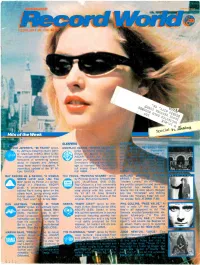
-FEBRUARY 28,1981 s Po, (tZtoo 4)0 1. .(1 C06/24,a402-(7/2,4 tE0 ic . ilistung SPeC:131.. SLEEPERS ND JEFFREYS, "96 TEARS" (prod. EMMYLOU HARRIS, -MISTER SAM' by Jeffreys-Clearmountain) (writ- (prod. by Ahern) (writer..f' er: Martinez) (ABKO, BMI) (3:06). (EdwinH.Morris&" The unforgettable organ riff intro ASCAP)(2:20).Putifr`!- forewarns of somethi-hg .special watch your speakers flo about to happen and Jeffreys' Emmylou's luscious voc vocal fever doesn't disappoint. .4 age to recreate the Ch marvelous update of the '67 hit full sound. Great for any to Epic 19-51008. WB 49684. RAY PARKER JR. & RAYDIO, "A WOMAN THE FOOLS, "RUNNING SCARED" (prod. GAHLANu NEEDS LOVE (JustLike You by Poncia) (writers: Orbison-Mel- ARTIST." From tha *Sr Do)" (prod. by Parker Jr.) (writer: son: (Acuff -Rose,BMI)(2:28). "Modern Lovers," it's obvious,k ParkerJr.)(Raydiola,ASCAP;, Roy Orbison is a hot commodity this prolific songwrte- and dramat (3:46). A velvet -smooth chorus these days and the Fools make a performerhasmeldedthetwo adorns Ray's loving tenor on the wise choice withthis cover of talents into his ideal album. Reggae classy hook, giviig st-ong multi - his'61 hit.Mike Girard's poplike"Christine" andchilling format appeal. From theJpco m- vocal captures the drama of the finales like "Mystery Kids" will cor- in g "Just Love" LP. A-ista 0592 original. EMI -America 8072. ner airplay. Epic JE 36983 (7.98) DAN HARTMAN, "HEAVEN IN YOUR HAWKS, "RIGHT AWAY" (prod. by Wer- PHIL COLLINS, "FACE VALUE." At ARMS" (prod. -

The Marshall Plan in Austria 69
CAS XXV CONTEMPORARY AUSTRIANAUSTRIAN STUDIES STUDIES | VOLUME VOLUME 25 25 This volume celebrates the study of Austria in the twentieth century by historians, political scientists and social scientists produced in the previous twenty-four volumes of Contemporary Austrian Studies. One contributor from each of the previous volumes has been asked to update the state of scholarship in the field addressed in the respective volume. The title “Austrian Studies Today,” then, attempts to reflect the state of the art of historical and social science related Bischof, Karlhofer (Eds.) • Austrian Studies Today studies of Austria over the past century, without claiming to be comprehensive. The volume thus covers many important themes of Austrian contemporary history and politics since the collapse of the Habsburg Monarchy in 1918—from World War I and its legacies, to the rise of authoritarian regimes in the 1930s and 1940s, to the reconstruction of republican Austria after World War II, the years of Grand Coalition governments and the Kreisky era, all the way to Austria joining the European Union in 1995 and its impact on Austria’s international status and domestic politics. EUROPE USA Austrian Studies Studies Today Today GünterGünter Bischof,Bischof, Ferdinand Ferdinand Karlhofer Karlhofer (Eds.) (Eds.) UNO UNO PRESS innsbruck university press UNO PRESS UNO PRESS innsbruck university press Austrian Studies Today Günter Bischof, Ferdinand Karlhofer (Eds.) CONTEMPORARY AUSTRIAN STUDIES | VOLUME 25 UNO PRESS innsbruck university press Copyright © 2016 by University of New Orleans Press All rights reserved under International and Pan-American Copyright Conventions. No part of this book may be reproduced or transmitted in any form, or by any means, electronic or mechanical, including photocopy, recording, or any information storage nd retrieval system, without prior permission in writing from the publisher. -
Progress in Empirical Research on Children's
Volume XII Number 2, November 1983 ISSN:0091-3995 Sex Information and Education Council of the U.S. PROGRESS IN EMPIRICAL RESEARCH ON CHILDREN’S SEXUALITY Ernest Borneman, PhD President, Austrian Society for Research in Sexology President, German Society for Research in Sociological Sexology [Throughout my years of attending local, regional, national, impossible in most countries of the western world. The result is and international conferences, I have rarely heard a paper that not only ignorance but a plethora of false information. provoked such intense and prolonged discussion as did Dr. When my first research team began its work some 40 years Ernest Borneman’s presentation at the Sixth World Congress of ago, we believed, for instance, that a boy’s first pollution (emis- Sexology he/d in Washington, D.C. in May 7983. For days after sion of semen at times other than during coitus) indicated that his talk, wherever conference participants gathered, someone his semen had become fertile. We believed, too, that a girl would invariably ask; “Did you hear Borneman’s paper!” and could not be impregnated before she had her menarche. We thus trigger engrossed interaction. Both the methodology and accepted these assumptions because they seemed obvious. It the interpretation of his findings prompted heated reaction never occurred to us to question or test them. pro and con. I a/so had the opportunity of using Dr. Borne- Then we heard of a nine-year-old girl who had been raped man’s paper with our New York University international and had borne a child prior to her menarche. -
Dissertation Committee for Michael James Schmidt Certifies That This Is the Approved Version of the Following Dissertation
Copyright by Michael James Schmidt 2014 The Dissertation Committee for Michael James Schmidt certifies that this is the approved version of the following dissertation: The Multi-Sensory Object: Jazz, the Modern Media, and the History of the Senses in Germany Committee: David F. Crew, Supervisor Judith Coffin Sabine Hake Tracie Matysik Karl H. Miller The Multi-Sensory Object: Jazz, the Modern Media, and the History of the Senses in Germany by Michael James Schmidt, B.A. Dissertation Presented to the Faculty of the Graduate School of The University of Texas at Austin In Partial Fulfillment Of the Requirements for the Degree of Doctor of Philosophy The University of Texas at Austin August 2014 To my family: Mom, Dad, Paul, and Lindsey Acknowledgements I would like to thank, above all, my advisor David Crew for his intellectual guidance, his encouragement, and his personal support throughout the long, rewarding process that culminated in this dissertation. It has been an immense privilege to study under David and his thoughtful, open, and rigorous approach has fundamentally shaped the way I think about history. I would also like to Judith Coffin, who has been patiently mentored me since I was a hapless undergraduate. Judy’s ideas and suggestions have constantly opened up new ways of thinking for me and her elegance as a writer will be something to which I will always aspire. I would like to express my appreciation to Karl Hagstrom Miller, who has poignantly altered the way I listen to and encounter music since the first time he shared the recordings of Ellington’s Blanton-Webster band with me when I was 20 years old. -
Uva-DARE (Digital Academic Repository)
UvA-DARE (Digital Academic Repository) "Our subcultural shit-music": Dutch jazz, representation, and cultural politics Rusch, L. Publication date 2016 Document Version Final published version Link to publication Citation for published version (APA): Rusch, L. (2016). "Our subcultural shit-music": Dutch jazz, representation, and cultural politics. General rights It is not permitted to download or to forward/distribute the text or part of it without the consent of the author(s) and/or copyright holder(s), other than for strictly personal, individual use, unless the work is under an open content license (like Creative Commons). Disclaimer/Complaints regulations If you believe that digital publication of certain material infringes any of your rights or (privacy) interests, please let the Library know, stating your reasons. In case of a legitimate complaint, the Library will make the material inaccessible and/or remove it from the website. Please Ask the Library: https://uba.uva.nl/en/contact, or a letter to: Library of the University of Amsterdam, Secretariat, Singel 425, 1012 WP Amsterdam, The Netherlands. You will be contacted as soon as possible. UvA-DARE is a service provided by the library of the University of Amsterdam (https://dare.uva.nl) Download date:27 Sep 2021 "Our Subcultural Shit-Music": Dutch Jazz, Representation, and Cultural Politics ACADEMISCH PROEFSCHRIFT ter verkrijging van de graad van doctor aan de Universiteit van Amsterdam op gezag van de Rector Magnificus prof. dr. D.C. van den Boom ten overstaan van een door het College voor Promoties ingestelde commissie, in het openbaar te verdedigen in de Agnietenkapel op dinsdag 17 mei 2016, te 14.00 uur door Loes Rusch geboren te Gorinchem Promotiecommissie: Promotor: Prof. -
Matthias Schriefl
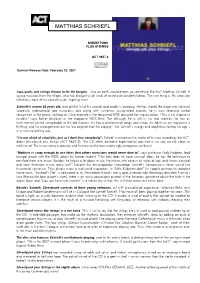
MATTHIAS SCHRIEFL SHREEFPUNK PLUS STRINGS ACT 9657-2 German Release Date: February 23, 2007 Jazz, punk, and strings thrown in for the bargain - who on earth would dream up something like this? Matthias Schriefl: A young musician from the Allgäu, who has brought us all kinds of weird and wonderful ideas. The nice thing is: His ideas are infectious; each of his concerts is an inspiring event. Schriefl is a mere 25 years old, and yet the list of his awards and credits is amazing. He has shared the stage with the most successful international jazz musicians, and along with numerous young-talent awards, he is now receiving similar recognition in the grown-up leagues. One example is the renowned WDR jazz prize for improvisation. “is no surprise to ” says Reiner ü in the magazine WDR-Print, “ although he is still in his mid twenties, he has an instrumental control comparable to the old masters: He has a phenomenal range and chops, his talent as an improviser is thrilling, and his arrangements are no less original than his ”. Yet, ’energy and playfulness betray his age û in a most refreshing way. “’not afraid of simplicity, just as I ’fear ” Schriefl summarises the motto of his new recording, the ACT- debut Shreefpunk plus Strings (ACT 9657-2). The CD offers daredevil experimental jazz that in no way sounds clean or intellectual. The music conveys passion and humour and allows surprisingly outrageous outbursts. “is crazy enough to use ideas that others musicians would never dare ”, says professor Andy Haderer, lead trumpet player with the WDR, about his former student. -

Iasa Journal (Formerly Phonographic Bulletin)
lasa• International Association of Sound Archives Association Internationale d'Archives Sonores Internationale Vereinigung der Schallarchive iasa journal (formerly Phonographic Bulletin) no. 3/May 1994 IASA JOURNAL Journal of the International Associa~on of Sound Archives IASA Organe de I'AsSociation Internationale d'Archives Sonores IASA Zeitschrift der Internationalen Vereinig'ung der Schallarchive IASA Editor:' Helen PHarrison, Open University Library ,Walton Hall, Milton Keynes, MK7 6AA. England. Fax: +44908 653744 . Reviews and RecenlPublications Editor: Pekka Gronow, Finnish Broadcasting Company, PO Box 10, SF ,00241, Helsinki, Finland. Fax: 358014802089 The IASA Journal is published twice a year and is sent to all members of IASA. Applications for membership inlASAshould be sent to the SecreU:irY General (see list of officers below), The annual dues are DM40 for individual members and DM110 for institutional members. Back copies of the IASA Journal from 1971 are available on application. Subscriptions to the current year's issues of the IASA Journal are also available to non-members at a cost of DM55. Le Journal de I'Association international d'archives sonores, le IASA Journal, est publie deux fois I'anet distribuea tous les membres. Veuillez envoyer vos demandes d'adhesion au secretaire dont vous trouverez l'adresse ci-dessous. Les cotisations annuelles sont en ce moment de DM40 pO!ll" les membres individuels et DMllOpour lesmembres institutionelles. Les numeros preceeentes (a partirde 1971) du IASA JOURNAL sont disponsib1es sur demande. Ceux qui ne sont pas menibres de I'Association peuvent obtenir un abonnement du IASA JOURNAL pour l'annre courante aucout de DM55. Da$IASA JOURNAL erscheint zweimal jahr!ich und geht alien Mitgliedern der IASA zu. -

Krautrock and the West German Counterculture
“Macht das Ohr auf” Krautrock and the West German Counterculture Ryan Iseppi A thesis submitted in partial fulfillment of the requirements for the degree of BACHELOR OF ARTS WITH HONORS DEPARTMENT OF GERMANIC LANGUAGES & LITERATURES UNIVERSITY OF MICHIGAN April 17, 2012 Advised by Professor Vanessa Agnew 2 Contents I. Introduction 5 Electric Junk: Krautrock’s Identity Crisis II. Chapter 1 23 Future Days: Krautrock Roots and Synthesis III. Chapter 2 33 The Collaborative Ethos and the Spirit of ‘68 IV: Chapter 3 47 Macht kaputt, was euch kaputt macht: Krautrock in Opposition V: Chapter 4 61 Ethnological Forgeries and Agit-Rock VI: Chapter 5 73 The Man-Machines: Krautrock and Electronic Music VII: Conclusion 85 Ultima Thule: Krautrock and the Modern World VIII: Bibliography 95 IX: Discography 103 3 4 I. Introduction Electric Junk: Krautrock’s Identity Crisis If there is any musical subculture to which this modern age of online music consumption has been particularly kind, it is certainly the obscure, groundbreaking, and oft misunderstood German pop music phenomenon known as “krautrock”. That krautrock’s appeal to new generations of musicians and fans both in Germany and abroad continues to grow with each passing year is a testament to the implicitly iconoclastic nature of the style; krautrock still sounds odd, eccentric, and even confrontational approximately twenty-five years after the movement is generally considered to have ended.1 In fact, it is difficult nowadays to even page through a recent issue of major periodicals like Rolling Stone or Spin without chancing upon some kind of passing reference to the genre. -
The Rise and Fall of the NEW Four Seasons 1966 to 1977 Chapter 99————Aftermathaftermath
The Rise and Fall of The NEW Four Seasons 1966 to 1977 Chapter 99————AftermathAftermath The end of the NEW Four Seasons left the fans dismayed at what was hap- pening. Communications were less speedy back then with no internet or cell phones and snail-mail between the UK and USA was as it is now…a week….but quarterly Newsletters kept fans informed of what was known, which was very little. Rumour and counter-rumour bounced around. John Paiva tried to keep the band together as an entity but the inability to trade on their name ( a contract limitation still in place today by lawyer Peter Bennett) and the expense of marketing them- selves (and touring) to their world wide fan base was something they didn’t feel they could do. And they needed a recording deal. Rex Woodard’s take on the period reveals the rumours and uncertainty …”The last concert of the tour had occurred at Radio City Music Hall on October 8. Warner-Curb wanted to tape the performance for an album but Private Stock, Valli’s label, refused permission. The actual final appearance took place on November 22nd 1977 at the Aladdin in Las Vegas. Fans reacted with puzzlement when the group quit singing any songs from the ‘Helicon’ album late in the tour. That hardly seemed to make sense since any future Four Seasons stage act would require new material to perform. Serious questions also arose as to who would remain in the new group. Valli announced that Lee Shapiro would split off to be Valli’s fulltime arranger.