Oil from Pumpkin (Cucurbita Pepo L.) Seeds: Evaluation Of
Total Page:16
File Type:pdf, Size:1020Kb
Load more
Recommended publications
-
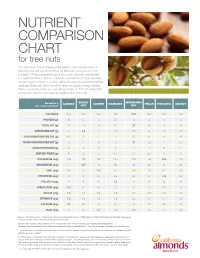
Nutrient Comparison Chart
NUTRIENT COMPARISON CHART for tree nuts You may know how to measure the perfect one-ounce portion of almonds, but did you know those 23 almonds come packed with nutrients? When compared ounce for ounce, almonds are the tree nut highest in fiber, calcium, vitamin E, riboflavin and niacin, and they are among the lowest in calories. Almonds provide a powerful nutrient package along with tasty crunch to keep you going strong, making them a satisfying snack you can feel good about. The following chart shows how almonds measure up against other tree nuts. BRAZIL MACADAMIA Based on a ALMOND CASHEW HAZELNUT PECAN PISTACHIO WALNUT one-ounce portion1 NUT NUT CALORIES 1602 190 160 180 200 200 160 190 PROTEIN (g) 6 4 4 4 2 3 6 4 TOTAL FAT (g) 14 19 13 17 22 20 13 19 SATURATED FAT (g) 1 4.5 3 1.5 3.5 2 1.5 1.5 POLYUNSATURATED FAT (g) 3.5 7 2 2 0.5 6 4 13 MONOUNSATURATED FAT (g) 9 7 8 13 17 12 7 2.5 CARBOHYDRATES (g) 6 3 9 5 4 4 8 4 DIETARY FIBER (g) 4 2 1.5 2.5 2.5 2.5 3 2 POTASSIUM (mg) 208 187 160 193 103 116 285 125 MAGNESIUM (mg) 77 107 74 46 33 34 31 45 ZINC (mg) 0.9 1.2 1.6 0.7 0.4 1.3 0.7 0.9 VITAMIN B6 (mg) 0 0 0.1 0.2 0.1 0.1 0.3 0.2 FOLATE (mcg) 12 6 20 32 3 6 14 28 RIBOFLAVIN (mg) 0.3 0 0.1 0 0 0 0.1 0 NIACIN (mg) 1.0 0.1 0.4 0.5 0.7 0.3 0.4 0.3 VITAMIN E (mg) 7.3 1.6 0.3 4.3 0.2 0.4 0.7 0.2 CALCIUM (mg) 76 45 13 32 20 20 30 28 IRON (mg) 1.1 0.7 1.7 1.3 0.8 0.7 1.1 0.8 Source: U.S. -

Alopecia Areata, Pumpkin Seed Oil, Sesame Oil
American Journal of Dermatology and Venereology 2019, 8(2): 28-32 DOI: 10.5923/j.ajdv.20190802.03 Sesame and Pumpkin Seed Oil are New Effective Topical Therapies for Alopecia Areata Khalifa E. Sharquie1,2,*, Adil A. Noaimi1,2, Muna S. Abass3 1Department of Dermatology, College of Medicine, University of Baghdad 2Iraqi and Arab Board for Dermatology and Venereology, Center of Dermatology and Venereology, Medical City, Baghdad, Iraq 3Center of Dermatology and Venereology, Medical City, Baghdad, Iraq Abstract Background: There are numerous topical and systemic therapies for alopecia areata. Pumpkin seed oil and sesame oil are edible food stuff, but they have many active therapeutic agents that could be useful in treatment of inflammatory diseases like alopecia areata. Objectives: To find new topical treatment for alopecia areata using plants extracts like pumpkin seed oil and sesame oil. Patients and methods: This interventional, single blinded comparative, therapeutic study conducted in Center of Dermatology, Medical City-Baghdad, Iraq during the period between September 2017 and September 2018. Forty patients, with patchy alopecia areata were enrolled with a total number of lesions were 122 patches. History and examination were done for each patient regarding all socio-demographics points related to the disease. The patients were divided into 2 groups according to type of treatment: Group using topical pumpkin seed oil: twenty patients with 58 patches were included in this group and topical pumpkin seed oil was applied twice daily to the patches, treatment continued for three months. Group B using topical sesame oil: twenty patients with 64 patches were enrolled in this group and topical sesame oil was applied to the patches twice a day for three months duration. -

List of Legumes
Healthy Oils & SmokePoints When it comes to the cooking oil in your cupboard, there is a huge difference in healthfulness depending on how the oil is stored and how it will be used. First let’s get some definitions for commonly used terms on labels and discussions about oils. Term Definition Cold Pressed Extracted without using heat. Extracted using a screw-type machine that presses the oil out. Can be done Expeller Pressed slowly, with very little heat, or can be done quickly with lots of friction and high temperatures. The first cold pressing which contains the best tasting and most healthful oils. Must contain less than 1% acids. By definition, this is cold-pressed and first Extra Virgin pressed, so don’t need to see these terms on the label. Must say 100% extra virgin, or may be a blend. The first cold pressing, but can contain a little more acids than the extra-virgin Virgin (1-3 percent). Seeds that have been genetically manipulated to decrease the amount of High Oleic essential fatty acids so that they have a longer shelf life. Are left in their state after pressing – no filtering. These oils tend to be more Unrefined Oils flavorful and richer in nutrients, however they have a very low smoke point. Oils have their impurities filtered out, to increase stability and allow for higher Refined temperature cooking. The processing can use toxic solvents, caustic soda, bleaches and phosphoric acid. Smoke Point Stage at which a heated oil begins to smoke, just before it bursts into flames. HEALTHY OILS & SMOKE POINTS PAGE | 1 © 2021 Health-Naturally.org Term Definition Oil should smell and taste like the food it came from. -

Basil Dolce Fresca
BASIL DOLCE FRESCA Ocimum basilicum BASIL PERSIAN Ocimum basilicum BEAN MASCOTTE Phaseolus vulgaris BEAN SEYCHELLES Phaseolus vulgaris BEET AVALANCHE Beta vulgaris BROCCOLI ARTWORK F1 Brassica oleracea Italica BRUSSELS SPROUTS HESTIA F1 Brassica oleracea CABBAGE KATARINA F1 Brassica oleracea (Capitata group) CHIVES, GARLIC GEISHA Allium tuberosum CUCUMBER PARISIAN GHERKIN F1 Cucumis sativus CUCUMBER PICK A BUSHEL F1 Cucumis sativus CUCUMBER SALADMORE BUSH F1 Cucumis sativus EGGPLANT PATIO BABY F1 Solanum melongena FENNEL ANTARES F1 Foeniculum vulgare KALE PRIZM F1 Brassica oleracea (Acephala Group) KOHLRABI KONAN F1 Brassica oleracea LETTUCE SANDY Lactuca sativa MELON MELEMON F1 Cucumis melo L. MIZUNA RED KINGDOM F1 Brassica juncea OKRA CANDLE FIRE F1 Abelmoschus esculentus ONION, BUNCHING WARRIOR Allium fistulosusm OREGANO CLEOPATRA Origanum syriaca PAK CHOI BOPAK F1 Brassica rapa chinensis PEA PATIO PRIDE Pisum sativum PEPPER AJI RICO F1 Capsicum baccatum PEPPER CHILI PIE F1 Capsicum annuum PEPPER CORNITO GIALLO F1 Capsicum annuum PEPPER EMERALD FIRE F1 Capsicum annuum PEPPER ESCAMILLO F1 Capsicum annuum PEPPER FLAMING FLARE F1 Capsicum annuum PEPPER GIANT RISTRA F1 Capsicum annuum PEPPER HOT SUNSET F1 Capsicum annuum PEPPER MAD HATTER F1 Capsicum baccatum PEPPER MAMA MIA GIALLO F1 Capsicum annuum PEPPER PRETTY N SWEET F1 Capsicum annuum PEPPER SWEET SUNSET F1 Capsicum annuum PEPPER SWEETIE PIE F1 Capsicum annuum PEPPER SERRANO FLAMING JADE F1 Capsicum annuum PUMPKIN CINDERELLA'S CARRIAGE F1 Cucurbita maxima PUMPKIN PEPITAS F1 Cucurbita pepo PUMPKIN SUPER MOON F1 Cucurbita maxima RADISH RIVOLI Raphanus sativus RADISH ROXANNE F1 Raphanus sativus RADISH SWEET BABY F1 Raphanus sativus SQUASH BOSSA NOVA F1 Cucurbita pepo SQUASH BUTTERSCOTCH F1 Cucurbita moschata SQUASH HONEYBABY F1 Cucurbita moschata SQUASH SUGARETTI F1 Cucurbita pepo STRAWBERRY DELIZZ F1 Fragaria F. -
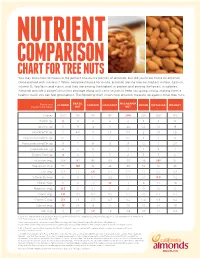
Chart for Tree Nuts
NUTRIENT COMPARISON CHART FOR TREE NUTS You may know how to measure the perfect one-ounce portion of almonds, but did you know those 23 almonds come packed with nutrients? When compared ounce for ounce, almonds are the tree nut highest in fiber, calcium, vitamin E, riboflavin and niacin, and they are among the highest in protein and among the lowest in calories. Almonds provide a powerful nutrient package along with tasty crunch to keep you going strong, making them a healthy snack you can feel good about. The following chart shows how almonds measure up against other tree nuts. BRAZIL MACADAMIA Based on a ALMOND CASHEW HAZELNUT PECAN PISTACHIO WALNUT one-ounce portion1 NUT NUT Calories 1602 190 160 180 200 200 160 190 Protein (g) 6 4 4 4 2 3 6 4 Total Fat (g) 14 19 13 17 22 20 13 18 Saturated Fat (g) 1 4.5 3 1.5 3.5 2 1.5 1.5 Polyunsaturated Fat (g) 3.5 7 2 2 0.5 6 4 13 Monounsaturated Fat (g) 9 7 8 13 17 12 7 2.5 Carbohydrates (g) 6 3 9 5 4 4 8 4 Dietary Fiber (g) 4 2 1 3 2 3 3 2 Potassium (mg) 208 187 160 193 103 116 285 125 Magnesium (mg) 77 107 74 46 33 34 31 45 Zinc (mg) 0.9 1.2 1.6 0.7 0.4 1.3 0.7 0.9 Vitamin B6 (mg) 0 0 0.1 0.2 0.1 0.1 0.3 0.2 Folate (mcg) 12 6 20 32 3 6 14 28 Riboflavin (mg) 0.3 0 0.1 0 0 0 0.1 0 Niacin (mg) 1.0 0.1 0.4 0.5 0.7 0.3 0.4 0.3 Vitamin E (mg) 7.3 1.6 0.3 4.3 0.2 0.4 0.6 0.2 Calcium (mg) 76 45 13 32 20 20 30 28 Iron (mg) 1.1 0.7 1.7 1.3 0.8 0.7 1.1 0.8 Source: U.S. -
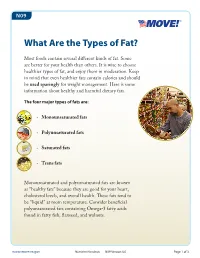
Nutrition Handout N09: What Are the Types of Fat?
N09 What Are the Types of Fat? Most foods contain several different kinds of fat. Some are better for your health than others. It is wise to choose healthier types of fat, and enjoy them in moderation. Keep in mind that even healthier fats contain calories and should be used sparingly for weight management. Here is some information about healthy and harmful dietary fats. The four major types of fats are: • Monounsaturated fats • Polyunsaturated fats • Saturated fats • Trans fats Monounsaturated and polyunsaturated fats are known as “healthy fats” because they are good for your heart, cholesterol levels, and overall health. These fats tend to be “liquid” at room temperature. Consider beneficial polyunsaturated fats containing Omega-3 fatty acids found in fatty fish, flaxseed, and walnuts. www.move.va.gov Nutrition Handouts • N09 Version 5.0 Page 1 of 3 Healthy Dietary Fats Monounsaturated Fat Polyunsaturated Fat Olive oil Soybean oil Canola oil Corn oil Sunflower oil Safflower oil Peanut oil Walnuts Olives Sunflower, sesame, and pumpkin seeds; flaxseed Nuts (almonds, peanuts, hazelnuts, Fatty fish (salmon, tuna, mackerel, herring, macadamia nuts, pecans, cashews) trout, anchovies, sardines, and eel) Avocados Soymilk Peanut butter Tofu Tips for increasing healthy fats in your diet: • Cook with olive oil. • Plan snacks of nuts or olives. • Eat more avocados. • Dress your own salads instead of using commercial dressings. Saturated fats and trans fats are known as the “harmful fats.” They increase your risk of disease and elevate cholesterol. Saturated fats tend to be solid at room temperature, but they are also found in liquid tropical oils (palm and coconut). -
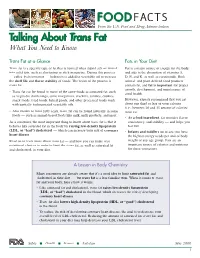
Talking About Trans Fat: What You Need to Know
FOODFACTS From the U.S. Food and Drug Administration Talking About Trans Fat What You Need to Know Trans Fat at-a-Glance Fats in Your Diet Trans fat is a specific type of fat that is formed when liquid oils are turned Fat is a major source of energy for the body, into solid fats, such as shortening or stick margarine. During this process and aids in the absorption of vitamins A, — called hydrogenation — hydrogen is added to vegetable oil to increase D, E, and K, as well as carotenoids. Both the shelf life and flavor stability of foods. The result of the process is animal- and plant-derived food products trans fat. contain fat, and fat is important for proper growth, development, and maintenance of • fat can be found in many of the same foods as saturated fat, such Trans good health. as vegetable shortenings, some margarines, crackers, candies, cookies, snack foods, fried foods, baked goods, and other processed foods made However, experts recommend that you get with partially hydrogenated vegetable oils. about one third or less of your calories (i.e., between 20 and 35 percent of calories) • Also known as trans fatty acids, trans fat can be found naturally in some from fat. foods — such as animal-based foods like milk, milk products, and meat. • As a food ingredient, fat provides flavor, As a consumer, the most important thing to know about trans fat is that it consistency, and stability — and helps you behaves like saturated fat in the body by raising low-density lipoprotein feel full. -

The Growing Importance of Local Pumpkin Seed Oil Production in Slovenia
Acta Ethnographica Hungarica 62(2), 373–388 (2017) DOI: 10.1556/022.2017.62.2.6 The Growing Importance of Local Pumpkin Seed Oil Production in Slovenia Maja Godina Golija Institute of Slovenian Ethnology, ZRC SAZU Abstract: Food represents a significant segment of human culture. It is not only a component of the material world and a means to satisfy basic biological needs, but also plays an important role in the economic and social life of the individual and community. Until the middle of the 20th century, the food culture of the Slovene population strongly depended on regional origin. Pumpkin seed oil has a special dietary role and a long tradition among the inhabitants of North- East Slovenia and the cultivation of oil seed pumpkins and production of pumpkin seed oil in the region was already mentioned in 18th century. Slovene pumpkin seed oil is of high-quality and is processed according to the traditional procedure. Since 2005, Styrian-Prekmurje pumpkin seed oil has been protected in the European Union with the Geographical Indication-PGI. Nowadays, the pumpkin seed oil is also becoming an important expression of regional affiliation and a notable factor of economic development in Prekmurje, Porabje and Štajerska, especially significant for tourism, catering and the production of traditional rural products. Keywords: pumpkin seed oil, food culture, Slovenia, economic development, tourism, heritage INTRODUCTION The production, preparation, and consumption of food are among the most basic of human activities and are associated with those rare cultural goods that are produced on a daily basis (Wiegelmann 2006:13). In past centuries, when the majority of the European as well as the Slovene population depended on their own food production, most of their economic activities were connected with it. -

Buffalo Gourd (Family Cucurbitaceae, Cucurbita Foetidissima)
Buffalo Gourd (Family Cucurbitaceae, Cucurbita foetidissima) By Gerald R Noonan PhD May 2013 © May 2013 Buffalo Gourds are a common sight along the trails near the San Pedro House and in many other parts of SPRNCA. They grow as a prostate vine that spreads along the ground and may grow up to 20 feet long. The leaves are relatively large, up to approximately a foot in length, grayish green above and whitish beneath. The triangular shaped leaves have fine teeth along the margins and are born on relatively long stalks. During approximately May to August, yellow flowers appear. They are funnel shaped, five-lobed, about 4 inches long, and have the basic ribbed and with veins. The flowers open very early in the day and are pollinated by bees. Pollinated flowers each produce a gourd that is approximately 4 inches long, round, and predominantly dark green but with light stripes. The gourds eventually mature to an even yellow color and with continued exposure to the sun become whitish in appearance. Buffalo Gourds are perennial, die back in the winter, and then grow back from the large root when weather becomes warmer. The triangular shaped leaves distinguish this plant from the other two gourd producing species of vines that occur in SPRNCA. Finger-leaved Gourds differ by having central silvery white markings on the tops of the five narrow fingerlike segments of each leaf. Melon Loco plants differ by having leaves that are roundish or kidney shaped, approximately 2-6 inches wide, and with irregular jagged edges or pleats. Buffalo Gourds occur in roadsides and in dry or sandy areas. -
University of Florida Thesis Or Dissertation Formatting
GENETICS AND EVOLUTION OF MULTIPLE DOMESTICATED SQUASHES AND PUMPKINS (Cucurbita, Cucurbitaceae) By HEATHER ROSE KATES A DISSERTATION PRESENTED TO THE GRADUATE SCHOOL OF THE UNIVERSITY OF FLORIDA IN PARTIAL FULFILLMENT OF THE REQUIREMENTS FOR THE DEGREE OF DOCTOR OF PHILOSOPHY UNIVERSITY OF FLORIDA 2017 © 2017 Heather Rose Kates To Patrick and Tomás ACKNOWLEDGMENTS I am grateful to my advisors Douglas E. Soltis and Pamela S. Soltis for their encouragement, enthusiasm for discovery, and generosity. I thank the members of my committee, Nico Cellinese, Matias Kirst, and Brad Barbazuk, for their valuable feedback and support of my dissertation work. I thank my first mentor Michael J. Moore for his continued support and for introducing me to botany and to hard work. I am thankful to Matt Johnson, Norman Wickett, Elliot Gardner, Fernando Lopez, Guillermo Sanchez, Annette Fahrenkrog, Colin Khoury, and Daniel Barrerra for their collaborative efforts on the dissertation work presented here. I am also thankful to my lab mates and colleagues at the University of Florida, especially Mathew A. Gitzendanner for his patient helpfulness. Finally, I thank Rebecca L. Stubbs, Andrew A. Crowl, Gregory W. Stull, Richard Hodel, and Kelly Speer for everything. 4 TABLE OF CONTENTS page ACKNOWLEDGMENTS .................................................................................................. 4 LIST OF TABLES ............................................................................................................ 9 LIST OF FIGURES ....................................................................................................... -
UNIVERSITY of CALIFORNIA, SAN DIEGO Pollinator Effectiveness Of
UNIVERSITY OF CALIFORNIA, SAN DIEGO Pollinator Effectiveness of Peponapis pruinosa and Apis mellifera on Cucurbita foetidissima A Thesis submitted in partial satisfaction of the requirements for the degree Master of Science in Biology by Jeremy Raymond Warner Committee in charge: Professor David Holway, Chair Professor Joshua Kohn Professor James Nieh 2017 © Jeremy Raymond Warner, 2017 All rights reserved. The Thesis of Jeremy Raymond Warner is approved and it is acceptable in quality and form for publication on microfilm and electronically: ________________________________________________________________ ________________________________________________________________ ________________________________________________________________ Chair University of California, San Diego 2017 iii TABLE OF CONTENTS Signature Page…………………………………………………………………………… iii Table of Contents………………………………………………………………………... iv List of Tables……………………………………………………………………………... v List of Figures……………………………………………………………………………. vi List of Appendices………………………………………………………………………. vii Acknowledgments……………………………………………………………………... viii Abstract of the Thesis…………………………………………………………………… ix Introduction………………………………………………………………………………. 1 Methods…………………………………………………………………………………... 5 Study System……………………………………………..………………………. 5 Pollinator Effectiveness……………………………………….………………….. 5 Data Analysis……..…………………………………………………………..….. 8 Results…………………………………………………………………………………... 10 Plant trait regressions……………………………………………………..……... 10 Fruit set……………………………………………………...…………………... 10 Fruit volume, seed number, -

Evaluation of Essential Oils and Extracts of Rose Geranium and Rose Petals As Natural Preservatives in Terms of Toxicity, Antimicrobial, and Antiviral Activity
pathogens Article Evaluation of Essential Oils and Extracts of Rose Geranium and Rose Petals as Natural Preservatives in Terms of Toxicity, Antimicrobial, and Antiviral Activity Chrysa Androutsopoulou 1, Spyridoula D. Christopoulou 2, Panagiotis Hahalis 3, Chrysoula Kotsalou 1, Fotini N. Lamari 2 and Apostolos Vantarakis 1,* 1 Department of Public Health, Faculty of Medicine, University of Patras, 26504 Patras, Greece; chrysandr@gmail.com (C.A.); chrysoulakotsalou@gmail.com (C.K.) 2 Laboratory of Pharmacognosy & Chemistry of Natural Products, Department of Pharmacy, University of Patras, 26504 Patras, Greece; spiridoulaxr@windowslive.com (S.D.C.); flam@upatras.gr (F.N.L.) 3 Tentoura Castro-G.P. Hahalis Distillery, 26225 Patras, Greece; hahalis@tentoura.gr * Correspondence: avanta@upatras.gr Abstract: Essential oils (EOs) and extracts of rose geranium (Pelargonium graveolens) and petals of rose (Rosa damascena) have been fully characterized in terms of composition, safety, antimicrobial, and antiviral properties. They were analyzed against Escherichia coli, Salmonella enterica serovar Typhimurium, Staphylococcus aureus, Aspergillus niger, and Adenovirus 35. Their toxicity and life span were also determined. EO of P. graveolens (5%) did not retain any antibacterial activity (whereas at Citation: Androutsopoulou, C.; 100% it was greatly effective against E. coli), had antifungal activity against A. niger, and significant Christopoulou, S.D.; Hahalis, P.; antiviral activity. Rose geranium extract (dilutions 25−90%) (v/v) had antifungal and antibacterial Kotsalou, C.; Lamari, F.N.; Vantarakis, activity, especially against E. coli, and dose-dependent antiviral activity. Rose petals EO (5%) retains A. Evaluation of Essential Oils and low inhibitory activity against S. aureus and S. Typhimurium growth (about 20−30%), antifungal Extracts of Rose Geranium and Rose activity, and antiviral activity for medium to low virus concentrations.