2013 Southern Division Spring Meeting, Nashville, Tennessee
Total Page:16
File Type:pdf, Size:1020Kb
Load more
Recommended publications
-
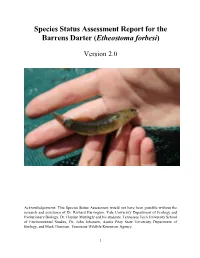
Species Status Assessment Report for the Barrens Darter (Etheostoma Forbesi)
Species Status Assessment Report for the Barrens Darter (Etheostoma forbesi) Version 2.0 Acknowledgements: This Species Status Assessment would not have been possible without the research and assistance of Dr. Richard Harrington, Yale University Department of Ecology and Evolutionary Biology, Dr. Hayden Mattingly and his students, Tennessee Tech University School of Environmental Studies, Dr. John Johansen, Austin Peay State University Department of Biology, and Mark Thurman, Tennessee Wildlife Resources Agency. 1 TABLE OF CONTENTS Chapter 1: Introduction ............................................................................................................... 3 Chapter 2: Biology and Life History ........................................................................................... 4 Taxonomy ................................................................................................................................ 4 Genetic Diversity ..................................................................................................................... 5 Morphological Description ...................................................................................................... 5 Habitat ..................................................................................................................................... 6 Lifecycle .................................................................................................................................. 7 Population Needs .................................................................................................................... -

C:\Fish\Eastern Sand Darter Sa.Wpd
EASTERN SAND DARTER STATUS ASSESSMENT Prepared by: David Grandmaison and Joseph Mayasich Natural Resources Research Institute University of Minnesota 5013 Miller Trunk Highway Duluth, MN 55811-1442 and David Etnier Ecology and Evolutionary Biology University of Tennessee 569 Dabney Hall Knoxville, TN 37996-1610 Prepared for: U.S. Fish and Wildlife Service Region 3 1 Federal Drive Fort Snelling, MN 55111 January 2004 NRRI Technical Report No. NRRI/TR-2003/40 DISCLAIMER This document is a compilation of biological data and a description of past, present, and likely future threats to the eastern sand darter, Ammocrypta pellucida (Agassiz). It does not represent a decision by the U.S. Fish and Wildlife Service (Service) on whether this taxon should be designated as a candidate species for listing as threatened or endangered under the Federal Endangered Species Act. That decision will be made by the Service after reviewing this document; other relevant biological and threat data not included herein; and all relevant laws, regulations, and policies. The result of the decision will be posted on the Service's Region 3 Web site (refer to: http://midwest.fws.gov/eco_serv/endangrd/lists/concern.html). If designated as a candidate species, the taxon will subsequently be added to the Service's candidate species list that is periodically published in the Federal Register and posted on the World Wide Web (refer to: http://endangered.fws.gov/wildlife.html). Even if the taxon does not warrant candidate status it should benefit from the conservation recommendations that are contained in this document. ii TABLE OF CONTENTS DISCLAIMER................................................................... -

Endangered Species
FEATURE: ENDANGERED SPECIES Conservation Status of Imperiled North American Freshwater and Diadromous Fishes ABSTRACT: This is the third compilation of imperiled (i.e., endangered, threatened, vulnerable) plus extinct freshwater and diadromous fishes of North America prepared by the American Fisheries Society’s Endangered Species Committee. Since the last revision in 1989, imperilment of inland fishes has increased substantially. This list includes 700 extant taxa representing 133 genera and 36 families, a 92% increase over the 364 listed in 1989. The increase reflects the addition of distinct populations, previously non-imperiled fishes, and recently described or discovered taxa. Approximately 39% of described fish species of the continent are imperiled. There are 230 vulnerable, 190 threatened, and 280 endangered extant taxa, and 61 taxa presumed extinct or extirpated from nature. Of those that were imperiled in 1989, most (89%) are the same or worse in conservation status; only 6% have improved in status, and 5% were delisted for various reasons. Habitat degradation and nonindigenous species are the main threats to at-risk fishes, many of which are restricted to small ranges. Documenting the diversity and status of rare fishes is a critical step in identifying and implementing appropriate actions necessary for their protection and management. Howard L. Jelks, Frank McCormick, Stephen J. Walsh, Joseph S. Nelson, Noel M. Burkhead, Steven P. Platania, Salvador Contreras-Balderas, Brady A. Porter, Edmundo Díaz-Pardo, Claude B. Renaud, Dean A. Hendrickson, Juan Jacobo Schmitter-Soto, John Lyons, Eric B. Taylor, and Nicholas E. Mandrak, Melvin L. Warren, Jr. Jelks, Walsh, and Burkhead are research McCormick is a biologist with the biologists with the U.S. -

Game, Fish, Furbearers, and Other Wildlife
ALABAMA REGULATIONS 2019-2020 GAME, FISH, FURBEARERS, AND OTHER WILDLIFE REGULATIONS RELATING TO GAME, FISH, FURBEARERS AND OTHER WILDLIFE KAY IVEY Governor CHRISTOPHER M. BLANKENSHIP Commissioner EDWARD F. POOLOS Deputy Commissioner CHUCK SYKES Director FRED R. HARDERS Assistant Director The Department of Conservation and Natural Resources does not discriminate on the basis of race, color, religion, age, gender, national origin or disability in its hiring or employment practices nor in admission to, access to, or operations of its programs, services or activities. This publication is available in alternative formats upon request. O.E.O. U.S. Department of the Interior Washington, D.C. 20204 TABLE OF CONTENTS Division of Wildlife and Freshwater Fisheries Personnel: • Administrative Office .......................................... 1 • Aquatic Education ................................................ 8 • Carbon Hill Fish Hatchery ................................... 7 • Eastaboga Fish Hatchery ...................................... 7 • Federal Game Agents ............................................ 5 • Fisheries Section ................................................... 6 • Fisheries Development ......................................... 8 • Hunter Education ................................................ 11 • Law Enforcement Section ..................................... 2 • Marion Fish Hatchery ........................................... 7 • Mussel Management ............................................. 6 • Non-game Wildlife ........................................... -
Part IV: Scoring Criteria for the Index of Biotic Integrity to Monitor
Part IV: Scoring Criteria for the Index of Biotic Integrity to Monitor Fish Communities in Wadeable Streams in the Coosa and Tennessee Drainage Basins of the Ridge and Valley Ecoregion of Georgia Georgia Department of Natural Resources Wildlife Resources Division Fisheries Management Section 2020 Table of Contents Introduction………………………………………………………………… ……... Pg. 1 Map of Ridge and Valley Ecoregion………………………………..……............... Pg. 3 Table 1. State Listed Fish in the Ridge and Valley Ecoregion……………………. Pg. 4 Table 2. IBI Metrics and Scoring Criteria………………………………………….Pg. 5 References………………………………………………….. ………………………Pg. 7 Appendix 1…………………………………………………………………. ………Pg. 8 Coosa Basin Group (ACT) MSR Graphs..………………………………….Pg. 9 Tennessee Basin Group (TEN) MSR Graphs……………………………….Pg. 17 Ridge and Valley Ecoregion Fish List………………………………………Pg. 25 i Introduction The Ridge and Valley ecoregion is one of the six Level III ecoregions found in Georgia (Part 1, Figure 1). It is drained by two major river basins, the Coosa and the Tennessee, in the northwestern corner of Georgia. The Ridge and Valley ecoregion covers nearly 3,000 square miles (United States Census Bureau 2000) and includes all or portions of 10 counties (Figure 1), bordering the Piedmont ecoregion to the south and the Blue Ridge ecoregion to the east. A small portion of the Southwestern Appalachians ecoregion is located in the upper northwestern corner of the Ridge and Valley ecoregion. The biotic index developed by the GAWRD is based on Level III ecoregion delineations (Griffith et al. 2001). The metrics and scoring criteria adapted to the Ridge and Valley ecoregion were developed from biomonitoring samples collected in the two major river basins that drain the Ridge and Valley ecoregion, the Coosa (ACT) and the Tennessee (TEN). -
Fishtraits: a Database on Ecological and Life-History Traits of Freshwater
FishTraits database Traits References Allen, D. M., W. S. Johnson, and V. Ogburn-Matthews. 1995. Trophic relationships and seasonal utilization of saltmarsh creeks by zooplanktivorous fishes. Environmental Biology of Fishes 42(1)37-50. [multiple species] Anderson, K. A., P. M. Rosenblum, and B. G. Whiteside. 1998. Controlled spawning of Longnose darters. The Progressive Fish-Culturist 60:137-145. [678] Barber, W. E., D. C. Williams, and W. L. Minckley. 1970. Biology of the Gila Spikedace, Meda fulgida, in Arizona. Copeia 1970(1):9-18. [485] Becker, G. C. 1983. Fishes of Wisconsin. University of Wisconsin Press, Madison, WI. Belk, M. C., J. B. Johnson, K. W. Wilson, M. E. Smith, and D. D. Houston. 2005. Variation in intrinsic individual growth rate among populations of leatherside chub (Snyderichthys copei Jordan & Gilbert): adaptation to temperature or length of growing season? Ecology of Freshwater Fish 14:177-184. [349] Bonner, T. H., J. M. Watson, and C. S. Williams. 2006. Threatened fishes of the world: Cyprinella proserpina Girard, 1857 (Cyprinidae). Environmental Biology of Fishes. In Press. [133] Bonnevier, K., K. Lindstrom, and C. St. Mary. 2003. Parental care and mate attraction in the Florida flagfish, Jordanella floridae. Behavorial Ecology and Sociobiology 53:358-363. [410] Bortone, S. A. 1989. Notropis melanostomus, a new speices of Cyprinid fish from the Blackwater-Yellow River drainage of northwest Florida. Copeia 1989(3):737-741. [575] Boschung, H.T., and R. L. Mayden. 2004. Fishes of Alabama. Smithsonian Books, Washington. [multiple species] 1 FishTraits database Breder, C. M., and D. E. Rosen. 1966. Modes of reproduction in fishes. -

TIMS FORD RESERVOIR Volume I
TIMS FORD RESERVOIR LAND MANAGEMENT AND DISPOSITION PLAN Volume I FINAL ENVIRONMENTAL IMPACT STATEMENT JUNE 2000 This page intentionally left blank Federal Register / Vol. 65, No. 217 / Wednesday, November 8, 2000 / Notices 67033 TENNESSEE VALLEY AUTHORITY purchasers who voluntarily seek to improvements for their electrical energy contract with TVA are affected. customers. Paperwork Reduction Act of 1995, as amended by P.L. 104±13; Submission Jacklyn J. Stephenson, Jacklyn J. Stephenson, for OMB Review; Comment Request Senior Manager, Enterprise Operations, Senior Manager, Enterprise Operations, Information Services. Information Services. AGENCY: Tennessee Valley Authority. [FR Doc. 00±28667 Filed 11±7±00; 8:45 am] [FR Doc. 00±28668 Filed 11±7±00; 8:45 am] ACTION: Submission for OMB Review; BILLING CODE 8120±08±P BILLING CODE 8120±08±P comment request. SUMMARY: The proposed information TENNESSEE VALLEY AUTHORITY TENNESSEE VALLEY AUTHORITY collection described below will be Paperwork Reduction Act of 1995, as Tims Ford Reservoir Land submitted to the Office of Management Amended by P.L. 104±13; Submission Management and Disposition Plan, and Budget (OMB) for review, as for OMB Review; Comment Request Franklin and Moore Counties, required by the Paperwork Reduction Tennessee Act of 1995 (44 U.S.C. Chapter 35, as AGENCY: Tennessee Valley Authority. amended). The Tennessee Valley AGENCY: Tennessee Valley Authority Authority is soliciting public comments ACTION: Submission for OMB review; (TVA). on this proposed collection as provided comment request. by 5 CFR Section 1320.8(d)(1). Requests ACTION: Issuance of Record of Decision. for information, including copies of the SUMMARY: The proposed information information collection proposed and collection described below will be SUMMARY: This notice is provided in supporting documentation should be submitted to the Office of Management accordance with the Council on directed to the Agency Clearance and Budget (OMB) for review, as Environmental Quality's regulations (40 Officer: Wilma H. -

Economic Impact of Recreational Fishing in Alabama Gbenga Ojumu Prairie View A&M University, Oaojumu@Pvamu.Edu
Professional Agricultural Workers Journal Volume 3 5 Number 2 Professional Agricultural Workers Journal 4-6-2016 Economic Impact of Recreational Fishing in Alabama Gbenga Ojumu Prairie View A&M University, oaojumu@pvamu.edu Diane Hite Auburn University Deacue Fields Auburn University, fieldde@auburn.edu Follow this and additional works at: http://tuspubs.tuskegee.edu/pawj Part of the Agricultural Economics Commons, and the Aquaculture and Fisheries Commons Recommended Citation Ojumu, Gbenga; Hite, Diane; and Fields, Deacue (2016) "Economic Impact of Recreational Fishing in Alabama," Professional Agricultural Workers Journal: Vol. 3: No. 2, 5. Available at: http://tuspubs.tuskegee.edu/pawj/vol3/iss2/5 This Article is brought to you for free and open access by Tuskegee Scholarly Publications. It has been accepted for inclusion in Professional Agricultural Workers Journal by an authorized administrator of Tuskegee Scholarly Publications. For more information, please contact craig@mytu.tuskegee.edu. ECONOMIC IMPACT OF RECREATIONAL FISHING IN ALABAMA *Gbenga Ojumu1, Diane Hite2, and Deacue Fields2 1Prairie View A&M University, Prairie, TX 2Auburn University, Auburn, AL Email of lead author: oaojumu@pvamu.edu Abstract Anglers’ direct mail survey data were used with IMPLAN (Impact Analysis for Planning), input- output system, to estimate the economic impact of recreational fishing in Alabama and the Alabama Black Belt. Separate economic impacts are analyzed for the Black Belt and the State; and direct, indirect, and induced economic impacts were estimated for government revenues, income, and employment. Possible increases in these impacts were also estimated for hypothetically improved recreational fishing sites, using the ‘ideal’ hypothetical site characteristics. The results showed a direct total value added impact of $102.5m; indirect impact of $24.7m, and an induced impact of $8.3m, which all add up to a total impact of $135.5m in total value added to the State. -

Geological Survey of Alabama Calibration of The
GEOLOGICAL SURVEY OF ALABAMA Berry H. (Nick) Tew, Jr. State Geologist ECOSYSTEMS INVESTIGATIONS PROGRAM CALIBRATION OF THE INDEX OF BIOTIC INTEGRITY FOR THE SOUTHERN PLAINS ICHTHYOREGION IN ALABAMA OPEN-FILE REPORT 1210 by Patrick E. O'Neil and Thomas E. Shepard Prepared in cooperation with the Alabama Department of Environmental Management and the Alabama Department of Conservation and Natural Resources Tuscaloosa, Alabama 2012 TABLE OF CONTENTS Abstract ............................................................ 1 Introduction.......................................................... 2 Acknowledgments .................................................... 6 Objectives........................................................... 7 Study area .......................................................... 7 Southern Plains ichthyoregion ...................................... 7 Methods ............................................................ 9 IBI sample collection ............................................. 9 Habitat measures............................................... 11 Habitat metrics ........................................... 12 The human disturbance gradient ................................... 16 IBI metrics and scoring criteria..................................... 20 Designation of guilds....................................... 21 Results and discussion................................................ 23 Sampling sites and collection results . 23 Selection and scoring of Southern Plains IBI metrics . 48 Metrics selected for the -

Final Environmental Assessment
Document Type: EA-Administrative Record Index Field: Final EA Project Name: Cumberland Solar Project Project Number: 2017-11 CUMBERLAND SOLAR PROJECT Limestone County, Alabama FINAL ENVIRONMENTAL ASSESSMENT Prepared for: Tennessee Valley Authority Knoxville, Tennessee Submitted By: Silicon Ranch Corporation Prepared By: HDR, Inc. January 2018 For Information, contact: Ashley A. Pilakowski NEPA Compliance Tennessee Valley Authority 400 West Summit Hill Drive, WT 11D Knoxville, Tennessee 37902-1499 Phone: 865-632-2256 Email: aapilakowski@tva.gov Table of Contents Table of Contents 1.0 INTRODUCTION .......................................................................................................... 1-1 1.1 PURPOSE AND NEED FOR ACTION ...................................................................... 1-1 1.2 SCOPE OF THIS ENVIRONMENTAL ASSESSMENT .............................................. 1-3 1.3 PUBLIC INVOLVEMENT .......................................................................................... 1-4 1.4 PERMITS AND APPROVALS ................................................................................... 1-4 2.0 DESCRIPTION OF THE PROPOSED SOLAR PROJECT AND ALTERNATIVEs ....... 2-1 2.1 NO ACTION ALTERNATIVE ..................................................................................... 2-1 2.2 PROPOSED ACTION ALTERNATIVE ...................................................................... 2-1 2.2.1 Solar Facility ..................................................................................................... -
Threatened and Endangered Species List
Effective April 15, 2009 - List is subject to revision For a complete list of Tennessee's Rare and Endangered Species, visit the Natural Areas website at http://tennessee.gov/environment/na/ Aquatic and Semi-aquatic Plants and Aquatic Animals with Protected Status State Federal Type Class Order Scientific Name Common Name Status Status Habit Amphibian Amphibia Anura Gyrinophilus gulolineatus Berry Cave Salamander T Amphibian Amphibia Anura Gyrinophilus palleucus Tennessee Cave Salamander T Crustacean Malacostraca Decapoda Cambarus bouchardi Big South Fork Crayfish E Crustacean Malacostraca Decapoda Cambarus cymatilis A Crayfish E Crustacean Malacostraca Decapoda Cambarus deweesae Valley Flame Crayfish E Crustacean Malacostraca Decapoda Cambarus extraneus Chickamauga Crayfish T Crustacean Malacostraca Decapoda Cambarus obeyensis Obey Crayfish T Crustacean Malacostraca Decapoda Cambarus pristinus A Crayfish E Crustacean Malacostraca Decapoda Cambarus williami "Brawley's Fork Crayfish" E Crustacean Malacostraca Decapoda Fallicambarus hortoni Hatchie Burrowing Crayfish E Crustacean Malocostraca Decapoda Orconectes incomptus Tennessee Cave Crayfish E Crustacean Malocostraca Decapoda Orconectes shoupi Nashville Crayfish E LE Crustacean Malocostraca Decapoda Orconectes wrighti A Crayfish E Fern and Fern Ally Filicopsida Polypodiales Dryopteris carthusiana Spinulose Shield Fern T Bogs Fern and Fern Ally Filicopsida Polypodiales Dryopteris cristata Crested Shield-Fern T FACW, OBL, Bogs Fern and Fern Ally Filicopsida Polypodiales Trichomanes boschianum -

At-Risk Species Assessment on Southern National Forests, Refuges, and Other Protected Areas
David Moynahan | St. Marks NWR At-Risk Species Assessment on Southern National Forests, Refuges, and Other Protected Areas National Wildlife Refuge Association Mark Sowers, Editor October 2017 1001 Connecticut Avenue NW, Suite 905, Washington, DC 20036 • 202-417-3803 • www.refugeassociation.org At-Risk Species Assessment on Southern National Forests, Refuges, and Other Protected Areas Table of Contents Introduction and Methods ................................................................................................3 Results and Discussion ......................................................................................................9 Suites of Species: Occurrences and Habitat Management ...........................................12 Progress and Next Steps .................................................................................................13 Appendix I: Suites of Species ..........................................................................................17 Florida Panhandle ............................................................................................................................18 Peninsular Florida .............................................................................................................................28 Southern Blue Ridge and Southern Ridge and Valley ...............................................................................................................................39 Interior Low Plateau and Cumberland Plateau, Central Ridge and Valley ...............................................................................................46