Social Workers and the Development of the NAACP
Total Page:16
File Type:pdf, Size:1020Kb
Load more
Recommended publications
-

NAACP) Access to Affordable Health Care Will Reduce Health Disparities Among People of Color
National Association for the Advancement of Colored People (NAACP) Access to affordable health care will reduce health disparities among people of color Organization Description: Founded in 1909, NAACP is the oldest and largest civil rights organization and works to achieve political, educational, social, and economic equality for minority groups. Its goal is to eliminate racial prejudice and remove all barriers of racial discrimination through democratic processes. NAACP drives their advocacy efforts through volunteerism and partnerships with other organizations. Proposal Summary: NAACP develops national health education initiatives, engages in community outreach, and partners with national and local organizations to sponsor health campaigns. Its goal is to increase access to high quality health care for all citizens and reduce health-related disparities among people of color through policies and practices. NAACP focuses on a range of health care issues such as universal insurance coverage, obesity, HIV/AIDS, and mental health. NAACP’s health agenda is only a subset of its broader advocacy efforts in education, economic empowerment, criminal justice and other areas where it is interested in reducing racial disparities. • Coverage: Because minorities are less likely to be insured, NAACP advocates for equal access to high quality, affordable health insurance for minorities. NAACP focuses primarily on reducing disparities in health care coverage, quality, and access, but it ultimately supports equal access for all citizens. NAACP encourages African Americans to sign up for the new Medicare prescription drug benefit. In addition to health insurance, NAACP believes all citizens should have equal access to health services, medicine, and preventive care. • Wellness and Prevention: NAACP supports efforts to reduce obesity and HIV/AIDS disparities. -

African American Culture
g e n e r a l i n f o r m a t i o n ν Most African-Americans are Christians of various denominations, such as Episcopal and Methodist or a combination of the two. They are also Baptist, Lutheran and he following information is provided to help Catholics as well as a number of Tyou become more aware of your patients’ and Pentecostals and Jehovah’s Witnesses. coworkers’ views, traditions, and actions. While you can use this information as a guide, ν African-Americans are a mainstay in the American entertainment culture in such keep in mind that all people within a culture fields as professional sports, cinema, are not the same. Be sure to ask your patients journalism and music. and their families about specific beliefs, practices, and customs that may be relevant ν You should address the patient in a and important during medical treatment and courteous manner. All people, without hospitalization. regard to culture, race, gender and disability, want to be treated with respect When describing the African-American culture, and courtesy. the following information could apply to African-Americans from all of the states, as ν Although most African-Americans were well as some African-Americans living outside born in the United States, a sizable of the United States. Each piece of number have come from such African information does not necessarily apply to all countries like: Nigeria, and Zaire/Congo. people of African-American descent. i n t e r - p e r s o n a l r e l a t i o n s h i p s relationship roles personal space ν Religion and extended family are traditionally ν Many African-Americans are outspoken, and very important among African-Americans. -

Garland's Million: the Radical Experiment To
October 14, 2019 To: ABF Legal History Seminar From: John Fabian Witt Re: October 23 seminar Thanks so much for looking at my drafts and coming to my session! I’m thrilled to have been invited to Chicago. I am attaching chapters 5 and 8 from my book-in-progress, tentatively titled Garland’s Million: The Radical Experiment to Save American Democracy. The book is the story of an organization known informally as the Garland Fund or formally as the American Fund for Public Service: a philanthropic foundation established in 1922 to give money to liberal and left causes. The Fund figures prominently in the history of civil rights lawyering because of its role setting in motion the early stages of the NAACP’s litigation campaign that led a quarter-century later to Brown v. Board of Education. I hope you will be able to get some sense of the project from the crucial chapters I’ve attached here. These chapters come from Part 2 of the book. Part 1 focuses on Roger Baldwin, the founder of the ACLU and the principal energy behind the Fund. Part 2 (including the chapters here) focuses on James Weldon Johnson, who ran the NAACP during the 1920s and was a board member of the Fund. Parts 3 and 4 turn respectively to Elizabeth Gurley Flynn (a labor radical on the board) and Felix Frankfurter, who in the 1920s served as a key outside consultant and counsel to the Fund. To set the stage, readers have learned in Part 1 about Baldwin as a disillusioned reformer, who advocated progressive programs like the initiative and referendum only to see direct democracy produce a wave of white supremacist initiatives. -

H.Doc. 108-224 Black Americans in Congress 1870-2007
“The Negroes’ Temporary Farewell” JIM CROW AND THE EXCLUSION OF AFRICAN AMERICANS FROM CONGRESS, 1887–1929 On December 5, 1887, for the first time in almost two decades, Congress convened without an African-American Member. “All the men who stood up in awkward squads to be sworn in on Monday had white faces,” noted a correspondent for the Philadelphia Record of the Members who took the oath of office on the House Floor. “The negro is not only out of Congress, he is practically out of politics.”1 Though three black men served in the next Congress (51st, 1889–1891), the number of African Americans serving on Capitol Hill diminished significantly as the congressional focus on racial equality faded. Only five African Americans were elected to the House in the next decade: Henry Cheatham and George White of North Carolina, Thomas Miller and George Murray of South Carolina, and John M. Langston of Virginia. But despite their isolation, these men sought to represent the interests of all African Americans. Like their predecessors, they confronted violent and contested elections, difficulty procuring desirable committee assignments, and an inability to pass their legislative initiatives. Moreover, these black Members faced further impediments in the form of legalized segregation and disfranchisement, general disinterest in progressive racial legislation, and the increasing power of southern conservatives in Congress. John M. Langston took his seat in Congress after contesting the election results in his district. One of the first African Americans in the nation elected to public office, he was clerk of the Brownhelm (Ohio) Townshipn i 1855. -

How Did the Civil Rights Movement Impact the Lives of African Americans?
Grade 4: Unit 6 How did the Civil Rights Movement impact the lives of African Americans? This instructional task engages students in content related to the following grade-level expectations: • 4.1.41 Produce clear and coherent writing to: o compare and contrast past and present viewpoints on a given historical topic o conduct simple research summarize actions/events and explain significance Content o o differentiate between the 5 regions of the United States • 4.1.7 Summarize primary resources and explain their historical importance • 4.7.1 Identify and summarize significant changes that have been made to the United States Constitution through the amendment process • 4.8.4 Explain how good citizenship can solve a current issue This instructional task asks students to explain the impact of the Civil Rights Movement on African Claims Americans. This instructional task helps students explore and develop claims around the content from unit 6: Unit Connection • How can good citizenship solve a current issue? (4.8.4) Formative Formative Formative Formative Performance Task 1 Performance Task 2 Performance Task 3 Performance Task 4 How did the 14th What role did Plessy v. What impacts did civic How did Civil Rights Amendment guarantee Ferguson and Brown v. leaders and citizens have legislation affect the Supporting Questions equal rights to U.S. Board of Education on desegregation? lives of African citizens? impact segregation Americans? practices? Students will analyze Students will compare Students will explore how Students will the 14th Amendment to and contrast the citizens’ and civic leaders’ determine the impact determine how the impacts that Plessy v. -

Social Workers and the Development of the NAACP Linda S
View metadata, citation and similar papers at core.ac.uk brought to you by CORE provided by ScholarWorks at WMU The Journal of Sociology & Social Welfare Volume 21 Article 11 Issue 1 March March 1994 Social Workers and the Development of the NAACP Linda S. Moore Texas Christian University Follow this and additional works at: https://scholarworks.wmich.edu/jssw Part of the African American Studies Commons, and the Social Work Commons Recommended Citation Moore, Linda S. (1994) "Social Workers and the Development of the NAACP," The Journal of Sociology & Social Welfare: Vol. 21 : Iss. 1 , Article 11. Available at: https://scholarworks.wmich.edu/jssw/vol21/iss1/11 This Article is brought to you for free and open access by the Social Work at ScholarWorks at WMU. For more information, please contact maira.bundza@wmich.edu. Social Workers and the Development of the NAACP LINDA S. MOORE Texas Christian University Social Work Program This article addresses the relationship between African-American leaders and settlement house workers in the development of the NAACP. Using social movement theory and Hasenfeld and Tropman's conceptualframe- work for interorganizationalrelations, it analyzes the linkages developed between voluntary associationsand how they benefitted all involved. This linkage provides lessons for today's struggle for social justice. Introduction This paper discusses the origins of the National Association for the Advancement of Colored People (NAACP) including the role played by settlement house workers in the development and ongoing leadership of that organization. Using social move- ment theory and Hasenfeld and Tropman's (1977) conceptual framework for interorganizational relations, it analyzes the way voluntary associations come together to create and maintain linkages which benefit all parties. -

1921 Tulsa Race Riot Reconnaissance Survey
1921 Tulsa Race Riot Reconnaissance Survey Final November 2005 National Park Service U.S. Department of the Interior CONTENTS INTRODUCTION 1 Summary Statement 1 Bac.ground and Purpose 1 HISTORIC CONTEXT 5 National Persp4l<live 5 1'k"Y v. f~u,on' World War I: 1896-1917 5 World W~r I and Postw~r ( r.: 1!1t7' EarIV 1920,; 8 Tulsa RaCR Riot 14 IIa<kground 14 TI\oe R~~ Riot 18 AIt. rmath 29 Socilot Political, lind Economic Impa<tsJRamlt;catlon, 32 INVENTORY 39 Survey Arf!a 39 Historic Greenwood Area 39 Anla Oubi" of HiOlorK G_nwood 40 The Tulsa Race Riot Maps 43 Slirvey Area Historic Resources 43 HI STORIC GREENWOOD AREA RESOURCeS 7J EVALUATION Of NATIONAL SIGNIFICANCE 91 Criteria for National Significance 91 Nalional Signifiunce EV;1lu;1tio.n 92 NMiol\ill Sionlflcao<e An.aIYS;s 92 Inl~ri ly E~alualion AnalY'is 95 {"",Iu,ion 98 Potenl l~1 M~na~menl Strategies for Resource Prote<tion 99 PREPARERS AND CONSULTANTS 103 BIBUOGRAPHY 105 APPENDIX A, Inventory of Elltant Cultural Resoun:es Associated with 1921 Tulsa Race Riot That Are Located Outside of Historic Greenwood Area 109 Maps 49 The African American S«tion. 1921 51 TI\oe Seed. of c..taotrophe 53 T.... Riot Erupt! SS ~I,.,t Blood 57 NiOhl Fiohlino 59 rM Inva.ion 01 iliad. TIll ... 61 TM fighl for Standp''''' Hill 63 W.II of fire 65 Arri~.. , of the Statl! Troop< 6 7 Fil'lal FiOlrtino ~nd M~,,;~I I.IIw 69 jii INTRODUCTION Summary Statement n~sed in its history. -

From African to African American: the Creolization of African Culture
From African to African American: The Creolization of African Culture Melvin A. Obey Community Services So long So far away Is Africa Not even memories alive Save those that songs Beat back into the blood... Beat out of blood with words sad-sung In strange un-Negro tongue So long So far away Is Africa -Langston Hughes, Free in a White Society INTRODUCTION When I started working in HISD’s Community Services my first assignment was working with inner city students that came to us straight from TYC (Texas Youth Commission). Many of these young secondary students had committed serious crimes, but at that time they were not treated as adults in the courts. Teaching these young students was a rewarding and enriching experience. You really had to be up close and personal with these students when dealing with emotional problems that would arise each day. Problems of anguish, sadness, low self-esteem, disappointment, loneliness, and of not being wanted or loved, were always present. The teacher had to administer to all of these needs, and in so doing got to know and understand the students. Each personality had to be addressed individually. Many of these students came from one parent homes, where the parent had to work and the student went unsupervised most of the time. In many instances, students were the victims of circumstances beyond their control, the problems of their homes and communities spilled over into academics. The teachers have to do all they can to advise and console, without getting involved to the extent that they lose their effectiveness. -

The Collective Struggle for the Negro Rights: 1915-1940
North Carolina Central Law Review Volume 2 | Issue 1 Article 8 4-1-1970 The olC lective Struggle for the Negro Rights: 1915-1940 Randall Walton Bland Follow this and additional works at: https://archives.law.nccu.edu/ncclr Part of the Civil Rights and Discrimination Commons Recommended Citation Bland, Randall Walton (1970) "The oC llective Struggle for the Negro Rights: 1915-1940," North Carolina Central Law Review: Vol. 2 : Iss. 1 , Article 8. Available at: https://archives.law.nccu.edu/ncclr/vol2/iss1/8 This Article is brought to you for free and open access by History and Scholarship Digital Archives. It has been accepted for inclusion in North Carolina Central Law Review by an authorized editor of History and Scholarship Digital Archives. For more information, please contact jbeeker@nccu.edu. Bland: The Collective Struggle for the Negro Rights: 1915-1940 THE COLLECTIVE STRUGGLE FOR NEGRO RIGHTS: 1915-1940 RANDALL WALTON BLAND* Following the Civil War, the newly-freed slave in the United States became disoriented and frustrated in a social structure not of his own making. The Negro, especially in the South, found himself in an en- vironment during the Reconstruction period almost as hostile as slavery. The Ku Klux Klan employed terror and violence to keep him in the lowest level of society. Southern land owners manipulated Negro workers in a peonage system that was little better than slavery itself, while "mobs drove Negro voters from the polls, and the lynch rope kept the Negro men from being men."' Deep concern over human dignity, self-preserva- tion, civil rights and true meaningful freedom led the American Negro to seek collective action. -

The 19Th Amendment
National Park Service U.S. Department of the Interior Women Making History: The 19th Amendment Women The right of citizens of the United States to vote shall not be denied or abridged by the United States or by any State on account of sex. Congress shall have power to enforce this article by appropriate legislation. —19th Amendment to the United States Constitution In 1920, after decades of tireless activism by countless determined suffragists, American women were finally guaranteed the right to vote. The year 2020 marks the 100th anniversary of the 19th Amendment. It was ratified by the states on August 18, 1920 and certified as an amendment to the US Constitution on August 26, 1920. Developed in partnership with the National Park Service, this publication weaves together multiple stories about the quest for women’s suffrage across the country, including those who opposed it, the role of allies and other civil rights movements, who was left behind, and how the battle differed in communities across the United States. Explore the complex history and pivotal moments that led to ratification of the 19th Amendment as well as the places where that history happened and its continued impact today. 0-31857-0 Cover Barcode-Arial.pdf 1 2/17/20 1:58 PM $14.95 ISBN 978-1-68184-267-7 51495 9 781681 842677 The National Park Service is a bureau within the Department Front cover: League of Women Voters poster, 1920. of the Interior. It preserves unimpaired the natural and Back cover: Mary B. Talbert, ca. 1901. cultural resources and values of the National Park System for the enjoyment, education, and inspiration of this and All rights reserved, including the right to reproduce this work future generations. -
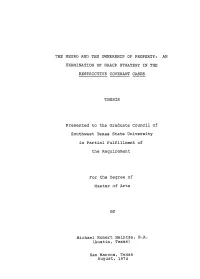
The Negro and the Ownership of Property: an Examination of Naacp Strategy in the Restrictive Covenant Cases
THE NEGRO AND THE OWNERSHIP OF PROPERTY: AN EXAMINATION OF NAACP STRATEGY IN THE RESTRICTIVE COVENANT CASES THESIS Presented to the Graduate Council of Southwest Texas State University in Partial Fulfillment of the Requirement For the Degree of Master of Arts BY Michael Robert Heintze, B.A. (Austin, Texas) San Marcos, Texas AugU,st, 1974 This work is dedicated to my parents; Albert and Bernice Heintze. Their countless sacrifices helped make this study a reality. iii ACKNOWLEDGMENTS In the course of completing this study, I have accumulated a multitide of intellectual debts. However, during the nine months since I began to study the history of the National Association for the Advancement of Colored People and the Restriotive Covenant Cases, I have been guided and sustained by three individuals. First, I am deeply indebted to Dr. Everette Swinney. As the chair man of my thesis committee, Dr. Swinney's leadership, stimulation, and judgement have been a constant source of professional enrichment. without his thoughtful assis tance, this work would have been virtually impossible. I am also grateful for the clear, constructive advice of Dr. W. W. Anderson. I owe a partioular debt of gratitude to Dr. Randall W. Bland, who kindled my interest in con stitutional law and provided the impetus for this study. In addition, I would like to extend my sincere thanks to Miss Jocelyn Koch for her patient and effi cient clerical assistance, which proved to be an in valuable asset throughout. Finally, to my wife, Cheryl, who has been frugal, kind, and a constant store of support, I want to say thank you for everything. -

The Teaching of the Trans-Atlantic Slave Trade and Itâ•Žs Lasting
SIT Graduate Institute/SIT Study Abroad SIT Digital Collections Independent Study Project (ISP) Collection SIT Study Abroad Spring 2013 The eT aching of the Trans-Atlantic Slave Trade and it’s Lasting Implications on the African Diaspora Mara Meyers SIT Study Abroad Follow this and additional works at: https://digitalcollections.sit.edu/isp_collection Part of the Curriculum and Social Inquiry Commons, Race and Ethnicity Commons, Race, Ethnicity and Post-Colonial Studies Commons, and the Social and Cultural Anthropology Commons Recommended Citation Meyers, Mara, "The eT aching of the Trans-Atlantic Slave Trade and it’s Lasting Implications on the African Diaspora" (2013). Independent Study Project (ISP) Collection. 1495. https://digitalcollections.sit.edu/isp_collection/1495 This Unpublished Paper is brought to you for free and open access by the SIT Study Abroad at SIT Digital Collections. It has been accepted for inclusion in Independent Study Project (ISP) Collection by an authorized administrator of SIT Digital Collections. For more information, please contact digitalcollections@sit.edu. School for International Training Study Abroad: Ghana Social Transformation and Cultural Expression Spring 2013 The Teaching of the Trans-Atlantic Slave Trade and it’s Lasting Implications on the African Diaspora Mara Meyers (The University of Michigan, Residential College) Project Advisor: Dr. Nathaniel Damptey Institute of African Studies University of Ghana, Legon Academic Director: Dr. Olayemi Tinuoye School for International Training i Abstract 1. Title: The Teaching of the Trans-Atlantic Slave Trade and it’s Lasting Implications on the African Diaspora 2. Author: Mara Meyers ( mzmeyers@umich.edu , University of Michigan, Residential College) 3. Objectives i.