TRAIL WALKER (USPS Permit #970-100) Brated with a Groundbreaking Ceremony at Tions Director
Total Page:16
File Type:pdf, Size:1020Kb
Load more
Recommended publications
-
Wings Over Dutchess
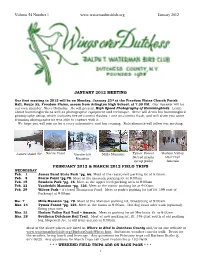
Volume 54 Number 1 www.watermanbirdclub.org January 2012 JANUARY 2012 MEETING Our first meeting in 2012 will be on Monday, January 23rd at the Freedom Plains Church Parish Hall, Route 55, Freedom Plains, across from Arlington High School, at 7:30 PM. Our Speaker will be our own member, Steve Golladay. He will present High Speed Photography of Hummingbirds. Learn about hummingbirds as well as photographic equipment and technique. Steve will demo his hummingbird photography setup, which includes five off camera flashes + one on-camera flash, and will show you some stunning photographs he was able to capture with it. We hope you will join us for a every informative and fun evening. Refreshments will follow our meeting. James Baird SP Norrie Point Vanderbilt Mills Mansion Tymor Forest Harlem Valley (w/red maple Rail Trail Mansion syrup pails) Amenia FEBRUARY 2012 & MARCH 2012 FIELD TRIPS WEDNESDAY Feb. 1 James Baird State Park *pg. 66. Meet at the restaurant parking lot at 9:00am. Feb. 8 Norrie Point *pg.78. Meet at the museum parking lot at 9:00am. Feb. 15 Bowdoin Park *pg. 16. Meet at the upper level parking area at 9:00am. Feb. 22 Vanderbilt Mansion *pg. 126. Meet at the visitor parking lot at 9:00am. Feb. 29 Wilcox Park – if closed Thompson Pond. Meet at park’s parking lot (off Rt. 199 east of Parkway) at 9:00am. Mar. 7 Mills Mansion *pg. 78. Meet at the Mansion parking lot, Staatsburg at 9:00am. Mar. 14 Tymor Forest *pg. 124. Meet at the barns at 9:00am. -

Early Summer 2016
Non-Profit Org. US Postage PAID Newburgh, NY Permit #2643 GAINING GROUND EARLY SUMMER 2016 Stories of Land Conservation “More Green in our Daily Lives” —The DuHamel-Handler Easement As city-dwellers, Stancy DuHamel and Carolyn Handler decided that they needed “more green in [their] daily lives.” They had discovered the PAULA SMITH DESIGNS INC. Harlem Valley while visiting friends in Pawling Millerton, NY 12546 paula@ridgebackfield.com and when they began to search for a home, it 518.398.9500 seemed like the perfect place to start. In Febru- ary of 1989, they found what they were looking for. They recall, “We turned off Route 22 and drove down a dirt road that curved through the PRINTED ON RECYCLED PAPER Scenic Photos: Kathy Landman hemlock forest of The Nature Conservancy’s Pawling Nature Reserve, and marveled that we were only 75 miles north of New York City. As we passed the wetlands of Duell Hollow, we were taken by the change in topography Upcoming events: and noticed the rich variety of plants and trees along the base of the hills and in the marsh. Our house, built in the early 1800’s, stood at the eastern end of this marsh. Less than a quarter mile up a dirt road was the Appalachian Trail. Join us for a We could not believe our good fortune.” Water Quality Talk at The Fountains of Millbrook— Free and Open to the Public! August 10th from 2 to 3 p.m. And Save the Date for our Annual Fall Country Luncheon on October 9th at Wethersfield Farm in Stanford—By invitation only— please call our office to be added to our mailing list. -
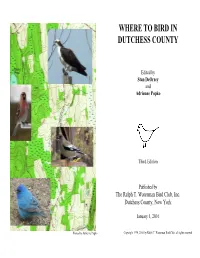
Where to Bird in Dutchess County, 3Rd Edition
WHERE TO BIRD IN DUTCHESS COUNTY Edited by Stan DeOrsey and Adrienne Popko Third Edition Published by The Ralph T. Waterman Bird Club, Inc. Dutchess County, New York January 1, 2016 Photos by Adrienne Popko Copyright 1990, 2016 by Ralph T. Waterman Bird Club, all rights reserved TABLE OF CONTENTS 6 Andrew Haight Road 35 Pawling Nature Reserve 7 Bowdoin Park 36 Pond Gut 8 Brace Mountain 37 Poughkeepsie Rural Cemetery 9 Buttercup Farm Wildlife S. 38 Reese Sanctuary 10 Cary Arboretum 39 Rockefeller / Pitcher Lane 11 Cascade Mountain Road 40 Saw Kill & South Bay Trails 12 Cruger Island 41 Skunks Misery Road 13 Deep Hollow Road 42 S. Quaker Hill / Tower Hill Rds 14 Depot Hill MUA 43 Stissing Mountain MUA 15 Edward R Murrow Park 44 Stony Kill Farm Env Ed Center 16 Eleanor Roosevelt NHS 45 Sylvan Lake / Clove Road 17 Ferncliff Forest 46 Taconic-Hereford MUA 18 Flint Hill / Huckleberry Roads 47 Taconic State Park 19 Freedom Park 48 Tamarack Lake & Swamp 20 Home of Franklin Roosevelt NHS 49 Tamarack Preserve 21 Hudson Highlands State Park 50 Thompson Pond Preserve 22 Hudson River - North 51 Tivoli Bays WMA 24 Hudson River - South 52 Tower Hill Road lnnisfree26 53 Tracy Road 27 James Baird State Park 54 Tymor Park 28 Lafayetteville MUA 55 Vanderbilt Mansion NHS 29 Lake Oniad 56 Vassar College 30 Locust Grove Historic Estate 57 Vassar College Farm 31 Millbrook School 58 Wappinger Lake 32 Montgomery Place 59 Wassaic MUA 33 Ogden Mills & Norrie State Park 60 Wilcox Park 34 Oriole Mills / Norton / Yantz Rds - 2 - CROSS REFERENCE OF LOCAL NAMES Many areas in Dutchess County are commonly known by names other than those used in this book. -
Here It Gradually Loses Elevation Approaching Lake Awosting
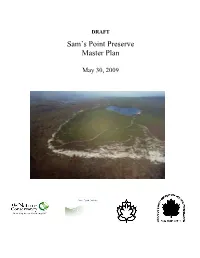
DRAFT Sam’s Point Preserve Master Plan May 30, 2009 Draft Master Plan Sam’s Point Preserve Cragsmoor, New York Prepared by: The Nature Conservancy Open Space Institute Sam’s Point Advisory Council Completed: (May 30, 2009) Contacts: Cara Lee, Shawangunk Ridge Program Director (clee@tnc.org ) Heidi Wagner, Preserve Manager (hwagner@tnc.org ) Gabriel Chapin, Forest and Fire Ecologist (gchapin@tnc.org ) The Nature Conservancy Eastern New York Chapter Sam’s Point Preserve PO Box 86 Cragsmoor, NY 12420 Phone: 845-647-7989 or 845-255-9051 Fax: 845-255-9623 Paul Elconin (pastaelco@optonline.com) Open Space Institute 1350 Broadway, Suite 201 New York, NY 10018 Phone: 212-629-3981 Fax: 212-244-3441 ii Table of Contents Table of Contents ii List of Tables iii List of Figures and Maps iv List of Appendices v Acknowledgments vi Executive Summary vii Introduction A. The Northern Shawangunk Mountains 1 B. A Community Based Conservation Approach 4 C. History of Sam’s Point Preserve 4 D. Regional Context - Open Space Protection and Local Government 7 I. Natural Resource Information A. Geology and Soils 10 B. Vegetation and Natural Communities 11 C. Wildlife and Rare Species 15 II. Mission and Goals A. Mission Statement 18 B. Conservation Goals 19 C. Programmatic Goals 20 D. Land Protection Goals 20 III. Infrastructure A. Facilities Plan 26 B. Roads and Parking Areas 27 C. Trails 32 D. Signage, Kiosks and Access Points 35 E. Ice Caves Trail 36 iii IV. Ecological Management and Research A. Fire Management 38 B. Exotic and Invasive Species Control 42 C. -
Hiking Poles -- to Use Them Or Not? by Geoff Fonseca That Is the 64 Thousand Dollar Question and One That Can Sometimes Erupt in a Raging Debate Among Hikers
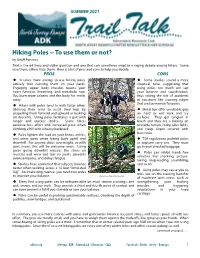
SUMMER 2021 Hiking Poles -- To use them or not? by Geoff Fonseca That is the 64 thousand dollar question and one that can sometimes erupt in a raging debate among hikers. Some love them, others hate them. Here is a list of pros and cons to help you decide. PROS CONS It takes more energy to use hiking poles Some studies sound a more actively (not carrying them on your pack). skeptical tone, suggesting that Engaging upper body muscles boosts your using poles too much will sap heart function, breathing, and metabolic rate. your balance and coordination, You burn more calories and the body fat melts thus raising the risk of accidents away. in situations like crossing ridges that are too narrow for poles. Hikers with poles tend to walk faster when allowing their arms to assist their legs by Metal tips offer unreliable grip propelling them forward and upward or braking on hard or wet rock and icy on descents. Using poles facilitates a gait with surfaces. They get tangled in longer and quicker strides. Some hikers brush and they are a liability on perceive less effort and increased pace when unstable terrain, rocky talus fields, climbing a hill with a heavy backpack. and steep slopes covered with bare rocks. Poles lighten the load on your knees, ankles, and other joints when hiking both uphill and TSA regulations prohibit poles downhill. For anyone older, overweight, or with as airplane carry-ons. They must joint issues, this will be welcome news. Using go in your checked baggage. poles going downhill reduces the stress on Poles can inhibit hands-free muscles and wear and tear on joints, prevents activities like snacking, picture- overuse injuries, and delays fatigue. -

February/March 2021 NYS Conservationist Magazine
NEW YORK STATE $3.50 FEBRUARY/MARCH 2021 MovingMa\,inga a MMOOSEQOSE Getting Outdoors in Winter Counting the Fish in the Sea Winter’s Beauty CONSERVATIONIST Dear Readers, Volume 75, Number 4 | February/March 2021 During these challenging times, Andrew M. Cuomo, Governor of New York State I encourage you to take advantage DEPARTMENT OF ENVIRONMENTAL CONSERVATION of the opportunities we have to Basil Seggos, Commissioner enjoy nature. For some people, Erica Ringewald, Deputy Commissioner for Public Affairs Harold Evans, Director of Office of Communication Services this time of year provides a THE CONSERVATIONIST STAFF chance to enjoy various outdoor Eileen C. Stegemann, Managing Editor winter adventures, while others Peter Constantakes, Assistant Editor look forward to the coming Tony Colyer-Pendas, Assistant Editor Megan Ciotti, Business Manager change of season, with warming Jeremy J. Taylor, Editor, Conservationist for Kids temperatures, the disappearance Rick Georgeson, Contributing Editor of snow, and di˜erent ways to get outside. DESIGN TEAM In this issue, we highlight some amazing photos of Andy Breedlove, Photographer/Designer Jim Clayton, Chief, Multimedia Services New°York’s winter beauty and celebrate a great winter Mark Kerwin, Art Director/Graphic Designer sport—snowmobiling—which can be enjoyed on more than Robin-Lucie Kuiper, Photographer/Designer 10,000 miles of trails throughout the state (pg. 12). You can Mary Elizabeth Maguire, Graphic Designer Jennifer Peyser, Graphic Designer also read about a native Floridian who moved to New York Maria VanWie, Graphic Designer and learned to cross country ski – and how that changed his EDITORIAL OFFICES view of the heavy snowfall we experienced this winter. -

County Travel Guide Hudson Valley Region
HUDSON VALLEY REGION DuCOUNTYtc TRAVELh GUIDEess SIMPLE AND SOPHISTICATED. YOU DESERVE DUTchESS. 1 2010 / 2011 HELLO. Welcome to scenic Dutchess County, formed in 1683 as one of the original counties of New York. Nestled in the Hudson River Valley, midway between New York City and the capital city of Albany, it is easily accessible by car, train, bus and air. With its abundance of historic landmarks, restaurants, festivals and natural scenic beauty, Dutchess County is 800 square miles of fascinating sites, lively events and breathtaking vistas. Above: History Relaxation Innisfree Garden, Millbrook Historic Sites ..................4 Accommodations .............24 Museums .....................6 Drive-in Movies ...............30 On the cover (clockwise from top left): Entertainment................30 Dutchess County Celebrates the Arts!; Recreation Shopping Malls ...............31 Kaatsbaan International Dance Center, Recreation....................8 Tivoli/Richard Brodzellar; Antiques ....................32 Biking .......................9 Richard B. Fisher Center for the Specialty Shops ...............32 Performing Arts, Bard College, Golf .........................9 Personal Growth ..............33 Annandale-on-Hudson. Family Fun...................10 Photo: Peter Aaron/ESTO; Fish & Game .................12 Frances Lehman Loeb Art Center, Cuisine Vassar College, Poughkeepsie; Hudson River Enjoyment .......12 Wineries ....................34 Rhinebeck Dance Center, Center for Shooting Clubs & Preserves .....13 Restaurants ..................44 -
5 IMPLEMENTATION Implementation of the Hudson River Valley Greenway Trail Is an Ongoing Process
5 IMPLEMENTATION Implementation of the Hudson River Valley Greenway Trail is an ongoing process. The existing hiking, biking and water trail routes can continue to be improved and promoted, while the multi-use path will require a significant level of new planning, design and capital investment. In the past 25 years, the Greenway has developed grass-roots and local government support for these efforts, providing an excellent foundation for the next generation of the trail system. The following actions are recommended for the ongoing success of the HRVG: 1. Continue promoting the Water Trail: this is the most direct connection to the river, and can be marketed without significant capital improvements to promote the whole Greenway. 2. Upgrade the existing Hiking Trails: The continuous hiking trail can be achieved with alignments closer to the river - and many of these key connections are already in progress. With the new TZ bridge path and the Walkway over the Hudson, a loop hiking trail can connect both sides of the river in the lower half of the valley. 3. Improve the on-road Bike Routes: the currently signed NYS Bike Route 9 is a challenging route and is limited to experienced cyclists. Improving signage, paved shoulders, bike lanes, bike parking and Amtrak access will all support increased use along the route. Both the PTNY and West Side routes are not currently designated, but they can be improved to create on-road routes on both sides of the river. 4. Develop the continuous Hudson River Valley Greenway Trail trunk line: the efforts of the past decades have led to significant new potential to create a continuous multi-use path the length of the Hudson River Valley from Manhattan to the Adirondacks. -
Appendices Section
APPENDIX 1. A Selection of Biodiversity Conservation Agencies & Programs A variety of state agencies and programs, in addition to the NY Natural Heritage Program, partner with OPRHP on biodiversity conservation and planning. This appendix also describes a variety of statewide and regional biodiversity conservation efforts that complement OPRHP’s work. NYS BIODIVERSITY RESEARCH INSTITUTE The New York State Biodiversity Research Institute is a state-chartered organization based in the New York State Museum who promotes the understanding and conservation of New York’s biological diversity. They administer a broad range of research, education, and information transfer programs, and oversee a competitive grants program for projects that further biodiversity stewardship and research. In 1996, the Biodiversity Research Institute approved funding for the Office of Parks, Recreation and Historic Preservation to undertake an ambitious inventory of its lands for rare species, rare natural communities, and the state’s best examples of common communities. The majority of inventory in state parks occurred over a five-year period, beginning in 1998 and concluding in the spring of 2003. Funding was also approved for a sixth year, which included all newly acquired state parks and several state parks that required additional attention beyond the initial inventory. Telephone: (518) 486-4845 Website: www.nysm.nysed.gov/bri/ NYS DEPARTMENT OF ENVIRONMENTAL CONSERVATION The Department of Environmental Conservation’s (DEC) biodiversity conservation efforts are handled by a variety of offices with the department. Of particular note for this project are the NY Natural Heritage Program, Endangered Species Unit, and Nongame Unit (all of which are in the Division of Fish, Wildlife, & Marine Resources), and the Division of Lands & Forests. -
April 2002 Interstatehiking@Mindspring.Com ______
Interstate Hiking Club th 70 Anniversary Organized 1931 Affiliate of the NY-NJ Trail Conference Schedule of Hikes November 2001 through April 2002 http://www.mindspring.com/~interstatehiking/ interstatehiking@mindspring.com _________________________________________________________________________________________ Interstate Hiking Club C/O Charles Kientzler 711 Terhune Drive Wayne, NJ 07470-7111 First Class Mail 1 GENERAL INFORMATION ABOUT THE INTERSTATE HIKING CLUB Who we are! The Interstate Hiking Club (IHC) is a medium-sized hiking club, organized in 1931, affiliated with the NY/NJ Trail Conference. IHC members are of various ages and diverse backgrounds. Guest are welcome! An adult must accompany anyone under 18. Where do we go? Most of our activities are centered in the NY/NJ area, some hikes are further away. The club occasionally sponsors trips in the Catskills and Pennsylvania. Our hikes are not usually accessible by public transportation. What do we do? Hikes generally are scheduled for every Sunday, and some Saturdays, as day long outings. They are graded by difficulty of terrain, distance and pace. Strenuous: More climbing, usually rugged walking, generally 9 miles or more. Moderate: Some climbing and rugged walking, but less than 9 miles. Easy: Generally easy, fairly level trails, slower pace, 6 to 8 miles. The club also maintains trails in association with the NY/NJ Trail Conference. Two Sundays a year are devoted to this service work. In addition we have done in the past, orienteering, snowshoeing, cross-country skiing, swimming, canoeing, mountain biking, backpacking, and camp-out in the Adirondacks and Maine. What to bring: Footwear is very important. Hiking boots with non-slip soles are essential for all hikes . -
Waterbody Classifications, Streams Based on Waterbody Classifications
Waterbody Classifications, Streams Based on Waterbody Classifications Waterbody Type Segment ID Waterbody Index Number (WIN) Streams 0202-0047 Pa-63-30 Streams 0202-0048 Pa-63-33 Streams 0801-0419 Ont 19- 94- 1-P922- Streams 0201-0034 Pa-53-21 Streams 0801-0422 Ont 19- 98 Streams 0801-0423 Ont 19- 99 Streams 0801-0424 Ont 19-103 Streams 0801-0429 Ont 19-104- 3 Streams 0801-0442 Ont 19-105 thru 112 Streams 0801-0445 Ont 19-114 Streams 0801-0447 Ont 19-119 Streams 0801-0452 Ont 19-P1007- Streams 1001-0017 C- 86 Streams 1001-0018 C- 5 thru 13 Streams 1001-0019 C- 14 Streams 1001-0022 C- 57 thru 95 (selected) Streams 1001-0023 C- 73 Streams 1001-0024 C- 80 Streams 1001-0025 C- 86-3 Streams 1001-0026 C- 86-5 Page 1 of 464 09/28/2021 Waterbody Classifications, Streams Based on Waterbody Classifications Name Description Clear Creek and tribs entire stream and tribs Mud Creek and tribs entire stream and tribs Tribs to Long Lake total length of all tribs to lake Little Valley Creek, Upper, and tribs stream and tribs, above Elkdale Kents Creek and tribs entire stream and tribs Crystal Creek, Upper, and tribs stream and tribs, above Forestport Alder Creek and tribs entire stream and tribs Bear Creek and tribs entire stream and tribs Minor Tribs to Kayuta Lake total length of select tribs to the lake Little Black Creek, Upper, and tribs stream and tribs, above Wheelertown Twin Lakes Stream and tribs entire stream and tribs Tribs to North Lake total length of all tribs to lake Mill Brook and minor tribs entire stream and selected tribs Riley Brook -

Restoring the Big East with Big Beasts: Ecosystem Recovery and Economic Sustainability in Adirondack Park
PRESS RELEASE July 2, 2015 Restoring the Big East with Big Beasts: Ecosystem Recovery and Economic Sustainability in Adirondack Park Is the Adirondack Park viable habitat for a sustainable population of cougars? Protect the Adirondacks hosts Christopher Spatz, President of the Cougar Rewilding Foundation, at the Paul Smith’s Visitor’s Interpretive Center on Sunday July 5th at 11 AM. For more information: Peter Bauer, Executive Director, Office 518.685.3088, Cell 518.796.0112 Lake George, NY – Protect the Adirondacks will host Christopher SPatz, President of the CouGar RewildinG Foundation, at the Paul Smith’s College Visitor’s Interpretive Center on Sunday July 5th at 11 AM as Part of its 2015 annual meetinG. SPatz’s Presentation is entitled “RestorinG the BiG East with BiG Beasts: Ecosystem Recovery and Economic Sustainability in Adirondack Park.” In 2015, the Cougar Rewilding Foundation published “Yellowstone East: The Economic Benefits of RestorinG the Adirondack Ecosystem with Native Wildlife,” which makes the economic case for reintroducinG and suPPorting a robust carnivore population in Adirondacks, such as the couGar. RePorts of couGars in the Adirondacks have Persisted for years in the Adirondack Park without verifiable evidence, with the one exception of a cougar that traveled through the Adirondack Park in 2007. Protect the Adirondacks manaGes a CouGar Watch Project, which has collected more than two dozen credible sightings over the Past two years. On the issue of the return of couGars to the Adirondacks, SPatz wrote: “The Adirondacks are missinG four native meGafauna, four sPecies whose millennial Presence created the Adirondack ecosystem: elk, bison, wolves and couGars.