Anglo Danish Costumes and Fashions
Total Page:16
File Type:pdf, Size:1020Kb
Load more
Recommended publications
-
The Skjoldehamn Find in the Light of New Knowledge
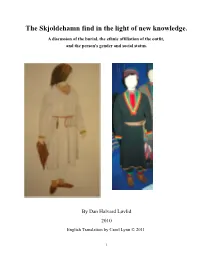
The Skjoldehamn find in the light of new knowledge. A discussion of the burial, the ethnic affiliation of the outfit, and the person's gender and social status. By Dan Halvard Løvlid 2010 English Translation by Carol Lynn © 2011 1 On the front page: The Skjoldehamn costume drawn by Berit Løvlid (left) and a Lule Sami costume exhibited on Norsk Folkemuseum from Tysfjord in Nordland in Norway (NFSA.3235) collected by the museum in 1953 (right). Photo: Dan Halvard Løvlid. Table of Contents 1 Introduction ............................................................................................................................................3 2 The grave................................................................................................................................................. 4 3 Sami? ......................................................................................................................................................6 3.1 Anthropological studies and DNA analysis. ..................................................................................6 3.2 Comparison with Sami costume traditions................................................................................... 7 3.2.1 The Sami culture areas ...............................................................................................................7 3.2.2 Sources .......................................................................................................................................8 3.2.3 Gjessing 's arguments against a Sami -

Tooth-Tool Use and Yarn Production in Norse Greenland
TOOTH -TOOL USE AND YARN PRODUCTION IN NORSE GREENLAND G. Richard Scott University of Nevada Reno, Department of Anthropology/MS 096, Reno, NV 89557; grscott@unr.edu Ruth Burgett Jolie Department of Anthropology, University of New Mexico ABSTRACT During a dental study of medieval Norse skeletons from Greenland, Iceland, and Norway, a distinct pattern of wear was observed on twenty-two anterior teeth of twelve Greenlanders. Further examina- tion revealed that cultural notches were limited almost exclusively to settlement-period Greenlandic females interred at Thjodhild’s church ad( 1000–1150). The most likely explanation for this patterned wear revolves around the manner in which females manipulated woolen thread on their maxillary in- cisors and canines during the production of a coarse woolen cloth (frieze) that was generated in large amounts during the early medieval period for local consumption and export to Europe. keywords: teeth, abrasion, wool INTRODUCTION Anthropologists have long studied normal crown wear to As the most directly visible aspect of the skeletal sys- evaluate the diet and dietary behavior of earlier human tem, teeth are also subject to the vagaries of human cultur- populations (Hinton 1981, 1982; Kieser et al. 2001; Molnar al behavior (cf. Milner and Larsen 1991). For that reason, 1971, 1972; Molnar et al. 1983; Walker 1978; Walker and they are useful in bioarchaeological research for making Erlandson 1986). Several methods have been developed inferences on the behavior of past human populations. to score such wear (Brothwell 1963; Dreier 1994; Murphy Behaviorally induced alterations fall under four general 1959; Scott 1979; Smith 1984) with the primary empha- categories: (1) intentional mutilation; (2) unintentional sis on pattern of dentine exposure. -

Pennsylvania Folklife Vol. 36, No. 3 Michael Colby
Ursinus College Digital Commons @ Ursinus College Pennsylvania Folklife Magazine Pennsylvania Folklife Society Collection Spring 1987 Pennsylvania Folklife Vol. 36, No. 3 Michael Colby Donald Graves Monica Pieper William T. Parsons Ursinus College Helen Urda Smith Follow this and additional works at: https://digitalcommons.ursinus.edu/pafolklifemag Part of the American Art and Architecture Commons, American Material Culture Commons, Christian Denominations and Sects Commons, Cultural History Commons, Ethnic Studies Commons, Fiber, Textile, and Weaving Arts Commons, Folklore Commons, Genealogy Commons, German Language and Literature Commons, Historic Preservation and Conservation Commons, History of Religion Commons, Linguistics Commons, and the Social and Cultural Anthropology Commons Click here to let us know how access to this document benefits oy u. Recommended Citation Colby, Michael; Graves, Donald; Pieper, Monica; Parsons, William T.; and Smith, Helen Urda, "Pennsylvania Folklife Vol. 36, No. 3" (1987). Pennsylvania Folklife Magazine. 116. https://digitalcommons.ursinus.edu/pafolklifemag/116 This Book is brought to you for free and open access by the Pennsylvania Folklife Society Collection at Digital Commons @ Ursinus College. It has been accepted for inclusion in Pennsylvania Folklife Magazine by an authorized administrator of Digital Commons @ Ursinus College. For more information, please contact aprock@ursinus.edu. I------.w'l_____ -----,.-~ ~tnn~ lJ {vania oeoeoeoeoeoeoeoeoeoeo ul Ii e (tontril1utor~ MI C HAEL COLBY, a teacher in the Bethlehem A rea School District, a nd DO ALD G RAVES, a freela nce wri ter for the Bethlehem Globe Times a nd Early American Life magazine, are deeply in volved in 18th century life a nd traditions. T hey have bee n growing a nd ha nd -processing fl ax- spinning, dyeing a nd weaving the fi ber into cloth as was done by the settlers in colonial Pennsylva nia- a nd have been connected with the Jacobsburg Environmental Center a nd Historic Bethlehem, Inc. -

Terminology Associated with Silk in the Middle Byzantine Period (AD 843-1204) Julia Galliker University of Michigan
University of Nebraska - Lincoln DigitalCommons@University of Nebraska - Lincoln Textile Terminologies from the Orient to the Centre for Textile Research Mediterranean and Europe, 1000 BC to 1000 AD 2017 Terminology Associated with Silk in the Middle Byzantine Period (AD 843-1204) Julia Galliker University of Michigan Follow this and additional works at: http://digitalcommons.unl.edu/texterm Part of the Ancient History, Greek and Roman through Late Antiquity Commons, Art and Materials Conservation Commons, Classical Archaeology and Art History Commons, Classical Literature and Philology Commons, Fiber, Textile, and Weaving Arts Commons, Indo-European Linguistics and Philology Commons, Jewish Studies Commons, Museum Studies Commons, Near Eastern Languages and Societies Commons, and the Other History of Art, Architecture, and Archaeology Commons Galliker, Julia, "Terminology Associated with Silk in the Middle Byzantine Period (AD 843-1204)" (2017). Textile Terminologies from the Orient to the Mediterranean and Europe, 1000 BC to 1000 AD. 27. http://digitalcommons.unl.edu/texterm/27 This Article is brought to you for free and open access by the Centre for Textile Research at DigitalCommons@University of Nebraska - Lincoln. It has been accepted for inclusion in Textile Terminologies from the Orient to the Mediterranean and Europe, 1000 BC to 1000 AD by an authorized administrator of DigitalCommons@University of Nebraska - Lincoln. Terminology Associated with Silk in the Middle Byzantine Period (AD 843-1204) Julia Galliker, University of Michigan In Textile Terminologies from the Orient to the Mediterranean and Europe, 1000 BC to 1000 AD, ed. Salvatore Gaspa, Cécile Michel, & Marie-Louise Nosch (Lincoln, NE: Zea Books, 2017), pp. 346-373. -
Textile Arts and Aesthetics in and Beyond the Medieval Islamic World
Perspective Actualité en histoire de l’art 1 | 2016 Textiles Crossroads of Cloth: Textile Arts and Aesthetics in and beyond the Medieval Islamic World Aux carrefours des étoffes : les arts et l’esthétique textiles dans le monde islamique médiéval et au-delà Vera-Simone Schulz Electronic version URL: http://journals.openedition.org/perspective/6309 DOI: 10.4000/perspective.6309 ISSN: 2269-7721 Publisher Institut national d'histoire de l'art Printed version Date of publication: 30 June 2016 Number of pages: 93-108 ISBN: 978-2-917902-31-8 ISSN: 1777-7852 Electronic reference Vera-Simone Schulz, « Crossroads of Cloth: Textile Arts and Aesthetics in and beyond the Medieval Islamic World », Perspective [Online], 1 | 2016, Online since 15 June 2017, connection on 01 October 2020. URL : http://journals.openedition.org/perspective/6309 ; DOI : https://doi.org/10.4000/ perspective.6309 Vera-Simone Schulz Crossroads of Cloth: Textile Arts and Aesthetics in and beyond the Medieval Islamic World A piece of woven silk preserved in the Cooper-Hewitt National Design Museum in New York (fig. 1) shows medallions with pearl borders in which various animals appear. The elephants, winged horses, and composite creatures with dog heads and peacock tails are positioned alternately face-to-face and back-to-back. The fabric is designed to be viewed both from a distance and more closely. From a distance, the overall structure with its repeating pattern forms a grid in which geometrical roundels oscillate between contact and isolation. They are so close they seem almost to touch both each other and the complicated vegetal patterns in the spaces between, although in fact each roundel remains separate from every other visual element in the textile. -
The Origin and Historical Background of Ottoman and Italian Velvets
University of Nebraska - Lincoln DigitalCommons@University of Nebraska - Lincoln Textile Society of America Symposium Proceedings Textile Society of America 2016 Velvet and Patronage: The Origin and Historical Background of Ottoman and Italian Velvets Sumiyo Okumura Dr. okumuras@gmail.com Follow this and additional works at: https://digitalcommons.unl.edu/tsaconf Part of the Art and Materials Conservation Commons, Art Practice Commons, Fashion Design Commons, Fiber, Textile, and Weaving Arts Commons, Fine Arts Commons, and the Museum Studies Commons Okumura, Sumiyo Dr., "Velvet and Patronage: The Origin and Historical Background of Ottoman and Italian Velvets" (2016). Textile Society of America Symposium Proceedings. 1008. https://digitalcommons.unl.edu/tsaconf/1008 This Article is brought to you for free and open access by the Textile Society of America at DigitalCommons@University of Nebraska - Lincoln. It has been accepted for inclusion in Textile Society of America Symposium Proceedings by an authorized administrator of DigitalCommons@University of Nebraska - Lincoln. Velvet and Patronage: The Origin and Historical Background of Ottoman and Italian Velvets Dr. Sumiyo Okumura Velvets are one of the most luxurious textile materials and were frequently used in furnishings and costumes in the Middle East, Europe and Asia in the fifteenth to sixteenth centuries. Owing to many valuable studies on Ottoman and Italian velvets as well as Chinese and Byzantine velvets, we have learned the techniques and designs of velvet weaves, and how they were consumed. However, it is not well-known where and when velvets were started to be woven. The study will shed light on this question and focus on the origin, the historical background and development of velvet weaving, examining historical sources together with material evidence. -

14Th Century English Sumptuary Laws THL Sarai Tindall Sarai.Tindall@Gmail.Com
14th century English Sumptuary Laws THL Sarai Tindall sarai.tindall@gmail.com http://clothingthepast.wordpress.com The stated reason for enactment of the 1363 English sumptuary law is because of “the Outragious and Excessive Apparel of divers People, against their Estate and Degree, to the great Destruction and Impoverishment of all the Land.” 1 The king, or his councilors and parliament, felt that people were spending too much on their clothing. The law lays out what fabrics, furs, and accessories people of each specific social group of the middle classes could purchase and wear for clothing. It is notable that this law does not mention anyone of the upper nobility or those of the lowest classes. The 1363 law seems to be mostly concerned with the creating of “an absolute social standing,” in which wealth, occupation, and rank are all combined to create one’s social standing. 2 The law breaks down the social classes based on a combination of rank and occupation. Knights were the highest social class, by rank, and Merchants were the highest by occupation, but still below knights. Some of the social classes, Knights, Esquires, and Merchants are further divided by their wealth, with some being afforded more expensive cloth for their clothing based on wealth. In this way money is used to allow a more privileged style of dress to those within a social class, but without overlapping into the lowest income of the social class above them. This would help to create a visual separation between classes, and a marketability of status through the use of income as a factor in determining final social status.3 However, even attempts at using multiple factors for determining a final social status were not always accurate since any one of those factors could change, as suggested by Sponsler.4 The factors should only be used to determine social status at a particular point in time, since anyone could easily gain or lose money very quickly thus altering their social status. -

Report of the First 16 Months
Fashioning the Viking Age Report of the first 16 months 1st of September 2018 – 31st of December 2019 Introduction The 1st of September 2018, the Fashioning the Viking Age project, funded by THE VELUX FOUNDATIONS, was launched at the National Museum of Denmark, Department for Ancient Cultures of Denmark and the Mediterranean (NM). The project is a collaboration between NM and Centre for Textile Research, University of Copenhagen (CTR) and Land of Legends, Lejre (LL). The general aim of the three-year research and outreach project is to create new and archaeologically well-founded interpretations and reconstructions of Viking Age textiles and clothing. The main participants: • Ulla Mannering (UM), Project Leader, NM • Charlotte Rimstad (CR), Project Coordinator, NM • Eva Andersson Strand (EAS), Director of CTR, UCHP • Ida Demant (ID), Leader of the Textile Workshop, LL • Irene Skals, Conservator (IS), NM Other participants: • Anne Batzer, Textile Dyer: Dyeing of textiles • Anne Lisbeth Schmidt, Conservator, National Museum of Denmark: Microscopy of skin and fur • Arne Jouttijarvi, Materials Scientist, Heimdal-archaeometry: Analysis of iron and gold objects • Carsten Gundlach, Physicist, Technical University of Denmark: CT scanning • Fria Gemynthe, Textile Technician, Land of Legends: Embroidery • Henriette Lyngstrøm, Archaeologist, SAXO-Institute, University of Copenhagen: Analysis of iron • Ina Vanden Berghe, Scientist at KIK-IRPA, Brussels: Dye analysis • Inger Heebøll, Ceramist, Land of Legends: Production of spindle whorls and loom weights. • Irene Skals, Conservator, Emerita: Fiber analysis • Jens Barnkob: Production of spindles • Lise Ræder Knudsen, Conservator, Vejle Conservation Centre: Analysis and production of tablet weaves • Lone Brøns-Pedersen, Clothing Constructor in LL: Construction patterns for the skin garments. -

Guidelines for 4-H Clothing Construction Projects
Guidelines for 4-H Clothing Construction Projects The 4-H clothing construction program enables youth to develop the competencies, knowledge and skills necessary to create clothing they enjoy wearing. 4-H members can progress through skill levels at their own rate. In the Clothing and Textiles project, youth gain consumer skills in making, purchasing and caring for clothing and accessories. 4-H members can choose to sew for personal pleasure, to exhibit garments or accessories at fairs, to participate in Fashion Revue or judging events, to take part in field trips and tours, and to sew items for community service projects. The project can be taken independently, as part of a 4-H club, or as a family unit. Older, more experienced 4-H members in this project can serve as junior/teen leaders, helping plan programs and teaching others. Skill Level: Beginner (1st & 2nd Year Sewers) Suggested Projects Suggested Fabrics Knowledge & Skills Look for projects using no • Broadcloth • Basic sewing tools, pattern or very simple • Calico notions, and terms commercial patterns with straight • Denim (soft) • Sew on buttons, simple stitching and only a few pattern • Drill repairs pieces. • Duck • Basic hand stitching • Felt • Operating a sewing • Aprons • Gingham machine • Laundry bag • Kettle • Straight machine sewing • Square Pillows cloth/weavers • Selecting and pre-treating • Pin cushion • Muslin fabric • Tote • Poplin • Fabric grain lines, pattern bag layout • Pot holders • Pinning and Cutting • Placemats • Following directions • Washcloth slippers • Basic seam and seam finish • Stuffed animals • Gathers • Hand puppets • Machine hems • Needle book • Turning inside out • Assemble sewing kit/box • Pressing • Safety Skill Level: Beginner (1st & 2nd Year Sewers) Suggested Projects Suggested Fabrics Knowledge & Skills Look for easy patterns with All of previous All of previous level plus: mostly straight seams, facings, level plus: armholes, and neckline. -

Von Nowgorod Bis London Studien Zu Handel, Wirtschaft Und Gesellschaft Im Mittelalterlichen Europa
Sonderdruck aus: Marie-Luise Heckmann / Jens Röhrkasten (Hg.) Von Nowgorod bis London Studien zu Handel, Wirtschaft und Gesellschaft im mittelalterlichen Europa Festschrift für Stuart Jenks zum 60. Geburtstag September 2008, ISBN 978-3-89971-446-3 V&R unipress Inhalt Abbildungen, Figures, Tabellen und Tables …………….…………………….… 5 Abkürzungen ……………………………………..……………………………… 9 KOMMUNIKATION UND MEDIEN DIETRICH KURZE Neujahrslied und Neujahrspredigt im 15. Jahrhundert …………………………. 13 VOLKER HENN Eine unbeachtete Brügger Kontorordnung aus dem 15. Jahrhundert ……..……. 31 KERSTIN RAS-DÜRSCHNER Mittelalter im Museum – Anmerkungen aus der museumspädagogischen Praxis ………………………………………………………………..…………………. 51 PATRICK SAHLE eScience History? ................................................................................................. 63 WIRTSCHAFT UND GESELLSCHAFT JÜRGEN SARNOWSKY Am Anfang einer »wirtschaftlichen Revolution«. Privilegien und Handel im Ober- italien der Ottonenzeit ……………………..…………………………………… 77 1 Inhalt JOHN H. MUNRO Hanseatic Commerce in Textiles from the Low Countries and England during the Later Middle Ages: Changing Trends in Textiles, Markets, Prices, and Values, 1290–1570 ..…………………………………………………………………….. 97 HERMAN VAN DER WEE Labour in late medieval and early modern Antwerp …………….……………. 183 ASTRID SCHMIDT-HÄNDEL Landtransport im Spätmittelalter und in der Frühen Neuzeit am Beispiel des Er- furter Waidhandels ……………………………………………….………...…. 197 ROLF HAMMEL-KIESOW Schriftlichkeit und Handelsgesellschaften niederdeutsch-hansischer und oberdeut- -

The Textile Terminology in Ancient Japan
University of Nebraska - Lincoln DigitalCommons@University of Nebraska - Lincoln Textile Terminologies from the Orient to the Centre for Textile Research Mediterranean and Europe, 1000 BC to 1000 AD 2017 The exT tile Terminology in Ancient Japan Mari Omura Gangoji Institute for Research of Cultural Property Naoko Kizawa Gangoji Institute for Research of Cultural Property Follow this and additional works at: http://digitalcommons.unl.edu/texterm Part of the Ancient History, Greek and Roman through Late Antiquity Commons, Art and Materials Conservation Commons, Classical Archaeology and Art History Commons, Classical Literature and Philology Commons, Fiber, Textile, and Weaving Arts Commons, Indo-European Linguistics and Philology Commons, Jewish Studies Commons, Museum Studies Commons, Near Eastern Languages and Societies Commons, and the Other History of Art, Architecture, and Archaeology Commons Omura, Mari and Kizawa, Naoko, "The exT tile Terminology in Ancient Japan" (2017). Textile Terminologies from the Orient to the Mediterranean and Europe, 1000 BC to 1000 AD. 28. http://digitalcommons.unl.edu/texterm/28 This Article is brought to you for free and open access by the Centre for Textile Research at DigitalCommons@University of Nebraska - Lincoln. It has been accepted for inclusion in Textile Terminologies from the Orient to the Mediterranean and Europe, 1000 BC to 1000 AD by an authorized administrator of DigitalCommons@University of Nebraska - Lincoln. The Textile Terminology in Ancient Japan Mari Omura, Gangoji Institute for Research of Cultural Property Naoko Kizawa, Gangoji Institute for Research of Cultural Property In Textile Terminologies from the Orient to the Mediterranean and Europe, 1000 BC to 1000 AD, ed. Salvatore Gaspa, Cécile Michel, & Marie-Louise Nosch (Lincoln, NE: Zea Books, 2017), pp. -
Silk, Saints and Relics. the Medieval Fabrics Collection at the CDMT1
37 OPEN SOURCE LANGUAGE VERSION > ESPAÑOL Silk, saints and relics. The medieval fabrics collection at the CDMT1 by Sílvia Saladrigas Cheng, Centre de Documentació i Museu Tèxtil - CDMT Coptic textiles, Gothic velvets, Valencian, Italian and French silks, oriental embroidery, cashmere shawls, printed textiles, liturgical objects, Modernista fabrics … the collections of the Textile Museum and Documentation Centre (CDMT) of Terrassa are diverse and varied. This paper showcases one of the CDMT’s many collections, its medieval fabrics collection, which contains significant examples from a period in which the objects were valuable and highly prized, appeared in inventories and wills, and were represented in detail in paintings and altarpieces. They are pieces that we must study if we are to understand the society and the cultural period of which they formed a part. 1 This paper is an updated The consideration of textiles as historical documents in their own right is not a version of a paper published very common practice in our country, despite the complete and representative in the journal Terme no. 21 (2006). collections of different cultures, historical periods and geographical areas that 2 2 In addition to the Textile are preserved in various centres and museums . For many years, their study, if Museum and Documentation carried out at all, has been done only in connection with iconographic motifs Centre (CDMT), there are and has been based on stylistic comparison with other arts. In addition, studies textile collections in the Marès Lace Museum (Arenys of the written (literary or notarial) sources have found elements for economic de Mar), Textile Printing and philological evaluation, but they have often proceeded along parallel paths Museum (Premià de Mar), without any connection to the real objects themselves.