Buddhism and Religious Tolerance in Indonesia
Total Page:16
File Type:pdf, Size:1020Kb
Load more
Recommended publications
-
Concise Ancient History of Indonesia.Pdf
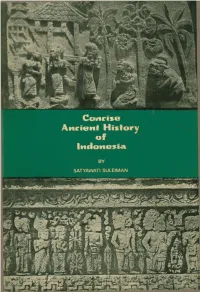
CONCISE ANCIENT HISTORY OF INDONESIA CONCISE ANCIENT HISTORY O F INDONESIA BY SATYAWATI SULEIMAN THE ARCHAEOLOGICAL FOUNDATION JAKARTA Copyright by The Archaeological Foundation ]or The National Archaeological Institute 1974 Sponsored by The Ford Foundation Printed by Djambatan — Jakarta Percetakan Endang CONTENTS Preface • • VI I. The Prehistory of Indonesia 1 Early man ; The Foodgathering Stage or Palaeolithic ; The Developed Stage of Foodgathering or Epi-Palaeo- lithic ; The Foodproducing Stage or Neolithic ; The Stage of Craftsmanship or The Early Metal Stage. II. The first contacts with Hinduism and Buddhism 10 III. The first inscriptions 14 IV. Sumatra — The rise of Srivijaya 16 V. Sanjayas and Shailendras 19 VI. Shailendras in Sumatra • •.. 23 VII. Java from 860 A.D. to the 12th century • • 27 VIII. Singhasari • • 30 IX. Majapahit 33 X. The Nusantara : The other islands 38 West Java ; Bali ; Sumatra ; Kalimantan. Bibliography 52 V PREFACE This book is intended to serve as a framework for the ancient history of Indonesia in a concise form. Published for the first time more than a decade ago as a booklet in a modest cyclostyled shape by the Cultural Department of the Indonesian Embassy in India, it has been revised several times in Jakarta in the same form to keep up to date with new discoveries and current theories. Since it seemed to have filled a need felt by foreigners as well as Indonesians to obtain an elementary knowledge of Indonesia's past, it has been thought wise to publish it now in a printed form with the aim to reach a larger public than before. -

In the Footsteps of Hayam Wuruk
IIAS_NL#39 09-12-2005 17:00 Pagina 17 > Research Rocks washed by the sea as Hayam Wuruk probably saw them at the cape of Tanjung Papuma. courtesy of author In the footsteps of Hayam Wuruk In the Old Javanese text Nagarakertagama or Desawarnana (1365), the Buddhist poet Prapanca describes King Hayam Wuruk’s journey through East Java in 1359. We followed the royal tracks in a 900-kilometer jeep expedition in June 2005 and discovered that many of the places can still be identified. Amrit Gomperts Renes, the caravan passed through a for- descending the steep ravine is impossi- cape of Tanjung Papuma, nowadays a human hands on the southern shore of est referred to as Jati Gumelar or ‘spread ble. Thus, in 1359, the wooden or bam- small tourist resort. The rocks jutting up Ranu Segaran, in front of a terraced gar- out teak trees’ (DW 23.1). The Dutch boo bridge may have been in a moul- close to the beach remain as Hayam den; this site may well indicate the loca- he expedition departed from the topographic maps show details of vege- dering state but it could not have been Wuruk may have seen them (see photo- tion of the bwat ranten. Tcourt of Majapahit, during the day tation that locate the forest near the vil- entirely in tatters. Such bridges chal- graph). of the full moon on 8 September 1359. lage of Tasnan which my Javanese trav- lenge our archaeological imagination. At the end of the journey, the royal car- The royal caravan drove in ox-carts, with el companions recognized as jati ‘teak’. -

Accounting and Accountability Strategies of Gajah Mada's
IOSR Journal of Economics and Finance (IOSR-JEF) e-ISSN: 2321-5933, p-ISSN: 2321-5925.Volume 5, Issue 6. Ver. I (Nov.-Dec. 2014), PP 19-24 www.iosrjournals.org Accounting and Accountability Strategies of Gajah Mada’s Government: Analysis of Power – Knowledge Calysta Dessi Rosyinadia1 , EG Sukoharsono2 , A Djamhuri3 1 Postgraduate Program, Faculty of Economic and Business, University of Brawijaya. Malang-Indonesia 2 Faculty of Economic and Business, University of Brawijaya. Malang-Indonesia 3 Faculty of Economic and Business, University of Brawijaya. Malang-Indonesia Abstract: This study is aimed to more deeply analyze the history of accounting in Indonesia, particularly in the Majapahit empire in the reign of Gajah Mada as the mahapatih (Prime Minister). The role of Gajah Mada in the establishment of the unity of archipelago has a significant contribution to the development of the accounting ideas in Indonesia. In addition to the expansion of the territory expressed in the Palapa oath, Gajah Mada committed to his own mission to improve the economy of Majapahit Empire. Gajah Mada’s accounting strategy is one of successful strategy that formed Indonesian archipelago. In the age of Gajah Mada, Majapahit was one of the biggest ports with biggest warehouse in Asia frequently transited by foreigners from various countries. Moreover, Gajah Mada used his power to formulate legislation governing Majapahit taxes and penalties. In the Gajah Mada reign, Majapahit Empire is levied kinds of taxes, namely: (a) trade tax, (b) tax for foreigner, (c) exit-premit tax,(d) land tax, and (e) arts tax. Keywords: Gajah Mada, Accounting History of Indonesia, Foucault Power-Knowledge Framework I. -

Buddhist Art and Architecture Ebook
BUDDHIST ART AND ARCHITECTURE PDF, EPUB, EBOOK Robert E Fisher | 216 pages | 24 May 1993 | Thames & Hudson Ltd | 9780500202654 | English | London, United Kingdom GS Art and Culture | Buddhist Architecture | UPSC Prep | NeoStencil Mahabodhi Temple is an example of one of the oldest brick structures in eastern India. It is considered to be the finest example of Indian brickwork and was highly influential in the development of later architectural traditions. Bodhgaya is a pilgrimage site since Siddhartha achieved enlightenment here and became Gautama Buddha. While the bodhi tree is of immense importance, the Mahabodhi Temple at Bodhgaya is an important reminder of the brickwork of that time. The Mahabodhi Temple is surrounded by stone ralling on all four sides. The design of the temple is unusual. It is, strictly speaking, neither Dravida nor Nagara. It is narrow like a Nagara temple, but it rises without curving, like a Dravida one. The monastic university of Nalanda is a mahavihara as it is a complex of several monasteries of various sizes. Till date, only a small portion of this ancient learning centre has been excavated as most of it lies buried under contemporary civilisation, making further excavations almost impossible. Most of the information about Nalanda is based on the records of Xuan Zang which states that the foundation of a monastery was laid by Kumargupta I in the fifth century CE. Vedika - Vedika is a stone- walled fence that surrounds a Buddhist stupa and symbolically separates the inner sacral from the surrounding secular sphere. Talk to us for. UPSC preparation support! Talk to us for UPSC preparation support! Please wait Free Prep. -

Stūpa to Maṇḍala: Tracing a Buddhist Architectural Development from Kesariya to Borobudur to Tabo1 Swati Chemburkar Jnanapravaha, Mumbai
Stūpa to Maṇḍala: Tracing a Buddhist Architectural Development from Kesariya to Borobudur to Tabo1 Swati Chemburkar Jnanapravaha, Mumbai INTRODUCTION There were occasions for the direct transfer of Southeast Asian Buddhist developments to India, and there is evidence of at least two specific moments when this occurred. Both instances provide oppor- tunities for a range of interpretative analyses.2 Hiram Woodward, in his “Esoteric Buddhism in Southeast Asia in the Light of Recent Scholarship,” singles out the moment when Bālaputradeva, an exiled scion of the Śailendra dynasty, the builders of the Buddhist Borobudur monument in Central Java, established a 1. This article is based on a paper presented at the conference “Cultural Dialogues between India and Southeast Asia from the 7th to the 16th Centuries” at the K.R. Cama institute, Mumbai, in January 2015. The Kesariya-Borobudur part of this article appears in Swati Chemburkar, “Borobudurs Pāla Forebear? A Field Note from Kesariya, Bihar, India,” in Esoteric Buddhism in Mediaeval Maritime Asia: Networks of Masters, Texts, Icons, ed. Andrea Acri (Singapore: ISEAS, 2016). I owe a special word of thanks to Prof. Tadeusz Skorupski for introducing me to esoteric Buddhism and generously sharing his deep knowledge of texts. I appreciate the critique of my draft by Hiram Woodward and Max Deeg. Despite their feedback, errors may still remain and they are no doubt mine. My sincere thanks to Yves Guichand and Christian Luczanits for graciously providing me the aerial images of the Kesariya stūpa and the layout of Tabo Monastery along with the photos. 2. Hiram Woodward, “Review: Esoteric Buddhism in Southeast Asia in the Light of Recent Scholarship,” Journal of Southeast Asian Studies 35, no. -

Diary of “A Mass of Stones ”: Borobudur in People's
DIARY OF “A MASS OF STONES”: BOROBUDUR IN PEOPLE’S EXPERIENCES YAP BOON HUI B.A. (Hons.), NUS A THESIS SUBMITTED FOR THE DEGREE OF MASTER OF ARTS SOUTHEAST ASIAN STUDIES PROGRAMME NATIONAL UNIVERSITY OF SINGAPORE 2006 Acknowledgements This thesis is dedicated to: the cancer warriors of whom I was a part of. my supervisor, the person with deep humanity -- Dr Jan Mrazek. My heartfelt thanks to you for being such a great mentor, and for helping me rekindle my love for writing. All that you have taught me will remain etched on my mind in this lifetime. Most importantly, thank you so much for successfully “transforming” me from a meek and mild person to an obnoxious and bold creature. Ms Nunuk Rahayu, for her invaluable contribution to my thesis. Professor Reynaldo C. Ileto, who is always encouraging and willing to share with me his personal experiences and knowledge. Thank you for always listening to us intently during lessons, and never failing to respond in the most humorous and intelligent manner. Dr Irving Chan Johnson, whose wit and humour brought so much fun and life to the lectures. Your burning questions always encourage students to think outside the box. Many of us do appreciate you. Professor Goh Beng Lan, who never fails to ask concernedly about the progress of my research work and about my health condition whenever we get to see each other. Professor John Miksic, who is always so kind and patient to help me with my endless enquiries regarding Borobudur and other religious monuments in Indonesia. I am really grateful for your advice and suggestions during the process of my research. -

Gayatri Dalam Sejarah Singhasari Dan Majapahit1
16 SEJARAH DAN BUDAYA, Tahun Ketujuh, Nomor 2, Desember 2013 GAYATRI DALAM SEJARAH SINGHASARI DAN MAJAPAHIT1 Deny Yudo Wahyudi1 Jurusan Sejarah FIS Universitas Negeri Malang Abstrak: Gayatri is an important woman figure in history of Majapahit. As a main family member, she had central role, although her role is invisible. Her status as Rajapatni gave her a big power, so she ascended her husband’s throne after her son in law, who has no son, died. Her Pendharmaan becomes an important source to be studied because of its vague of supporting data. Key Words: Gayatri, history, Singhasari, Majapahit Pergulatan menarik ditunjukkan Prof. Drake Singhasari sebagai pendahulu raja-raja (mantan Diplomat Canada) ketika akan Majapahit. Sumber lain selama ini hanya memilih tema tulisan sejarah sebagai kebiasa- Pararaton dan Nagarakartagama. Informasi an beliau ketika bertugas di luar negeri. yang diberikan oleh Mula-Malurung banyak Pilihan terhadap sosok Gayatri sebagai bahan yang memperkuat atau bahkan memperjelas tulisan patut diacungi ibu jari karena beliau kisah dalam Pararaton, karena tidak semua tidak tergoda untuk mengangkat nama-nama hal kisah dalam Pararton tergambarkan besar dalam sejarah Majapahit, semisal Prabu dengan jelas dan justru beberapa menimbul- Wijaya, Hayam Wuruk, Patih Gajah Mada kan pertanyaan. ataupun kalau tokoh wanita, Tribhuana dan Silsilah raja-raja Singhasari me- Suhita yang lebih banyak perannya dalam nunjukkan bahwa semua cabang dalam sejarah kerajaan. Selanjutnya saya akan keluarga ini pernah memerintah3 dalam tahta sedikit berdiskusi dengan tulisan Prof. Drake Singhasari. Hal yang menarik bahwa politik melalui tulisan sederhana, karena jika me- perkawinan selain sebagai upaya konsolidasi lakuklan kontra tulisan memerlukan waktu dan meredam suksesi juga dapat berakibat panjang untuk mempersiapkan suatu proses berlawanan, yaitu penuntutan hak atas tahta. -
International Collaboration Research Report Study Program: Language Educational Science S3 Budget Year 2020
INTERNATIONAL COLLABORATION RESEARCH REPORT STUDY PROGRAM: LANGUAGE EDUCATIONAL SCIENCE S3 BUDGET YEAR 2020 TITLE: Corpus-based Study of Utterances Used in Buddhism and Hinduism and Its Implementation in the Cultural Guiding Technique Instructions for Tourism Students in Indonesia and Thailand Researcher Team: Prof. Dr. Pratomo Widodo (Chief Researcher) Dr. Margana, M.Hum, MA Ashadi, Ed.D Iwan Akbar, S.Pd, M.Hum Wiwiek Afifah, S.Pd, M.Pd Rohani, S.Pd, MA Ni Wayan Surya Mahayanti, S.Pd, M.Pd Partner Researcher: Prof. Dr. Korakoch Attaviriyahupap (Silpakorn University, Thailand) RESEARCH AND COMMUNITY SERVICE INSTITUTE UNIVERSITAS NEGERI YOGYAKARTA 2020 PREFACE International collaborative academic research is becoming more challenging. Whether it is to gain access for short or long-term goals. For a number of reasons, international collaborative research will definitely have a positive impact for both parties. A number of collaborative researches has been carried out, but those raised issues that have the same identification from both parties are still rarely conducted. Therefore, this proposal focusses to explore the similarities existed in Indonesia and Thailand. This research attempt to explore the positive sources between Indonesia and Thailand. As we know that between those two nations lie a huge number of cultural-spiritual heritages that can be positively gained for some goals. In this proposal, researchers from Indonesia and Thailand will raise the issue of cultural tourism which has nuances of Buddhist and Hindu culture with several considerations: (1) Indonesia and Thailand have similar geographical and cultural characteristics so that this issue is considered very appropriate to be raised. (2) Both institutions namely Yogyakarta State University and Thailand have the same study program, English Department, so this research is considered appropriate and will have many benefits for students. -

Art Radar Shadow of the Past Oct 2016
“Shadow of the Past”: Indonesian artist Arahmaiani at Tyler Rollins Fine Art, New York Posted on 18/10/2016 Arahmaiani’s new exhibition “Shadow of the Past” explores Buddhist meditation in relation to ecological and feminist activism. Arahmaiani’s exhibition “Shadow of the Past” presents a new body of work conceived while living in a Buddhist community in Tibet. Art Radar takes a look at the performance artist known as much for ecological activism and sexual dissidence as for her art. Arahmaiani, ‘Descending Rainbow’, 2016, mattress, pillow, bed spread, netting, table, candlestick with candle, book, book bag, photograph, belt, hat, robe, bag. Image courtesy Tyler Rollins Fine Art and the artist. In 2014 Arahmaiani (b. 1965, Bandung) had her first solo exhibition in United States. Entitled “Fertillity of the Mind” at Tyler Rollins Fine Art the exhibition surveyed a 30-year career in which the Indonesian artist has explored the architectures and techniques of representations of the body, sexuality, nature and faith through performance, installation and multimedia works. Her current exhibition, also at Tyler Rollins Fine Art, entitled “Shadow of the Past” further demonstrates the way in which Arahmaiani’s artistic practice is intimately entwined with her ecological and feminist activism. Arahmaiani, “Shadow of the Past”, 2016, installation view at Tyler Rollins Fine Art. Image courtesy Tyler Rollins Fine Art. Arahmaiani: A Muslim feminist artist in dialogue with Buddhism “Shadow of the Past” is one of the many artistic products that have emerged since the artist began working six years ago in collaboration with Buddhist monks and villagers in the Tibetan plateau region. -

Nagarakretagama
THE "SAMAYA" OF BHARADAH AND KUTURAN* Soewito Santoso For those who have visited Bali, and for those who are conversant with the ancient history of Java, the names of Bharadah and Kuturan will not be unfamiliar. The former will simply remember how readily the Balinese refer to these figures. The latter, however, will recall the complex problems involved in interpreting the actions of these two men as recorded in the old literature of Java and Bali--the Nagarakre tagama , the Pararaton, the Calon-Arang, the Ramayana and so forth. Among these texts the Nagarakretagama is unique in that it is the only known manuscript dealing with the history of the kingdom of Maja- pahit (1292-1520) which was written when the kingdom was still at the height of its power.* 1 In their attempt to uncover the history of this once most powerful kingdom in Southeast Asia, scholars such as Brandes, Kern, Krom, Berg, Pigeaud and Poerbatjaraka have studied the Nagara kretagama carefully, but have inevitably come to conflicting conclu sions. The text has been published four times, most recently by Pigeaud, who supplied an extensive glossary and notes.2 But the last word has surely not yet been spoken. One of the central issues for these scholars has been the nature of the historical relations between Java and Bali. Since the reign of the eleventh century Javanese king, Erlanggya, Bali was off and on a dependency of Java. Berg, one of the most vigorous students of this relationship, has persistently expressed the view that the conquest of Bali by Majapahit during the reign of Hayam Wuruk was completely justi fied on the basis of an agreement {samaya) made earlier between Bhara dah and Kuturan at the time when Java was still ruled by Erlanggya. -

Jesada Buaban Abstract Through the National Buddhist Federation
Jesada Buaban** Abstract through the National Buddhist Federation (Walubi) of Indonesia in the 1970s. It questions how did the Thai missionary monks, as a foreign group, develop relationships with Indonesian politicians and elites? And how did the Indonesian political context of assimilation policy pave the way for that? It was found that the TDM members have been used to support Indonesian government as found in the Thai history, those monks work in Indonesia not as ordinary missionaries but in the name of the Thai bureaucrats who carry official passports and supported by the Thai government and monarchy. When assimilation policy was reinforced by Suharto in the 1970s, religious organizations were forced to respond the government policy. This ultimately caused many conflicts between Buddhist native monks and politicians. While other Buddhist organizations withdraw and/or were forced to withdraw from Walubi, Thai monks decided to support the dictatorial government, which finally opened an opportunity for Thai Buddhism to play a vital role in Walubi and become one of popular Buddhist orders in Indonesia nowadays. Keywords: assimilation policy, Buddhism, missionary, Walubi Introduction Indonesia is known as the most populous Muslim-majority country. Nevertheless, in order to assimilate the diverse population of this country, the gover cy emphasizes the Pancasila (five pillars), beginning with the first religious principle: Ketuhanan yang Maha Esa, Belief in the One and Only God (Benyamin, 2008, p. 223). Nevertheless, there only six religions, i.e. Islam, Protestantism, Catholicism, Hinduism, Buddhism and Confucianism are recognized by the lity: The Propagation of Thai Theravada Buddhism in Indonesia by Dhammayutta Missionaries (2017). -

BAB III SETTING PENELITIAN A. Gambaran Umum Kota Malang 1
BAB III SETTING PENELITIAN A. Gambaran Umum Kota Malang 1. Sejarah Kota Malang Kota Malang terletak 90 km sebelah selatan Surabaya dan merupakan kota terbesar di kedua di Jawa Timur setelah Surabaya, serta merupakan salah satu kota terbesar di Indonesia menurut jumlah penduduk. Selain itu, Malang juga merupakan kota terbesar kedua di wilayah Pulau Jawa bagian selatan setelah Bandung. Kota Malang berada di dataran tinggi yang cukup sejuk, dan seluruh wilayahnya berbatasan dengan Kabupaten Malang. Luas wilayah kota Malang adalah 110,06[2] km2. Bersama dengan Kota Batu danKabupaten Malang, Kota Malang merupakan bagian dari kesatuan wilayah yang dikenal dengan Malang Raya (Wilayah Metropolitan Malang). Wilayah Malang Raya yang berpenduduk sekitar 4,5 juta jiwa, adalah kawasan metropolitan terbesar kedua di Jawa Timur setelah Gerbangkertosusila. Kawasan Malang Raya dikenal sebagai salah satu daerah tujuan wisata utama di Indonesia. Malang dikenal sebagai salah satu kota tujuan pendidikan terkemuka di Indonesia karena banyak universitas dan politeknik negeri maupun swasta yang terkenal hingga seluruh Indonesia dan menjadi salah satu tujuan pendidikan berada di kota ini, beberapa di antaranya yang paling terkenal adalah Universitas Brawijaya, Universitas Negeri Malang, UIN Maulana Malik Ibrahim Malang, Universitas Muhammadiyah Malang, dan Universitas Islam Malang. 45 Sebutan lain kota ini adalah kota bunga, dikarenakan pada zaman dahulu Malang dinilai sangat indah dan cantik dengan banyak pohon-pohon dan bunga yang berkembang dan tumbuh dengan indah dan asri. Malang juga dijuluki Parijs van Oost-Java, karena keindahan kotanya bagaikan kota "Paris" di timur Pulau Jawa. Selain itu, Malang juga mendapat julukan Zwitserland van Javakarena keindahan kotanya yang dikelilingi pegunungan serta tata kotanya yang rapi, menyamai negara Swiss di Eropa.