Social Ecology and the Right to the City
Total Page:16
File Type:pdf, Size:1020Kb
Load more
Recommended publications
-

Radical Environmentalism: the New Civil Disobedience?
Seattle Journal for Social Justice Volume 6 Issue 1 Fall/Winter 2007 Article 35 November 2007 Radical Environmentalism: The New Civil Disobedience? Cesar Cuauhtemoc Garcia Hernandez Follow this and additional works at: https://digitalcommons.law.seattleu.edu/sjsj Recommended Citation Hernandez, Cesar Cuauhtemoc Garcia (2007) "Radical Environmentalism: The New Civil Disobedience?," Seattle Journal for Social Justice: Vol. 6 : Iss. 1 , Article 35. Available at: https://digitalcommons.law.seattleu.edu/sjsj/vol6/iss1/35 This Article is brought to you for free and open access by the Student Publications and Programs at Seattle University School of Law Digital Commons. It has been accepted for inclusion in Seattle Journal for Social Justice by an authorized editor of Seattle University School of Law Digital Commons. For more information, please contact coteconor@seattleu.edu. 289 Radical Environmentalism: The New Civil Disobedience? César Cuauhtémoc García Hernández1 God said, “I have given you every seed-bearing plant which is on the face of all the earth, and every tree that bears fruit with seed. It will be for your food. To every wild animal, to every bird of the sky, to everything that creeps along the ground, to everything that has the breath of life, I give every green plant for food.” So it was. God saw all that he had made, and it was very good. Book of Genesis2 We know that the white man does not understand our ways. One portion of land is the same to him as the next, for he is a stranger who comes in the night and takes from the land whatever he needs. -

Green Parties and Elections to the European Parliament, 1979–2019 Green Par Elections
Chapter 1 Green Parties and Elections, 1979–2019 Green parties and elections to the European Parliament, 1979–2019 Wolfgang Rüdig Introduction The history of green parties in Europe is closely intertwined with the history of elections to the European Parliament. When the first direct elections to the European Parliament took place in June 1979, the development of green parties in Europe was still in its infancy. Only in Belgium and the UK had green parties been formed that took part in these elections; but ecological lists, which were the pre- decessors of green parties, competed in other countries. Despite not winning representation, the German Greens were particularly influ- enced by the 1979 European elections. Five years later, most partic- ipating countries had seen the formation of national green parties, and the first Green MEPs from Belgium and Germany were elected. Green parties have been represented continuously in the European Parliament since 1984. Subsequent years saw Greens from many other countries joining their Belgian and German colleagues in the Euro- pean Parliament. European elections continued to be important for party formation in new EU member countries. In the 1980s it was the South European countries (Greece, Portugal and Spain), following 4 GREENS FOR A BETTER EUROPE their successful transition to democracies, that became members. Green parties did not have a strong role in their national party systems, and European elections became an important focus for party develop- ment. In the 1990s it was the turn of Austria, Finland and Sweden to join; green parties were already well established in all three nations and provided ongoing support for Greens in the European Parliament. -

Rewilding, "The Hoop," and Settler Apocalypse Bruno Seraphin
Document generated on 09/27/2021 10:41 a.m. The Trumpeter Journal of Ecosophy Rewilding, "the Hoop," and Settler Apocalypse Bruno Seraphin Radical Ecologies in the Anthropocene Article abstract Volume 32, Number 2, 2016 This paper presents an ethnographic account of a grassroots network of mostly white-identified nomads who travel in the northwest United States’ Great Basin URI: https://id.erudit.org/iderudit/1042989ar and Columbia Plateau regions. Living mostly on National Forest land, this DOI: https://doi.org/10.7202/1042989ar movement of “rewilders” appropriates local Indigenous peoples’ traditional ecological knowledge in order to gather and replant wild foods in a seasonal See table of contents round that they refer to as the “Sacred Hoop.” I discuss the Hoop network in order to explore the environmental ethics of a group that is at once strikingly unique and also an embodiment of the problems of settler colonialism within the broader environmentalist movement. I begin by introducing the group's Publisher(s) ecologies and ethics, and subsequently move into an examination of the Athabasca University Press multiple and sometimes-contradictory lines of apocalyptic narrative logic at work in Hoopster discourse. I assert that the Hoopsters’ conflicting accounts of the Anthropocene, and the temporality of its disasters, are a manifestation of ISSN their ongoing work grappling with their own racial positionality. Despite the 1705-9429 (digital) Hoopsters’ uncompromising critiques of colonialism, capitalism, and environmental exploitation, they struggle to come to terms with their role in Explore this journal ongoing colonialism and the marginalization of Indigenous peoples. In this way, the Hoopsters echo the troubled narratives at work in broader North American environmental thought, which consistently reveres the idea of Indigenous cultures while failing to enter into solidarity relationships with Cite this article contemporary Indigenous communities and their efforts toward Seraphin, B. -
GREEN YOUTH for a GLOBAL GREEN CHANGE Documentation
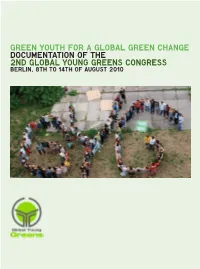
GREEN YOUTH FOR A GLOBAL GREEN CHANGE Documentation of the 2nd Global Young Greens Congress Berlin, 8th to 14th of August 2010 Dear readers! 3 A short history of the Global Young Greens 4 HISTORY 2nd Congress 8 programmE 9 Regional Meetings 10 Workshops 12 the perspectives of small content scale farming and the agricultural issues 16 Green New Deal – A Concept for a Global Economic Change? 17 Impressions 18 General Assembly of GYG Congress Berlin 2010 20 Summary of our Structure Reform 21 GYG in Action 22 Passed Proposals 23 Statements 25 Participants 26 Introduction of the new Steering Committee 28 Plans 32 THANK-YOU‘S 30 IMPRINT 31 2 global young greens—Congress 2010 Dear readers! We proudly present to you the documentation of the 2nd Global Young Greens Congress held in Berlin from 8th to 14th of August 2010! More than 100 participants from over 50 countries spent five days of discussing as well as exchanging opinions and experiences from their homecountries in order to get closer together and fight with “Youth Power for a Global Green Change“. Workshops, fishbowl discussions and a world café were organised as parts of the congress. The debated topics were endless – reaching from economics and gender issues to social justice, peace and conflicts and - of course - climate change. After three days of debating, two days of General Assem- bly followed. In this, new structures were adopted as well as several topical proposals to form a wider political platform. With this documentation, we are trying to show what the congress was about and what was behind. -

Inclusive Democracy and Participatory Economics TAKIS FOTOPOULOS
DEMOCRACY & NATURE: The International Journal of INCLUSIVE DEMOCRACY, Vol. 9, No. 3 (November 2003) Inclusive Democracy and Participatory Economics TAKIS FOTOPOULOS Although Michael Albert is well aware of the existence of the Inclusive Democracy (ID) project, still, in his new book Parecon (Par) 1 he prefers to ignore its existence and follows the trouble-free path to compare Parecon with the disastrous central planning system and the narrowly ecological Bioregionalism, or with social ecology which, in fact, offers no mechanism at all for the allocation of resources as it is based on a post-scarcity moral economy. However, even if may be a good tactics to demonstrate the “superiority” of a proposal by avoiding the dialogue with alternative viable proposals, 2 it certainly does not help the advancement of the discussion, urgently needed today, on alternative proposals of social organisation. It is therefore the aim of this paper to fill this gap and compare and contrast the ID project with Parecon, which I consider to be the main systematic proposals of an alternative economy recently advanced, so that readers could make their own minds about the pros and cons of each project. I will begin with a discussion of the general nature of the two proposals and I will continue with the main characteristics of Parecon, which I will then discuss in detail in the rest of the paper, comparing them with the corresponding characteristics of the ID project. Main elements of the two proposals The nature of Parecon and the ID project At the outset, it has to be made clear that Parecon, unlike the ID project, is not a political project about an alternative society. -
Jack Halberstam and Tavia Nyong'o Introduction: Theory in the Wild
Jack Halberstam and Tavia Nyong’o Introduction: Theory in the Wild New forms of wildness call to us on all sides, whether in the form of odd weather patterns, inventive forms of political activism, new classi - cations of the body, uctuating investments in disorder, or a renewed embrace of the ephemeral. But, at the same time, wildness has a history, a past and, potentially, a future. As certain new forms of wildness present themselves to us (the digital wildness of the glitch), others slip from view altogether (natural habitats). To say that wild- ness has a past is in no way to declare that past over or to announce the arrival of a new discursive regime. Rather, we claim here that the past of wildness is not all that wildness is or can be. Wild- ness has certainly functioned as a foil to civiliza- tion, as the dumping ground for all that white set- tler colonialism has wanted to declare expired, unmanageable, undomesticated, and politically unruly. For us, that makes wildness all the more appealing. Like another problematical term — queer — wildness names, while rendering partially opaque, what hegemonic systems would interdict or push to the margins. Unlike the way claims have been made on behalf of the queer, we are not brushing o a rejected term and refurbishing it here so much as we are attending to what an idea The South Atlantic Quarterly 117:3, July 2018 10.1215/00382876-6942081 © 2018 Duke University Press Downloaded from http://read.dukeupress.edu/south-atlantic-quarterly/article-pdf/117/3/453/535923/1170453.pdf by guest on 01 October 2021 454 The South Atlantic Quarterly • July 2018 has always gathered in its wake and what it gestures toward in terms of the expunged features of our own critical systems of making sense and order. -

Democracy and Inclusivity: a Reflection from the 2019 Bali Civil Society and Media Forum
Democracy and Inclusivity: A Reflection from the 2019 Bali Civil Society and Media Forum Editor Dinna Prapto Raharja, Ph.D Democracy and Inclusivity: A Reflection from the 2019 Bali Civil Society and Media Forum Editor Dinna Prapto Raharja, Ph.D Democracy and Inclusivity: A Reflection from the 2019 Bali Civil Society and Media Forum Editor Dinna Prapto Raharja, Ph.D Published by: Friedrich-Ebert-Stiftung (FES) Kantor Perwakilan Indonesia Jalan Kemang Selatan II No. 2 A | Jakarta 12730 Telepon : +62-21-7193711 Fax : +62-21-71791358 Email : info@fes.or.id Website: www.fes.or.id ISBN 978-602-8866-27-9 Oktober 2020 Reproduction of this work in any form whatsoever, including photocopies whitout the written permission of the publishers, is prohibited Not for Sale Contents Foreword from the Friedrich Ebert Stiftung [p. 6] Foreword from the Ministry of Foreign Affairs of the Republic of Indonesia [p. 9] Acronym and Abbreviation [p. 12] CHAPTER ONE Social Inclusion in Today’s Democracies Dinna Prapto Raharja [p. 15] CHAPTER TWO Trust and Confidence in Democracy Syahredzan Johan [p. 29] CHAPTER THREE Exclusivity and Democracy in Decline in Southeast Asia Naruemon Thabchumpon [p. 41] CHAPTER FOUR Beyond Numbers, Ensuring Inclusivity in a Growingly Exclusive Democratic Realm Sylvia Yazid and Mireille Marcia Karman [p. 51] CHAPTER FIVE Democracy, Capitalism and The New Media Andina Dwifatma [p. 63] CHAPTER SIX Hoax, Polarization, and Democracy: a Civil Society Perspective Anita Ashvini Wahid [p. 73] CHAPTER SEVEN Way Forward Dinna Prapto Raharja [p. 83] Profile of Writers [p. 90] Democracy and Inclusivity: A Reflection from the 2019 Bali Civil Society and Media Forum Foreword from the Friedrich-Ebert-Stiftung The Friedrich-Ebert-Stiftung Indonesia Office (FES) felt pleased when the Indonesian Ministry of Foreign Affairs (KEMLU) invited FES for the second time to become a co- organizer of the »Bali Democracy Media and Civil Society Forum (BCSMF)«, which was held again as a parallel and integral part of the Bali Democracy Forum (BDF). -

Social Ecology and Communalism
Murray Bookchin Bookchin Murray $ 12,95 / £ xx,xx Social Ecology and Communalism Replace this text Murray Bookchin ocial cology Social Ecology and Communalism and Communalism Social Ecology S E and Communalism AK Press Social Ecology and Communalism Murray Bookchin Social Ecology and Communalism Bookchin, Murray Social Ecology and Communalism Library of Congress Control Number 2006933557 ISBN 978-1-904859-49-9 Published by AK Press © Eirik Eiglad and Murray Bookchin 2006 AK Press 674–A 23rd St. Oakland, CA 94612 USA www.akpress.org akpress@akpress.org AK Press UK PO Box 12766 Edinburgh, EH8 9YE Scotland (0131) 555–5165 www.akuk.com ak@akedin.demon.co.uk Design and layout by Eirik Eiglad Contents An Introduction to Social Ecology and Communalism 7 What is Social Ecology? 19 Radical Politics in an Era of Advanced Capitalism 53 The Role of Social Ecology in a Period of Reaction 68 The Communalist Project 77 After Murray Bookchin 117 An Introduction to Social Ecology and Communalism We are standing at a crucial crossroads. Not only does the age- old “social question” concerning the exploitation of human labor remain unresolved, but the plundering of natural resources has reached a point where humanity is also forced to politically deal with an “ecological question.” Today, we have to make conscious choices about what direction society should take, to properly meet these challenges. At the same time, we see that our very ability to make the necessary choices are being undermined by an incessant centralization of economic and political power. Not only is there a process of centralization in most modern nation states that divests humanity of any control over social affairs, but power is also gradually being transferred to transnational institutions. -

Takis Fotopoulos[1]
Social Ecology, Eco- Communitarianism and Inclusive Democracy Takis Fotopoulos[1] Social Ecology and Inclusive Democracy John Clark’s critique of the politics of social ecology has no direct bearing on the Inclusive Democracy project ―only to the extent that the latter constitutes a synthesis of, among other traditions, some elements of libertarian municipalism. Readers of this journal are, anyway, well aware of the fact that the project of inclusive democracy represents a synthesis as well as a transcendence of the two major historical traditions, the socialist and the democratic ones, as well as of the radical currents in the new social movements (the open in browser PRO version Are you a developer? Try out the HTML to PDF API pdfcrowd.com feminist and particularly the ecological, of which social ecology is the most important radical component). Therefore, John Clark’s exclusive reliance on Murray Bookchin’s work on democracy in order to carry out an outright attack against direct democracy, ignoring, in the process, the work of Castoriadis and of this journal on the matter, seems —superficially at least— to be bizarre. However, this significant omission could easily be explained if one notes that what is from Clark’s viewpoint ‘one of the greatest strengths of Bookchin's politics’, is also, from a democratic perspective, the greatest weakness of this politics. Thus, according to Clark: One of the greatest strengths of Bookchin's politics is its grounding in ethics and the philosophy of nature (...) For Bookchin, politics is ultimately grounded in the process of evolutionary unfolding and self- realisation that has been taking place over the natural and social history of this planet. -

'Wild Capitalism'
University of Massachusetts Amherst ScholarWorks@UMass Amherst Anthropology Department Faculty Publication Anthropology Series January 2005 'Wild Capitalism’ and ‘Ecocolonialism’: A Tale of Two Rivers Krista Harper University of Massachusetts - Amherst, kharper@anthro.umass.edu Follow this and additional works at: https://scholarworks.umass.edu/anthro_faculty_pubs Part of the Agricultural and Resource Economics Commons, Comparative Politics Commons, Eastern European Studies Commons, Environmental Policy Commons, Nature and Society Relations Commons, Place and Environment Commons, Politics and Social Change Commons, Public Affairs Commons, Public Policy Commons, Science and Technology Policy Commons, Science and Technology Studies Commons, and the Social and Cultural Anthropology Commons Recommended Citation Harper, Krista, "'Wild Capitalism’ and ‘Ecocolonialism’: A Tale of Two Rivers" (2005). American Anthropologist. 72. https://scholarworks.umass.edu/anthro_faculty_pubs/72 This Article is brought to you for free and open access by the Anthropology at ScholarWorks@UMass Amherst. It has been accepted for inclusion in Anthropology Department Faculty Publication Series by an authorized administrator of ScholarWorks@UMass Amherst. For more information, please contact scholarworks@library.umass.edu. KRISTA HARPER “Wild Capitalism” and “Ecocolonialism”: A Tale of Two Rivers ABSTRACT The development and pollution of two rivers, the Danube and Tisza, have been the site and subject of environmental protests and projects in Hungary since the late 1980s. Protests against the damming of the Danube rallied opposition to the state socialist government, drawing on discourses of national sovereignty and international environmentalism. The Tisza suffered a major environmental disaster in 2000, when a globally financed gold mine in Romania spilled thousands of tons of cyanide and other heavy metals into the river, sending a plume of pollution downriver into neighboring countries. -
ABSTRACT Title of Dissertation: for the END IS a LIMIT
ABSTRACT Title of Dissertation: FOR THE END IS A LIMIT: THE QUESTION CONCERNING THE ENVIRONMENT Ozguc Orhan, Doctor of Philosophy, 2007 Dissertation Directed By: Professor Charles E. Butterworth Department of Government and Politics Professor Ken Conca Department of Government and Politics This dissertation argues that Aristotle’s philosophy of praxis (i.e., ethics and politics) can contribute to our understanding of the contemporary question concerning the environment. Thinking seriously about the environment today calls for resisting the temptation to jump to conclusions about Aristotle’s irrelevance to the environment on historicist grounds of incommensurability or the fact that Aristotle did not write specifically on environmental issues as we know them. It is true that environmental problems are basically twentieth-century phenomena, but the larger normative discourses in which the terms “environmental” and “ecological” and their cognates are situated should be approached philosophically, namely, as cross-cultural and trans-historical phenomena that touch human experience at a deeper level. The philosophical perspective exploring the discursive meaning behind contemporary environmental praxis can reveal to us that certain aspects of Aristotle’s thought are relevant, or can be adapted, to the ends of environmentalists concerned with developmental problems. I argue that Aristotle’s views are already accepted and adopted in political theory and the praxis of the environment in many respects. In the first half of the dissertation, I -

John Zerzan Organized Labor Versus "The Revolt Against Work"
John Zerzan Organized labor versus "the revolt against work" Serious commentators on the labor upheavals of the Depression years seem to agree that disturbances of all kinds, including the wave of sit-down strikes of 1936 and 1937, were caused by the 'speed-up' above all. Dissatisfaction among production workers with their new CIO unions set in early, however, mainly because the unions made no efforts to challenge management's right to establish whatever kind of work methods and working conditions they saw fit. The 1945 Trends in Collective Bargaining study noted that "by around 1940" the labor leader had joined the business leader as an object of "widespread cynicism" to the American employee. Later in the 1940s C. Wright Mills, in his The New Men of Power: Amenca's Labor Leaders, described the union's role thusly: "the integration of union with plant means that the union takes over much of the company's personnel work, becoming the discipline agent of the rank-and-file." In the mid-1950s, Daniel Bell realized that unionization had not given workers control over their job lives. Struck by the huge, Spontaneous walk-out at River Rouge in July. 1949, over the speed of the Ford assembly line, he noted that "sometimes the constraints of work explode with geyser suddenness." And as Bell's Work and Its Discontents (1956) bore witness that "the revolt against work is widespread and takes many forms, “so had Walker and Guest's Harvard study, The Man on the Assembly Line (1953), testified to the resentment and resistance of the man on the line.