When Continental Break-Up Ignores Crustal Heterogeneity
Total Page:16
File Type:pdf, Size:1020Kb
Load more
Recommended publications
-
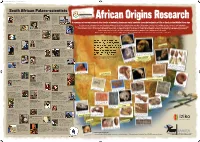
South African Palaeo-Scientists the Names Listed Below Are Just Some of South Africa’S Excellent Researchers Who Are Working Towards Understanding Our African Origins
2010 African Origins Research MAP_Layout 1 2010/04/15 11:02 AM Page 1 South African Palaeo-scientists The names listed below are just some of South Africa’s excellent researchers who are working towards understanding our African origins. UNIVERSITY OF CAPE TOWN (UCT) Dr Thalassa Matthews analyses the Dr Job Kibii focuses PALAEOBIOLOGICAL RESEARCH thousands of tiny teeth and bones of fossil on how fossil hominid Professor Anusuya Chinsamy-Turan is one microfauna to reconstruct palaeoenviron- and non-hominid of only a few specialists in the world who mental and climatic changes on the west faunal communities coast over the last 5 million years. changed over time and African Origins Research studies the microscopic structure of bones of dinosaurs, pterosaurs and mammal-like uses this to reconstruct reptiles in order to interpret various aspects ALBANY MUSEUM, past palaeoenviron- of the biology of extinct animals. GRAHAMSTOWN ments and palaeo- A summary of current research into fossils of animals, plants and early hominids from the beginning of life on Earth to the Middle Stone Age PERMIAN AGE PLANTS ecology. THE HOFMEYR SKULL Dr Rose Prevec studies the “No other country in the world can boast the oldest evidence of life on Earth extending back more than 3 billion years, the oldest multi-cellular animals, the oldest land-living plants, Professor Alan Morris described the Glossopteris flora of South Africa (the PAST HUMAN BEHAVIOUR Hofmeyer skull, a prehistoric, fossilized ancient forests that formed our coal Professor Chris Henshilwood directs the most distant ancestors of dinosaurs, the most complete record of the more than 80 million year ancestry of mammals, and, together with several other African countries, a most remarkable human skull about 36 000 years old deposits) and their end-Permian excavations at Blombos Cave where that corroborates genetic evidence that extinction. -

A. the Cape Province Fold Belt
SECTION II-A BRIEF SURVEY OF THE GEOLOGY OF THE CAPE SYSTEM A. THE CAPE PROVINCE FOLD BELT 1. Distribution and Folding The main occurrence of the Cape System in South Africa is confined to the Cape Province where a threefold division is recognised, namely the Table Mountain Series, or T.M.S., the Bokkeveld Series and, at the top, the Witte berg Series. The rocks occur along the western and southern margins of the sub-continent (see map on p. 10) where they lie with marked unconformity on older formations with granite intrusives. In the south and southwest, the Cape System dips beneath and is overlain conformably by the tillite of the Dwyka Series which forms the base of the Karroo System, but along the 'western margin the tillite when followed northwards, gradually overlaps the variolls series of the Cape System and finally lies directly on pre-Cape rocks. The whole system has been folded with a general N-S strik on the West and more intensely with a general E-W strike in the south with especially complex crumpling in the SW in the vicinity of Ceres and the Hex River Mountains, where the two fold axes Ineet. The folds in the south are frequently overturned, and are sometimes isoclinal. Usually lateral folds display a fairly teep pitch with the result that they ar hortened, outcrops occur en echelon and a particular horizon may reappear a nwnber of times in a traverse acros the ),stem. Pressure .has resulted in the alteration of organic matter to graphite in many cases and the cOlnplete de truction of micro flora. -

The Origin and Early Evolution of Dinosaurs
Biol. Rev. (2010), 85, pp. 55–110. 55 doi:10.1111/j.1469-185X.2009.00094.x The origin and early evolution of dinosaurs Max C. Langer1∗,MartinD.Ezcurra2, Jonathas S. Bittencourt1 and Fernando E. Novas2,3 1Departamento de Biologia, FFCLRP, Universidade de S˜ao Paulo; Av. Bandeirantes 3900, Ribeir˜ao Preto-SP, Brazil 2Laboratorio de Anatomia Comparada y Evoluci´on de los Vertebrados, Museo Argentino de Ciencias Naturales ‘‘Bernardino Rivadavia’’, Avda. Angel Gallardo 470, Cdad. de Buenos Aires, Argentina 3CONICET (Consejo Nacional de Investigaciones Cient´ıficas y T´ecnicas); Avda. Rivadavia 1917 - Cdad. de Buenos Aires, Argentina (Received 28 November 2008; revised 09 July 2009; accepted 14 July 2009) ABSTRACT The oldest unequivocal records of Dinosauria were unearthed from Late Triassic rocks (approximately 230 Ma) accumulated over extensional rift basins in southwestern Pangea. The better known of these are Herrerasaurus ischigualastensis, Pisanosaurus mertii, Eoraptor lunensis,andPanphagia protos from the Ischigualasto Formation, Argentina, and Staurikosaurus pricei and Saturnalia tupiniquim from the Santa Maria Formation, Brazil. No uncontroversial dinosaur body fossils are known from older strata, but the Middle Triassic origin of the lineage may be inferred from both the footprint record and its sister-group relation to Ladinian basal dinosauromorphs. These include the typical Marasuchus lilloensis, more basal forms such as Lagerpeton and Dromomeron, as well as silesaurids: a possibly monophyletic group composed of Mid-Late Triassic forms that may represent immediate sister taxa to dinosaurs. The first phylogenetic definition to fit the current understanding of Dinosauria as a node-based taxon solely composed of mutually exclusive Saurischia and Ornithischia was given as ‘‘all descendants of the most recent common ancestor of birds and Triceratops’’. -

GAMMA-KAPPA 765Kv Transmission Line, Western Cape Province
1 GAMMA-KAPPA 765kV Transmission Line, Western Cape Province SCOPING REPORT PALAEONTOLOGY Compiled by: Dr JF Durand (Sci.Nat.) For: MDT Environmental (Pty) Ltd 673 Glossoti Street, Garsfontein, Pretoria 0081, SOUTH AFRICA 25 July 2020 2 Table of Contents: 1. Executive Summary………………………………..…………………………....................3 2. Introduction……………………………………………………………………….................4 3. Terms of reference for the report………………………………………………................5 4. Details of study area and the type of assessment…………………………………….....8 5. Geological setting……………………………………………………………………………9 6. Palaeontology of the study area…………………………..……………………………...11 7. Conclusion and Recommendations………… …………………………………………20 8. Declaration of Independence……………………………………………………………..22 . List of Figures: Figure 1: Google Earth photo indicating the study area……...………………….……….. 8 Figure 2: Geological map of the study area with the proposed power grid for the Gamma-Kappa section (adapted from the 1: 1 000 000 Geology Map for South Africa, Lesotho and Swaziland, Geological Survey, 1970) ………………………10 Figure 3: Biostratigraphical map indicating the Karoo Supergroup strata including the biozonation of the Lower Beaufort Group in the study area (adapted from Rubidge, 1995)………………………………………………………………………...11 Figure 4: Mesosaurus fossil skeleton………………………………….…………………….12 Figure 5: Tapinocephalus skull……………………………………………………………… 14 Figure 6 : Bradysaurus skeleton …………………………………………………………… 15 Figure 7: Atherstonia………………………………………………………………………… 15 Figure 8: Rhinesuchus skull………………………………………………………………....16 -

The Systematic Position of the Enigmatic Thyreophoran Dinosaur Paranthodon Africanus, and the Use of Basal Exemplifiers in Phyl
1 The systematic position of the enigmatic thyreophoran dinosaur Paranthodon africanus, 2 and the use of basal exemplifiers in phylogenetic analysis 3 4 Thomas J. Raven1,2 ,3 and Susannah C. R. Maidment2 ,3 5 61Department of Earth Science & Engineering, Imperial College London, UK 72School of Environment & Technology, University of Brighton, UK 8 3Department of Earth Sciences, Natural History Museum, London, UK 9 10Corresponding author: Thomas J. Raven 11 12Email address: tom.raven13@imperial.ac.uk 13 14 15 16 17 18 19 20 21ABSTRACT 22 23The first African dinosaur to be discovered, Paranthodon africanus was found in 1845 in the 24Lower Cretaceous of South Africa. Taxonomically assigned to numerous groups since discovery, 25in 1981 it was described as a stegosaur, a group of armoured ornithischian dinosaurs 26characterised by bizarre plates and spines extending from the neck to the tail. This assignment 27that has been subsequently accepted. The type material consists of a premaxilla, maxilla, a nasal, 28and a vertebra, and contains no synapomorphies of Stegosauria. Several features of the maxilla 29and dentition are reminiscent of Ankylosauria, the sister-taxon to Stegosauria, and the premaxilla 30appears superficially similar to that of some ornithopods. The vertebral material has never been 31described, and since the last description of the specimen, there have been numerous discoveries 32of thyreophoran material potentially pertinent to establishing the taxonomic assignment of the 33specimen. An investigation of the taxonomic and systematic position of Paranthodon is therefore 34warranted. This study provides a detailed re-description, including the first description of the 35vertebra. Numerous phylogenetic analyses demonstrate that the systematic position of 36Paranthodon is highly labile and subject to change depending on which exemplifier for the clade 37Stegosauria is used. -
The Role of Fossils in Interpreting the Development of the Karoo Basin
Palaeon!. afr., 33,41-54 (1997) THE ROLE OF FOSSILS IN INTERPRETING THE DEVELOPMENT OF THE KAROO BASIN by P. J. Hancox· & B. S. Rubidge2 IGeology Department, University of the Witwatersrand, Private Bag 3, Wits 2050, South Africa 2Bernard Price Institute for Palaeontological Research, University of the Witwatersrand, Private Bag 3, Wits 2050, South Africa ABSTRACT The Permo-Carboniferous to Jurassic aged rocks oft1:J.e main Karoo Basin ofSouth Africa are world renowned for the wealth of synapsid reptile and early dinosaur fossils, which have allowed a ten-fold biostratigraphic subdivision ofthe Karoo Supergroup to be erected. The role offossils in interpreting the development of the Karoo Basin is not, however, restricted to biostratigraphic studies. Recent integrated sedimentological and palaeontological studies have helped in more precisely defming a number of problematical formational contacts within the Karoo Supergroup, as well as enhancing palaeoenvironmental reconstructions, and basin development models. KEYWORDS: Karoo Basin, Biostratigraphy, Palaeoenvironment, Basin Development. INTRODUCTION Invertebrate remains are important as indicators of The main Karoo Basin of South Africa preserves a facies genesis, including water temperature and salinity, retro-arc foreland basin fill (Cole 1992) deposited in as age indicators, and for their biostratigraphic potential. front of the actively rising Cape Fold Belt (CFB) in Fossil fish are relatively rare in the Karoo Supergroup, southwestern Gondwana. It is the deepest and but where present are useful indicators of gross stratigraphically most complete of several depositories palaeoenvironments (e.g. Keyser 1966) and also have of Permo-Carboniferous to Jurassic age in southern biostratigraphic potential (Jubb 1973; Bender et al. Africa and reflects changing depositional environments 1991). -
The Stratigraphy and Structure of the Kommadagga Subgroup and Contiguous Rocks
THE STRATIGRAPHY AND STRUCTURE OF THE KOMMADAGGA SUBGROUP AND CONTIGUOUS ROCKS by ROGER SWART B.Sc . (Hons) Thesis presented in fulfilment of the requirements for the degree of Master of Science in the Department of Geology, Rhodes University ,Grahamstown. January 1982 ABSTRACT The Lake Mentz and Kommadagga Subgroups were deposited i n a marine environment and are characterised by a heterogeneous sequence of sediments, which range in grain size from clays to grits . During the first phase of deposition the Kwee~ vlei Shale and Floriskraal Formations were deposited in a prograding shoreline environment, whereas the succeeding Waaipoort Shale Formation is interpreted as represnting a reworked shoreline. The final phase of deposition of the Cape Supergroup was a regressive one in which the Kommadagga Subgroup wa s fo rmed. The coa rs eni ng upward cycle of thi s subgroup represents a deltaic deposit. A significant time gap appears to exist before the deposition of the glacial-marine Dwyka Tillite Formation. Structurally, the area was subjected to deformation by buckle folding at about 250 Ma into a series of folds with southward dipping axial planes. Only one phase of deformation is recognised in the study area . A decrease in pore space, mineral overgrowths,formation of silica and calcite cements and development of aut~igenic minerals such as opal, stilpnomelane; analcite, prehnite, muscovite and various clay minerals are the characteristic diagenetic features of the sediments.The mineralogical evidence suggests that the maximum temperature -
Joint Geological Survey/University of Cape Town MARINE GEOSCIENCE UNIT TECHNICAL ^REPORT NO. 13 PROGRESS REPORTS for the YEARS 1
Joint Geological Survey/University of Cape Town MARINE GEOSCIENCE UNIT TECHNICAL ^REPORT NO. 13 PROGRESS REPORTS FOR THE YEARS 1981-1982 Marine Geoscience Group Department of Geology University of Cape Town December 1982 NGU-Tfc—Kh JOINT GEOLOGICAL SURVEY/UNIVERSITY OF CAPE TOWN MARINE GEOSCIENCE UNIT TECHNICAL REPORT NO. 13 PROGRESS REPORTS FOR THE YEARS 1981-1982 Marine Geoscience Group Department of Geology University of Cape Town December 1982 The Joint Geological Survey/University of Cape Town Marine Geoscience Unit is jointly funded by the two parent organizations to promote marine geoscientific activity in South Africa. The Geological Survey Director, Mr L.N.J. Engelbrecht, and the University Research Committee are thanked for their continued generous financial and technical support for this work. The Unit was established in 1975 by the amalgamation of the Marine Geology Programme (funded by SANCOR until 1972) and the Marine Geophysical Unit. Financial ?nd technical assistance from the South African National Committee for Oceanographic Research, and the National Research Institute for Oceanology (Stellenbosch) are also gratefully acknowledged. It is the policy of the Geological Survey and the University of Cape Town that the data obtained may be presented in the form of theses for higher degrees and that completed projects shall be published without delay in appropriate media. The data and conclusions contained in this report are made available for the information of the international scientific community with tl~e request that they be not published in any manner without written permission. CONTENTS Page INTRODUCTION by R.V.Dingle i PRELIMINARY REPORT ON THE BATHYMETRY OF PART OF 1 THE TRANSKEI BASIN by S.H. -

Revealing the Beattie Magnetic Anomaly and the Anatomy Of
11th SAGA Biennial Technical Meeting and Exhibition Swaziland, 16 - 18 September 2009, pages 490 - 499 Revealing the Beattie Magnetic Anomaly and the anatomy of the crust of southernmost Africa: Geophysics and deep sub- surface geology where the Cape Fold Belt and Karroo Basin meet A. S. Lindeque1,2,3, M.J. de Wit4 1. Now at Alfred Wegener Institute for Polar and Marine Research, Geophysics, Building D3280, Am Alten Hafen 26, 27568 Bremerhaven, Germany, ansalique@gmail.com 2. Council for Geoscience, Western Cape, P.O. Box 572, Bellville 7535, Cape Town, South Africa 3. GeoForschungsZentrum Potsdam, Section 2.2, Telegrafenberg, 14473 Potsdam, Germany 4. AEON - Africa Earth Observatory Network and Department of Geological Sciences, University of Cape Town, Rondebosch 7701, South Africa, maarten.dewit@uct.ac ABSTRACT The deep crust of the southernmost margin of Africa contains unresolved tectonic features such as the Paleozoic Cape Fold Belt (CFB), the Paleozoic-Mesozoic Karroo Basin and the largest terrestrial magnetic anomaly, the Beattie Magnetic Anomaly (BMA). Without resolving these structures, our understanding of the evolution of the southern margin will be incomplete and limited. Under the auspices of the Inkaba yeAfrica framework, several geophysical datasets were acquired from 2004 to 2007, along two transects across the margin and its unique tectonic features. This research presents a tectonic model and crustal geometry, at the centre 100 km of the western transect. The model is derived from the joint interpretation of: surface geology, aeromagnetic data, nearby deep boreholes, teleseismic receiver functions, impedance spectroscopy measurements on borehole samples, near vertical reflection seismic data (NVR), shallow P- and S-wave velocity data, wide angle refraction data and magnetotelluric data. -

Taphonomy As an Aid to African Palaeontology*
Palaeont. afr., 24 (1981 ) PRESIDENTIAL ADDRESS: TAPHONOMY AS AN AID TO AFRICAN PALAEONTOLOGY* by C.K. Brain Transvaal Museum, P.O. Box 413, Pretoria 0001 SUMMARY Palaeontology has its roots in both the earth and life sciences. Its usefulness to geology comes from the light which the understanding of fossils may throw on the stratigraphic re lationships of sediments, or the presence of economic deposits such as coal or oil. In biology, the study of fossils has the same objectives as does the study of living animals or plants and such objectives are generally reached in a series of steps which may be set out as follows: STEP I. Discovering what forms of life are, or were, to be found in a particular place at a particular time. Each form is allocated a name and is fitted into a system of classification. These contributions are made by the taxonomist or the systematist. STEP 2. Gaining afuller understanding ofeach described taxon as a living entity. Here the input is from the anatomist, developmental biologist, genetIcIst, physi ologist or ethologist and the information gained is likely to modify earlier decisions taken on the systematic position of the forms involved. STEP 3. Understanding the position ofeach form in the living community or ecosystem. This step is usually taken by a population biologist or ecologist. Hopefully, any competent neo- or palaeobiologist (I use the latter term deliberately in this context in preference to "palaeontologist") should be able to contribute to more than one of the steps outlined above. Although the taxonomic and systematic steps have traditionally been taken in museums or related institutions, it is encouraging to see that some of the steps subsequent to these very basic classificatory ones are now also being taken by museum biol ogists. -

Proceedings of the 18Th Biennial Conference of the Palaeontological Society of Southern Africa Johannesburg, 11–14 July 2014
Proceedings of the 18th Biennial Conference of the Palaeontological Society of Southern Africa Johannesburg, 11–14 July 2014 Table of Contents Letter of Welcome· · · · · · · · · · · · · · · · · · · · · · · · · · · · · · · · · · · · · · · · · · · · · · · · · · · · · · · · · · · · · · · · · · · · · · · · · · · · · · · · · · 63 Programme · · · · · · · · · · · · · · · · · · · · · · · · · · · · · · · · · · · · · · · · · · · · · · · · · · · · · · · · · · · · · · · · · · · · · · · · · · · · · · · · · · · · · · · · 64 · · · · · · · · · · · · · · · · · · · · · · · · · · · · · · · · · · · · · · · · · · · · · · · · · · · · · · · · · · · · · · · · · · · · · · · · · · · · · · · 66 Hand, K.P., Bringing Two Worlds Together: How Earth’s Past and Present Help Us Search for Life on Other Planets · · · · · · · 66 · · · · · · · · · · · · · · · · · · · · · · · · · · · · · · · · · · · · · · · · · · · · · · · · · · · · · · · · · · · · · · · · · · · · · · · · · · · · · · · · · · 67 Erwin, D.H., Major Evolutionary Transitions in Early Life: A Public Goods Approach · · · · · · · · · · · · · · · · · · · · · · · · · · · · · · · · · 67 Lelliott, A.D., A Survey of Visitors’ Experiences of Human Origins at the Cradle of Humankind, South Africa· · · · · · · · · · · · · · 68 Looy, C., The End-Permian Biotic Crisis: Why Plants Matter · · · · · · · · · · · · · · · · · · · · · · · · · · · · · · · · · · · · · · · · · · · · · · · · · · · 69 Reed, K., Hominin Evolution and Habitat: The Importance of Analytical Scale · · · · · · · · · · · · · · · · · · · · · · · · · · · · · -
Remagnetizations in Late Permian and Early Triassic Rocks from Southern Africa and Their Implications for Pangeareconstructions
412 Earth and Planetary Science Letters, 79 (1986) 412-418 Elsevier Science Publishers B.V., Amsterdam - Printed in The Netherlands 151 Remagnetizations in Late Permian and Early Triassic rocks from southern Africa and their implications for Pangea reconstructions Martha M. Ballard ‘, Rob Van der Voo * and I.W. HZlbich 2 ’ Department of Geological Sciences, University of Michigan, Am Arbor, MI 48109 (U.S.A.) ’ Department of Geology, University of Stellenbosch, Stellenbosclr (Republic of South Africa) Received March 31,1985; revised version received June 24, 1986 -A paleomagnetic study of late Paleozoic and early Mesozoic sedimentary rocks from southern Africa suggests wide-spread remagnetization of these rocks. Samples of the Mofdiahogolo Formation in Botswana and of the Lower Beaufort Group in South Africa were treated using thermal, alternating field and chemical demagnetization. The Mofdiahogolo redbeds show a univectoral decay of the remanence revealing a characteristic direction of D = 340°, I = - 58O, k = 64, a9s = 12O. The Lower Beaufort sandstones, using thermal and alternating field demagnetization, show a very similar direction of D = 337O, I = -63”, k = 91, ags = 6O. A fold test on the Beaufort rocks is negative indicating that this magnetization is secondary and acquired after the Permo-Triassic Cape Belt folding event. Previous studies have reported similar directions in the Upper Beaufort redbeds as well as in the Kenyan Maji ya Chumvi Formation of Early Triassic age. The poles of these studies have been used in testing the validity of the various Pangea reconstructions for the Late Permian and the Early Triassic. Our results suggest that these poles may also be based on remagnetized data and that their use to document the position of Gondwana in Pangea reconstructions should be treated with caution.