African Union Election Observation Mission Report: Zambia 2016
Total Page:16
File Type:pdf, Size:1020Kb
Load more
Recommended publications
-

Zambia General Elections
Report of the Commonwealth Observer Group ZAMBIA GENERAL ELECTIONS 20 September 2011 COMMONWEALTH SECRETARIAT Table of Contents Chapter 1 ................................................................................................... 1 INTRODUCTION ...................................................................................... 1 Terms of Reference ....................................................................................... 1 Activities ....................................................................................................... 1 Chapter 2 ................................................................................................... 3 POLITICAL BACKGROUND ....................................................................... 3 Early History ................................................................................................. 3 Colonial History of Zambia ............................................................................. 3 Post-Independence Politics ............................................................................ 3 2001 General Elections .................................................................................. 4 2006 General Elections .................................................................................. 5 The 2008 Presidential By-Election ................................................................... 5 Other Developments ...................................................................................... 5 Constitutional Review ................................................................................... -

Food Security Research Project
FOOD SECURITY RESEARCH PROJECT MARKET ACCESS, TRADE & ENABLING POLICIES (MATEP)PROGRAM ZAMBIA HORTICULTURAL RAPID APPRAISAL: UNDERSTANDING THE DOMESTIC VALUE CHAINS OF FRESH FRUITS AND VEGETABLES By Munguzwe Hichaambwa David Tschirley WORKING PAPER No. 17 FOOD SECURITY RESEARCH PROJECT LUSAKA, ZAMBIA September 2006 (Downloadable at: http://www.aec.msu.edu/agecon/fs2/zambia/index.htm) ACKNOWLEDGEMENTS We would like to thank Stanley Mushingwani of the Agricultural Market Information Center (AMIC) at Ministry of Agriculture and Cooperatives for research assistance; Michael T. Weber of Michigan State University Department of Agricultural Economics for helpful input throughout the process; Anthony Mwanaumo when, as Director of FSRP, he provided constant encouragement to both of us during the research; and to all the people – farmers, traders, supermarket managers, Freshpikt management, officials in City Council and Ministry of Local Government and Housing, and others who gave freely of their time and information to help us understand Zambia’s horticultural marketing system. We only hope we have done justice to the information they have given us; all errors are ours. Funding for this work came from USAID/Zambia mission through Market Access, Trade, and Enabling Policies (MATEP) Program. Page ii TABLE OF CONTENTS ACKNOWLEDGEMENTS.......................................................................................................ii LIST OF TABLES....................................................................................................................iv -

Can African States Conduct Free and Fair Presidential Elections? Edwin Odhiambo Abuya
Northwestern Journal of International Human Rights Volume 8 | Issue 2 Article 1 Spring 2010 Can African States Conduct Free and Fair Presidential Elections? Edwin Odhiambo Abuya Follow this and additional works at: http://scholarlycommons.law.northwestern.edu/njihr Recommended Citation Edwin Odhiambo Abuya, Can African States Conduct Free and Fair Presidential Elections?, 8 Nw. J. Int'l Hum. Rts. 122 (2010). http://scholarlycommons.law.northwestern.edu/njihr/vol8/iss2/1 This Article is brought to you for free and open access by Northwestern University School of Law Scholarly Commons. It has been accepted for inclusion in Northwestern Journal of International Human Rights by an authorized administrator of Northwestern University School of Law Scholarly Commons. Copyright 2010 by Northwestern University School of Law Volume 8, Issue 2 (Spring 2010) Northwestern Journal of International Human Rights Can African States Conduct Free and Fair Presidential Elections? Edwin Odhiambo Abuya* Asiyekubali kushindwa si msihindani.1 I. INTRODUCTION ¶1 Can African States hold free and fair elections? To put it another way, is it possible to conduct presidential elections in Africa that meet internationally recognized standards? These questions can be answered in the affirmative. However, in order to safeguard voting rights, specific reforms must be adopted and implemented on the ground. In keeping with international legal standards on democracy,2 the constitutions of many African states recognize the right to vote.3 This right is reflected in the fact that these states hold regular elections. The right to vote is fundamental in any democratic state, but an entitlement does not guarantee that right simply by providing for elections. -
Database of Mineral Resources of Zambia
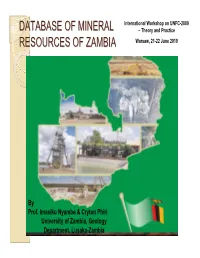
International Workshop on UNFC-2009 DATABASEDATABASE OFOF MINERALMINERAL – Theory and Practice RESOURCESRESOURCES OFOF ZAMBIAZAMBIA Warsaw, 21-22 June 2010 By Prof. Imasiku Nyambe & Cryton Phiri University of Zambia, Geology Department, Lusaka-Zambia PRESENTATIONPRESENTATION LAYOUTLAYOUT y Introduction y Regional Geological Setting y Stratigraphy y Geology and Mineral Resources y Mining Administration Of Mineral Resource y Regional Mapping y Geochemical Survey y Mineral Resource Exploration y Mineral Resource Evaluation y Mineral Potential y Conclusion y References IntroductionIntroduction y Zambia is a landlocked country in Southern Africa with a total area of 752,614km² and with a population of 12 million people. Located well in the tropics and enjoys a sunny climate with three distinct seasons. The country is endowed with mineral resources and since 1930s the mining industry has been the economic backbone of Zambia. RegionalRegional GeologicalGeological SettingSetting y Zambia is a vivacious country forming a natural hub for the regions diverse activities. Its diverse mineral endowment is entirely a function of the variety of geological terrains and the multiplicity of thermal tectonic events that have overprinted and shaped these terrains. Position of Zambia RegionalRegional GeologicalGeological SettingSetting Zambia’s geological terrains y The multiplicity of tectono‐thermal events reflect somewhat a complex geology. These differential movements have played an important role in the geological evolution and the genesis of the country’s -

Zambia Page 1 of 8
Zambia Page 1 of 8 Zambia Country Reports on Human Rights Practices - 2003 Released by the Bureau of Democracy, Human Rights, and Labor February 25, 2004 Zambia is a republic governed by a president and a unicameral national assembly. Since 1991, multiparty elections have resulted in the victory of the Movement for Multi-Party Democracy (MMD). MMD candidate Levy Mwanawasa was elected President in 2001, and the MMD won 69 out of 150 elected seats in the National Assembly. Domestic and international observer groups noted general transparency during the voting; however, they criticized several irregularities. Opposition parties challenged the election results in court, and court proceedings were ongoing at year's end. The anti-corruption campaign launched in 2002 continued during the year and resulted in the removal of Vice President Kavindele and the arrest of former President Chiluba and many of his supporters. The Constitution mandates an independent judiciary, and the Government generally respected this provision; however, the judicial system was hampered by lack of resources, inefficiency, and reports of possible corruption. The police, divided into regular and paramilitary units under the Ministry of Home Affairs, have primary responsibility for maintaining law and order. The Zambia Security and Intelligence Service (ZSIS), under the Office of the President, is responsible for intelligence and internal security. Civilian authorities maintained effective control of the security forces. Members of the security forces committed numerous serious human rights abuses. Approximately 60 percent of the labor force worked in agriculture, although agriculture contributed only 15 percent to the gross domestic product. Economic growth increased to 4 percent for the year. -
Use of Gis for Analysis of Community Health Worker Patient
USE OF GIS FOR ANALYSIS OF COMMUNITY HEALTH WORKER PATIENT REGISTRIES FROM CHONGWE DISTRICT, A RURAL LOW-RESOURCE SETTING, IN LUSAKA PROVINCE, ZAMBIA by Mine Metitiri, MPH, CPH A Thesis Presented to the FACULTY OF THE USC GRADUATE SCHOOL UNIVERSITY OF SOUTHERN CALIFORNIA In Partial Fulfillment of the Requirements for the Degree MASTER OF SCIENCE (GEOGRAPHIC INFORMATION SCIENCE AND TECHNOLOGY) December 2014 Copyright 2014 Mine Metitiri TABLE OF CONTENTS DEDICATION........................................................................................................................... v ACKNOWLEDGEMENTS .................................................................................................... vi LIST OF TABLES .................................................................................................................. vii LIST OF FIGURES ............................................................................................................... viii LIST OF ABBREVIATIONS ................................................................................................. ix ABSTRACT .............................................................................................................................. xi CHAPTER ONE: INTRODUCTION ..................................................................................... 1 Motivation .......................................................................................................................... 3 CHAPTER TWO: BACKGROUND...................................................................................... -

Zambia Page 1 of 16
Zambia Page 1 of 16 Zambia Country Reports on Human Rights Practices - 2002 Released by the Bureau of Democracy, Human Rights, and Labor March 31, 2003 Zambia is a republic governed by a president and a unicameral national assembly. Since 1991 generally free and fair multiparty elections have resulted in the victory of the Movement for Multi -Party Democracy (MMD). In December 2001, Levy Mwanawasa of the MMD was elected president, and his party won 69 out of 150 elected seats in the National Assembly. The MMD's use of government resources during the campaign raised questions over the fairness of the elections. Although noting general transparency during the voting, domestic and international observer groups cited irregularities in the registration process and problems in the tabulation of the election results. Opposition parties challenged the election result in court, and court proceedings remained ongoing at year's end. The Constitution mandates an independent judiciary, and the Government generally respected this provision; however, the judicial system was hampered by lack of resources, inefficiency, and reports of possible corruption. The police, divided into regular and paramilitary units operated under the Ministry of Home Affairs, had primary responsibility for maintaining law and order. The Zambia Security and Intelligence Service (ZSIS), under the Office of the President, was responsible for intelligence and internal security. Members of the security forces committed numerous, and at times serious, human rights abuses. Approximately 60 percent of the labor force worked in agriculture, although agriculture contributed only 22 percent to the gross domestic product. Economic growth slowed to 3 percent for the year, partly as a result of drought in some agricultural areas. -

Post-Populism in Zambia: Michael Sata's Rise
This is the accepted version of the article which is published by Sage in International Political Science Review, Volume: 38 issue: 4, page(s): 456-472 available at: https://doi.org/10.1177/0192512117720809 Accepted version downloaded from SOAS Research Online: http://eprints.soas.ac.uk/24592/ Post-populism in Zambia: Michael Sata’s rise, demise and legacy Alastair Fraser SOAS University of London, UK Abstract Models explaining populism as a policy response to the interests of the urban poor struggle to understand the instability of populist mobilisations. A focus on political theatre is more helpful. This article extends the debate on populist performance, showing how populists typically do not produce rehearsed performances to passive audiences. In drawing ‘the people’ on stage they are forced to improvise. As a result, populist performances are rarely sustained. The article describes the Zambian Patriotic Front’s (PF) theatrical insurrection in 2006 and its evolution over the next decade. The PF’s populist aspect had faded by 2008 and gradually disappeared in parallel with its leader Michael Sata’s ill-health and eventual death in 2014. The party was nonetheless electorally successful. The article accounts for this evolution and describes a ‘post-populist’ legacy featuring hyper- partisanship, violence and authoritarianism. Intolerance was justified in the populist moment as a reflection of anger at inequality; it now floats free of any programme. Keywords Elections, populism, political theatre, Laclau, Zambia, Sata, Patriotic Front Introduction This article both contributes to the thin theoretic literature on ‘post-populism’ and develops an illustrative case. It discusses the explosive arrival of the Patriotic Front (PF) on the Zambian electoral scene in 2006 and the party’s subsequent evolution. -

Effectiveness of Community Participation in Decision
EFFECTIVENESS OF COMMUNITY PARTICIPATION IN DECISION MAKING AND IMPLEMENTATION OF WATER SUPPLY AND SANITATION PROJECTS: A CASE STUDY OF CHONGWE DISTRICT BY TIMOTHY PHIRI A DISSERTATION SUBMITTED TO THE UNIVERSITY OF ZAMBIA IN PARTIAL FULFILMENT OF THE REQUIREMENT OF THE DEGREE OF MASTER OF PUBLIC ADMINISTRATION (MPA) THE UNIVERSITY OF ZAMBIA LUSAKA 2015 DECLARATION I, TIMOTHY PHIRI, declare that this dissertation represents my own work and that it has not been previously submitted for a degree, diploma or other qualifications at this or another university. Signature: ___________________________________________ Date: _______________________________________________ i CERTIFICATE OF APPROVAL FORM This dissertation of TIMOTHY PHIRI has been approved as partial fulfilment of the requirement for the award of the Degree of Master of Public Administration by the University of Zambia. Examiner Signature Date __________________ __________________ _________ __________________ ___________________ _________ __________________ ____________________ _________ ii COPYRIGHT All rights reserved. No part of this dissertation may be reproduced or stored in any form or by any means without prior permission in writing from the author. iii DEDICATION To Agness Falesi Phiri iv ABSTRACT The study investigated factors that lead to low levels of community participation in decision making and implementation of water supply and sanitation projects in Chongwe District. Focus was on five political units (wards) namely Nthandabale, Chalimbana, Nakatindi, Lukoshi and Chongwe. -

Zambia's 2001 Elections: the Tyranny of Small Decisions, 'Non-Decisions
Third World Quarterly, Vol 23, No 6, pp 1103–1120, 2002 Zambia’s 2001 elections: the tyranny of small decisions, ‘non-decisions’ and ‘not decisions’ PETER BURNELL ABSTRACT The course of the 1990s witnessed deterioration in the quality of elections held across sub-Saharan Africa. Zambia’s elections for the presidency, parliament and local government held on 27 December 2001 are no exception. They returned the Movement for Multi-Party Democracy (MMD) to power, but with much reduced popular support and leaving doubts about the legitimacy of the result. A ‘tyranny of small decisions’, ‘non-decisions’ and ‘not decisions’ perpetrated over 12 months or more leading up to these elections combined to influence the outcome. The previous MMD government and the formally autono- mous Electoral Commission were primarily but not wholly responsible. For independent analysts as well as for the political opposition, who secured a majority of parliamentary seats while narrowly failing to capture the presidency, identifying the relevant category of ‘decisions’ to which influences belong and comparing their impact is no straightforward matter. Zambia both illustrates the claim that ‘administrative problems are typically the basis of the flawed elections’ in new democracies and refines it by showing the difficulty of clearly separating the administrative and political factors. In contrast Zimbabwe’s presi- dential election in March 2002, which had the Zambian experience to learn from, appears a more clear-cut case of deliberate political mischief by the ruling party. There is little doubt that in the course of the 1990s the quality of Africa’s elections went into decline. -
Status, Priorities and Needs for T I Bl Il T I Sustainable Soil Management In
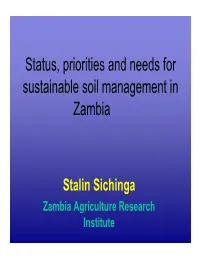
Status, priorities and needs for sustitaina ble so il managemen tit in Zambia SSStalin Sichinga Zamb ia Ag ricu ltu re Resea r ch Institute Introduction Zambia has an area of 750,000 km2 with about 13.9 million people and ample land resources 0ut of 9 million ha cultivable land, only 14% is cropped in any year About 55 - 60% of the land area is covered by natural forest and 6% of Zambia‘s land surface is covered by water. Agro-ecological regions and soil distribution The country is classified into three agro-ecological regions based on soil types, rainfall, and other climatic conditions Agro-Ecological Regions N Chiengi Kaputa Mpulungu W E Nchelenge Mbala Nakonde Mporokoso S Kawambwa Mungwi Isoka Scale 1: 2,500,000 Mwense Luwingu Kasama Chinsali Chilubi Mansa Chama LEGEND Samfya Milenge Mpika Regions Mwinilunga Chililabombwe Solwezi Agro-ecological Region I Chingola Mufulira Lundazi I Ka lul u shi Kitwe Ndola IIa Lufwanyama Luans hya Chavuma Serenje Mambwe Kabompo Masaiti IIb Mpongwe Zambezi Mufumbwe Chipata Kasempa Petauke Katete Chadiza III Annual rainfall is <750mm Kapiri Mposhi Mkushi Nyimba Kabwe Lukulu Kaoma Mumbwa Chibombo Kalabo Mongu Chongwe Lusaka Urban Luangwa Itezhi-Tezhi Kafue Namwala Mazabuka Senanga Monze KEY Siavonga Sesheke Gwembe Shangombo Choma District boundary e Kazungula Kalomo w g n o z a in Livingstone S 200 0 200 400 Kilometers December 2002 The region contains a diversity of soil types ranging from slightly acidic Nitosols to alkaline Luvisols with pockets of Vertisols, Arenosols, Leptosols and, Solonetz. The physical limitations of region I soils Hazards to erosion, lim ite d so il dept h in t he hills an d escarpment zones, presence of hardpans in the pan dambo areas, ppyoor workability in the cracking gy, clay soils, problems of crusting in most parts of the Southern province, low water-holding capacities and the problem of wetness in the valley dambos, plains and swamps. -

Northern Voices - Celebrating 30 Years of Development Partnership in Northern Province, Zambia
Northern Voices - Celebrating 30 years of development partnership in Northern Province, Zambia Mbala Nakonde Isoka Mungwi Luwingu Kasama Chilubi Mpika Lusaka Contents Page Preface 4 Introduction 5 Governance 6 Education 15 Health 23 Water and Sanitation 33 Livelihoods, Food and Nutrition Security 39 HIV & AIDS 49 Preface As Ambassador of Ireland to Zambia, it is with great pleasure that I introduce to you “Northern Voices - Celebrating 30 years of development partnership in Northern Province, Zambia.” This Booklet marks an important milestone in the great friendship I personally had the great pleasure and privilege to work in Northern which has always characterised the relationship between the Province during the years 1996 to 1998, and it is with great pride that I Governments of Ireland and Zambia. 2012 marks the thirtieth return as Ambassador of Ireland to see the page of this great tradition anniversary of the launch of Irish Aid’s local development turning once more, to its next chapter. programme in Zambia’s Northern Province, and presented herewith are thirty distinct perspectives on the nature of that This Booklet offers us the opportunity to reflect on the great many partnership and the many benefits it has engendered – for both successes that we have enjoyed together, while refocusing our energy our great peoples. and determination upon the challenges yet to come. It is my sincere hope that you find it an interesting and valuable resource. The Booklet tells the story of the thirty year programme of development cooperation through the eyes of the very people Finbar O’Brien that have benefitted from it most.