Disease of Aquatic Organisms 134:57
Total Page:16
File Type:pdf, Size:1020Kb
Load more
Recommended publications
-

Pedal Luring in the Leaf-Frog Phyllomedusa Burmeisteri (Anura, Hylidae, Phyllomedusinae)
Phyllomedusa 1(2):93-95, 2002 © 2002 Melopsittacus Publicações Científicas ISSN 1519-1397 Pedal luring in the leaf-frog Phyllomedusa burmeisteri (Anura, Hylidae, Phyllomedusinae) Jaime Bertoluci Departamento de Zoologia, Universidade Federal de Minas Gerais. Caixa Postal 486, Belo Horizonte, MG, Brazil, 31270-901. E-mail: bertoluc@icb.ufmg.br. Keywords - Phyllomedusa burmeisteri, Phyllomedusinae, Hylidae, Anura, pedal luring, prey capture, feeding behavior. Luring behavior as a strategy of prey cap- the frog was maintained in a 60 × 30 × 37-cm ture has evolved independently in several glass terrarium containing soil and a bromeliad. squamate lineages, including pygopodid lizards On the fourth day of acclimation at 2300 h and (Murray et al. 1991), and boid (Murphy et al. under dim light, pedal luring was observed in 1978, Radcliffe et al. 1980), viperid (Greene response to offering the frog an individual adult and Campbell 1972, Heatwole and Dawson cricket (Orthoptera); the same observations were 1976, Henderson 1970, Sazima 1991), elapid made the next night. During the next three days, (Carpenter et al. 1978), and colubrid snakes the frog fed on domestic cockroaches (Sazima and Puorto 1993). Bavetz (1994) (Blattaria), but pedal luring was not observed in reported pedal luring related to predation in these circumstances. Larval mealworms ambystomatid salamanders. In anurans, this (Tenebrio sp.) also were offered to the frog, but feeding behavior has been described only for the always were refused. terrestrial leptodactylid frogs Ceratophrys Phyllomedusa burmeisteri is a sit-and-wait calcarata (Murphy 1976) and C. ornata predator that typically perches with its hands (Radcliffe et al. 1986). Pedal luring apparently and feet firmly grasping the substrate while does not occur in the terrestrial leptodactylids searching for prey. -

Ceratophrys Cranwelli) with Implications for Extinct Giant Frogs Scientific Reports, 2017; 7(1):11963-1-11963-10
PUBLISHED VERSION A. Kristopher Lappin, Sean C. Wilcox, David J. Moriarty, Stephanie A.R. Stoeppler, Susan E. Evans, Marc E.H. Jones Bite force in the horned frog (Ceratophrys cranwelli) with implications for extinct giant frogs Scientific Reports, 2017; 7(1):11963-1-11963-10 © The Author(s) 2017 Open Access This article is licensed under a Creative Commons Attribution 4.0 International License, which permits use, sharing, adaptation, distribution and reproduction in any medium or format, as long as you give appropriate credit to the original author(s) and the source, provide a link to the Creative Commons license, and indicate if changes were made. The images or other third party material in this article are included in the article’s Creative Commons license, unless indicated otherwise in a credit line to the material. If material is not included in the article’s Creative Commons license and your intended use is not permitted by statutory regulation or exceeds the permitted use, you will need to obtain permission directly from the copyright holder. To view a copy of this license, visit http://creativecommons.org/licenses/by/4.0/. Originally published at: http://doi.org/10.1038/s41598-017-11968-6 PERMISSIONS http://creativecommons.org/licenses/by/4.0/ 19th of April 2018 http://hdl.handle.net/2440/110874 www.nature.com/scientificreports OPEN Bite force in the horned frog (Ceratophrys cranwelli) with implications for extinct giant frogs Received: 27 March 2017 A. Kristopher Lappin1, Sean C. Wilcox1,2, David J. Moriarty1, Stephanie A. R. Stoeppler1, Accepted: 1 September 2017 Susan E. -

Micro-CT Imaging of Anuran Prey in Ceratophrys Ornata (Anura: Ceratophryidae)
SALAMANDRA 51(2) 209–211 30 June 2015 ISSNCorrespondence 0036–3375 Correspondence To have a frog in the throat: micro-CT imaging of anuran prey in Ceratophrys ornata (Anura: Ceratophryidae) Thomas Kleinteich Christian-Albrechts-Universität zu Kiel, Funktionelle Morphologie und Biomechanik, Am Botanischen Garten 9, 24118 Kiel, Germany e-mail: tkleinteich@zoologie.uni-kiel.de Manuscript received: 21 May 2014 Accepted: 11 July 2014 by Alexander Kupfer Frogs of the genus Ceratophrys are sit-and-wait preda- solution as a contrast agent, following the protocol suggest- tors that feed on a variety of different prey types, includ- ed by Metscher (2009) but with a staining time of three ing spiders, insects, crabs, annelids, but also vertebrates weeks. The specimen was scanned in distilled water. like snakes, lizards, rodents, and other frogs (Duellman & In the resulting micro-CT dataset, I identified a second Lizana 1994). Among amphibian pet keepers, Ceratophrys frog inside the digestive tract of the Ceratophrys ornata spp. are often referred to as pac-man frogs on account of specimen (Figs 1A–C). By using the 3D analysis and visual- their ability to consume vast amounts of prey as well as isation software package Amira 5.4.3, I virtually separated relatively large prey items. Chávez et al. (2011) reported the prey frog from the C. ornata to visualise the prey speci- on an individual of C. cornuta preying upon Leptodactylus men separately for estimating volume measurements. The dydimus (Anura: Leptodactylidae) that was approximate- volume of the C. ornata was 52.26 cm3. From this volume, ly two thirds of its own snout–vent length. -
In Search of the Horned Frog (Ceratophrys Ornata) in Argentina: Complementing Field Surveys with Citizen Science
Herpetological Conservation and Biology 12(3):664–672. Submitted: 26 May 2017; Accepted: 8 November 2017; Published 16 December 2017. IN SEARCH OF THE HORNED FROG (CERATOPHRYS ORNATA) IN ARGENTINA: COMPLEMENTING FIELD SURVEYS WITH CITIZEN SCIENCE CAMILA DEUTSCH1,4, DAVID BILENCA2,3, AND GABRIELA AGOSTINI1,2 1Conservación de Anfibios en Agroecosistemas, La Plata (1900), Argentina 2Consejo Nacional de Investigaciones Científicas y Técnicas, Universidad de Buenos Aires Instituto de Ecología, Genética y Evolución de Buenos Aires, Grupo de Estudios sobre Biodiversidad en Agroecosistemas, Buenos Aires, Argentina 3Universidad de Buenos Aires, Facultad de Ciencias Exactas y Naturales, Departamento de Biodiversidad y Biología Experimental, Buenos Aires, Argentina 4Corresponding author, e-mail: deucamila@gmail.com Abstract.—The Horned Frog (Ceratophrys ornata) is a threatened amphibian that occurs in the temperate grasslands of Argentina, Brazil, and Uruguay. Several populations from Argentina have apparently declined and the species has not been recorded in Uruguay and Brazil for the last 35 y. In Argentina, published occurrence data based on field surveys are scarce, representing only a few localities in the Pampean Region. Considering thatC. ornata is an iconic and distinctive species, we conducted a citizen science program to obtain occurrence data as a complement to field surveys. From 2008 to 2017, we used auditory and visual methods to survey adult C. ornata at 78 localities in the Pampean Region during both spring and summer. From 2015 to 2017, we conducted the citizen science program using online surveys and direct interviews to gather records obtained in the last 10 y. The citizen science program yielded 147 records, representing a nine-fold increase from the 15 records obtained during field surveys. -

Pzg Library News
1/4 Vernacular Name FROG, ORNATE HORNED (aka: Argentine Horned Frog, Argentine Wide-mouthed Frog, Bell’s Horned Frog, Pacman Frog) GEOGRAPHIC RANGE South America: Argentina, Uruguay, Brazil. HABITAT Burrow in the leafy, muddy vegetation of the tropical forest floor of tropical lowlands. CONSERVATION STATUS • IUCN: Not Yet Assessed (2014). • This species is in significant decline (but at a rate of less than 30% over 10 years) because it is subject to intense persecution: habitat loss (due to agricultural development and housing development) is a major threat, as is water and soil pollution due to agriculture, industry and human settlement. COOL FACTS • The horned frog is named so because it has large fleshy points above its eyes that resemble small horns – e.g., fleshy eyelid “horns”. The "horn" is a triangular prolongation of the edge of the upper eyelid. It is not hard or sharp, as it is only a flap of skin, but perhaps it makes the wide head appear even wider and, therefore, less acceptable to predators. • The horned frogs' most prominent feature is its mouth, which accounts for roughly half of its overall size. These frogs are often called "mouths with legs" because the mouth appears to be the entire front half of the body. Their huge mouths and ravenous appetites have earned them the pet trade nickname “Pac Man frogs”. • One extraordinary characteristic that these amphibians possess is their innate ability to devour organisms larger than their own body size. They feed on frogs, lizards, other reptiles, mice and large insects. • Like all amphibians, horned frogs have porous skin and respond quickly to changes in the environment. -
Data on Metabolic Rates Across Anurans
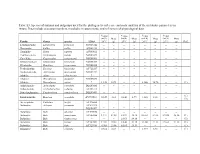
Table S3. Species of anurans and outgroups used for the phylogenetic inference and meta-analysis of the metabolic parameters in Anura. Data include accession numbers, metabolic measurements, and references of physiological data. VO2RES VO2RES VO2EX VO2EX (ml/h) Mass (ml/h) Mass (ml/h) Mass (ml/h) Mass Family Genus species 1216S 20°C (g) 25°C (g) 20°C (g) 25°C (g) Ref. Lepidosirenidae Lepidosiren paradoxa NC003342 -- -- -- -- -- -- -- -- Phasianidae Gallus gallus AP003319 -- -- -- -- -- -- -- -- Hominidae Homo sapiens AC000021 -- -- -- -- -- -- -- -- Typhlonectidae Typhlonectes natans NC002471 -- -- -- -- -- -- -- -- Caeciliidae Gegeneophis ramaswamii NC006301 -- -- -- -- -- -- -- -- Rhinatrematidae Rhinatrema bivittatum NC006303 -- -- -- -- -- -- -- -- Hynobiidae Hynobius formosanus NC008084 -- -- -- -- -- -- -- -- Plethodontidae Eurycea bislineata AY728217 -- -- -- -- -- -- -- -- Ambystomatidae Ambystoma mexicanum NC005797 -- -- -- -- -- -- -- -- Alytidae Alytes obstetricans * -- -- -- -- -- -- -- -- Alytidae Discoglossus galganoi NC006690 -- -- -- -- -- -- -- -- Alytidae Discoglossus pictus * 1.142 30.71 -- -- 8.166 30.70 -- -- (1) Arthroleptidae Arthroleptis variabilis DQ283081 -- -- -- -- -- -- -- -- Arthroleptidae Trichobatrachus robustus AY843773 -- -- -- -- -- -- -- -- Batrachophrynidae Caudiverbera caudiverbera DQ283439 -- -- -- -- -- -- -- -- (1) Bombinatoridae Bombina orientalis AY957562 0.149 2.62 0.340 3.79 1.230 2.60 -- -- (2) Brevicipitidae Callulina kreffti AY326068 -- -- -- -- -- -- -- -- Bufonidae Atelopus peruensis AY819329 -

Hand and Foot Musculature of Anura: Structure, Homology, Terminology, and Synapomorphies for Major Clades
HAND AND FOOT MUSCULATURE OF ANURA: STRUCTURE, HOMOLOGY, TERMINOLOGY, AND SYNAPOMORPHIES FOR MAJOR CLADES BORIS L. BLOTTO, MARTÍN O. PEREYRA, TARAN GRANT, AND JULIÁN FAIVOVICH BULLETIN OF THE AMERICAN MUSEUM OF NATURAL HISTORY HAND AND FOOT MUSCULATURE OF ANURA: STRUCTURE, HOMOLOGY, TERMINOLOGY, AND SYNAPOMORPHIES FOR MAJOR CLADES BORIS L. BLOTTO Departamento de Zoologia, Instituto de Biociências, Universidade de São Paulo, São Paulo, Brazil; División Herpetología, Museo Argentino de Ciencias Naturales “Bernardino Rivadavia”–CONICET, Buenos Aires, Argentina MARTÍN O. PEREYRA División Herpetología, Museo Argentino de Ciencias Naturales “Bernardino Rivadavia”–CONICET, Buenos Aires, Argentina; Laboratorio de Genética Evolutiva “Claudio J. Bidau,” Instituto de Biología Subtropical–CONICET, Facultad de Ciencias Exactas Químicas y Naturales, Universidad Nacional de Misiones, Posadas, Misiones, Argentina TARAN GRANT Departamento de Zoologia, Instituto de Biociências, Universidade de São Paulo, São Paulo, Brazil; Coleção de Anfíbios, Museu de Zoologia, Universidade de São Paulo, São Paulo, Brazil; Research Associate, Herpetology, Division of Vertebrate Zoology, American Museum of Natural History JULIÁN FAIVOVICH División Herpetología, Museo Argentino de Ciencias Naturales “Bernardino Rivadavia”–CONICET, Buenos Aires, Argentina; Departamento de Biodiversidad y Biología Experimental, Facultad de Ciencias Exactas y Naturales, Universidad de Buenos Aires, Buenos Aires, Argentina; Research Associate, Herpetology, Division of Vertebrate Zoology, American -

1704632114.Full.Pdf
Phylogenomics reveals rapid, simultaneous PNAS PLUS diversification of three major clades of Gondwanan frogs at the Cretaceous–Paleogene boundary Yan-Jie Fenga, David C. Blackburnb, Dan Lianga, David M. Hillisc, David B. Waked,1, David C. Cannatellac,1, and Peng Zhanga,1 aState Key Laboratory of Biocontrol, College of Ecology and Evolution, School of Life Sciences, Sun Yat-Sen University, Guangzhou 510006, China; bDepartment of Natural History, Florida Museum of Natural History, University of Florida, Gainesville, FL 32611; cDepartment of Integrative Biology and Biodiversity Collections, University of Texas, Austin, TX 78712; and dMuseum of Vertebrate Zoology and Department of Integrative Biology, University of California, Berkeley, CA 94720 Contributed by David B. Wake, June 2, 2017 (sent for review March 22, 2017; reviewed by S. Blair Hedges and Jonathan B. Losos) Frogs (Anura) are one of the most diverse groups of vertebrates The poor resolution for many nodes in anuran phylogeny is and comprise nearly 90% of living amphibian species. Their world- likely a result of the small number of molecular markers tra- wide distribution and diverse biology make them well-suited for ditionally used for these analyses. Previous large-scale studies assessing fundamental questions in evolution, ecology, and conser- used 6 genes (∼4,700 nt) (4), 5 genes (∼3,800 nt) (5), 12 genes vation. However, despite their scientific importance, the evolutionary (6) with ∼12,000 nt of GenBank data (but with ∼80% missing history and tempo of frog diversification remain poorly understood. data), and whole mitochondrial genomes (∼11,000 nt) (7). In By using a molecular dataset of unprecedented size, including 88-kb the larger datasets (e.g., ref. -
Frog Eat Frog: Exploring Variables Influencing Anurophagy
Frog eat frog: exploring variables influencing anurophagy G. John Measey1, Giovanni Vimercati1, F. Andre´ de Villiers1, Mohlamatsane M. Mokhatla1, Sarah J. Davies1, Shelley Edwards1 and Res Altwegg2,3 1 Centre for Invasion Biology, Department of Botany & Zoology, Stellenbosch University, Stellenbosch, South Africa 2 Statistics in Ecology, Environment and Conservation, Department of Statistical Sciences, University of Cape Town, Rondebosch, Cape Town, South Africa 3 African Climate and Development Initiative, University of Cape Town, South Africa ABSTRACT Background. Frogs are generalist predators of a wide range of typically small prey items. But descriptions of dietary items regularly include other anurans, such that frogs are considered to be among the most important of anuran predators. However, the only existing hypothesis for the inclusion of anurans in the diet of post-metamorphic frogs postulates that it happens more often in bigger frogs. Moreover, this hypothesis has yet to be tested. Methods. We reviewed the literature on frog diet in order to test the size hypothesis and determine whether there are other putative explanations for anurans in the diet of post-metamorphic frogs. In addition to size, we recorded the habitat, the number of other sympatric anuran species, and whether or not the population was invasive. We controlled for taxonomic bias by including the superfamily in our analysis. Results. Around one fifth of the 355 records included anurans as dietary items of populations studied, suggesting that frogs eating anurans is not unusual. Our data showed a clear taxonomic bias with ranids and pipids having a higher proportion of anuran prey than other superfamilies. Accounting for this taxonomic bias, we found that size in addition to being invasive, local anuran diversity, and habitat produced a model that best fitted our data. -

Islet Hormones from the African Bullfrog Pyxicephalus Adspersus (Anura:Ranidae): Structural Characterization and Phylogenetic Implications
General and Comparative Endocrinology 119, 85–94 (2000) doi:10.1006/gcen.2000.7493, available online at http://www.idealibrary.com on Islet Hormones from the African Bullfrog Pyxicephalus adspersus (Anura:Ranidae): Structural Characterization and Phylogenetic Implications J. Michael Conlon,*,1 Amber M. White,* and James E. Platz† *Regulatory Peptide Center, Department of Biomedical Sciences, Creighton University School of Medicine, Omaha, Nebraska 68178; and †Department of Biology, Creighton University, Omaha, Nebraska 68178 Accepted March 28, 2000 The African bullfrog Pyxicephalus adspersus is generally amino acid sequence of PP, but not those of the other islet classified along with frogs of the genus Rana in the subfam- hormones, is of value as a molecular marker for inferring ily Raninae of the family Ranidae but precise phylogenetic phylogenetic relationships between early tetrapod species. relationships between species are unclear. Pancreatic © 2000 Academic Press polypeptide (PP), insulin, and glucagon-like peptide (GLP-1) were isolated from an extract of P. adspersus Pancreatic polypeptide (PP) is a 36-amino acid res- pancreas and characterized structurally. A comparison of idue C-terminally ␣-amidated peptide that is synthe- the amino acid sequence of Pyxicephalus PP (APSEPQ- sized primarily in the F cell of the pancreatic islets of 10 20 30 ⅐ HPGG QATPEQLAQY YSDLYQYITF ITRPRF NH2) tetrapods. PP is a member of a family of homologous with those of the known amphibian PP molecules in a max- regulatory peptides that comprises, in addition to PP, imum parsimony analysis generates a single phylogenetic neuropeptide tyrosine (NPY) synthesized in neurons tree in which Pyxicephalus is the sister to the clade compris- of the central and peripheral nervous systems and in ing the members of the genus Rana. -
Hdl 86511.Pdf
PUBLISHED VERSION Susan E. Evans, Joseph R. Groenke, Marc E. H. Jones, Alan H. Turner, David W. Krause New material of Beelzebufo, a hyperossified frog (Amphibia: anura) from the Late Cretaceous of Madagascar PLoS One, 2014; 9(1):e87236-1-e87236-61 © 2014 Evans et al. This is an open-access article distributed under the terms of the Creative Commons Attribution License, which permits unrestricted use, distribution, and reproduction in any medium, provided the original author and source are credited. Originally published at: http://doi.org/10.1371/journal.pone.0087236 PERMISSIONS http://creativecommons.org/licenses/by/4.0/ http://hdl.handle.net/2440/86511 New Material of Beelzebufo, a Hyperossified Frog (Amphibia: Anura) from the Late Cretaceous of Madagascar Susan E. Evans1*, Joseph R. Groenke2, Marc E. H. Jones1,3, Alan H. Turner2, David W. Krause2 1 Department of Cell and Developmental Biology, University College London, London, United Kingdom, 2 Department of Anatomical Sciences, Stony Brook University, Stony Brook, New York, United States of America, 3 School of Earth and Environmental Sciences, The University of Adelaide, Adelaide, South Australia, Australia Abstract The extant anuran fauna of Madagascar is exceptionally rich and almost completely endemic. In recent years, many new species have been described and understanding of the history and relationships of this fauna has been greatly advanced by molecular studies, but very little is known of the fossil history of frogs on the island. Beelzebufo ampinga, the first named pre-Holocene frog from Madagascar, was described in 2008 on the basis of numerous disarticulated cranial and postcranial elements from the Upper Cretaceous (Maastrichtian) Maevarano Formation of Madagascar. -

Anesthetic Considerations for Amphibians Mark A
Topics in Medicine and Surgery Anesthetic Considerations for Amphibians Mark A. Mitchell, DVM, MS, PhD Abstract The popularity of amphibians in research, zoological exhibits, and as pets is on the rise. With this increased popularity comes a need for veterinarians to develop methods for managing these animals for various diagnostic and surgical proce- dures. For many of these procedures, the provision of anesthesia is a must. Fortunately, there are a number of different anesthetics available to the veterinary clinician for anesthetizing amphibians, including tricaine methanesulfonate, clove oil, propofol, isoflurane, and ketamine. In addition to the variety of anesthetics at our disposal, there is also a wider range of methods for delivering the anesthetics than are generally available for higher vertebrates, including immersion, topical, and intracoelomic routes of delivery. The purpose of this article is to review the different methods that can be used to successfully manage an amphibian patient through an anesthetic event. Copyright 2009 Elsevier Inc. All rights reserved. Key words: amphibian; anesthesia; anesthetic; anuran; monitoring; urodelan mphibians are commonly used in research will respond to an anesthetic the same way. In cases and are popular exhibit animals in zoological in which there is no reference for a particular spe- Acollections. Although they are not as popular cies, special precautions should be taken to mini- as reptiles in the pet trade, they are being presented mize the likelihood of complications. to veterinarians in clinical practice with increased Regardless of the species, success with anesthesia frequency. Because veterinarians are being asked to can be achieved by following a consistent, well- work with these animals, it is important that we planned protocol.