The Doctirne of Paticcasamuppada
Total Page:16
File Type:pdf, Size:1020Kb
Load more
Recommended publications
-

Xvii Three Baskets (Tipitaka) I Buddhism
261 XVII THREE BASKETS ( TIPITAKA ) I BUDDHISM COTETS 1. What is the Tipitaka ? 2. Language of Buddha’s words (Buddhavacana ) 3. What is Pali? 4. The First Council 5. The Second Council 6. The Great Schism 7. Origin of the Eighteen ikayas (Schools of Buddhism) 8. The Third Council 9. Committing the Tipitaka to Memory 10. Fourth Council: Committing the Tipitaka to Writing 11. Fifth and Sixth Councils in Myanmar 12. Conclusion 13. Appendix: Contents of the Tipitaka or Three Baskets 14. Explanatory Notes 15. References 262 • Buddhism Course 1. What is the Tipitaka ? The word of the Buddha, which is originally called the Dhamma , consists of three aspects, namely: Doctrine ( Pariyatti ), Practice (Patipatti ) and Realization ( Pativedha ). The Doctrine is preserved in the Scriptures called the Tipitaka . English translators of the Tipitaka have estimated it to be eleven times the size of the Christian Bible. It contains the Teachings of the Buddha expounded from the time of His Enlightenment to Parinibbana over forty-five years. Tipitaka in Pali means Three Baskets (Ti = Three, Pitaka = Basket), not in the sense of function of storing but of handing down , just like workers carry earth with the aid of baskets handed on from worker to worker, posted in a long line from point of removal to point of deposit, so the Baskets of Teachings are handed down over the centuries from teacher to pupil. The Three Baskets are: Basket of Discipline ( Vinaya Pitaka ), which deals mainly with the rules and regulations of the Order of monks and nuns; Basket of Discourses ( Sutta Pitaka ) which contains the discourses delivered by the Buddha to individuals or assemblies of different ranks in the course of his ministry; Basket of Ultimate Things ( Abhidhamma Pitaka ) which consists of the four ultimate things: Mind ( Citta ), Mental-factors ( Cetasikas ), Matter ( Rupa ) and ibbana . -

Com 23 Draft B
Community Issue 23 - Page 1 Autumn 2005 / 2548 The Upāsaka & Upāsikā Newsletter Issue No. 23 Dagoba at Mahintale Dagoba InIn thisthis issue.......issue....... InIn peoplepeople wewe trusttrust ?? TheThe Temple at Kosgoda The wisdom of the heartheart SicknessSickness——A Teacher AssistedAssisted DyingDying MakingMaking connectionsconnections beyond words BluebellBluebell WalkWalk Community Community Issue 23 - Page 2 In people we trust? Multiculturalism and community relations have been This is a thoroughly uncomfortable position to be in, as much in the news over recent months. The tragedy of anyone who has suffered from arbitrary discrimination can the London bombings and the spotlight this has attest. There is a feeling of helplessness that whatever one thrown on to what is called ‘the Moslem community’ says or does will be misinterpreted. There is a resentment has led me to reflect upon our own Buddhist that one is being treated unfairly. Actions that would pre- ‘community’. Interestingly, the name of this newslet- viously have been taken at face value are now suspected of ter is ‘Community’, and this was chosen in discussion having a hidden agenda in support of one’s group. In this between a number of us, because it reflected our wish situation, rumour and gossip tend to flourish, and attempts to create a supportive and inclusive network of Forest to adopt a more inclusive position may be regarded with Sangha Buddhist practitioners. suspicion, or misinterpreted to fit the stereotype. The AUA is predominantly supported by western Once a community has polarised, it can take a great deal converts to Buddhism. Some of those who frequent of work to re-establish trust. -
Bibliography Glossary
366 BIBLIOGRAPHY GLOSSARY -^ f 367 BIBLIOGRAPHY A. Primary Sources Abhidhamma-Mulatlkd [Se], Sinhalese edition, edited by Dehigaspe Pandit Pannasara Thera & Palannoruve Pandit Wimaladhamma Thera, finally revised by Kukulanpe Siri Dewarakkhita Thera, approved by Baddegama Siri Piyaratana Nayaka Thera, and published as Volume VII, Vidyodaya Tika Publication, Colombo, 1938. Abhidhamma-Mulatlkd [Ue], Ramasahkara TripathI, Sampurnananda Sanskrit University, Varanasi, 1988. Abhidhammatthasangaha & Abhidhammatthavibhdviril-tikd [Atths (Ve) & Atth-vt (Ve)], Vol. 133, Devanagari edition of the Pali text of the Chattha Sahgayana, Vipassana Research Institute, Igatpiui, 1998. Ahguttara-Nikdya [AN] 5 Vols, edited by R. Morris & E. Hardy, The Pali Text Society, London, 1961-1976. Ahguttaranikdya-Tikd [AN-t (Ve)], Vol. 44-46, Devanagari edition of the Pali text of the Chattha Sahgayana, Vipassana Research Institute, Igatpuri,1995. Anudlpariipdtha [Ad], Myanmar edition of the Pali text of the Chattha Sangayana published by Department of Religious Affairs in Myarraiar. Apaddna [Ap (Ve)], Vol. 57-58, Devanagari edition of the Pali text of the Chattha Sahgayana, Vipassana Research Institute, Igatpuri, 1998. Atthsdlinl: Buddhaghosa's Commentary on the Dhammasahgani edited by P.V. Bapat and R.D. Vadekar, Bhandarkar Oriental Series No. 3, Poona, 1942. Atthasdlini, edited by Ramasahkara TripathI, Sampumanand Sanskrit University, Varanasi, 1989. Atthasdlirii-Atthayojandya, edited by Ramasahkara TripathI, Sampumanand Sanskrit University, Varanasi, 1989. Atthasdinibhdsdtikd [Ab-t], Vol. II, written by Ven. Janakabhivamsa, New Burma offset Pitaka Publication, Amarapura, 4"' edition 2002. Atthasdinibhdsdtikd [Ab-t], Vol. Ill, by Ven. Janakabhivamsa, New Burma offset Pitaka Publication, Amarapura, 4* edition 1995 (Myanmar Script). Culaniddesa [Cnd (Ve)], Vol. 78, Devanagari edition of the Pali text of the Chattha Sahgayana, Vipassana Research Institute, Igatpuri, 1998. -

Dana Pāramī (The Perfection of Giving)
Dana Pāramī (The Perfection of Giving) Miss Notnargorn Thongputtamon Research Scholar, Department of Philosophy and Religion, Faculty of Arts, Banaras Hindu University, Varanasi, India sweet_cake1987@hotmail.com Received Dec 14,2018; Revised Mar 4, 2019; Accepted May 29, 2019 ABSTRACT Every religion in the world likes to teach that charity is important. This is the case with Buddhism also. The Buddha describes the three central practices as Dana (generosity), Sila (morality) and Bhavana (meditation). Bhikkhu Bodhi writes, “the practice of giving is universally recognized as one of the most basic human virtues”, and Susan Elbaum Jootle confirms that it is a basis of merit or wholesome kamma and when practiced in itself, it leads ultimately to liberation from the cycle of repeated existence”. Buddhists do not seek publicity for charity. But it is the practice of the vehicle of great enlightenment (mahābodhiyāna) to improve their skillfulness in accumulating the requisites for enlightenment. We now undertake a detailed explanation of the Dana Pāramī. Keywords: Dana (generosity), Bhavana (meditation), Sila (morality) 48 The Journal of The International Buddhist Studies College What are the Pāramis? For the meaning of the Pāramīs, the Brahmajāla Sutta explains that they are the noble qualities such as giving and etc., accompanied by compassion and skillful means, untainted by craving and conceit views (Bhikkhu Bodhi, 2007). Traleg Kyabgon Rinpoche renders “pāramīs” into English as “transcendent action”. He understands “transcendent action” in the sense of non-egocentric action. He says: “Transcendental” does not refer to some external reality, but rather to the way in which we conduct our lives and perceive the world – either in an egocentric way or non-egocentric way. -

Dialogues of the Buddha
http://www.sacred-texts.com/bud/dob/dob-01tx.htm Sacred-Texts Buddhism Index Previous Next {p. 1} DIALOGUES OF THE BUDDHA. DÎGHA NIKÂYA. [COLLECTION OF LONG DIALOGUES.] I. BRAHMA-GÂLA SUTTA{1}. [THE PERFECT NET.] I. 1. Thus have I heard. The Blessed One was once going along the high road between Râgagaha and Nâlandâ{2} with a great company of the brethren, with about five hundred brethren. And Suppiya the mendicant{3} too was going along the high road between Râgagaha and Nâlandâ with his disciple the youth Brahmadatta. Now just then Suppiya the mendicant was speaking in many ways in dispraise of the Buddha, in dispraise of the Doctrine, in dispraise of the Order. But young Brahmadatta, his pupil, gave utterance, in many ways, to praise of the Buddha, to praise of the Doctrine, to praise of the Order. Thus they two, teacher and pupil, holding opinions in direct contradiction one to the other, were following, step by {1. The whole of this Sutta was translated into English by the Rev. Daniel Gogerly, Wesleyan missionary in Ceylon, in the Journal of the Ceylon Branch of the Royal Asiatic Society for 1846 (reprinted by P. Grimblot in his 'Sept Suttas Pâlis,' Paris, 1876). 2. Nâlandâ, afterwards the seat of the famous Buddhist university, was about seven miles north of Râgagaha, the capital of Magadha, the modern Rag-gir (Sum. p. 35). 3. Suppiya was a follower of the celebrated teacher Sañgaya, whose views are set out and controverted in the next Sutta.} {p. 2} step, after the Blessed One and the company of the brethren. -

Out of the Shadows: Socially Engaged Buddhist Women
University of San Diego Digital USD Theology and Religious Studies: Faculty Scholarship Department of Theology and Religious Studies 2019 Out of the Shadows: Socially Engaged Buddhist Women Karma Lekshe Tsomo PhD University of San Diego, tsomo@sandiego.edu Follow this and additional works at: https://digital.sandiego.edu/thrs-faculty Part of the Buddhist Studies Commons, and the Religious Thought, Theology and Philosophy of Religion Commons Digital USD Citation Tsomo, Karma Lekshe PhD, "Out of the Shadows: Socially Engaged Buddhist Women" (2019). Theology and Religious Studies: Faculty Scholarship. 25. https://digital.sandiego.edu/thrs-faculty/25 This Book is brought to you for free and open access by the Department of Theology and Religious Studies at Digital USD. It has been accepted for inclusion in Theology and Religious Studies: Faculty Scholarship by an authorized administrator of Digital USD. For more information, please contact digital@sandiego.edu. Section Titles Placed Here | I Out of the Shadows Socially Engaged Buddhist Women Edited by Karma Lekshe Tsomo SAKYADHITA | HONOLULU First Edition: Sri Satguru Publications 2006 Second Edition: Sakyadhita 2019 Copyright © 2019 Karma Lekshe Tsomo All rights reserved No part of this book may not be reproduced or utilized in any form or by any means, electronic or mechanical, or by any information storage or retreival system, without the prior written permission from the publisher, except in the case of brief quotations. Cover design Copyright © 2006 Allen Wynar Sakyadhita Conference Poster -
Exporting Dharma to New Lands: Empirical Approaches of Teaching Dharma in Predominantly Non-Buddhist States
Exporting Dharma to New Lands: Empirical Approaches of Teaching Dharma in Predominantly Non-Buddhist States Saw Yee Mon Reader in Buddhism Introduction Muttāhaṃ, bhikkhave, sabbapāsehi, yedibbā ye ca mānusā. Tumhepi, bhikkhave, muttā sabbapāsehi, ye dibbā ye ca mānusā. Caratha, bhikkhave, cārikaṃ bahujanahitāya bahujanasukhāya Lokānukampāya atthaya hitaya sukāya devamanussānaṃ.1 This verse is expounded by Buddha to sixty of his ariyā disciples after a year of his buddha-hood, while residing at Mighadāvuṃ forest, almost two thousand-six hundred years ago. According to this, Buddha urged his disciples to make journeys in order to disseminate dharma for the benefit of all the sentient beings including humans, deities and brahmās. It was the very first mission assigned by Buddha to his ariya sānghā. Throughout two and a half millenniums, dharma has been taught and learned by Buddhists from generations to generations. In this paper, three particular approaches for teaching dharma are explored and discussed in accordance with the Pāli Texts. The emphasis is made on teaching dharma in new lands where Buddhism is never known or little known. The Need to Export Teachings of Buddha In simple economic term, we export goods and services to other regions and countries in order to gain income in return. Regarding the export of teachings of Buddha, what can we expect in return? The return is greater than we can imagine. In simplest way, it reduces stress, tension and anxiety of every individual. This has ripple effect and as an accumulated output of this, society as a whole may become less aggressive and more peaceful which tends to be the ultimate goal of the present day global society which is more or less in turmoil. -

Unit 4 Philosophy of Buddhism
Philosophy of Buddhism UNIT 4 PHILOSOPHY OF BUDDHISM Contents 4.0 Objectives 4.1 Introduction 4.2 The Four Noble Truths 4.3 The Eightfold Path in Buddhism 4.4 The Doctrine of Dependent Origination (Pratitya-samutpada) 4.5 The Doctrine of Momentoriness (Kshanika-vada) 4.6 The Doctrine of Karma 4.7 The Doctrine of Non-soul (anatta) 4.8 Philosophical Schools of Buddhism 4.9 Let Us Sum Up 4.10 Key Words 4.11 Further Readings and References 4.0 OBJECTIVES This unit, the philosophy of Buddhism, introduces the main philosophical notions of Buddhism. It gives a brief and comprehensive view about the central teachings of Lord Buddha and the rich philosophical implications applied on it by his followers. This study may help the students to develop a genuine taste for Buddhism and its philosophy, which would enable them to carry out more researches and study on it. Since Buddhist philosophy gives practical suggestions for a virtuous life, this study will help one to improve the quality of his or her life and the attitude towards his or her life. 4.1 INTRODUCTION Buddhist philosophy and doctrines, based on the teachings of Gautama Buddha, give meaningful insights about reality and human existence. Buddha was primarily an ethical teacher rather than a philosopher. His central concern was to show man the way out of suffering and not one of constructing a philosophical theory. Therefore, Buddha’s teaching lays great emphasis on the practical matters of conduct which lead to liberation. For Buddha, the root cause of suffering is ignorance and in order to eliminate suffering we need to know the nature of existence. -
Review of Research Issn: 2249-894X Impact Factor : 5.7631(Uif) Volume - 10 | Issue - 7 | April - 2021
Review of ReseaRch issN: 2249-894X impact factoR : 5.7631(Uif) volUme - 10 | issUe - 7 | apRil - 2021 EXPOSITIONS OF THE TEN PERFECTIONS RELATING TO THE THERAVADA BUDDHIST LITERATURE Kosalla Ph.D. Scholar, Center for Mahayana Buddhist Studies, Acharya Nagarjuna University, Guntur, Andhra Pradesh, India. ABSTRACT There are various religions that we can see all over the world. Among them, this paper is going to focus on the Buddhism and explains about the perfection. Buddhism was foundered by the Gautama Buddha who Awakened One by fulfilled ten perfections (Paramita) in the past lives. And also, Buddhism is the world’s fourth largest religion with over five hundred million followers, or over 7% of the global population, known as Buddhists. All religions probably have their own histories, own teachings, and own final goals. Hereby, we are going to show concerned about Buddhism’s history, teaching, and final goal briefly in this article. There is no effect without cause. KEYWORDS: Perfection = Paramita, Awakened One = Buddha, Sacrifice. INTRODUCTION The roots of perfection and its characteristics Here, we can see the roots of perfection in the Theravada pitaka which is the Buddha taught for fourty-five years. According to Khuddaka texts, bodhisatva become a Buddha as a result of the completion of perfections (paramita). (1) In the Apadana, five perfections are mentioned by name: Nekkhamma, Khanti, Metta, Sacca and Adhitthana. (2) In the Cariyapitaka, seven paranitas are illustrated in the stories: Dana, Sila, Nekkhamma, Adhitthana, Sacca, Metta and Upekkha, while the Uddana-gatha mention ten: Dana, Sila, Nekkhamma, Adhitthana, Sacca, Metta, Upekkha, Khanti, Viriya and Panna. -
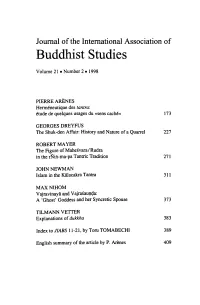
Explanations of Dukkha 383
Journal of the International Association of Buddhist Studies Volume 21 • Number 2 • 1998 PIERRE ARfcNES Herm6neutique des tantra: 6tude de quelques usages du «sens cach6» 173 GEORGES DREYFUS The Shuk-den Affair: History and Nature of a Quarrel 227 ROBERT MAYER The Figure of MaheSvara/Rudra in the rNin-ma-pa Tantric Tradition 271 JOHN NEWMAN Islam in the Kalacakra Tantra 311 MAX NIHOM Vajravinaya and VajraSaunda: A 'Ghost' Goddess and her Syncretic Spouse 373 TILMANN VETTER Explanations of dukkha 383 Index to JIABS 11-21, by Torn TOMABECHI 389 English summary of the article by P. Arenes 409 TILMANN VETTER Explanations of dukkha The present contribution presents some philological observations and a historical assumption concerning the First Noble Truth. It is well-known to most buddhologists and many Buddhists that the explanations of the First Noble Truth in the First Sermon as found in the Mahavagga of the Vinayapitaka and in some other places conclude with a remark on the five upadanakkhandha, literally: 'branches of appro priation'. This remark is commonly understood as a summary. Practically unknown is the fact that in Hermann OLDENBERG's edition of the Mahavagga1 (= Vin I) this concluding remark contains the parti cle pi, like most of the preceding explanations of dukkha. The preceding explanations are: jati pi dukkha, jara pi dukkha, vyadhi pi dukkha, maranam pi dukkham, appiyehi sampayogo dukkho, piyehi vippayogo dukkho, yam p' iccham na labhati tarn2 pi dukkham (Vin I 10.26). Wherever pi here appears it obviously has the function of coordinating examples of events or processes that cause pain (not: are pain3): birth is causing pain, as well as decay, etc.4 1. -

Engaged Buddhism: Buddhist Liberation Movements in Asia
EEnnggaaggeedd BBuuddddhhiissmm 1 Buddhism ― a Balancing Factor for Current World Developments Buddhism ― a Balancing Factor for Current World Developments By Venerable Dhammavamso1 oday, the world may seem at its zenith of development. In spite of their Tdifferent forms in different countries and regions, current world developments have a common point: the West (since the Renaissance) and the East (since the past century) have developed along materialistic lines. As a result, various things have been replaced with others in both the environmental and human fields. For the past decades some Buddhist scholars, in the face of so many social changes, have attempted to reassess the role of Buddhism in the new situation of the world. Hence, a question is raised as to whether traditional Buddhism, which has shaped the civilization of many peoples in the East for centuries, may remain adaptive and fluid in the modern era. Generally speaking, there are two discernible different tendencies among those scholars. Some scholars such as Thich Nhat Hanh, Walpola Rahula, Sulak Sivaraksa, H.H. the Dalai Lama, Robert Thurman, and so on, maintain that there remains a continuity between Buddhism today and Buddhism of the past. Although the world is changing rapidly with its various developments, humanity’s fundamental sufferings and the best ways of dealing with them remain the same as what are already explicitly formulated in most Buddhist teachings. Therefore, Buddhism today, whatever new forms it may take on, is essentially contiguous with its tradition. In the words of Sivaraksa: “To be of help we must become more selfless and less selfish. -
Language and Discourse
Piya Tan SD 26.11 Language and discourse Language and Discourse A brief survey of Buddhist philosophy of language, epistemology and logic Freeing the mind from noise by Piya Tan ©2006, 2008 To LORENZ DEUTSCHENBAUR of Bavaria, Germany, Ludwig Maxilian Universität, Munich, & the NUSBS Discovering Buddhism, May your inward journey bring you light and peace, and for others, too, 2008. 1 W hat are language and discourse? 1.1 LANGUAGE, DISCOURSE AND MEANING. W ithout language, there will be no religion; no True Teaching could be communicated. And yet, language can hide or distort the message just as well. As such, some understanding of the nature of language helps us understand the problems involved in learning and teaching the Dharma, overcome such problems, rightly understand the Dharma, and effectively con- vey the means of spiritual liberation to others. Language is a means of expression and communication learned and used at the interface of our minds and the external world. Discourse is how we present our ideas and feelings through language to communi- cate with othersœit is how we use language to record our thoughts, and to inform or influence others. Discourse is also about how the Buddha teaches the Dharma.1 Language significantly shapes discourse: language gives palpable form to what is in our minds that we wish to express; discourse gives meaning to what is communicated in language. Meaning is how we or our audience value or relate to what is expressed in language. Often, the term language is used to denote both itself and discourse, and meaning has a broad sense in terms of how we evaluate thought, word and action.